
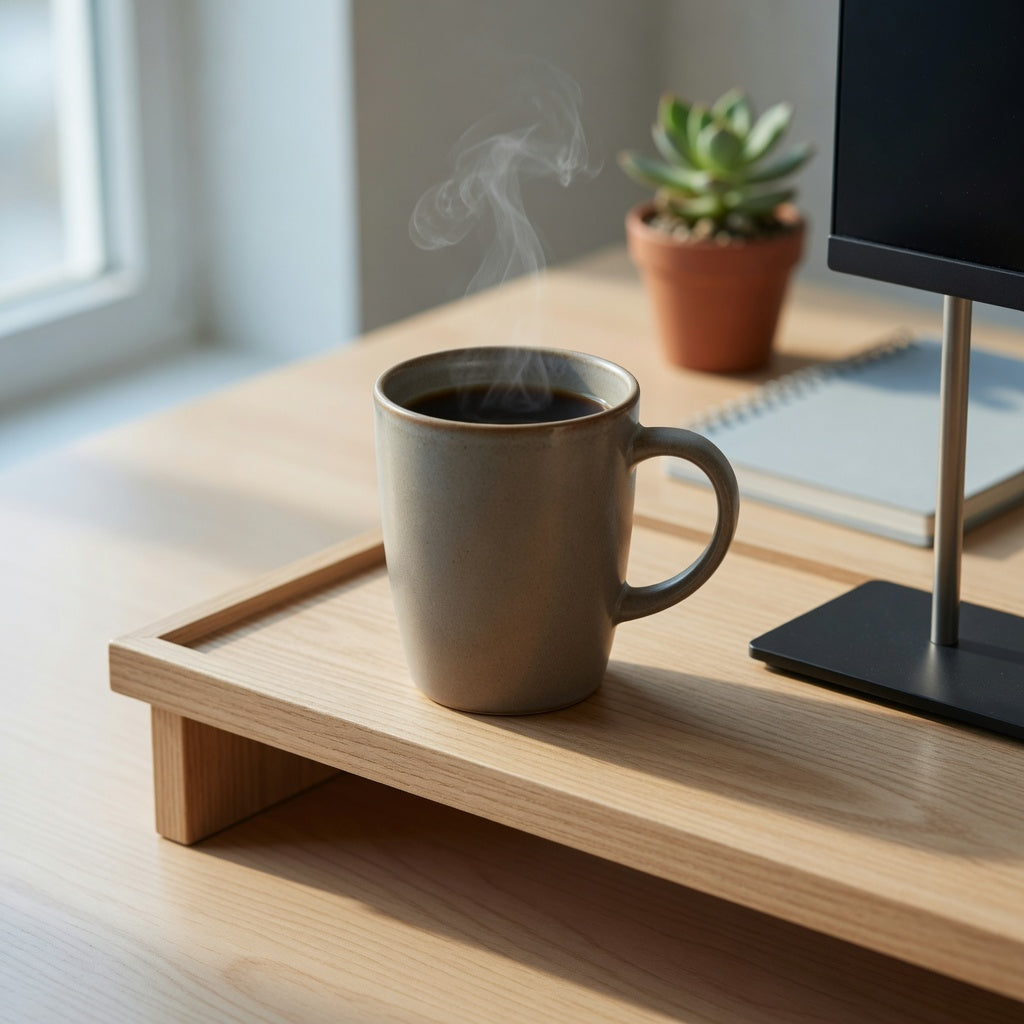
Best Tall Mugs for Home Office Desk Shelf Coffee: Compare First
Reading time: about 10 minutes
The mug has to live somewhere. On most home-office desks that means a riser shelf, a monitor stand, or the narrow strip beside a printer — and that is exactly where a lot of tall mugs quietly fail. When shoppers write to us looking for the best tall mugs for home office desk shelf coffee, the conversation rarely starts with ounces. It starts with a tape measure and a slightly embarrassed admission that the last mug they bought doesn't fit.
Short version: overall height and base diameter decide whether the mug works on a shelf, and the handle counts toward the width. Material, lid, and care rules come after the mug physically fits.
Best tall mugs for home office desk shelf coffee: three numbers beat the ounce rating
Listings lead with capacity. That number describes how much liquid a vessel holds and tells you nothing about whether it clears your shelf. The three measurements that actually decide desk fit:
- Overall height to the rim. Not the shoulder of the body — the rim is what hits the shelf underside.
- Base diameter. Drives both the footprint on a narrow shelf and how much force it takes to tip.
- Total width including the handle. A 3-inch body with a 1.5-inch handle needs 4.5 inches of slot, not 3.
Most listings publish capacity and nothing else. Treat height, diameter, and handle projection as unconfirmed until you read the spec block or ask the seller directly — and that applies to our own pieces too. Our Landscape Tall Coffee Tea Mug carries "tall" in its name, so check the current listing for exact height, base diameter, capacity, and care instructions against your own shelf gap instead of assuming the word tall implies a specific number of inches.
The same discipline applies to decorative shapes. A pleated body can read slimmer on screen than it measures once the handle is added, which is why the Pleated Coffee Tea Cup is worth measuring rather than eyeballing when slot width is your binding constraint. If your shelf gap is under about four inches, a tall mug is simply the wrong purchase — a shorter, wider cup on a saucer will serve you better, and no amount of styling fixes that.
How much clearance does a tall mug need under a shelf, monitor stand, or brewer?
Three separate gaps decide this, and most buyers measure only the first.
- Shelf gap at the front and back edges. Measure desk surface to underside, then subtract roughly a quarter inch for the lift-and-slide motion. Check the back too, since a loaded riser can sag in the middle.
- Monitor stand opening, in both height and depth. If the opening is barely taller than the mug you cannot tilt it out, so you need clearance above the rim for your knuckles.
- Brewer clearance with the drip tray in and again with it out. Pulling the tray is often the difference between a clean fit and a tilt-and-pray pour. Published clearances vary by model and change with accessories, so your machine manual is the only figure worth trusting.
Handle projection is the number everyone forgets. A mug can clear the shelf height and still foul the side frame or a monitor arm. And a handle opening that fits three fingers comfortably when empty can feel cramped once the mug is full and hot.
There is a quieter issue too: a hot mug parked tight under a shelf pushes steam up into the underside. On a painted or veneered riser that is repeated moisture exposure over months. Not a catastrophe — just an argument for real headroom rather than a zero-clearance fit.
Does a tall mug tip more easily next to a keyboard?
Usually yes, and it is geometry rather than build quality. A tall body carries more mass high above the desk, so the same elbow bump moves it further. Base diameter is the counterweight: a wide foot relative to height lowers the tipping point, while a narrow base under a tall body is the pairing that ends up across your keyboard.
Filled weight compounds it. Water is roughly 1 gram per milliliter, so a 350 mL pour adds about 350 g of liquid before you count the mug itself. A tall mug is heavy when full, and a heavy mug that starts to go takes the coffee with it.
- Stability win: a tall mug with a genuinely wide base, parked on the far side of your mouse hand.
- Stability risk: a tall, narrow body on a smooth desk with no coaster.
- Cheap fix: a cork or felt coaster adds grip and protects a wood desktop from heat rings.
Tall narrow shapes still earn their place, because they free up shelf real estate that a wide bowl-shaped mug eats. It is a trade, not a free upgrade.
What does a 350 ml mug actually pour once you leave room for milk?
Convert before comparing, because listings mix ounces and milliliters freely. NIST lists 1 U.S. fluid ounce as 29.57353 milliliters, which gives you clean numbers to work from:
| Listing says | In milliliters | What it means at a desk |
|---|---|---|
| 8 fl oz | about 237 mL | one standard drip cup, almost no headspace |
| 10 fl oz | about 296 mL | a modest pour with room for a splash of milk |
| 12 fl oz | about 355 mL | close to a 350 mL mug, a common tall-mug size |
| 14 fl oz | about 414 mL | a long coffee, comfortable headspace for foam |
| 16 fl oz | about 473 mL | large; check handle comfort when full |
| 20 fl oz | about 591 mL | oversized; verify shelf and brewer clearance first |
Then subtract headspace. Stated capacity is measured near the rim, and nobody fills to the rim and carries a mug across a room. Leave roughly half an inch to three quarters of an inch if you add milk or foam, more if the mug travels. A generous 16 oz mug may pour closer to 13 or 14 oz in practice — still a big coffee, just not the number on the box. For a deeper look at how one common size behaves, our breakdown of the 350 ml tall coffee mug walks through the same math.
Ceramic, vacuum-insulated, or a heated coaster: which desk setup are you building?
Three different products get called a tall desk mug, and they solve different problems.
Single-wall ceramic or porcelain
The default, and usually the right answer for desk-shelf duty. Pleasant to drink from, easy to wash, and it looks good on an open shelf. The wall warms through, which some people like and others find too hot near the base. Surface decoration is the variable that most often changes microwave guidance, so read the care line on the exact piece.
Double-wall vacuum, handled
Better heat retention and no condensation on the outside, which matters on a wood desk or beside a laptop. The trade-offs are real: these are often wider at the base than a ceramic mug of the same capacity, lids tend to be splash-resistant rather than leakproof, and many handled insulated mugs are too wide for a car cup holder. If the mug never leaves the house, you are paying for insulation you may not need.
Actively heated mug or coaster
Solves cold coffee directly, but adds a cord or battery, a heavier base, and its own care rules. Many specify hand washing and are not dishwasher safe. Worth it for a slow sipper on back-to-back calls; overkill if you finish a mug in twenty minutes.
Where the glaze and microwave questions actually get answered
This is the part of mug shopping where confident marketing copy outruns the paperwork, so here is what the regulators actually say.
- Lead leach limits exist and are specific. FDA sets an action level of 0.5 micrograms per milliliter of leaching solution for ceramic cups and mugs under CPG 545.450, and that cups-and-mugs guideline is applied to any one of six units tested. FDA treats cups and mugs as small hollowware used for hot drinks, normally holding about 240 mL, with a handle.
- "Lead Free" is a regulatory phrase, not a mood. FDA guidance states that ceramicware whose extractable lead exceeds the action levels may be treated as adulterated, and ware that contains extractable lead when tested by the CPG method should not be labeled Lead Free.
- Decorative ware is presumed to be food ware. Under 21 CFR 109.16, ornamental ceramicware that looks suitable for food use is considered food use unless it carries the required conspicuous "Not for Food Use" warning or has a hole through the food-contact surface, because glaze and decal lead can leach.
- Metallic decoration and microwaves do not mix. CPSC recalled ceramic mugs in 2023 whose metallic print could spark in a microwave after being mislabeled microwave safe, posing a fire hazard.
The practical takeaway: if a mug has a metallic rim, metallic print, or a metallic-looking decal, keep it out of the microwave regardless of the label. If a piece is sold as decor, do not drink from it. And if a listing makes a lead-free claim with no test reference, treat it as a claim to verify rather than a settled fact.
A desk-side checklist before you add to cart
- Measure the shelf gap at front and back, then subtract a quarter inch.
- Measure the monitor stand opening in both height and depth.
- Measure brewer clearance with the drip tray in place and again with it removed.
- Add body diameter plus handle projection to get true slot width.
- Decide your realistic fill, then pick capacity above it — not the capacity you wish you drank.
- Read the care line: dishwasher, microwave, and whether metallic decoration is present.
- Confirm the mug will not need to travel in a cup holder if it is a wide insulated model.
If you would rather compare several shapes side by side than one at a time, browse the unique coffee mugs collection with those numbers written down. It is faster than scrolling listings and guessing, and you can filter by profile rather than by ounce rating. Our guide to ceramic mug storage and shelf fit is a useful second pass once you know your gaps.
Frequently asked questions
Will a tall mug fit under my Nespresso or Keurig, or will I have to tilt it?
That depends on the model and whether the drip tray is fitted, so measure your own machine rather than trusting a general figure. Go from the base plate to the dispenser with the tray in, then again with it out. If clearance is within a quarter inch of the mug height, plan on sliding rather than tilting.
How do I compare a 350 ml mug to a 16 oz listing?
Use the conversion: 1 U.S. fluid ounce is 29.57353 mL, so 350 mL is about 11.8 fl oz and a 16 oz mug is about 473 mL. Then subtract headspace. A mug that measures 16 oz to the rim typically pours closer to 13 or 14 oz once you leave room for milk.
Can I microwave a tall ceramic mug with a metallic design?
No. CPSC recalled ceramic mugs in 2023 after metallic print sparked in microwaves when the mugs had been mislabeled microwave safe. Metallic rims, bands, and decals stay out of the microwave even when a listing says otherwise, and any lid with metal components should come off first.
Are the best tall mugs for home office desk shelf coffee dishwasher safe?
It varies by glaze, decoration, and lid, so read the care line on the exact listing you are buying. Metallic decoration and some hand-finished surfaces are frequent exceptions, and insulated handled mugs often specify hand washing to protect the vacuum seal.
Do tall mugs spill more easily on a desk?
A tall mug with a narrow base tips with less force than a short, wide one, because more mass sits higher and a full mug is heavier. Look for a wide base relative to height, use a coaster for grip, and keep the mug on the far side of your mouse hand.
Start with your three measurements, then choose the shape that fits them. If you are undecided between a tall ceramic silhouette and a pleated cup, the full collection lets you compare both against the same shelf gap and the same realistic pour size.
More from our blog
Read more

Cozy Coffee Corner Mugs: Capacity, Handle Fit, and Glaze Care
Cozy coffee corner mugs are slow-sip, stay-home cups, so usable capacity, handle opening, rim finish, and glaze care matter more than the photo. Here is how we compare them in our store, plus what ...
Read more
14 Oz Ceramic Coffee Mugs Size Decision Guide: Smaller or Larger?
A practical 14 oz ceramic coffee mugs size decision guide: what the listed ounces actually measure, how 400 ml, 440 ml and 480 ml compare, and when sizing down or up is the smarter buy for your pou...
Read more
Leave a comment
This site is protected by hCaptcha and the hCaptcha Privacy Policy and Terms of Service apply.