



Unique Ceramic Art Mugs Gift: Glaze, Capacity and Handle Checks
Reading time: about 10 minutes
A mug can look flawless in a listing photo and still end up at the back of the cupboard by March: too heavy once it is full, a handle that pinches two fingers, or a glaze that only tolerates hand-washing nobody signed up for. We sell ceramic drinkware, and the messages that come back to us are almost never about the artwork. They are about fit and care.
Shopping for a unique ceramic art mugs gift means judging two objects at once — a piece of visible art, and a vessel that will hold hot liquid, cross a room, and get washed far more often than the giver imagines. Here is the sequence our team works through before anything goes into a gift box.
What are the three kinds of art mug a shopper is actually offered?
The label gets used for products that age very differently on a kitchen shelf. Knowing which one you are buying settles most of the other questions.
- Printed or decal artwork on a production body. Predictable: the photo, the capacity, and the care line usually match what lands on the doorstep. The trade-off is that "unique" describes the design, not the object — a second buyer can order the identical mug tomorrow.
- Studio-style pottery with a reactive or kiln-varied glaze. Colour moves during firing, so two pieces from the same run differ in depth and pattern placement. This is where most "it looked darker online" complaints come from, and in pottery it is usually normal rather than a fault.
- Sculpted or novelty forms — animal handles, faceted bodies, pocket hand-warmer shapes. Charming, but the silhouette raises new questions: which hand holds it, whether it nests in a cupboard, and whether a decorative element sits on the drinking rim.
If you are browsing by motif rather than by construction, our unique coffee mugs collection shows the current shapes and patterns side by side — a fairer comparison than judging one listing in isolation against a recipient's kitchen.
Which four measurements decide whether a gift mug gets used daily?
Gift mugs fail at the sink and the desk, not on the shelf. Four numbers predict that better than any styled photo.
- Listed capacity versus a realistic pour. FDA's compliance guide describes ceramic cups and mugs as hollowware that normally, though not exclusively, holds about 240 mL (8 fl oz) and is made with a handle — a useful baseline. A large mug may only reach its stated number at the very lip, so ask what a comfortable fill actually looks like.
- Handle opening. The most common comfort complaint we hear is a handle too narrow or too short for the fingers. Ask for the inner span, not the outside width.
- Rim thickness. A thick rounded rim reads sturdy; a thin tapered rim feels refined against the lip. Neither is better, but a chunky rim is noticeable to someone who sips tea slowly for twenty minutes.
- Weight when full. Dense stoneware plus 12 oz of coffee becomes a two-hand carry for some people. If the listing gives only the empty weight, ask for the filled figure.
Is the glaze food-safe, and what is a seller actually allowed to claim?
This is the part gift guides skip, and it is worth two minutes.
- FDA's compliance guide sets an action level of 0.5 micrograms of lead per millilitre of leaching solution for ceramic cups and mugs, applied to any one of six units tested.
- For cadmium, the action level for small hollowware — under 1.1 litres — is also 0.5 micrograms per millilitre, again across six units.
- FDA guidance says ceramicware containing extractable lead should not carry a "Lead Free" label at all, and the agency has reported imported traditional pottery labelled that way that still leached lead.
- California's Department of Public Health draws a distinction worth borrowing: lead-free means no lead, while lead-safe means some lead may be present but does not release above Proposition 65 limits. The department also flags hand-made and hand-crafted tableware as more likely to contain lead unless the buyer is confident the maker uses a lead-free glaze, and notes that lead cannot be spotted by looking.
A seller who says "food-safe glaze, fired to maturity" and can point to testing is a different proposition from a listing that says only "handmade." Decorative-only pieces announce themselves, too: FDA treats ceramicware as unsuitable for food use only when it carries both a conspicuous stick-on warning and a permanent statement on the base, or has a hole bored through the food-contact surface. A small "Not for Food Use" line under the foot is not a design quirk. It is an instruction.
Dishwasher and microwave: will a unique ceramic art mugs gift survive a real kitchen?
Microwave rules follow the decoration, not the clay
FDA explains that microwaves are reflected by metal, the same reason foil has no place in a microwave. Gold-tone rims, platinum luster, and metallic overglaze fall under that rule regardless of the body underneath. A mug can have a perfectly sound glaze and still be the wrong gift for someone who reheats coffee four times a day. If the listing is silent, ask before you buy.
Dishwasher rules follow the glaze and the stack
CDPH warns that dishwasher use can damage a glaze, make later leaching more likely, and in some cases contaminate other dishes in the same load. That risk concentrates in older pieces and unknown glazes, but it is still a reason to keep a metallic-trimmed or heavily decorated mug off the bottom rack. Stacking matters too. Chips on art mugs usually appear at the rim and along the outer curve of the handle, exactly where two mugs meet.
One microwave detail worth passing on with the gift
FDA has received reports of serious burns when water heated alone in a clean cup became superheated and then erupted as the cup was moved. Stirring in instant coffee or sugar before heating greatly reduces that risk. Worth mentioning to a first-apartment recipient.
Will the mug that arrives match the listing photo?
With kiln-varied glazes, expect a cousin, not a twin. Good sellers say so in the description; better ones photograph several pieces from the same run. Ask three things: how much colour shift is normal, whether the piece shown is the piece shipped, and what the exchange policy covers if the glaze reads too dark or too pale under kitchen lighting. Then decide whether variation is part of the gift. Someone who wants exactly the photographed object is safer with a printed design; a pottery collector often prefers a piece that differs from its picture. We go deeper on that trade-off in our comparison of a unique ceramic mug gift for coffee lovers.
Which of our current motifs fits the person you are buying for?
Motif is the fastest filter in this category, because it is the thing the recipient sees every morning. Three directions from the current range, and who each tends to suit:
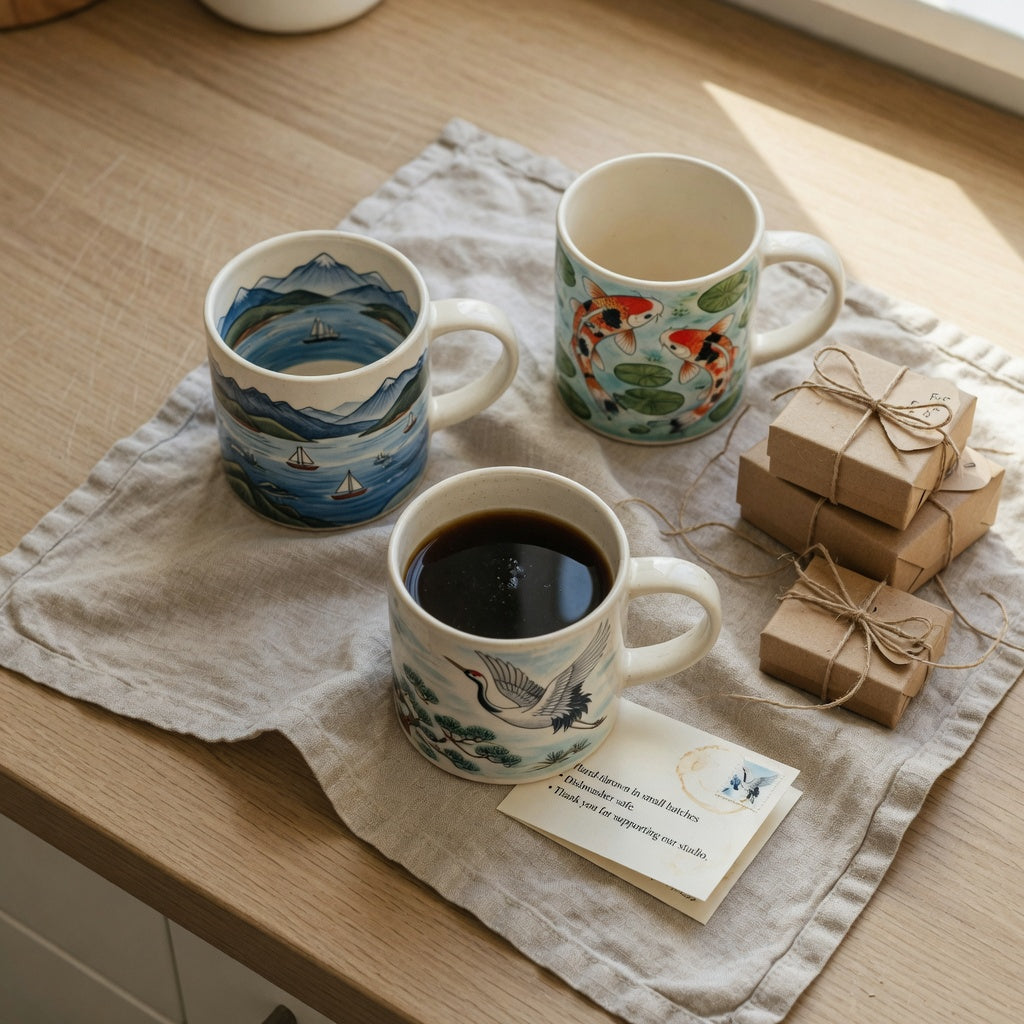
- For the landscape person — calm kitchen, neutral counters, a windowsill of plants — the Mountain & Sea coffee and tea mug reads as a scene rather than a pattern. It is the pick when you want the art noticed second, after the coffee.
- For the bolder recipient — patterned apron, loud playlist — the Koi Fish coffee and tea mug gives the eye something to follow. A strong motif like this works best as a standalone piece, not as one of six matching mugs on an open shelf.
- For a quieter gift, office and desk presents included, The Crane coffee and tea mug leans on a single subject and restrained composition — the sort of mug that does not compete with a monitor or a stack of paperwork.
| Motif | Reader it tends to suit | Confirm on the current listing |
|---|---|---|
| Mountain & Sea | Neutral kitchens, calm desks, landscape lovers | Listed capacity, glaze note, dishwasher and microwave lines |
| Koi Fish | Bold colour fans; a standalone shelf piece | Same, plus whether decoration sits near the drinking rim |
| The Crane | Quiet, minimal taste; office desks | Same, plus packed weight for shipping |
One honest caveat: we are describing visible motifs, not publishing a spec sheet. Capacity, glaze notes, and microwave or dishwasher guidance belong to the individual listing and can change between runs, so confirm them on the product page before checkout. A gift is a poor place to guess.
Packing, shipping, and the sealed-box problem
Handles are the most vulnerable part of a mug in transit, and a hairline crack at the shoulder of the handle may not reveal itself until the first hot drink. That creates a real trade-off: opening the box breaks the sealed-gift feeling, but checking the piece inside the return window is the only reliable way to catch shipping damage in time.
A practical sequence: unbox it, run a thumb around the rim and along both handle joints, hold it up to a window to look for a crack line in the glaze, then re-wrap it in the same paper. Gifting in winter? Tell the recipient to warm the mug with tap water before pouring boiling water into a cold piece. Thermal shock is a genuine failure mode for thick-bodied pottery, and it is a two-second habit.
What should you ask a seller when the listing stays quiet?
Send these six questions as one message. A seller who answers all of them quickly is telling you something about how they will handle a problem later.
- Is the food-contact surface glazed, and is that glaze tested for lead and cadmium?
- What is the listed capacity, and what is a realistic pour?
- Is it dishwasher-safe, microwave-safe, or hand-wash only — and does the trim change that?
- How much colour variation should I expect from the photo?
- What does it weigh when full, and how wide is the handle opening?
- How is it packed, and what happens if it arrives chipped?
Two more of our buying breakdowns sit well beside this one: six checks before buying a unique ceramic tea mug for the tea drinker on your list, and unique coffee mugs for home decor lovers if the mug is doubling as shelf decor.
Frequently asked questions
Is a unique ceramic art mugs gift usually dishwasher-safe?
Often, but it depends on the glaze and the trim rather than the clay body. Metallic luster and gold-tone bands should be hand-washed, and California's public health department warns that dishwasher cycles can damage some glazes and make later leaching more likely. Check the care line on that specific listing before you rely on it.
How can I tell whether the glaze is food-safe?
Ask the seller directly and expect specifics about a tested food-safe glaze, not just the word "handmade." FDA sets an action level of 0.5 micrograms per millilitre of lead for ceramic mugs across six tested units and says ware with extractable lead should not be labelled "Lead Free." A piece marked "Not for Food Use" on the base is decorative only.
Will the mug I receive look exactly like the product photo?
With printed designs, usually yes. With kiln-varied or reactive glazes, expect visible differences in colour depth and pattern placement, because that is normal for the process. Ask how much variation is typical and what the exchange policy covers before buying.
What capacity works best for coffee versus tea?
FDA's guide describes ceramic mugs as typically holding around 240 mL (8 fl oz), so anything larger is a deliberate step up. Drip coffee drinkers tend to want more volume; tea drinkers often prefer a smaller pour that stays hot to the last sip. Match the mug to the habit, not to the shelf.
Can I microwave a mug with a gold or metallic rim?
No. FDA notes that microwaves are reflected by metal, the same reason foil should stay out of the oven. Metallic overglaze, luster, and gold-tone rims are best kept out of the microwave regardless of what the body is made of.
Start with the person, not the pattern: note how they take their coffee, whether their kitchen runs on dishwasher cycles, and whether the mug will live at a desk. Then open the unique coffee mugs collection, shortlist two motifs, and run the six questions above against those listings before checkout. If the seller cannot answer them, that is your answer.
Ready to pick your mug? Two ways to save on today's order:
Ordering 1–3 mugs? Get an extra 10% off your 1st order with code 10_OFF Apply 10% Off & Shop Wooden-Handle Mugs →
Gifting 4+ mugs? Buy 3, Get the 4th Free applies automatically at checkout (no code needed; offers do not stack) · Free standard shipping (Nov pre-Christmas delivery: 15–20 calendar days US) · Free replacement if chipped in transit.
Popular mug buying guides: Ceramic Tea Cups & Infuser Mugs · Ceramic Mugs with Lids Compared · Wooden-Handle Tea Infuser Mugs Compared · Christmas & Secret Santa Mugs 2026 · Espresso & Cortado Cups Guide · Cup & Saucer Gift Sets · All 25 Mugs Spec Table · Mug Size Guide · Shipping & Promo FAQ
FIRST ORDER 10% OFF (CODE: 10_OFF) · OR BUY 3, GET THE 4TH FREE


Read more

Coffee Mug vs Tea Mug Size Checklist: 7 Checks Before You Buy
Two mugs stamped 12 oz can pour completely different drinks. This coffee mug vs tea mug size checklist separates labeling cups, brewer cups, and printed capacity so you can match a mug to your drin...
Read more
Office Desk Coffee Mug Gift Ideas: What Buyers Should Compare
A store-side comparison of desk mugs, lidded cups, tumblers, and heated mugs for office gifting — covering capacity, handle clearance, desk footprint, dishwasher and microwave risks, food-safety la...
Read more
Leave a comment
This site is protected by hCaptcha and the hCaptcha Privacy Policy and Terms of Service apply.