
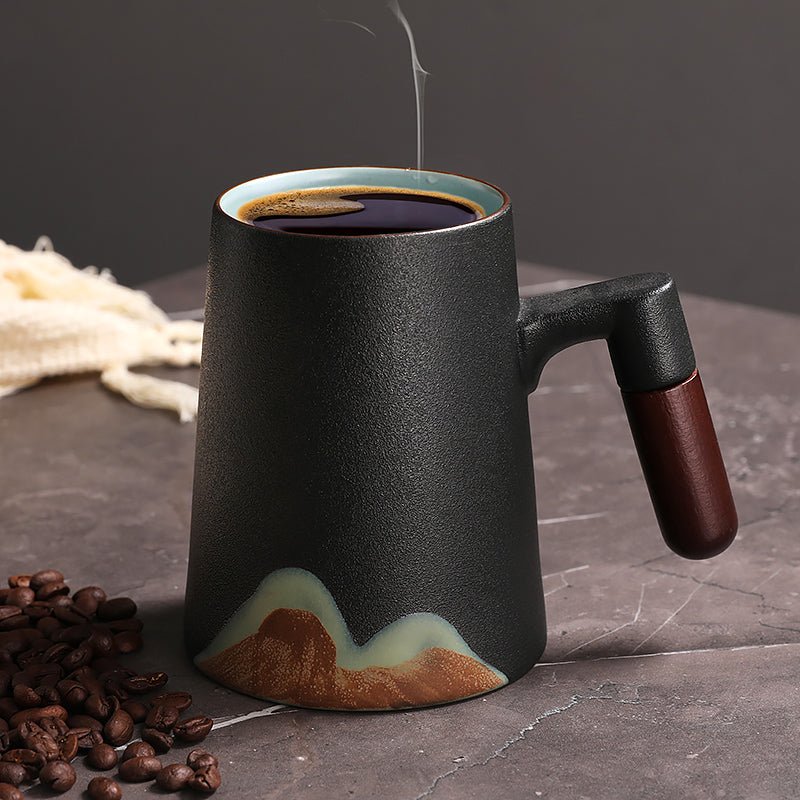
Chai Tea Mug Compact Kitchen Product Shortlist Guide: 3 Capacity Picks
Reading time: about 9 minutes
A mug can clear the front of a cabinet shelf and still stop the door from closing because its handle meets the hinge. Put a kettle, spoon rest, and chai saucepan on a narrow counter, and a mug selected only for its artwork can become an everyday obstruction. This is where a chai tea mug compact kitchen product shortlist guide needs to separate serving capacity from physical fit.
At CoffeifyMug, we handle and sell this category, and capacity is one of the few useful facts shoppers can compare before considering exterior shape. The verified choices here are The Flow at 400 ml, Morning and Night at 440 ml, and The Rock at 480 ml. Their catalog descriptions support tea use.
We will not treat those capacities as exterior dimensions. They do not establish mug height, maximum body width, total width including the handle, stackability, dishwasher compatibility, microwave suitability, or heat-retention performance. This shortlist also does not imply that chai ingredients, a lid, an infuser, a spoon, or any brewing accessory is included.
What can this chai tea mug compact kitchen product shortlist guide decide?
It can identify the capacity tier that matches the amount you actually drink. It cannot guarantee cabinet fit from milliliters alone. In our experience, the most reliable compact-kitchen decision starts with four checks:
- Measure the finished serving. Pour your usual prepared chai into a marked measuring cup once, including the milk or other additions you normally use. Leave practical headroom rather than treating the listed capacity as a recommended fill line.
- Measure the full storage opening. Check from the shelf surface to the lowest cabinet lip, hinge, hook, or shelf above. Measure depth with the door closed and width with neighboring mugs in place.
- Recreate the counter workflow. Set out the kettle or saucepan, spoon rest, and the mug you already use. The remaining clear area is the space the new mug must occupy during preparation.
- Check the washing route. Account for sink space, drying-rack slots, and handle clearance between rack tines. Only plan around dishwasher placement if the exact product instructions confirm dishwasher use.
Capacity chooses the serving tier. Exterior measurements and care instructions determine whether that tier will work in the kitchen.
400 ml, 440 ml, or 480 ml: which serving pattern fits?
The differences are modest, so each step should solve a specific problem. This table compares only verified capacity and the buyer situations that follow from it:
| Mug | Listed capacity | Choose it when | Skip it when |
|---|---|---|---|
| The Flow | 400 ml | Your finished serving sits comfortably below 400 ml and you prefer the lowest-capacity option | Your usual pour would leave little lifting and spill headroom |
| Morning and Night | 440 ml | 400 ml feels restrictive, but you do not need the largest listed capacity | The additional 40 ml does not solve a real serving problem |
| The Rock | 480 ml | You make a larger single serving and want the most capacity of these three | You usually drink a smaller portion or dislike carrying a fuller mug |
Do not infer an exterior size ranking from this table. A lower-capacity mug is not automatically shorter or narrower, because body and handle shapes can distribute volume differently.
The Flow 400 ml: when a restrained pour is the priority
Reader situation: Your measured chai serving falls comfortably below 400 ml, you want one controlled portion, and extra unused capacity offers no benefit in your daily routine.
Why it fits: The Flow coffee tea mug has the lowest listed capacity in this shortlist. That makes it the logical first product page for a shopper who has already ruled out 440 ml and 480 ml on serving volume, not on assumed cabinet size.
Reason to skip: A finished drink close to 400 ml may leave too little headroom for carrying the mug comfortably. Skip it as a storage solution, too, if you have not confirmed the mug's exterior fit against your cabinet opening and handle clearance.
Morning and Night 440 ml: the middle-capacity decision
Reader situation: Your normal serving exceeds what you would comfortably put in a 400 ml mug, but 480 ml would mostly create unused room. You want a middle option without jumping directly to the largest capacity.
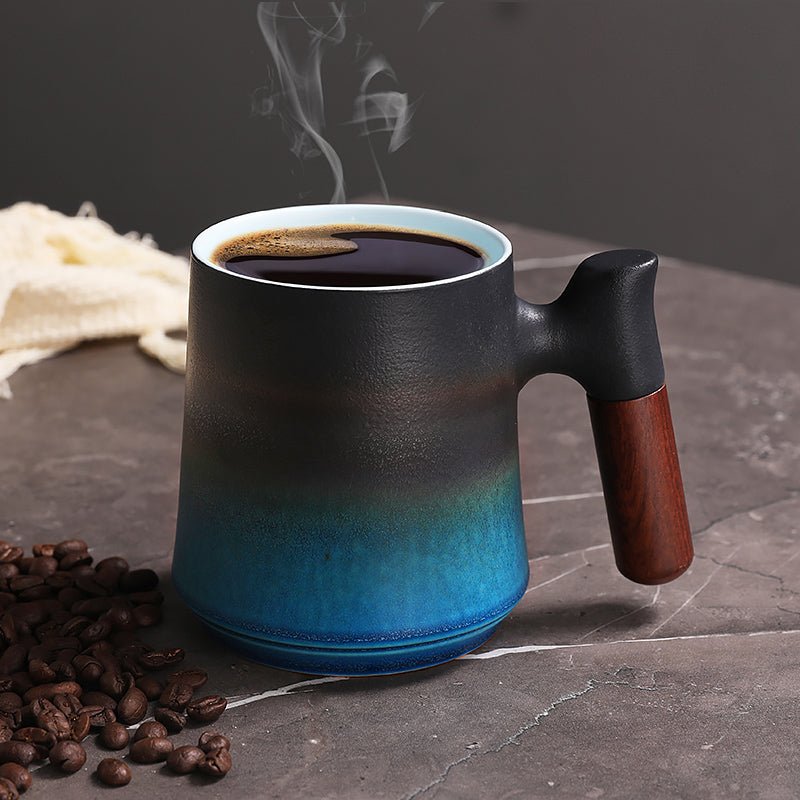
Why it fits: The Morning and Night coffee tea mug adds 40 ml over The Flow while remaining 40 ml below The Rock. That specific middle position is useful when your measured drink, including additions, is the deciding variable.
Reason to skip: Do not choose 440 ml simply because it sounds like the safest compromise. It is not guaranteed to be physically between the other mugs in height, width, handle reach, or shelf footprint. If exact cabinet fit is the hard stop, verify those details first.
The Rock 480 ml: when fewer refills matter more
Reader situation: You make a larger finished chai, prefer one pour, and have a designated counter or cupboard position that can be checked against the product's exterior shape.
Why it fits: The Rock coffee tea mug is the largest listed option at 480 ml. It is the direct shortlist choice when 400 ml and 440 ml would not accommodate your intended serving with useful headroom.
Reason to skip: More available volume is not automatically more practical. A fuller mug carries more liquid weight, and unused capacity does not help a small kitchen. This is also not the right category if you need a leak-resistant travel vessel, built-in strainer, lid, or verified insulated performance.
Cabinet lips, mug handles, and rack tines: the fit check capacity cannot do
The common measuring mistake we see is checking the empty shelf face while ignoring the route into the cabinet. A mug may fit once upright but still catch the shelf above while being tilted into place. The handle can also prevent a door from closing even when the body clears the rear wall.
- Measure overall height against the lowest part of the usable opening, not just the space between shelves.
- Check maximum body width where neighboring cups, bowls, or jars narrow the available slot.
- Check total width including the handle with the mug positioned the way it will actually be stored.
- Confirm closed-door depth, especially if the handle faces forward.
- For a dishwasher-approved mug, check the handle against rack tines and make sure the mug does not obstruct normal rack movement.
Use an existing mug as a physical benchmark and write down its outside measurements. If the exterior dimensions you need are not available on the exact listing, ask before ordering rather than substituting capacity for fit. Shoppers whose main constraint is shape rather than serving volume should compare additional styles in the unique coffee mugs collection.
Milk residue, rim chips, and care claims: what should you verify?
Compact kitchens often have one small sink and a crowded drying rack, so care is part of product fit. We use the same practical inspection points when handling mugs in our store that we recommend for a delivery or gift unboxing:
- Check the rim in good light for chips, cracks, or a sharp damaged area before first use.
- Inspect both handle attachment points for a visible hairline crack or movement.
- Place the mug on a clean, flat, dry counter to confirm that the base sits steadily. Clear away crumbs before deciding that a mug rocks.
- Wash before first use according to the instructions supplied with the exact product.
- After a milk-based or spiced chai, rinse the interior before residue dries, then follow the stated washing method.
Tea suitability does not by itself establish dishwasher or microwave compatibility. We also do not assign special thermal performance from the product capacity. If those features control your purchase, verify the exact listing or select a different mug style that makes the required care and construction claims explicit.
A five-minute shortlist before opening a product page
- Measure your usual finished chai serving.
- Choose 400 ml, 440 ml, or 480 ml based on serving volume and needed headroom.
- Record cabinet height, closed-door depth, body-width allowance, and total handle-width allowance.
- Check the exact product information for exterior dimensions, included items, and care guidance.
- Use each product's skip reason honestly. Remove any option that fails either the serving check or the storage check.
The value of this chai tea mug compact kitchen product shortlist guide is permission to stop at a mismatch. A visually appealing mug that cannot clear the cabinet lip, leaves no carrying headroom, or requires care that does not suit your routine is not the practical choice.
Frequently asked questions
Can a chai tea mug compact kitchen product shortlist guide guarantee cabinet fit?
No. The guide can narrow the choice by listed capacity, but capacity is a volume measurement rather than an exterior dimension. Confirm overall height, maximum body width, closed-door depth, and total width including the handle before treating any option as a cabinet fit.
Is a 400 ml mug large enough for chai with milk?
It can be if your fully prepared serving, including milk or other additions, sits comfortably below 400 ml. Measure the finished drink once and leave room below the rim for lifting and carrying. If your serving approaches the listed capacity, compare the 440 ml and 480 ml choices.
Will a 480 ml mug always take more shelf space than a 400 ml mug?
Not necessarily. Capacity does not reveal whether a mug's volume comes from extra height, a wider body, or a different shape. The Rock has the largest listed capacity here, but exterior fit still needs a separate check.
Are these mugs dishwasher-safe, microwave-safe, or insulated?
This shortlist does not make those claims. The verified catalog information used here supports tea use and the three listed capacities. Follow the exact product page and supplied care instructions rather than assuming care or temperature performance from the mug category.
Do these mugs include chai, an infuser, or a lid?
This guide does not imply that drink ingredients or brewing accessories are included. Review the exact product listing for package contents. If an infuser, lid, or travel feature is essential, a different product category may suit the job better.
Take your measured serving and cabinet-fit notes to the corresponding product page: 400 ml for The Flow, 440 ml for Morning and Night, or 480 ml for The Rock. If none survives both checks, return to the collection and compare shapes instead of forcing a capacity choice into a cupboard that cannot support it.
More from our blog
Read more
Apple Cider Mug Compact Kitchen Product Shortlist Guide: 3 Picks
Compare three everyday ceramic mugs using verified 400 ml and 480 ml capacities, plus practical checks for cabinet space, handle clearance, and filled weight. Each recommendation includes a clear r...
Read more
Dandelion Coffee Mug Compact Kitchen Product Shortlist Guide
Compare The Gradient and The Flow at 400 ml with The Rock at 480 ml using cabinet measurements, normal pour volume, and handle comfort. Each recommendation includes a clear reason to choose it, ski...
Read more
Leave a comment
This site is protected by hCaptcha and the hCaptcha Privacy Policy and Terms of Service apply.