
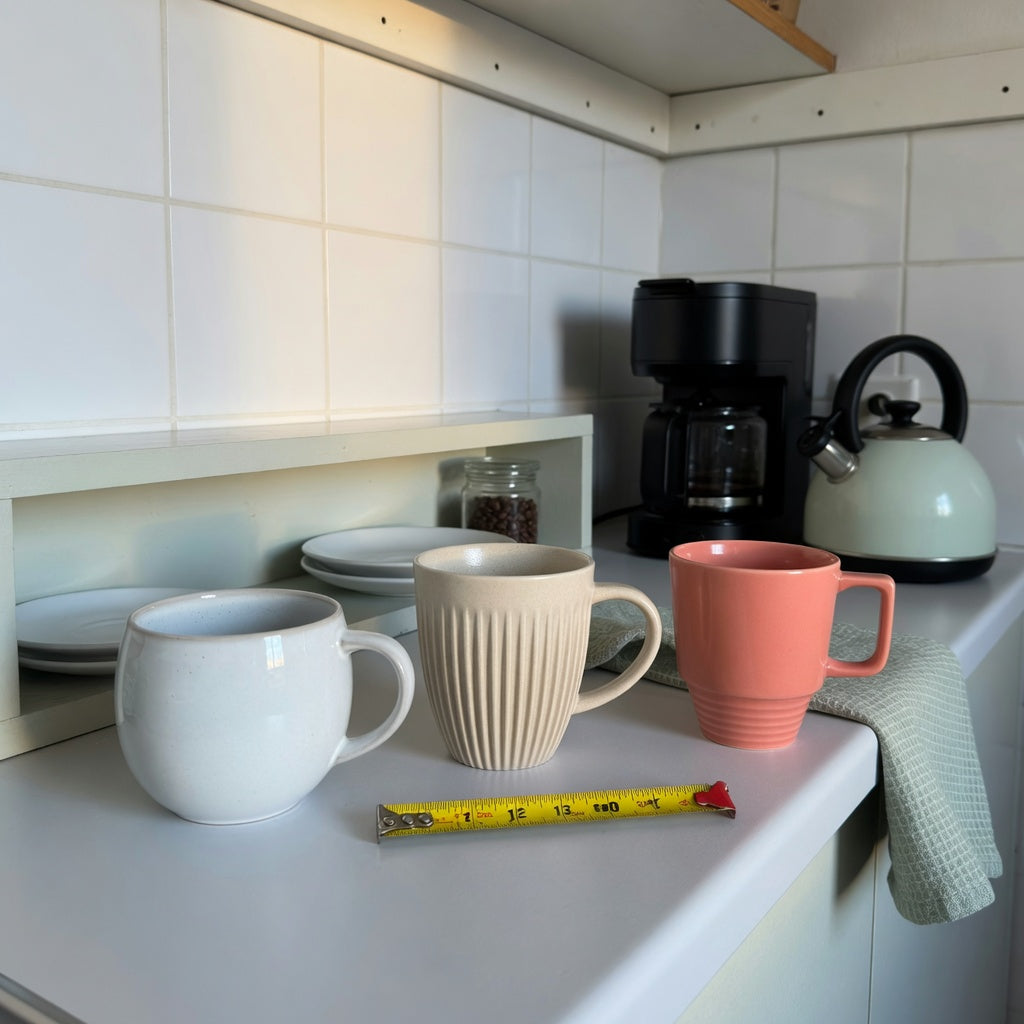
Minimalist Ceramic Mug Compact Kitchen Product Shortlist Guide: 3 Picks
Reading time: about 9 minutes
A cabinet door that catches a mug handle turns a neat purchase into permanent counter clutter. This minimalist ceramic mug compact kitchen product shortlist guide starts with the space that controls the decision: usable cabinet depth, clearance between shelves, and the counter strip left after the kettle or coffee maker is in place.
In our store, compact-kitchen comparisons often change once we place handled mugs side by side. The body may look narrow, but the handle creates the widest part of the footprint. We have kept this shortlist to three current ceramic forms with handles: the Round Coffee Tea Mug, Pleated Coffee Tea Cup, and Retro Coffee Tea Cup. We compare their visible shapes, ceramic material, handles, and listed capacities without making assumptions about durability, care, or performance.
Here, minimalist is a shopper-facing style lens. It describes how much visual detail a mug brings to a small kitchen, not a formal design classification. Product details can also change, so treat each linked product page as the source for current capacity, dimensions, and care information. If a measurement or care method is not listed, do not infer it from a photograph.
Minimalist ceramic mug compact kitchen product shortlist guide: three fit checks
We use three checks before discussing color or styling. Each one removes options that would otherwise look suitable on screen.
- Closed cabinet envelope: Measure from the back wall to the inside of the closed door, then from the shelf surface to the shelf or cabinet ceiling above. An 11-inch cabinet depth or 4.5-inch shelf gap is a hard limit set by your kitchen, not proof that a particular mug will fit.
- Handle-inclusive footprint: Measure the body and handle together at their widest point. When our team compares mugs on a narrow shelf, we orient every handle as it would be stored rather than using the body diameter alone.
- Working counter zone: Measure the space that remains after the coffee maker and kettle are in their normal positions. A 16-inch counter strip can look generous while empty but become restrictive once both appliances and their handles are accounted for.
Compare those numbers only with measurements explicitly provided on the product listing. If your cabinet has almost no spare clearance and a required product dimension is not stated, ask before ordering rather than relying on perspective in the images.
What does minimalist mean on an always-visible shelf?
Small kitchens amplify visual detail because the same few objects remain in view. A smooth round mug usually reads quieter than a pleated surface, while a retro profile brings a more recognizable style cue. That is not a ranking of quality. It is a way to decide how much texture and character you want beside a kettle, dish rack, or row of pantry jars.
The handle also affects the visual rhythm of a shelf. Matching handle direction can make several mugs look orderly, but it may use more width than alternating them. Before buying multiples, test both arrangements with a mug you already own and measure the resulting row.
Shallow closed cabinet: should the Round Coffee Tea Mug lead?
For an upper cabinet with 11 inches of usable depth and limited clearance at the door, the Round Coffee Tea Mug is the first product page we would inspect. Its visible round body offers a smoother, less textured profile than the pleated option, which suits shoppers who want the mug to recede visually once the cabinet opens.
- Choose it if: You prefer a simple round silhouette, closed storage, and a listed capacity that matches your normal coffee or tea pour.
- Verify before buying: Compare the listed overall size with the cabinet depth, shelf height, and space needed by the handle. A round body does not guarantee a compact total footprint.
- Skip it if: You want pronounced surface texture, need confirmed stackability, or require a sealed travel format rather than an open ceramic mug.
This is the least visually detailed candidate in the three-product shortlist, but that alone does not make it the smallest. Capacity and handle projection can change the result, so the current listing must settle the fit question.
Ten-inch open shelf: is the Pleated Coffee Tea Cup worth the texture?
An open shelf above the sink is storage and display at the same time. The Pleated Coffee Tea Cup is the scenario pick for a shopper who wants visible surface detail without choosing a printed motif. Its pleated exterior gives the form more presence than the smooth round option.
- Choose it if: Your 10-inch-deep shelf is visible from the main room and you prefer structured texture over a plain exterior.
- Verify before buying: Confirm that the listed base and overall footprint fit fully on the shelf. Also measure side-to-side spacing with the handle included if several cups will sit in one row.
- Skip it if: You prefer fewer exterior contours to wipe, want the quietest possible silhouette, or plan to stack cups without confirmed stacking information.
Pleating should not be treated as evidence of stackability or a particular grip performance. Those claims require specific product information. For a tight shelf, the practical question remains straightforward: does the listed footprint fit while leaving enough room to lift the cup without moving its neighbors?
Sixteen-inch drink station: does the Retro Coffee Tea Cup fit?
A counter shared by a coffee maker and kettle often has room for only one mug at a time. The Retro Coffee Tea Cup is the style-led candidate for that setup, especially if the mug remains visible between drinks. Its retro presentation carries more character than the round form, so it can make a small drink station feel intentional without adding another decorative object.
- Choose it if: You use the same station for coffee and tea, like a recognizable retro shape, and the listed capacity suits both of your usual pours.
- Verify before buying: Check the full footprint against the space left on the 16-inch counter strip. Leave the mug in the position where it will actually sit rather than measuring an empty counter.
- Skip it if: Your definition of minimalist means the plainest available geometry, the counter must remain completely clear, or the listed dimensions exceed your storage space.
This option shows why minimalist is a personal style filter rather than a fixed category. Some shoppers use the term to mean fewer objects with more personality. Others want every object to be visually plain. The retro form suits the first approach better than the second.
Capacity, ceramic, shape, and handle: which variable breaks a tie?
Style gets the three mugs onto the shortlist. The following details determine which one should survive it.
| Buyer variable | Practical comparison | Reason to remove an option |
|---|---|---|
| Listed capacity | Pour your usual drink into a measuring jug, including milk or the space you normally leave at the rim, and compare that amount with the listed capacity. | The mug is too small for the normal pour or larger than you want to store. |
| Ceramic material | All three shortlist products are ceramic, keeping the material comparison consistent. | You need a different material, a sealed lid, or an insulated travel format. |
| Visible shape | Compare the smooth round body, pleated surface, and retro styling according to how each will look in your actual kitchen. | The form adds more visual detail than you want on an exposed shelf or counter. |
| Handle | Use the widest overall span for cabinet planning. If the handle opening is not measured on the listing, do not assume how it will fit your hand. | The handle conflicts with the cabinet door, neighboring mugs, or your preferred grip. |
| Care information | Read the current product instructions before using a dishwasher or microwave. | Your required care method is not confirmed on the listing. |
Capacity is especially easy to misread. Two mugs with a similar listed capacity can occupy different amounts of shelf space because their body shapes and handles differ. Conversely, the smallest-looking mug in a styled photograph may not hold your normal drink. Use the listing data and your measuring jug, not visual scale alone.
Which option should leave the shortlist first?
A useful shortlist eliminates products as clearly as it recommends them. We would remove each option for the following reasons:
- Remove the Round Coffee Tea Mug if a plain surface feels too neutral or its current listing does not provide enough information for a cabinet with almost no spare clearance.
- Remove the Pleated Coffee Tea Cup if you want a completely smooth exterior, confirmed stacking is essential, or the handle-inclusive width does not work on your open shelf.
- Remove the Retro Coffee Tea Cup if your kitchen calls for the least decorative form or you do not want a mug kept visibly at the drink station.
- Remove all three if you need non-ceramic material, insulation, a sealed lid, or a capacity outside what the current listings provide.
There is no benefit in forcing one of these products into a use case it does not meet. A different mug style is the better purchase if travel, stacking, or an exact unlisted dimension is the deciding requirement.
A five-minute cabinet-to-checkout shortlist
- Write down usable cabinet depth, vertical shelf clearance, and the widest side-to-side slot available.
- Measure your existing mug from body edge to handle edge so you can see which dimension currently causes trouble.
- Record your normal drink volume with a measuring jug rather than estimating from the mug's appearance.
- Decide which visible form fits the room: smooth round, pleated texture, or retro character.
- Open the three product pages and compare only the listed capacity, material, dimensions, handle details, and care information.
The minimalist ceramic mug compact kitchen product shortlist guide works best as an elimination tool. If none of the three survives your measurements, browse our unique coffee mugs collection with the same numbers beside you. Keep the products that fit first, then compare their styling.
Frequently asked questions
How should I use a minimalist ceramic mug compact kitchen product shortlist guide?
Start with your cabinet, shelf, and counter measurements, then compare those numbers with the current product listings. Remove any mug whose capacity, full footprint, or care information does not meet your needs. Use shape and styling only to break the tie between products that pass those checks.
Is a round mug always better for a shallow cabinet?
No. A round body may look compact, but the handle can create the widest part of the mug. The listed overall dimensions and your closed-door cabinet depth determine fit, not the shape name alone.
Can the Pleated Coffee Tea Cup be stacked in a low cabinet?
Do not assume stackability unless the current listing confirms it or provides enough information to evaluate the base and rim. If stacking is essential, verify that detail before ordering. Side-by-side storage is the more cautious plan when stacking information is absent.
Are these ceramic mugs dishwasher- or microwave-safe?
Use only the care guidance stated on the current product page. Ceramic material by itself does not confirm compatibility with every dishwasher or microwave routine. If the care method you need is not listed, ask before purchase.
Which mug is best if I drink both coffee and tea?
All three are presented as coffee-and-tea forms, so compare their listed capacities with your larger usual pour. The Retro Coffee Tea Cup is the style-led candidate for a shared drink station, but it is not automatically more versatile than the other two. Capacity, footprint, and handle comfort still decide the practical fit.
Next step: Measure usable depth, shelf clearance, and handle-inclusive width now. Keep only the product whose current listing matches those limits and your usual drink volume, then make the final choice by visible shape.
More from our blog
Read more
Ceramic Tea Mug Compact Kitchen Product Shortlist Guide: 3 Picks
Measure your usable counter and cabinet space, then compare three current ceramic mugs by listed capacity, visible form, and handle shape. Each option includes a clear reason to choose it and a rea...
Read more
Ceramic Tea Mug Compact Kitchen Practical Purchase Checklist: Fit First
Measure the shelf opening, total width with handle, counter footprint, and your normal pour before choosing. This checklist compares CoffeifyMug ceramic listings without guessing at unlisted dimens...
Read more
Leave a comment
This site is protected by hCaptcha and the hCaptcha Privacy Policy and Terms of Service apply.