

Ceramic Mug With Wooden Handle: Shared Household Checklist
Reading time: about 10 minutes
At 7:15 a.m., one person is filling a mug at the coffee machine while someone else is waiting to make tea. The problem is rarely color. It is usually that the same mug suits one person's pour, cupboard space, and grip better than the other's. That is why our ceramic mug with wooden handle shared household practical purchase checklist starts with daily habits instead of decorative claims.
We handle and sell this category in our store, and we keep the comparison within facts a shopper can verify. The linked products support a ceramic mug with a wooden handle, while their current pages and photos can be used to compare listed capacity, visible vessel form, and handle shape. We do not infer wood species, finish, coating, detachability, water resistance, cleaning method, heat performance, or production details that are not stated.
Open the Mountain Sea II ceramic coffee and tea mug with wooden handle and The Cloud coffee and tea mug with wooden handle in separate tabs. Treat them as separate product listings, not as a matching set. One is a relevant next step only if its current listed capacity, pictured vessel form, and visible handle shape suit the person who will use it.
Whose usual pour should determine the listed capacity?
A household average is not useful if one person makes a short tea and another prepares a larger coffee with milk. Start by measuring each person's finished drink in an existing cup or measuring vessel. Include the milk, water, or ice normally added, and record the level where that person actually stops rather than filling to the rim for the sake of a bigger number.
The capacity on a product page is a comparison point. It does not tell us where a particular user will find the most comfortable fill line, and it does not establish heat retention or serving performance. A shopper who dislikes carrying a nearly full mug may prefer more room above the normal pour, while someone with limited cabinet space may reject extra volume that will never be used.
| Household detail | What to record | How it affects the choice |
|---|---|---|
| Morning coffee | The normal finished volume, including milk or cream | Compare it with the current listed capacity without assuming a brim-full serving |
| Tea | The usual water volume and any space needed for the regular preparation routine | Reject a capacity that feels unnecessarily large for that person's normal serving |
| Iced drink | The finished volume after ice is added | Use capacity only as a space comparison, not as evidence of thermal performance |
| Occasional guest use | The drink size most often served to visitors | Decide whether the mug must suit guests or can remain assigned to one resident |
If the Mountain Sea II listing shows the capacity that best matches one resident's recorded pour, continue evaluating that product's form and handle. If The Cloud listing is the closer capacity match for another person, apply the same checks there. The product name alone should not decide which household member receives which mug.
Can each person identify a preferred mug by vessel form?
Vessel form is the visible silhouette of the ceramic body. Useful photo-based details include the apparent height-to-width relationship, whether the sides look straight, tapered, or rounded, how open the rim appears relative to the body, and how broad the base looks. These are legitimate visual comparisons. They are not measured dimensions.
That distinction matters online. Two product photos may be cropped or scaled differently, so a mug that looks larger in one image is not automatically larger in person. Use the listed capacity for volume and the photos for form. If exact height, rim width, or base diameter is essential for a shelf, coffee machine, or cup holder, confirm those measurements rather than estimating them from the image.
Different vessel forms can also prevent mix-ups in a shared kitchen. One resident may consistently reach for the more upright-looking body, while another prefers a more open-looking silhouette. Choosing two visibly distinct individual mugs can create an easy ownership cue without suggesting that the products are sold together. It is often more practical than buying two identical pieces and trying to remember whose is whose.
Will the wooden handle shape suit different grip habits?
A handle photo can show shape, but it cannot prove comfort. We compare the apparent opening, the clearance between the inner curve and ceramic body, the upper and lower curves, the visible grip thickness, and where the handle sits against the vessel. We do not translate those observations into exact finger clearance unless dimensions are provided.
Ask each regular user how they hold a mug. Some hook one or two fingers through the opening and support the base with the other hand. Others expect more fingers to fit inside the handle. A grip shape that looks controlled to one person may look cramped or oversized to another, especially when hand sizes differ.
There is another claim boundary here: a wooden handle does not automatically establish a specific surface temperature, insulation level, water resistance, or removable construction. Those details require an explicit statement from the product page or seller. If any of them is central to the purchase, a visible wood surface is not enough evidence.
What must be confirmed before sink and dishwasher duty?
Cleaning routines cause more friction in a shared household than they do for a single careful owner. One person may wash a favorite mug immediately, while another puts every used cup into the dishwasher at night. We cannot prescribe a care method for these mugs without verified instructions, and shoppers should not assume that ceramic care rules automatically cover the wooden handle.
Before buying, check the current listing or ask for confirmation on these points:
- Is a specific hand-washing or dishwasher method stated?
- Is the wooden handle described as fixed or detachable?
- Are soaking limits or drying instructions provided?
- Is any coating, finish, or water-resistance treatment identified?
- Are microwave use or other heat-related instructions explicitly stated?
An unanswered question remains an unknown. If every mug in your home goes through an automatic dishwasher cycle, do not rely on appearance or general advice about other wooden-handle mugs. Confirm compatibility before checkout or choose a style with care instructions that match the household routine.
One shared mug, two personal mugs, or a housewarming gift?
The right selection logic changes with the job the mug must do. A single communal mug has to clear every regular user's requirements. Two personal mugs can be chosen around separate capacities, forms, and handle preferences. A gift has to work with information that may be incomplete.
- One mug shared by two people: Use the stricter capacity, storage, grip, and care requirements. If either person rejects the handle shape or cannot confirm the necessary care routine, the mug is not a practical communal choice.
- One personal mug per resident: Match the Mountain Sea II listing to the person who prefers its current listed capacity and pictured form, and use The Cloud listing only if its corresponding details fit the other person. Check the quantity stated on each page because separate links do not establish a bundle.
- Housewarming or roommate gift: Buy only when you know the recipient's normal serving size and general handle preference. A visually distinctive mug can make a thoughtful personal item, but it is a weak choice for an unknown dishwasher routine.
- Home and office crossover: Compare the visible base and overall form with the available desk area, then verify dimensions if the fit is tight. These listings do not establish a sealed travel lid or spill-resistant design.
- Occasional guest mug: Favor broad compatibility over one person's highly specific grip preference. If the visible handle opening raises doubts for several users, a different handle style may serve guests more reliably.
For a gift recipient whose preferences are unclear, the more useful next step is to compare other shapes in our unique coffee mugs collection. That keeps the decision open instead of forcing a wooden handle into a household that may prioritize easy stacking, a travel lid, or explicitly documented dishwasher care.
Ceramic mug with wooden handle shared household practical purchase checklist
Run this pass-fail check with the two product pages open and the regular users present. It takes a few minutes and prevents decorative preference from hiding an everyday mismatch.
- List every regular user and write down each person's normal coffee, tea, or iced drink volume.
- Compare those volumes with the capacity currently listed on each product page. Do not treat a page capacity as the required fill level.
- Study the ceramic vessel forms side by side, including their apparent proportions, side profile, rim openness, and base shape.
- Do not estimate exact physical dimensions from separately cropped product photos. Verify measurements if shelf, machine, or desk clearance is tight.
- Compare the visible wooden handle openings, curves, body clearance, and grip sections against each person's normal holding style.
- Check the available cabinet shelf, counter space, drying area, and office desk rather than imagining the mug in an empty display setting.
- Confirm any required care, coating, water-resistance, detachability, microwave, or dishwasher details. Treat missing information as unknown.
- Decide whether each mug is communal or assigned to one person. Distinct forms are useful ownership cues, but separate product listings should not be treated as a set.
- Stop if any essential requirement is unsupported. Move to another handle or vessel style instead of hoping the missing detail will work out.
The ceramic mug with wooden handle shared household practical purchase checklist is complete only when every required fact has been confirmed or every remaining unknown has been consciously accepted. Capacity, vessel form, and handle shape can narrow the choice, but they cannot answer unlisted care or construction questions.
When is another mug style the more practical purchase?
A wooden-handle ceramic mug is not a universal household cup. Skip this category if you need a sealed travel lid, documented compatibility with a specific appliance, confirmed stacking dimensions, an all-ceramic handle, or a care routine that the listing does not support. It is also a poor shared choice when one resident dislikes the grip shape or the household wants a clearly bundled matching set.
Exact material requirements are another stopping point. The available facts do not establish the wood species, finish, coating, water resistance, or production method. Buyers who need any of those details should obtain confirmation before purchasing. If the answer is unavailable, compare a different mug in the collection with specifications that meet the requirement.
Frequently asked questions
How do I use the ceramic mug with wooden handle shared household practical purchase checklist?
Record each user's normal drink volume, then compare it with the capacity currently listed on each product page. Next, compare the visible vessel form and handle shape against storage space and grip habits. Confirm any essential care or construction details rather than filling gaps with assumptions.
Are the Mountain Sea II and The Cloud mugs sold as a matching set?
Do not assume they are a set. They are linked through separate product pages, so check the stated contents and quantity on the individual listing before ordering.
Can a ceramic mug with a wooden handle go in the dishwasher?
The provided facts do not establish a dishwasher-safe care method for these products. Check the current product instructions or request confirmation before putting either mug through a dishwasher cycle. A ceramic body does not, by itself, answer how the wooden handle should be cleaned.
How can I tell if the wooden handle will fit larger hands?
Product photos can help you compare opening shape, curvature, visible clearance, and apparent grip thickness, but they do not prove exact hand fit. Look for stated dimensions or ask for measurements if finger clearance is a deciding factor. Without measurements, comfort remains a personal uncertainty.
Which mug is better for a shared household, Mountain Sea II or The Cloud?
Neither is automatically better for every shared kitchen. Choose the listing whose current capacity, visible vessel form, and handle shape match the intended user's pour and grip preferences. If neither clears the household's storage, care, or fit requirements, compare a different style rather than forcing the choice.
Next step: Open both product pages, measure each regular drink once, and complete the nine checks before ordering. Choose the individual mug that clears the user's confirmed requirements, or return to the unique mug collection when an essential detail remains unsupported.
More from our blog
Read more
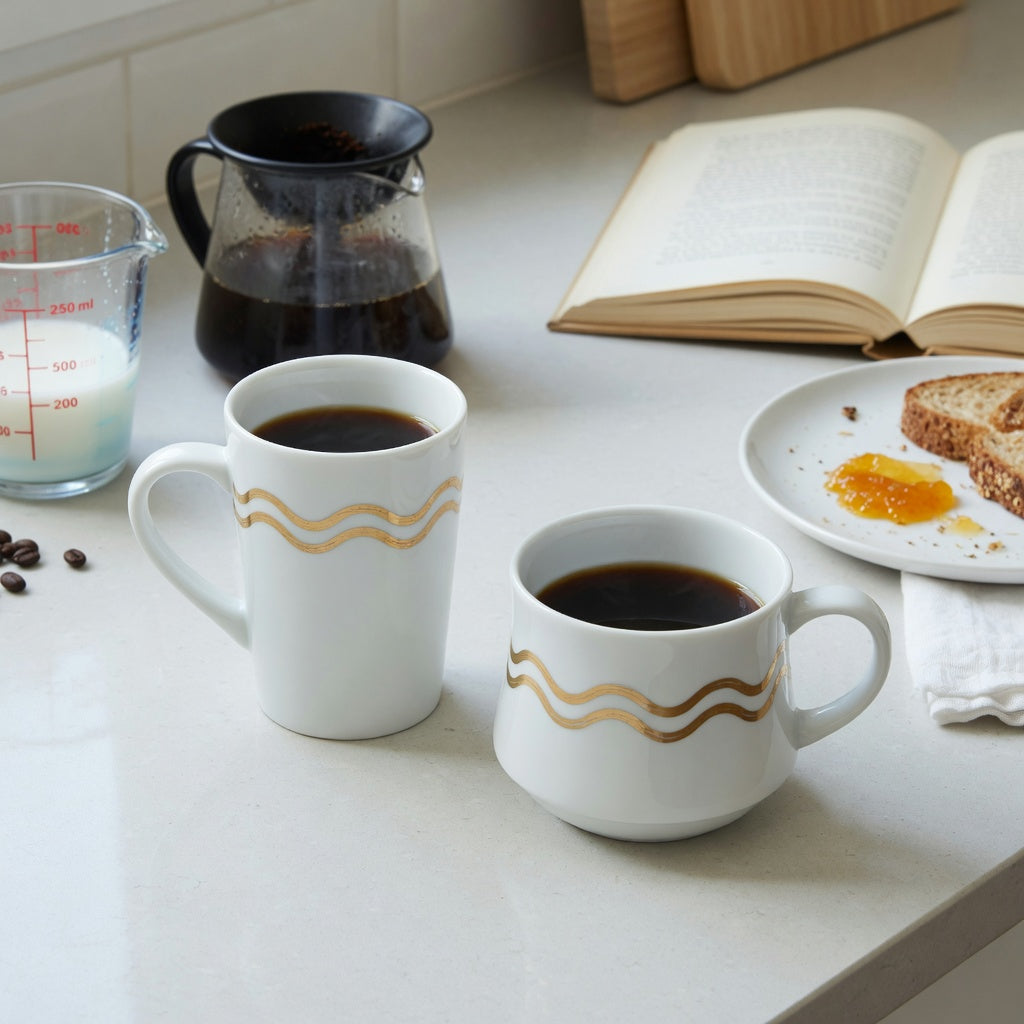
White and gold coffee mug weekend coffee practical purchase checklist
Compare the tall waves and Kio silhouettes against your measured weekend pour, counter setup, and verified listing details. Our checklist separates visible facts from unknowns, including material, ...
Read more
Ceramic Coffee Mug With Handle: Shared Household Purchase Checklist
Match each household member's normal pour, storage space, and need for visual identification to listed capacity, ceramic material, handle form, and vessel shape. This checklist also flags care and ...
Read more
Leave a comment
This site is protected by hCaptcha and the hCaptcha Privacy Policy and Terms of Service apply.