

Ceramic Mug Shapes Size Decision Guide: 200, 250 or 400 ml
Reading time: about 10 minutes
A customer emailed us last spring about a 400 ml mug that, in her words, made her tea go cold. The mug was fine. Her pour was roughly 200 ml of oolong, so more than half the interior sat empty and exposed while she drank. The fix was a smaller cup, not a thicker wall and not a lid. That is the premise of this ceramic mug shapes size decision guide: start with what you actually pour, then pick the silhouette and listed capacity that matches it.
Our current lineup makes that comparison unusually clean. Three shapes, three distinct capacities — 200 ml, 250 ml and 400 ml — with visibly different bodies and handles. We will stay inside what we can verify: listed capacity, visible silhouette, handle geometry. We are not going to tell you a named shape makes coffee sweeter or less acidic, because the sellers repeating that claim do not back it up with anything.
Ceramic mug shapes size decision guide: what do 200, 250 and 400 ml actually pour?
Metric capacities trip up U.S. shoppers because most coffee gear is still sold in fluid ounces. NIST's approximate conversion puts 1 fluid ounce at 29.57 ml. Run our three listings through that and the decision stops being abstract:
| Option | Listed capacity | Roughly in fluid ounces | What that volume usually covers |
|---|---|---|---|
| Pleated Coffee & Tea Cup | 200 ml | about 6.8 fl oz | Small pour-overs, tea you re-steep, short espresso drinks with a splash of milk |
| Ball Handle Coffee & Tea Mug | 250 ml | about 8.5 fl oz | The standard single-serve pour, with headroom for milk or a larger tea measure |
| The Flow Coffee & Tea Mug | 400 ml | about 13.5 fl oz | Long blacks, big morning brews, iced drinks with room for ice |
One caveat we repeat to customers: a listed capacity is normally measured to the rim, not to a comfortable fill line. Leave the headspace you need for milk, ice or a spoon, and a 250 ml mug behaves like a 200 ml one at the table. Plan around working volume, not the number on the box.
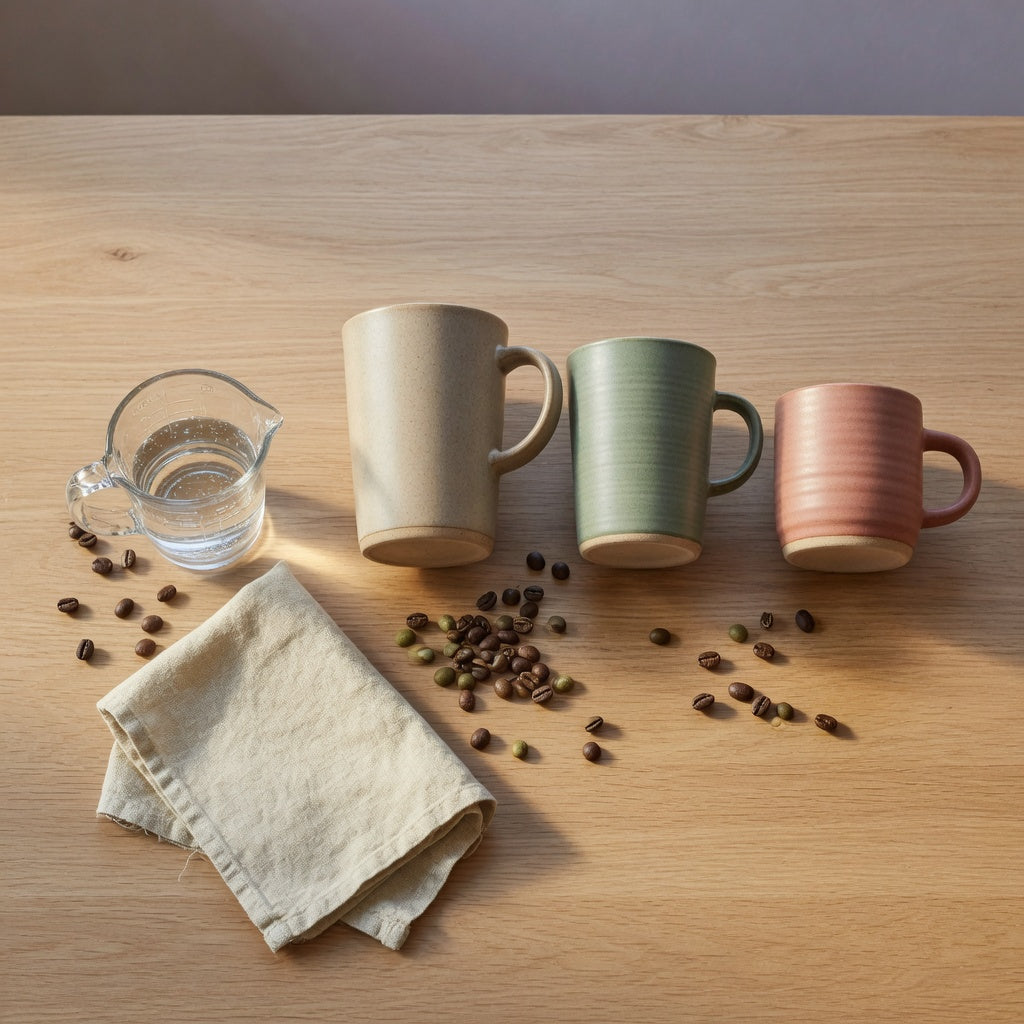
In our store, we keep a graduated beaker at the packing bench so we can show a shopper what 200 ml looks like beside 400 ml before they order. The gap surprises people more often than the product photos suggest — a mug that looks modest on screen can read as genuinely small on a counter.
Why does the FDA's cup-versus-mug wording matter when you're sizing?
The FDA's ceramicware guidance describes cups and mugs as small hollowware used for hot beverages, normally around 240 ml (8 fl oz) and normally made with a handle. In that document, a cup normally has a base and curved sides, while a mug has cylindrical sides. Nothing there says a 200 ml vessel is a cup and a 400 ml vessel is a mug — those words describe form, not volume. But the 240 ml reference point is useful, because it lands almost exactly between our 200 ml and 250 ml options. That is why both feel like normal mugs in the hand, while the 400 ml reads immediately as a deliberate step up.
If you want the primary source, the FDA guidance on ceramic hollowware is short and worth skimming before you buy from any maker, not just us.
When is the smaller silhouette the more practical buy?
Small is not a compromise. For a large group of drinkers it is the correct answer, and the 200 ml Pleated cup and 250 ml Ball Handle mug exist for exactly that group.
- You finish a drink in five minutes. A short black, a cortado, a small milk drink — the 200 ml cup is sized to the pour instead of leaving two-thirds of the interior empty and cooling.
- You re-steep tea. Smaller cups mean more infusions, each one drunk while it is still hot, rather than one large mug going tepid halfway down.
- Counter and spout clearance is tight. A 200 ml body slides under a low machine spout or a short cabinet shelf where a taller 400 ml mug will not sit.
- You want a defined grip point. The Ball Handle gives you a rounded loop rather than a flat strap. Check the listing photos for opening size before you order, because loop handles and strap handles do not clear knuckles the same way.
- It is a gift for a smaller hand. Filled weight scales with volume. 250 ml of liquid adds roughly 250 g before the ceramic is counted at all.
Where the smaller option stops working: iced drinks and big brews. Ice displaces liquid, so a 200 ml cup packed with ice holds far less than 200 ml of coffee. And if you routinely brew a 12 oz mug in one go, a 200 ml cup just means a second trip to the brewer. That is your signal to move up.
When does the 400 ml The Flow earn its shelf space?
The Flow at 400 ml is for drinkers whose cup is a project rather than a pause. It suits a long black, a large morning brew, or an iced coffee where you need room for ice and still want a real drink at the end. Slow drinkers who want one vessel to last an entire meeting are the other obvious fit.
The trade-offs are real, so plan for them:
- Weight when full. 400 ml of liquid is about 400 g before the mug is added, so a full pour becomes a two-handed lift for some drinkers, especially in a heavier clay body.
- Cabinet height. Taller bodies and taller handles need shelf clearance. Measure the gap before you commit.
- Heat behaves differently, not better. More liquid stores more total heat, but a wider opening exposes more surface and the open top lets heat leave by evaporation. Whether any given silhouette stays hot longer depends on wall thickness and opening area together. We deliberately do not rank shapes as hotter, because the honest answer is that it depends on the whole vessel.
How do rim thickness and handle geometry change the size call?
Two mugs can hold the same 250 ml and feel nothing alike. Before you buy on capacity alone:
- Look at the rim in the listing photos. A thin, rounded lip is comfortable to sip from. A thick, flat rim feels solid and diner-like but can dribble if the pour lip is not shaped. Rim finish affects the drinking experience more than body profile does.
- Count your fingers. In our experience, most shoppers want two comfortable fingers through the handle on a 200–250 ml mug and three on a 400 ml mug. If the opening looks narrow in the photos, ask before ordering.
- Check the balance point. A narrow base under a wide body tips when full. A wider foot ring is steadier on a desk or a lap tray.
- Look at the interior, not just the exterior. A pleated or faceted outside can be beautiful while the inside stays smooth and rinses clean. If the facets continue inward, coffee oils and tea tannins collect in the corners over months of use. Confirm the interior finish with the seller.
What should you measure at home before choosing a size?
We tell shoppers to take three measurements before ordering anything:
- The cabinet shelf gap — how much height is actually available above the mug.
- Clearance under the coffee machine spout or kettle lip.
- Dishwasher rack spacing, especially where a tall handle has to fit between tines.
Then compare those numbers against the listed dimensions on each product page rather than guessing from photos. Our unique coffee mugs collection shows the silhouettes together, which makes the height difference between the 200 ml cup and the 400 ml mug far easier to judge than any single product shot. If you want the broader comparison of materials, lids and everyday durability before narrowing to a size, our ceramic mug buying comparison covers that ground.
Does the clay body change the size decision?
It can, at the margins. Dense, vitrified stoneware tends to weigh more for the same volume. Porcelain can be made thinner, so a 400 ml porcelain mug may feel lighter in the hand than a 400 ml stoneware one. Earthenware is more porous and relies on a sound glaze to hold liquid. None of this changes the volume math, but it changes how a large mug feels at the end of a long pour — worth checking if weight is your sticking point. Where a listing does not state the clay body, ask rather than assume.
Where does food-contact safety fit into a shape decision?
It does not change which size you buy, but it should change which listing you trust. The FDA sets a lead guideline of 0.5 micrograms per ml of leaching solution for ceramic cups and mugs, tested across six units using methods that include ASTM C738 — an acetic-acid extraction the standard itself describes as severe compared with ordinary use. Decorative-only pieces sit in a different category from food-use ware. If a silhouette you love comes from a maker who cannot say which one it is, that is your answer.
Frequently asked questions
Is 400 ml too big for a single coffee?
Only if you pour well under 300 ml into it. A 400 ml mug holding a 200 ml pour leaves a lot of exposed surface and an open top, so the drink cools faster than it would in a smaller cup. If your usual pour is under 250 ml, buy the smaller size and keep the 400 ml for long or iced drinks.
Does a wide mouth really cool coffee faster than a narrow one?
Generally yes. A wider opening exposes more surface area and lets more heat escape by evaporation, and any open top loses heat faster than a lidded vessel. The effect is real but modest next to how much liquid is in the mug, so do not choose a shape on this factor alone.
What is the best size if the mug is a gift?
Match the recipient's usual pour, not the mug that looks best on a shelf. If they drink small pour-overs or re-steep tea, the 200 ml pleated cup will actually get used. If they brew a big morning mug, The Flow at 400 ml fits better. This is where a ceramic mug shapes size decision guide earns its keep — it forces the volume question before the aesthetic one.
Should I buy the 250 ml Ball Handle mug or the 200 ml Pleated cup?
Base it on headroom. The Ball Handle at 250 ml gives you roughly 50 ml more working space for milk or a larger tea measure, while the 200 ml cup keeps a small pour proportionate instead of half-filling the vessel. Both are single-serve sizes with handles, so rim feel and handle shape usually decide it.
Is a pleated or faceted mug harder to clean?
The outside does not matter; the inside does. Smooth, rounded interiors rinse clean, while interior corners and facets collect coffee oils and tea tannins over time. Check interior photos before ordering, and confirm with the seller that the piece is food-use ware rather than decorative only.
Pick your working volume first — 200 ml for small, frequent pours, 250 ml for a standard single serve with headroom, 400 ml for long or iced drinks — then let rim feel, handle clearance and shelf height settle the rest. Browse the full collection to see the three silhouettes side by side, jot down your cabinet gap and spout clearance, and order the capacity that matches the drink you make most often rather than the one that photographs best.
More from our blog
Read more
14 Oz Ceramic Coffee Mugs Size Decision Guide: Smaller or Larger?
A practical 14 oz ceramic coffee mugs size decision guide: what the listed ounces actually measure, how 400 ml, 440 ml and 480 ml compare, and when sizing down or up is the smarter buy for your pou...
Read more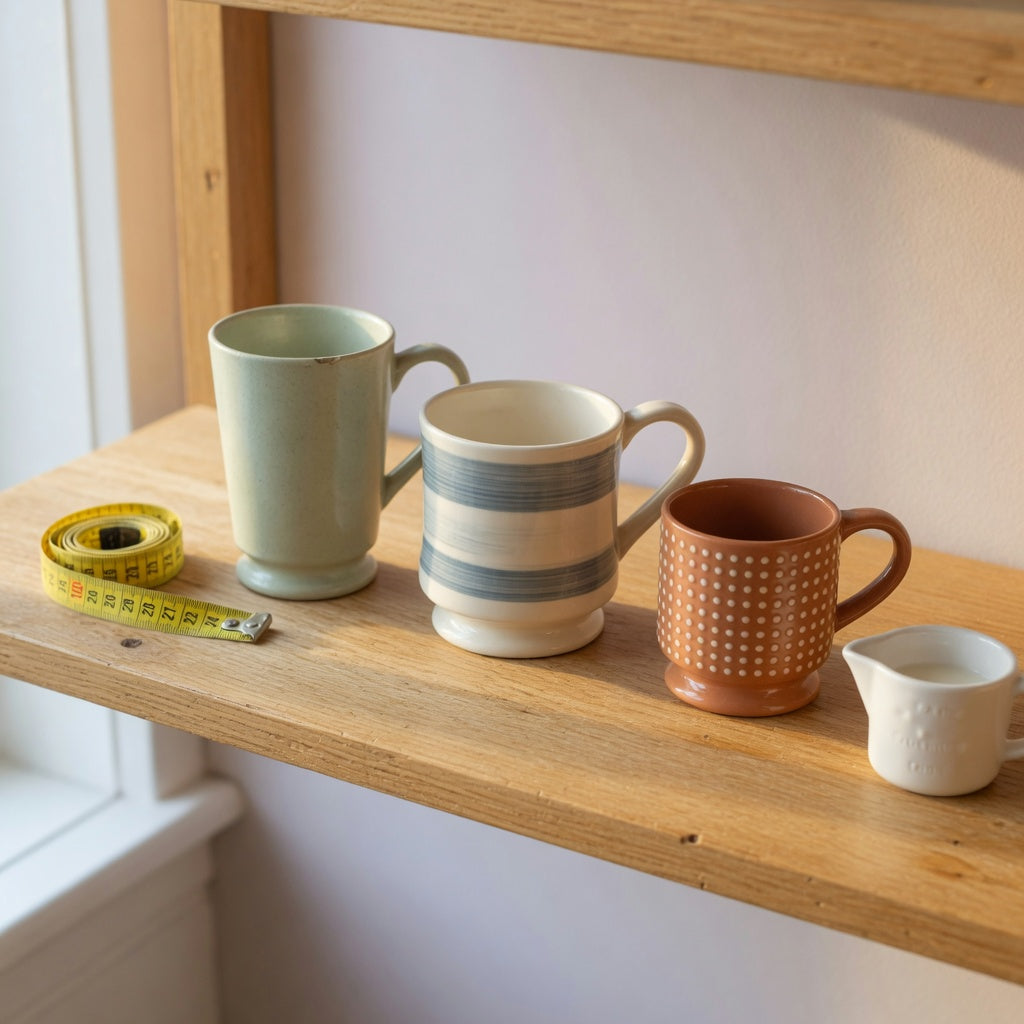
14 Oz Ceramic Coffee Mugs Storage Fit Guide: Shape vs Shelf
A 14 oz mug can still fail your cabinet, because handle projection and exterior height decide fit, not capacity. Here is how our 400 ml, 440 ml, and 480 ml shapes compare on real shelves and in rea...
Read more
Leave a comment
This site is protected by hCaptcha and the hCaptcha Privacy Policy and Terms of Service apply.