
14 Oz Ceramic Coffee Mugs Size Decision Guide: Smaller or Larger?
Reading time: about 9 minutes
Two mugs sat on a customer's counter last month, both listed at 14 oz, one a full inch taller than the other. She wanted to know which listing was lying. Neither was. One figure had been measured to the brim, the other to a fill line, and both were being judged against the 12 oz cafe cup she was trying to replace. That gap is why this 14 oz ceramic coffee mugs size decision guide starts with arithmetic instead of adjectives.
Fourteen U.S. fluid ounces converts to roughly 414 ml, because NIST defines the U.S. fluid ounce as 29.57353 ml. So a listing reading 400 ml, 440 ml or 480 ml is describing three genuinely different cups, not three spellings of one. For context, FDA's ceramicware guidance treats cups and mugs as small hollowware normally around 240 ml (8 fl oz), which makes a true 14 oz fill a generous everyday pour — and puts the whole 400–480 ml range far below the 1.1 litre large-hollowware threshold.
14 Oz Ceramic Coffee Mugs Size Decision Guide: Which Number Is the Listing Quoting?
Before comparing bodies, work out what the number on the page actually measures:
- Brim capacity — filled to the very edge with zero headroom. Popular in marketplace listings because it produces the largest figure.
- Comfortable fill — a centimetre or two below the rim, so you can add milk, stir, and walk without slopping.
- Lidded capacity — measured with the lid seated, where the lid skirt and gasket can take up part of the stated volume.
When a listing gives one number and no explanation, assume brim capacity until the seller tells you otherwise, then subtract headroom before you compare it to a cafe cup. That single step resolves most of the confusion behind the search term 14 oz ceramic coffee mugs.
Where our 400 ml, 440 ml and 480 ml mugs land against 14 oz
Our millilitre figures are exact; the ounce figures are conversions, rounded for convenience.
| Mug | Stated capacity | Approx. fl oz | Where it lands |
|---|---|---|---|
| The Flow | 400 ml | ~13.5 fl oz | Just under 14 oz |
| Morning and Night | 440 ml | ~14.9 fl oz | Closest to a literal 14 oz |
| The Rock | 480 ml | ~16.2 fl oz | Comfortably above 14 oz |
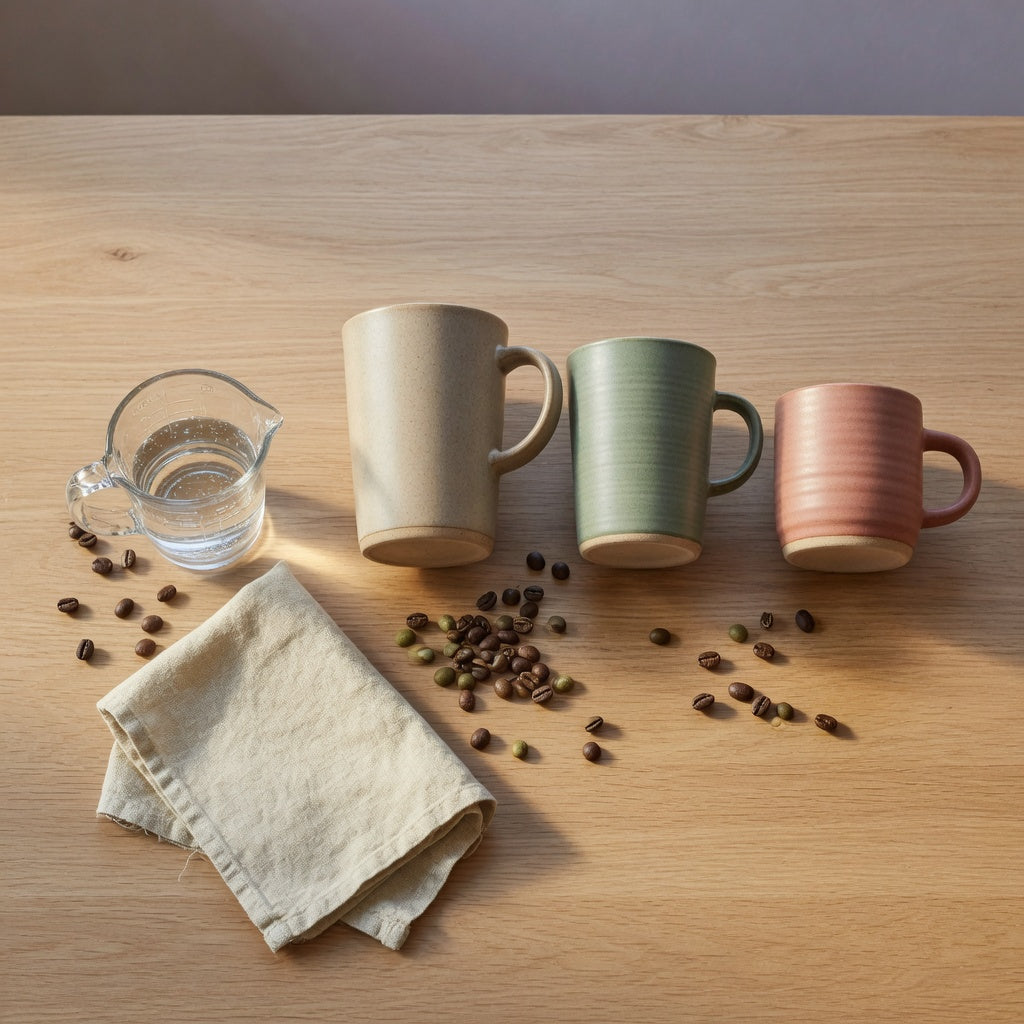
Two of those three are not 14 oz mugs, and pretending otherwise would make the choice harder rather than easier. If you would rather see the shapes than read a table, the unique coffee mugs collection shows the three bodies in one place, which is more useful than any single hero photo.
When the smaller 400 ml mug is the more practical buy
The Flow coffee and tea mug holds 400 ml, about 13.5 fl oz. That is a real step down from 414 ml, and it solves specific problems we hear about repeatedly:
- Your usual pour is 8–10 oz. A short black coffee in a much larger mug spends its final third lukewarm. Less air above the liquid means less heat to lose.
- Your cabinet is shallow. Interior shelf height is the single most common fit complaint customers bring us.
- You carry it one-handed up the stairs. 400 ml of coffee is roughly 400 g of liquid before the ceramic body is counted at all.
- The person using it has a smaller grip. Less reach across a hot wall, and less wrist strain on the second cup of the morning.
What it is not good for: iced coffee built over a full glass of ice, or a milk-heavy drink where foam needs room to sit above the liquid line. If your baseline is closer to cafe sizing, step down a level with our morning coffee ceramic mug comparison notes before you commit.
When a 440 ml mug is the honest answer to "14 oz"
The Morning and Night coffee and tea mug holds 440 ml, about 14.9 fl oz. This is the one for the shopper who measured her old cup, typed 14 oz into a search bar, and meant it: a single pour, enough headroom for a splash of milk, and a spoon that stays in the cup without dragging your knuckle through the coffee.
It sits in the useful gap between a modest morning coffee and a full-size latte, without sliding into oversized territory. That middle position is also why it tends to be the safest gift choice when you do not know the recipient's exact pour — it is large enough to feel generous and small enough not to overwhelm a small kitchen.
When 480 ml earns the extra cabinet height
The Rock coffee and tea mug holds 480 ml, about 16.2 fl oz. Buy it when the drink, not the habit, is the deciding factor:
- Milk-heavy coffees, where the foam should sit above the liquid rather than spill over the rim.
- Iced drinks, because ice displaces a startling amount of volume — a 480 ml mug filled normally with ice leaves far less drinkable liquid than the number suggests.
- Long desk sessions, where you want one fill to last and accept a slightly cooler final third.
The trade-offs are real. A filled 480 ml mug is heavier in the hand, wants more vertical clearance under a brewer spout, and is the least likely of the three to suit a car cup holder. It is also the wrong pick if your usual pour is under 10 oz — you will be pouring a small drink into a large vessel and paying for it in heat loss.
Handle opening, empty weight and the one-handed carry test
Capacity gets all the attention; the handle gets all the complaints. A full mug is gripped by a handle heated from the wall beside it, so opening width and the gap between handle and body decide whether your knuckles brush hot ceramic on the walk back to your desk.
These details are not standardised across listings and are almost never photographed. Ask the seller, or check the listing, for:
- Handle opening width in centimetres, and the handle-to-wall gap.
- Empty weight, so you can add the drink weight yourself.
- Exterior height and diameter — height matters most for shelves and brewer clearance.
- Foot diameter, because a narrow base under a tall body tips more readily on a soft surface.
- Whether the body stacks, since straight-sided mugs usually nest better than flared ones.
In our store we would rather answer five specific questions than have you guess from a photo, and our pre-order checklist for handled mugs walks through the same points in more detail.
Care marks are per piece, not per collection
Microwave and dishwasher wording is the most frequently mis-transferred specification in this category. A metallic handle, a gold rim band, or an overglaze decal can remove microwave safety on a body that is otherwise identical to a microwave-safe sibling. Read the care wording for the exact mug in your cart, not the collection page.
One safety note worth keeping separate from the rest: the California Department of Public Health advises against microwaving or dishwashing tableware that contains, or might contain, lead, because heat and detergent can worsen leaching. That guidance applies to suspect ware — it is not a statement that ceramic mugs in general leach. Our broader ceramic mug comparison for coffee and tea drinkers covers stain, chip and glaze behaviour over repeated washes.
Glaze, lead and what a "lead free" label does not promise
FDA sets an action level of 0.5 micrograms of lead per millilitre of leaching solution for cups and mugs, judged on any one of six units and tested with methods such as ASTM C738. That is a leach limit for the finished piece, not a statement about the glaze recipe. Cadmium has its own action levels — 0.5 micrograms per millilitre for small hollowware and 0.25 for large.
Two distinctions are worth carrying into any listing:
- Lead free versus lead safe. CDPH defines lead-free tableware as containing no lead, while lead-safe ware may contain some lead that does not leach above Proposition 65 levels. Ware above those levels can still be sold in California with a written warning.
- Decorative versus food-use ware. Under 21 CFR 109.16, ceramicware that looks suitable for food is treated as food use unless it carries a "Not for Food Use" warning or is physically disabled for contact. A mug-shaped object is not automatically a mug.
CDPH also notes you cannot judge lead by looking at a glaze, and that decoration sitting on top of the glaze is a higher concern than plain interior glaze. Coffee is acidic, which is part of why this category gets extra scrutiny. FDA has found imported pottery labelled "Lead Free" that still released extractable lead above action levels, so ask whether there is leach testing behind the label rather than accepting the sticker.
Frequently asked questions
Is a 14 oz ceramic mug the same as a 400 ml mug?
No. Fourteen U.S. fluid ounces converts to about 414 ml, so a 400 ml mug is roughly 13.5 fl oz. Our Morning and Night mug at 440 ml is the closer match at about 14.9 fl oz.
Is 14 oz enough for a latte?
Shoppers comparing milk-heavy drinks commonly look in the 14–16 oz range because foam needs headroom above the liquid. If you build a large latte with plenty of foam, the 480 ml Rock leaves more working room than the 400 ml Flow.
Can I microwave a ceramic mug that has a metallic handle or rim?
Metal trim and some overglaze decals generally rule out microwave use even when the ceramic body itself is microwave-safe. Check the care wording for the specific mug you are buying rather than for the collection it belongs to.
What is the difference between lead-free and lead-safe ceramic mugs?
Lead-free ware contains no lead; lead-safe ware may contain some lead but does not leach above California's Proposition 65 standards. Neither label replaces asking the seller whether leach testing exists for that piece.
How do I apply this 14 oz ceramic coffee mugs size decision guide when buying a set?
Pick the capacity your most common pour needs, then check handle opening, empty weight and stackability across the whole set. Matching-looking sets often hide small height differences that decide whether the mugs fit your shelf.
If you are still torn, work the checklist in this order: your usual pour in millilitres, the interior height of the shelf where the mug will live, and the handle opening you can grip comfortably when the mug is full. Then browse the unique coffee mugs collection and match capacity to routine, not to the biggest number on the page.
Read more

Best Tall Mugs for Home Office Desk Shelf Coffee: Compare First
A tall mug only earns its shelf space if it clears the gap, stays stable next to a keyboard, and still pours a useful cup after headspace. Here are the measurements, materials, and care trade-offs ...
Read more
Ceramic Mug Shapes Size Decision Guide: 200, 250 or 400 ml
A 400 ml mug is not automatically the better buy. We compare our 200 ml, 250 ml and 400 ml silhouettes by working volume, rim feel, handle clearance and real shelf fit, so the size call takes five ...
Read more
Leave a comment
This site is protected by hCaptcha and the hCaptcha Privacy Policy and Terms of Service apply.