
Ceramic Tea Mug Size Decision Guide: 390, 400 or 480 ml?
Reading time: about 9 minutes
An oversized mug looks practical on a product page, then may feel unnecessary beside a keyboard if you only fill part of it. A smaller mug can look easier to place on a kitchen counter, yet fail to hold your usual pour with the headroom you prefer. This ceramic tea mug size decision guide compares CoffeifyMug's current 390 ml, 400 ml and 480 ml choices so you can make the decision from your routine rather than from the word large or small.
We sell and handle this category, and our most useful comparisons begin with facts the current listings support. All three options are ceramic coffee and tea mugs. We compare their listed capacities, visible body forms and handle shapes in ordinary serving situations without turning those details into unsupported claims about performance.
How should you use this ceramic tea mug size decision guide?
Start with your own serving rather than an assumed drink standard. Listed capacity describes the vessel, but it does not tell us how much you personally pour or how much space you leave below the rim.
- Measure the amount you normally pour into your current mug.
- Allow for the headroom you prefer instead of matching your pour exactly to the listed capacity.
- Compare body form and handle geometry after identifying the capacities that can accommodate that amount.
| Current option | Listed capacity | Visible body form | Visible handle shape | Main decision cue |
|---|---|---|---|---|
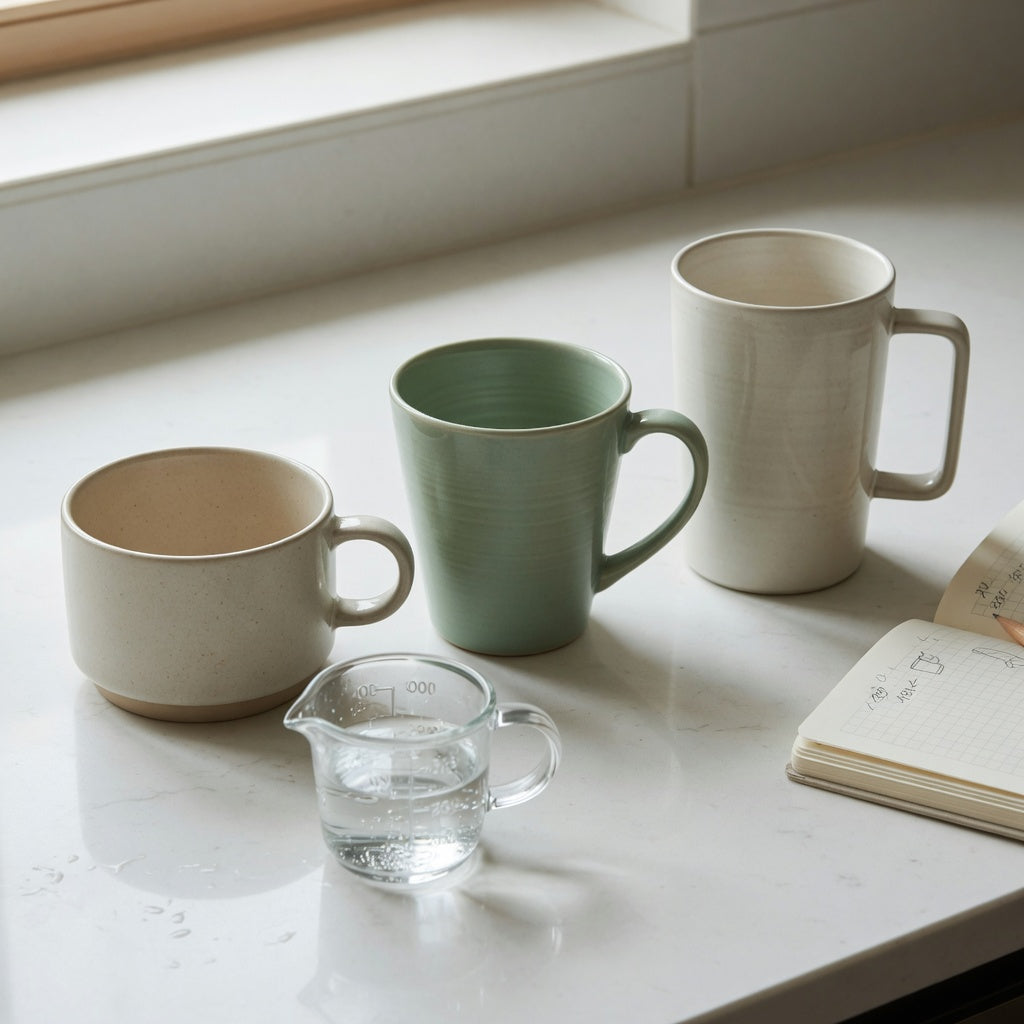
| Round Coffee Tea Mug | 390 ml | Low, wide round body | Compact circular loop | Smallest listed capacity |
| The Flow Coffee Tea Mug | 400 ml | Gently tapered, medium-height body | Open C-shaped handle | Middle listed capacity |
| Morning Night Coffee Tea Mug | 480 ml | Taller upright cylinder | Wide rectangular loop | Largest listed capacity |
The first comparison is easy to miss: 390 ml and 400 ml are only 10 ml apart. The 480 ml option adds 80 ml over the Flow and 90 ml over the Round. That means the Round-versus-Flow choice should usually give more weight to form and handle shape, while the Morning Night presents a clearer capacity change.
When is the 390 ml Round the practical smaller choice?
Start with the 390 ml Round Coffee Tea Mug if your measured serving fits within its listed capacity while preserving the headroom you like. Its low, wide round body also makes sense for shoppers who prefer a broader silhouette instead of a taller vessel.
The compact circular handle is an equally important part of this decision. If your current favorite mug has a close loop that fits your grip well, the Round offers the most similar visible handle style among these three. If compact loops tend to crowd your fingers, rings or knuckles, do not choose it solely because it has the lowest capacity.
There is another limitation: low and wide does not automatically mean the smallest desk or shelf footprint. Exact external dimensions are not part of this comparison. Choose the Round for its 390 ml capacity and visible proportions, not from an assumption that it will occupy the least surface area.
Why choose the 400 ml Flow instead of 390 or 480 ml?
The 400 ml The Flow Coffee Tea Mug is the middle option, but capacity alone is not its strongest reason to buy. It holds just 10 ml more than the Round. Its practical distinction is the combination of a gently tapered body and an open C-shaped handle.
This option makes sense if your usual pour sits around the 390-400 ml range and you prefer the Flow's more open handle geometry over a compact circular loop. It is also a reasonable gift starting point when the recipient has not requested the smallest or largest current capacity, although mug shape and grip remain personal choices.
The Flow is not the best answer if your only goal is a meaningfully larger serving than the Round. Ten additional milliliters is a narrow difference. If your measured pour needs more than 400 ml, or you specifically want more room per serving, the 480 ml option creates a clearer step up.
When does the 480 ml Morning Night earn the extra capacity?
The 480 ml Morning Night Coffee Tea Mug is the practical choice when your measured pour exceeds what you want to place in a 390 ml or 400 ml vessel. It provides 80 ml more listed capacity than the Flow and 90 ml more than the Round.
That extra capacity can reduce refill frequency only if you actually pour more into each serving. Filling a 480 ml mug with the same amount you place in a 390 ml mug does not create a refill advantage. This sounds obvious, but it is the main reason we ask shoppers to measure their current pour before moving to the largest option.
The Morning Night also has the tallest, most upright visible body of the three, paired with a wide rectangular loop. That combination suits shoppers who intentionally want a more substantial vessel and prefer a rectangular handle profile. It is not the most practical choice for someone seeking a compact visual form or who already leaves much of a smaller mug unused.
How do body form and handle shape change the capacity decision?
Capacity tells you how much volume is listed. It does not establish exterior width, height, base diameter or internal handle clearance. In our experience, online mug comparisons become more reliable when shoppers separate those variables instead of treating a higher capacity as a larger version of the same design.
- Round: a low, wide ceramic body paired with a compact circular handle.
- Flow: a gently tapered body paired with an open C-shaped handle.
- Morning Night: a taller upright body paired with a wide rectangular handle.
Handle terminology matters here. The outer shape of a handle is not the same thing as its inner finger clearance, and product photos are not measurements. An open C shape may look more familiar to someone who uses a conventional side grip, while a rectangular loop may appeal to someone who prefers straighter edges. Neither shape is universally more comfortable.
Use a mug you already own as a physical reference. Note how many fingers you place through its handle, whether your knuckles touch the body and whether you support the base with your other hand. Then compare that known grip with the visible handle geometry on the product pages. This gives you a more useful starting point than guessing from capacity alone.
Which size fits a desk, kitchen counter or gift routine?
| Reader situation | Why it matters | Practical starting option | Trade-off to check |
|---|---|---|---|
| Small office desk and a measured pour at or below 400 ml | Unused capacity adds no benefit to the serving | Round or Flow | Low and wide is not necessarily narrower; exact footprint still matters |
| Long work session with a pour above 400 ml | The additional 80-90 ml can be used in one serving | Morning Night | The taller, larger visible form may feel more prominent beside work equipment |
| Kitchen counter use with a familiar compact-loop grip | Handle familiarity may matter more than a 10 ml capacity difference | Round | The compact loop may not suit every hand |
| Everyday use with a preference for an open C handle | The Flow changes handle and body form without a major capacity jump | Flow | It does not provide much more volume than the Round |
| Gift recipient whose preferred serving size is unknown | A middle capacity avoids assuming they want the largest option | Flow | The recipient may value the Round or Morning Night silhouette more |
If the recipient or household needs a different visual style, do not force one of these three capacity choices. The unique coffee mugs collection provides a broader next step for comparing current ceramic forms.
Where does this comparison stop being useful?
These listings are presented as ceramic coffee and tea mugs for ordinary serving. This guide is not evidence for travel use, exact shelf fit, cup-holder compatibility or any feature that is not stated on the relevant product page. A shopper who needs a purpose-built travel vessel or an exact external measurement should choose from products that explicitly document those requirements.
The guide also cannot promise that a visible handle shape will fit every hand. If handle clearance is your deciding factor, compare the product page with a mug whose grip you already know. Do not infer exact measurements from separately scaled photographs.
A two-minute size check before ordering
- Measure your usual pour. Use the amount you actually serve, not the maximum amount you think you might want someday.
- Add your preferred headroom. Do not assume you will fill the mug to its full listed capacity.
- Compare the capacity gaps. Round to Flow is 10 ml; Flow to Morning Night is 80 ml; Round to Morning Night is 90 ml.
- Match the handle. Choose among the compact circular loop, open C shape and wide rectangular loop using your current mug as a reference.
- Check the setting. Consider the visible body form beside your keyboard, on your kitchen counter or in the recipient's usual mug space.
A larger listed capacity is useful only when your actual serving uses it. A smaller option is practical only when its body and handle still suit the way you hold and place the mug.
Frequently asked questions
Is 390 ml very different from 400 ml in everyday use?
The listed difference is only 10 ml. If your normal pour is close to the limit, that amount may affect your preferred headroom, but most shoppers should also compare the Round's low body and compact loop with the Flow's tapered body and open C-shaped handle.
Will a 480 ml ceramic mug mean fewer refills?
Potentially, if you use the extra capacity. The Morning Night lists 80 ml more than the Flow and 90 ml more than the Round. If you pour the same amount into every mug, changing vessel size will not reduce the amount you need to refill.
Which ceramic tea mug size works best on a small desk?
This ceramic tea mug size decision guide does not name a universal desk winner because listed capacity is not an external footprint measurement. Start with the Round or Flow if your serving fits within 390-400 ml, then decide whether a low, wide body or a tapered medium-height body better suits the space around your keyboard and notebook.
Which handle shape is better for larger hands?
The Flow's open C-shaped handle and the Morning Night's wide rectangular loop are the first options to compare if a compact circular loop usually feels restrictive. We cannot guarantee hand fit from visible shape alone, so use the handle on your current mug as a reference for finger placement and clearance.
Can I use these ceramic mugs for both coffee and tea?
The current listings present all three as coffee and tea mugs, and each is listed as ceramic. This article compares them as ordinary serving vessels rather than making beverage-specific brewing or performance claims.
Next step: Write down your usual measured pour, preferred body profile and familiar handle shape. Choose the Round for 390 ml with a low, wide form, the Flow for 400 ml with a taper and open C handle, or the Morning Night for 480 ml with a taller body and rectangular loop. If none matches all three answers, continue the comparison in the unique mug collection linked above.
More from our blog
Read more
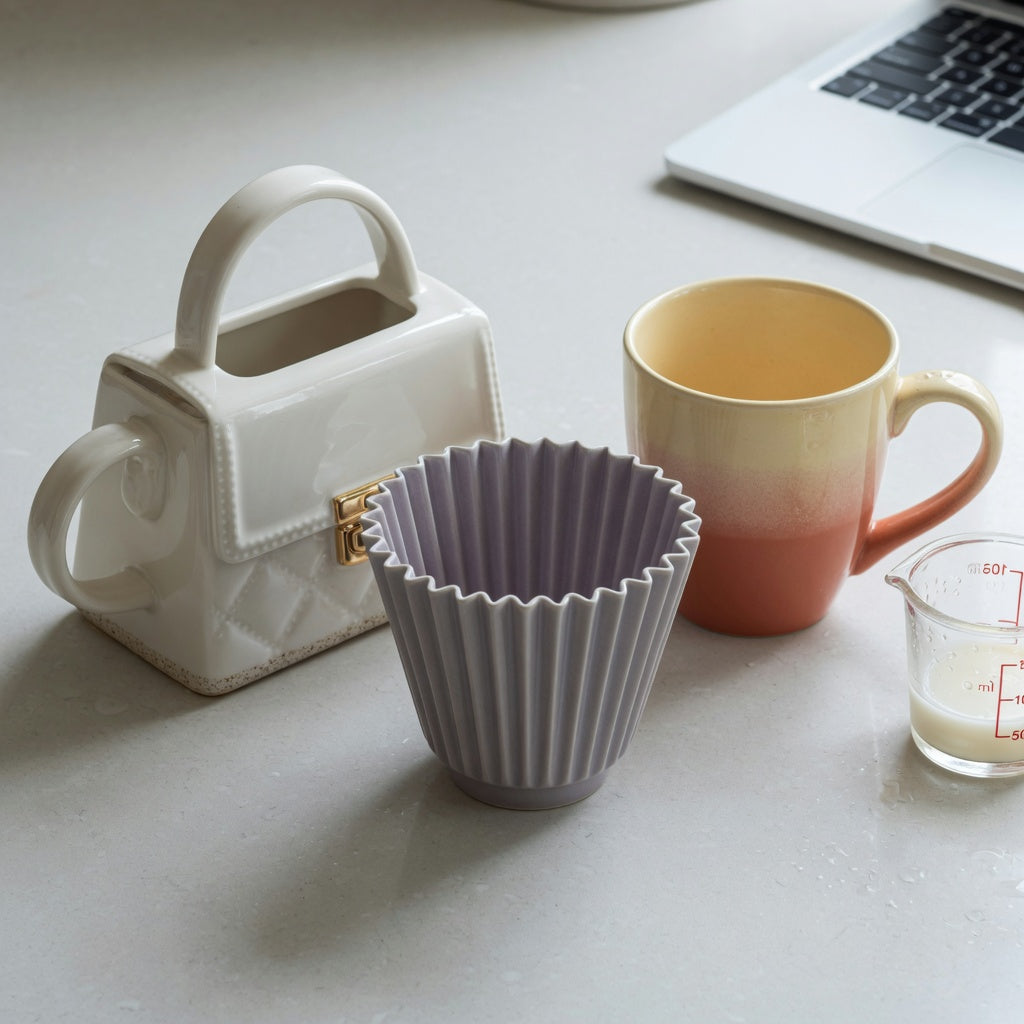
Cute Ceramic Coffee Mugs Size Decision Guide: 400-480 ml
Compare CoffeifyMug's current 400, 440, and 480 ml ceramic options by measured pour, desk footprint, cabinet space, gifting, and care. This guide also explains where capacity alone can mislead.
Read more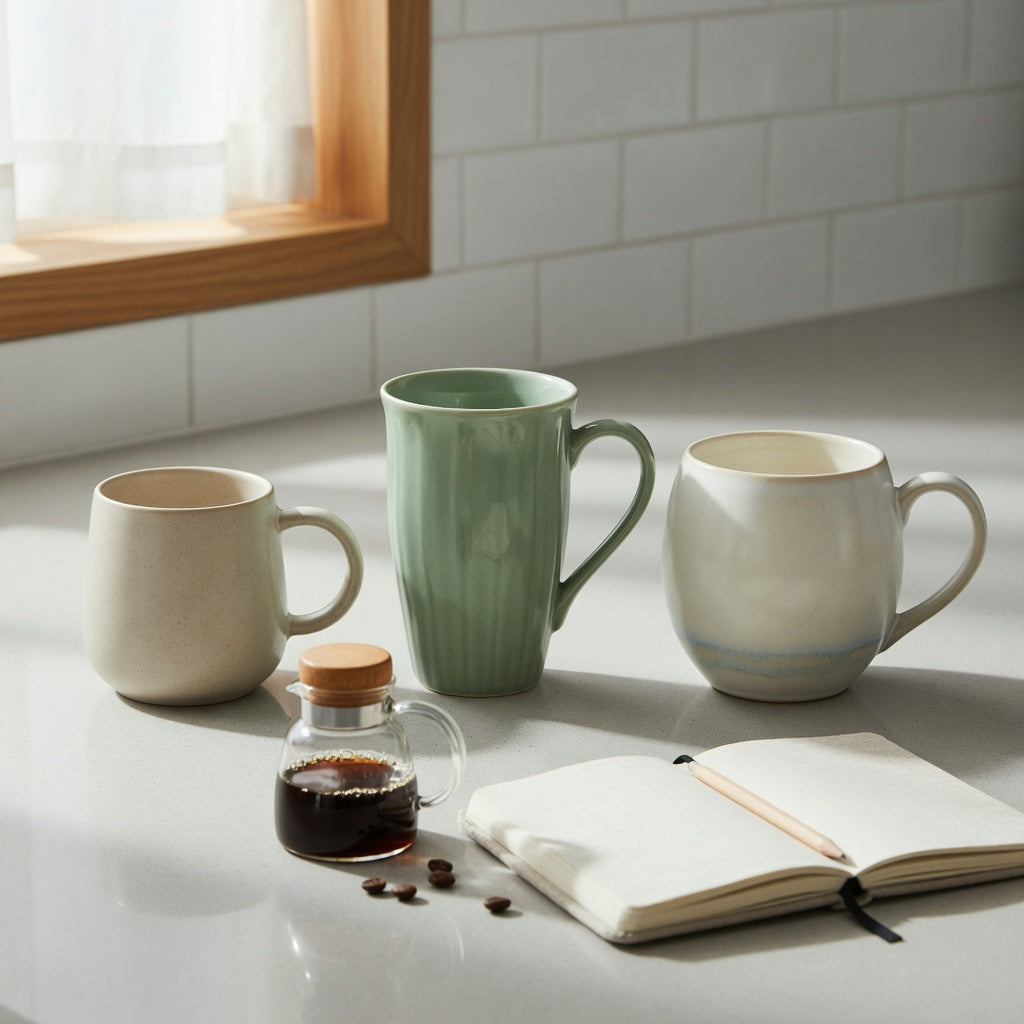
Ceramic Coffee Mug With Handle Size Decision Guide: 12, 14 or 15 oz?
Compare CoffeifyMug's current 12 oz, 14 oz, and 15 oz ceramic mugs by pour routine, visible handle form, vessel shape, storage checks, and gifting context. This guide also explains what listed capa...
Read more
Leave a comment
This site is protected by hCaptcha and the hCaptcha Privacy Policy and Terms of Service apply.