



Ceramic Mug Shapes Morning Routine Product Shortlist Guide: 200–400 ml
Reading time: about 10 minutes
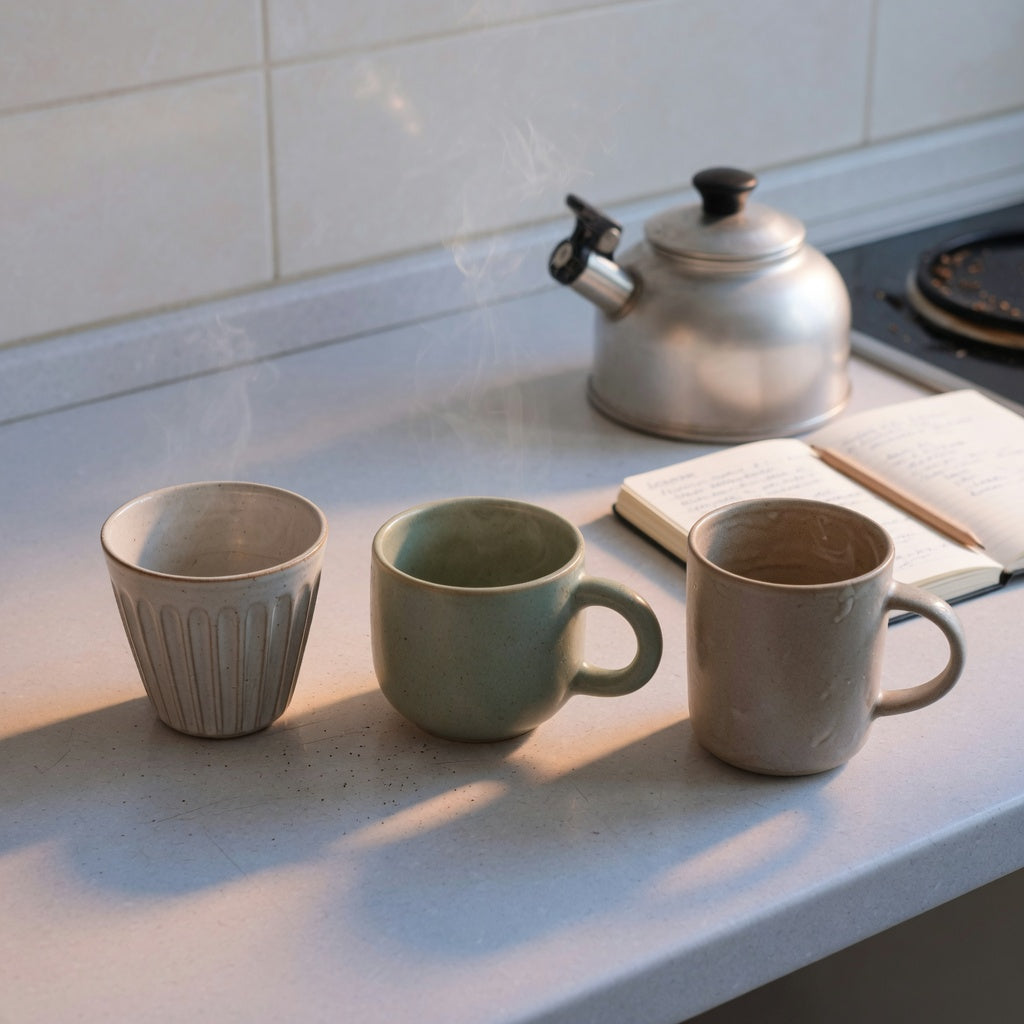
Three mugs sit on the shelf in our stockroom: a 200 ml pleated cup, a 250 ml ball-handled mug, and a 400 ml mug. Side by side they look like small variations on one idea. Filled at 6:45 in the morning, they behave like three different tools — one is a short stop, one is a standard pour, one is a commitment that has to survive a meeting.
This ceramic mug shapes morning routine product shortlist guide is deliberately narrow. We are not ranking every silhouette on the market. We are matching three listed capacities to the way a weekday morning actually runs: how long you stand at the counter, how much you pour out of habit, and whether you will refill before lunch. If you would rather see the whole range first, browse the unique coffee mugs collection, then come back here with two numbers in hand.
What three numbers decide the shortlist before you look at a single shape?
Write these down before you open a product page. They eliminate more options than any styling photo.
- Usual pour. Roughly 200 ml for a short first cup, 250 ml for a standard coffee, 400 ml for a long desk morning. If you genuinely do not know, pour your normal amount into a measuring jug once. Two minutes, and it settles most of this.
- Time at the counter. Under five minutes, five to fifteen, or a mug that travels to a desk and has to come back empty.
- Refill tolerance. None, one refill, or "it has to last until the next meeting."
Work from listed capacity, not a guessed café size. NIST’s approximate conversion is 1 fl oz = 29.57 ml, which puts 200 ml at about 6.8 fl oz, 250 ml at about 8.5 fl oz, and 400 ml at about 13.5 fl oz. FDA guidance describes cups and mugs as small ceramic hollowware that normally, but not exclusively, holds about 240 mL, with mugs generally having cylindrical sides and cups generally curved sides. Treat that 240 mL as a reference point, not a rule that every morning needs it.
The shortlist at a glance: a ceramic mug shapes morning routine product shortlist guide in one table
| Listed capacity | Mug | Morning it fits | Skip it if |
|---|---|---|---|
| 200 ml | Pleated Coffee & Tea Cup | Short tea, concentrated coffee, or a milk drink finished standing at the counter | You refill twice before 9 a.m. or your only morning drink is a long one |
| 250 ml | Ball Handle Coffee & Tea Mug | One standard coffee with a defined grip point | Shelf gap or spout clearance is tight, or you need to check handle room for large hands |
| 400 ml | The Flow Coffee & Tea Mug | A desk block, a slow start, fewer trips to the kettle | You drink espresso-size pours, or your dish rack is already crowded |
The table is the fast version. The sections below explain the trade-off behind each row, because "choose or skip" depends on your kitchen and your hands, not on a ranking.
Pick the 200 ml Pleated cup for a short first cup — skip it if you refill twice
The Pleated Coffee & Tea Cup is listed at 200 ml. Choose it when your first drink of the day is short and hot: a small tea, a concentrated coffee, a milk drink you finish while the kettle is still warm. Portion control is the practical feature here. A 200 ml cup makes it harder to pour a 12 oz habit and then let half of it go cold while you answer email.
Skip it if you refill twice before 9 a.m., or if your only morning drink is a long coffee. Look closely at the exterior too. A pleated body has more vertical grooves than a plain cylinder, which means more edges to pass over when you hand-dry. That is not a defect, just a slower towel pass. Check the interior and rim in the listing photos rather than assuming the inside matches the outside texture.
Tea-first mornings follow a different rhythm; our ceramic tea mug morning routine shortlist goes deeper on opening width and slower sipping.
The 250 ml Ball Handle mug earns its space when grip matters more than volume
The Ball Handle Coffee & Tea Mug is listed at 250 ml — close to that 240 mL common reference, which is why it reads as the "standard coffee" shape to a lot of shoppers. The ball handle is the feature you are actually buying. It gives a distinct, rounded grip point instead of a flat strap.
Choose it if you want one fill to cover a normal coffee and you like a defined place for your fingers to land. Skip it if your cabinet shelf is low, your brewer spout sits close to the counter, or you have large hands and wear rings. A projecting handle needs clearance, and handle openings vary between shapes. Measure the shelf gap and the space under the spout before you blame the mug. If finger room is the deciding question, ask us about the handle opening on the current listing — we would rather answer that than have you guess from a photo.
For the longer version of that conversation, see our ceramic coffee mug with handle morning routine guide.
Is the 400 ml Flow the right shape for a desk morning?
The Flow Coffee & Tea Mug is listed at 400 ml, roughly 13.5 fl oz. That is a different morning contract: fewer trips to the kettle, not a daintier sip. Choose it for a long desk block, a slow start with a book, or any morning where you pour once and would rather not get up again.
Skip it if you drink espresso-size pours, if you like a hot drink to stay hot to the last mouthful, or if your dish rack is tight. A full 400 ml mug is meaningfully heavier in the hand, and the added height can foul a low spout. If you routinely leave an inch in the bottom, you are carrying more than you drink and a 250 ml mug would serve you better. We publish the capacity but not a full silhouette spec sheet, so check the listing photos for rim and body profile before you commit.
What do rim, wall, and handle actually change about the sip?
Silhouette gets photographed. Rim, wall, and handle do the daily work. We cannot rank named shapes as sweeter or more aromatic — that claim needs controlled side-by-side tasting at equal volume, wall thickness, and clay body, and we have not run that test. Here is what you can judge yourself in the first week:
- Rim. A rounded or slightly flared lip tends to feel softer against the mouth; a thin, clean edge feels more precise. Run a fingertip around the rim when the mug arrives — a rough patch or a glaze gap is the thing worth catching immediately.
- Wall. A thicker wall feels steadier and slows heat moving through the side, but the open top still vents heat. A thick wall is not a lid. Preheating with hot tap water for thirty seconds does more for temperature than a shape name does.
- Handle. Two fingers should pass through without pinching, and your thumb should land somewhere natural. Ball, C, and D handles change where pressure sits on your hand.
- Opening. A wider mouth gives room for latte art and lets aroma reach you, and it also exposes more surface to air. A narrower mouth suits tea and slow sipping.
- Interior. Rounded inside walls are easier to see and wipe. Faceted or square bodies deserve a close look at the inside corners and the foot ring, where residue and rinse water sit.
Heat is where product copy usually outruns the evidence. More exposed surface area and thinner walls increase heat flow, and an open top adds evaporation. If a seller claims a specific shape stays hotter, ask for measurements taken at equal volume and wall thickness.
What do we check on a listing before calling a shape a good buy?
In our experience, most returns come from fit and clearance rather than from glaze color. We keep comparisons to listed capacity, visible silhouette, and handle geometry because those are the details we can state without guessing about a specific potter's clay or firing schedule. The rest you should confirm on the product page you are actually buying:
- Capacity and fill line. "Large" is not a measurement. 200 ml, 250 ml, and 400 ml are.
- Rim diameter and handle opening. These two numbers decide whether a mug feels cramped or secure in your hand.
- Food-use statement. FDA’s Compliance Policy Guide Sec. 545.450 sets a lead guideline of 0.5 micrograms per milliliter of leaching solution for ceramic cups and mugs, and cites ASTM C738 among the test methods. Leaching is a glaze-and-firing question, not a silhouette question, and decorative ware is not a drinking vessel.
- Care instructions. If the page does not say dishwasher or microwave safe, ask before the first cycle. Do not infer it from the shape or the sheen of the glaze.
- Clearance. Height under the spout, shelf gap, and how far the handle reaches. A mug that fits the cabinet may not fit the brewer.
One honest limitation: plenty of routines need two shapes, not one. A 200 ml cup for the first quiet ten minutes plus a 400 ml mug for the desk is a common pairing in our order notes, and it beats forcing a single mug to do both jobs. Buying as a gift? Keep the return window in mind — handle comfort is the hardest thing to judge from a photograph.
Frequently asked questions
Is 250 ml enough for a regular coffee?
For many people, yes. 250 ml is about 8.5 fl oz, close to the 240 mL common reference in FDA guidance for cups and mugs. It is not enough if you normally drink from a 16 oz travel mug or want one fill to carry you through a long meeting.
Does a wider ceramic mug keep coffee hotter?
Not automatically. A wider opening exposes more surface to the air, and an open top loses heat through evaporation. Wall thickness, preheating the mug, and whether you use a lid matter more than the shape name. We do not rank shapes as hotter without side-by-side measurements at equal volume.
How do I choose between the Pleated 200 ml, the Ball Handle 250 ml, and The Flow 400 ml?
Use this ceramic mug shapes morning routine product shortlist guide as a filter: the 200 ml Pleated cup suits a short tea or concentrated coffee you finish at the counter, the 250 ml Ball Handle covers a standard one-mug coffee with a defined grip point, and the 400 ml Flow is for a long desk morning with fewer refills. If you need two, pair the small cup with the large mug and skip the middle.
Can a handleless or narrow ceramic cup work for hot coffee?
Some drinkers prefer it, especially for tea in a yunomi-style cup where the wall is meant to warm your hands. With very hot coffee, a handle gives more control and keeps fingertips off the body. If you have limited grip strength or sensitive fingertips, choose a handled mug first and treat handleless as a second cup.
What food-safety detail matters most on a ceramic mug?
A clear food-use statement matters more than shape. FDA guidance sets a lead guideline of 0.5 micrograms per milliliter for ceramic cups and mugs and cites ASTM C738 among the extraction test methods. Decorative or collectible ware should not be used for drinking unless the seller confirms food-use status for that specific piece.
Which one should I start with if I only buy a single mug?
Start with the capacity you actually finish, not the one you wish you drank. Most first-time buyers who describe a normal weekday coffee land on the 250 ml Ball Handle. If you already know you refill before lunch, go straight to the unique coffee mugs collection with your usual pour and your shelf clearance measured, and pick from there.
More from our blog
Ready to pick your mug? Two ways to save on today's order:
Ordering 1–3 mugs? Get an extra 10% off your 1st order with code 10_OFF Apply 10% Off & Shop Wooden-Handle Mugs →
Gifting 4+ mugs? Buy 3, Get the 4th Free applies automatically at checkout (no code needed; offers do not stack) · Free standard shipping (Nov pre-Christmas delivery: 15–20 calendar days US) · Free replacement if chipped in transit.
Popular mug buying guides: Ceramic Tea Cups & Infuser Mugs · Ceramic Mugs with Lids Compared · Wooden-Handle Tea Infuser Mugs Compared · Christmas & Secret Santa Mugs 2026 · Espresso & Cortado Cups Guide · Cup & Saucer Gift Sets · All 25 Mugs Spec Table · Mug Size Guide · Shipping & Promo FAQ
FIRST ORDER 10% OFF (CODE: 10_OFF) · OR BUY 3, GET THE 4TH FREE


Read more
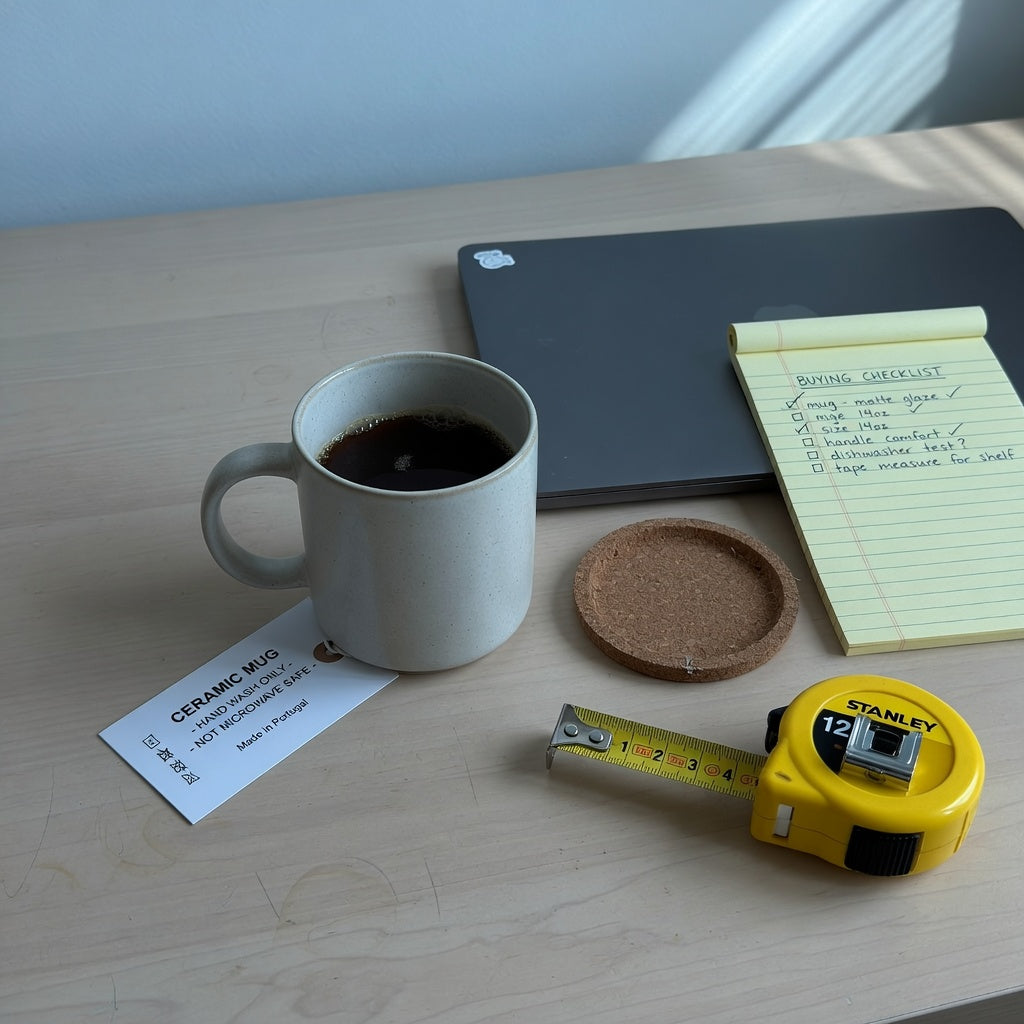
14 Oz Ceramic Coffee Mugs Home Office Practical Purchase Checklist
A 14 oz label hides the details that decide whether a mug works at a desk: brim capacity versus working fill, handle clearance, weight, care limits, and food-contact claims. This checklist turns th...
Read more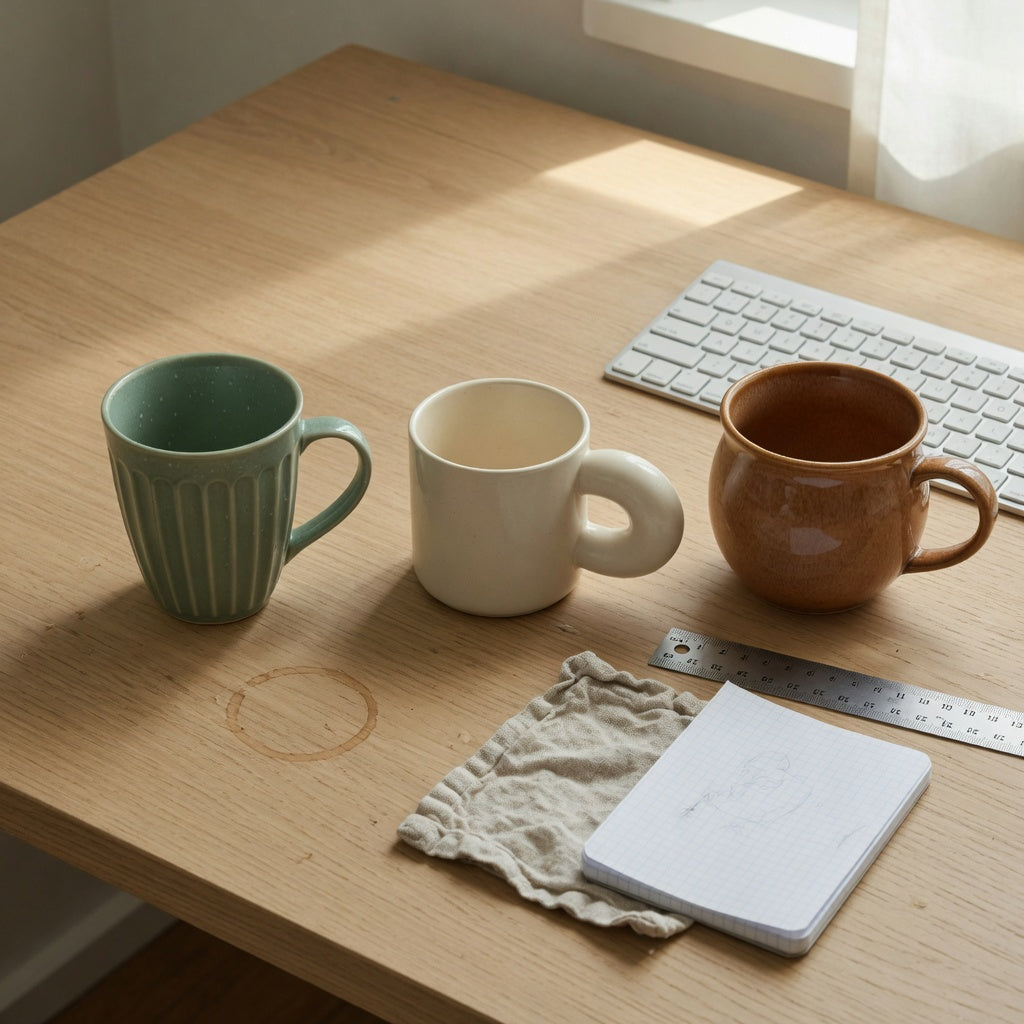
Ceramic Mug Shapes Home Office Practical Purchase Checklist
A shape-by-shape buying checklist for ceramic mugs that fit a real home-office desk, a machine spout and your actual grip, with capacity conversions, rim and handle tests, and the limits of what a ...
Read more
Leave a comment
This site is protected by hCaptcha and the hCaptcha Privacy Policy and Terms of Service apply.