



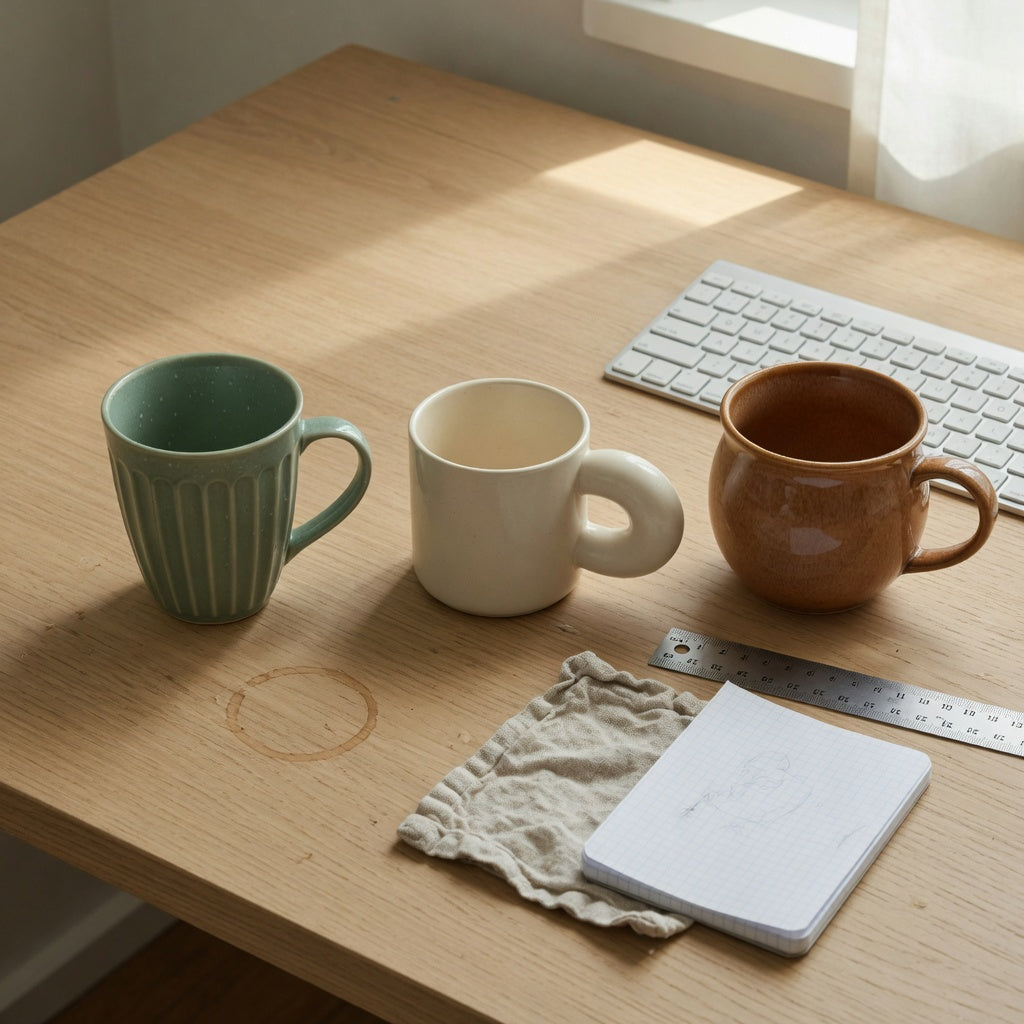
Ceramic Mug Shapes Home Office Practical Purchase Checklist
Reading time: about 11 minutes
A 400 ml mug can look perfect in a product photo and still be the wrong mug for a desk where the monitor sits 30 cm from the keyboard. The tall body blocks the screen edge, the base crowds the mouse mat, and the handle leaves two fingers of room. That is why this ceramic mug shapes home office practical purchase checklist starts with a tape measure, not a mood board: silhouette, capacity, rim, handle and clearance decide whether a mug earns its spot beside the keyboard.
We pack, photograph and ship these mugs every week, and the questions from people building a home office are consistent. They are not asking which shape is prettiest. They are asking which one survives a Monday of calls, a refill habit, and a narrow gap between keyboard and monitor stand.
What the cup-versus-mug wording does and does not tell you
Retail names are loose. A cup can be a bowl and a mug can be almost anything with a handle attached. The one place the terms get pinned down is food-contact guidance: the FDA describes cups and mugs as small ceramic hollowware used for beverages such as coffee or tea above room temperature, normally, but not exclusively, holding around 240 ml (8 fl oz) and made with a handle. In that same guidance, a cup normally has curved sides while a mug has cylindrical sides.
Two useful takeaways. First, 240 ml is a default, not a rule; our own range runs from 200 ml to 400 ml for exactly that reason. Second, the word mug on a product page tells you almost nothing about silhouette. You have to read the profile.
Convert before you compare. NIST gives 1 fluid ounce as 29.57 ml, so a US-labelled 8 oz mug is about 237 ml, our 200 ml pleated cup is roughly 6.8 fl oz, the 250 ml ball-handle mug lands near 8.5 fl oz, and the 400 ml Flow is close to 13.5 fl oz. Skipping that conversion is how people replace a mug and end up with less capacity than they had.
Which silhouette suits the drink you actually make?
Five profiles cover nearly everything sold as a ceramic coffee mug, and each one changes how you drink far more than how the drink tastes.
- Straight cylinder. Flat walls, no shoulder, easy to judge fill level, stores tidily. The wide open top also loses heat fastest and gives you no narrowing to gather aroma.
- Belly or barrel. Widest at the middle, narrower at the rim. Sits well in a cupped hand, feels stable when full, and the tightened opening holds a little more warmth around the surface.
- Tapered or flared. Narrow base, wider rim. Stable on a saucer and pleasant to sip from a thin lip, but a broader surface cools faster and sloshes if you carry it back from the kitchen.
- Bowl-like latte cup. Wide and shallow. More surface for milk texture and latte art; the trade-off is heat loss and a footprint that eats desk space.
- Handleless. A yunomi-style cup suits tea you sip warm. With fresh hot coffee there is nothing between your palm and the wall, so this is not the right shape for a scalding brew.
Specialty-coffee training commonly ties espresso to a cup up to about 90 ml and milk drinks such as cappuccino, flat white and latte to the 150–240 ml band, with different milk and foam ratios. That is why a 200 ml cup is a sensible short milk drink or tea cup, a 250 ml mug covers an everyday coffee, and a 400 ml mug is a long-drink vessel rather than an all-day default.
Sellers often say a particular silhouette makes coffee sweeter, more acidic or more floral. We have not found controlled evidence for that, and neither have the specialty sources we trust. Temperature, fill level and opening size move perceived flavour far more than the curve of a wall does. If you want to see how different those profiles look side by side, our collection of unique coffee mugs shows all three of ours together.
The ceramic mug shapes home office practical purchase checklist: six measurements
Get a tape measure out before you fall for a profile. These are the six numbers we ask buyers for when they are setting up a desk.
- Usable capacity, not brim capacity. Leave 15–20 mm of headroom, about a thumb joint, and you are pouring noticeably less than the listed number.
- Total height including the handle. A handle that rises above the rim changes which cupboard shelf or desk nook the mug fits.
- Base diameter against your desk gap. Measure the space between keyboard and monitor stand first. A base wider than that gap means the mug lives somewhere else.
- Spout clearance. Measure from the drip tray of your coffee machine to the spout, then subtract 20 mm. That is your maximum mug height for brewing straight into the cup.
- Handle opening. Measure the gap, not the outer handle size; those two numbers differ by roughly the thickness of the handle itself.
- Interior transitions. Run a fingertip inside. Sharp corners where the wall meets the base, or deep grooves on the inside, are where coffee oils and tea tannin collect.
Handle geometry: how many fingers, and where does your thumb land?
Handle shape gets less attention than body shape and causes more disappointment. There is no published ergonomic standard for mug handles, so the honest test is your own grip with the mug loaded.
Fill it with water to the level you would really use, then hold it one-handed for thirty seconds. You are checking three things: whether two fingers pass through the loop without pinching, whether your thumb has a flat or curved spot to rest on, and whether your knuckles clear the wall when the drink is hot.
The ball-shaped handle on our Ball Handle 250 ml mug presents a rounded grip; whether it suits your fingers depends on the handle opening, which the live listing should confirm. A C- or D-shaped handle offers more thumb support and hangs better on a hook or a mug tree. If the handle is the part you keep agonising over, our guide to ceramic coffee mugs with handles for home offices goes further into loop shapes, thumb rests and grip.
Rim thickness, flare, and the drip line down the outside
Most why-does-this-mug-drip complaints trace back to the rim. A thick, rounded rim tends to hold a bead of liquid that escapes down the outside when you tip the cup back; a thinner, slightly flared lip tends to release the last drop into the cup instead. Potters call it a pour lip, and it is a design feature rather than decoration.
Two quick checks:
- Run a fingertip right around the rim. Wobble, grit or an unglazed patch is a defect, not character.
- Look at the rim in profile. A gentle outward flare pulls liquid forward; a rolled, heavy rim pushes it sideways.
Flared rims are also cooler on the lip with a very hot drink, because a thin edge sheds heat quickly. The cost is the same wide opening releasing heat from the whole surface, so a flared mug of coffee goes tepid sooner than a narrow-mouthed mug of identical volume. If you refill often and drink slowly, a narrower opening usually wins.
Stacking, spout clearance, and the desk space you actually have
A home office is not a kitchen shelf. The mug competes with a mouse, a notebook and a charging cable. Three things worth measuring: footprint including handle overhang, stack height if you keep two or three, and clearance under the machine spout or kettle if you brew at the desk.
Our largest shape, The Flow 400 ml mug, is the one to measure carefully. At 400 ml it suits a long black coffee or a big morning tea you do not want to refill, but it is also the mug most likely to foul a low spout or crowd a small desk mat. It is not the right pick if you usually drink 150 ml and let the rest go cold. Check the live listing for its overall height and opening diameter rather than judging from the photo; packshots are shot on white with no scale reference, which is exactly how people end up surprised.
If your habit is tea through the morning rather than one coffee at nine, a smaller cup you refill is often the more practical answer than a large mug that goes cold half-full. We covered that trade-off in our guide to ceramic tea mugs for home offices.
Where decorative shapes stop paying rent
Faceted, square and heavily sculpted bodies photograph beautifully and are genuinely lovely to hold, for some people. The costs are specific and worth naming:
- Inside corners. Square or faceted interiors trap residue at every transition. A rounded interior that sweeps smoothly from wall to base wipes clean in one pass.
- Pleats and grooves. Our Pleated 200 ml cup has a pleated name and silhouette. Check the listing photos for how deep those folds run and whether the interior is smooth. Decoration outside is free; decoration inside is a cleaning tax you pay daily.
- Small loops on wide bodies. A tiny handle on a heavy mug means a two-finger grip on a full load, which is when drops happen.
- Stability. A sculpted base with a small contact patch tips more readily on a soft desk mat than a broad flat foot.
None of that makes decorative shapes a bad buy. A sculptural mug is often the one you keep on the desk because you like looking at it. Buy it knowing the cleaning trade-off. Our post on ceramic sculptural mugs for home offices covers that balance in more depth.
Glaze, clay body, and the food-contact questions worth asking
Shape does not change what leaches out of a glaze. Glaze chemistry and firing do, so that is where your questions should go.
For ceramic cups and mugs intended for food use, FDA compliance guidance sets a lead guideline of 0.5 micrograms per millilitre of leaching solution in any single unit of six tested. The referenced method, ASTM C738, uses acetic acid and is described as a severe test unlikely to be matched in ordinary use. The FDA also states there is no known safe level of lead exposure, with developing fetuses, infants and children particularly vulnerable, which is why decorative-only ware should never become the morning mug.
Clay body matters separately from silhouette. Vitrified stoneware and porcelain are dense and take glaze well; earthenware stays porous and depends on a sound glaze to hold liquid. If a listing does not state food-safe use, which body it is made from, or test results, ask before checkout. We would rather answer that email than have you guess.
Matching our three capacities to a working day
Here is how the three shapes in our range line up, limited to what we can actually verify: listed capacity and the silhouette the name points to.
| Shape | Listed capacity | The desk job it suits | Verify before you buy |
|---|---|---|---|
| Pleated Coffee & Tea Cup | 200 ml (about 6.8 fl oz) | Short milk drinks, or tea you plan to refill; smallest listed capacity of the three | Depth of the pleats and whether the interior is smooth |
| Ball Handle Coffee & Tea Mug | 250 ml (about 8.5 fl oz) | The everyday coffee at roughly an 8 oz pour; rounded ball handle changes the grip | Handle opening size against your own hand |
| The Flow Coffee & Tea Mug | 400 ml (about 13.5 fl oz) | Long black coffees and big teas where you would rather not get up mid-task | Height for spout clearance; base diameter against your desk gap |
Start with capacity, then confirm the rest on the live listing: wall thickness, opening diameter, dishwasher guidance and the food-contact statement. Those details can shift between production runs, and a blog post should never be your only source for them.
Frequently asked questions
Do ceramic mug shapes actually matter in a home office?
Yes, but for handling rather than flavour. Height decides spout clearance, base diameter decides desk fit, handle opening decides grip, and wall thickness plus opening size decide how quickly the drink cools. Run each candidate through the ceramic mug shapes home office practical purchase checklist above and most of the decision makes itself.
Is a wide, shallow cup better for latte art than a tall straight mug?
A wide, shallow bowl gives you more milk surface and a shorter pour distance, which makes patterns easier to control. You can pour into a taller cylindrical mug, but the pattern sets differently and the milk sinks deeper before it reaches the surface. Buy the bowl shape if latte art is the goal; buy the cylinder if you mostly drink black coffee.
How many fingers should fit through a mug handle?
There is no published standard, so treat it as a personal fit test. As a working rule, you want at least two fingers through the loop with room to spare and a thumb rest that keeps your knuckles off a hot wall, and that test should be done with the mug filled to the level you actually use, not empty.
Does a thick-walled diner mug keep coffee hotter than thin porcelain?
Wall mass and a narrower opening generally slow heat loss, and pre-warming a thick mug with hot water first makes a noticeable difference. But we have not seen a controlled comparison of named silhouettes at equal volume and wall thickness, so treat confident this-shape-stays-hottest claims from sellers with scepticism.
Are handleless ceramic cups practical for hot coffee?
For tea at a comfortable sipping temperature, yes, that is what a yunomi is designed for. For coffee poured near boiling, no: without a handle there is no separation between your palm and the wall, and you will either wait or burn. Keep handleless cups for tea and for smaller volumes.
Before you add it to the cart
Three checks catch most bad purchases: measure your spout clearance, hold the handle with the mug full, and confirm the food-contact statement on the listing. Then pick the capacity that matches your refill habit rather than the biggest number on the page.
All three of our silhouettes are compared side by side in the unique coffee mugs collection. Open the listings, check the height and opening dimensions, and if anything is unclear, ask us before you order. We would rather send you the right mug once.
Ready to pick your mug? Two ways to save on today's order:
Ordering 1–3 mugs? Get an extra 10% off your 1st order with code 10_OFF Apply 10% Off & Shop Wooden-Handle Mugs →
Gifting 4+ mugs? Buy 3, Get the 4th Free applies automatically at checkout (no code needed; offers do not stack) · Free standard shipping (Nov pre-Christmas delivery: 15–20 calendar days US) · Free replacement if chipped in transit.
Popular mug buying guides: Ceramic Tea Cups & Infuser Mugs · Ceramic Mugs with Lids Compared · Wooden-Handle Tea Infuser Mugs Compared · Christmas & Secret Santa Mugs 2026 · Espresso & Cortado Cups Guide · Cup & Saucer Gift Sets · All 25 Mugs Spec Table · Mug Size Guide · Shipping & Promo FAQ
FIRST ORDER 10% OFF (CODE: 10_OFF) · OR BUY 3, GET THE 4TH FREE


Read more
Ceramic Mug Shapes Morning Routine Product Shortlist Guide: 200–400 ml
A narrow, scenario-based shortlist that matches three listed ceramic mug capacities to your usual pour, counter time, and refill tolerance — with an explicit reason to choose or skip each one, plus...
Read more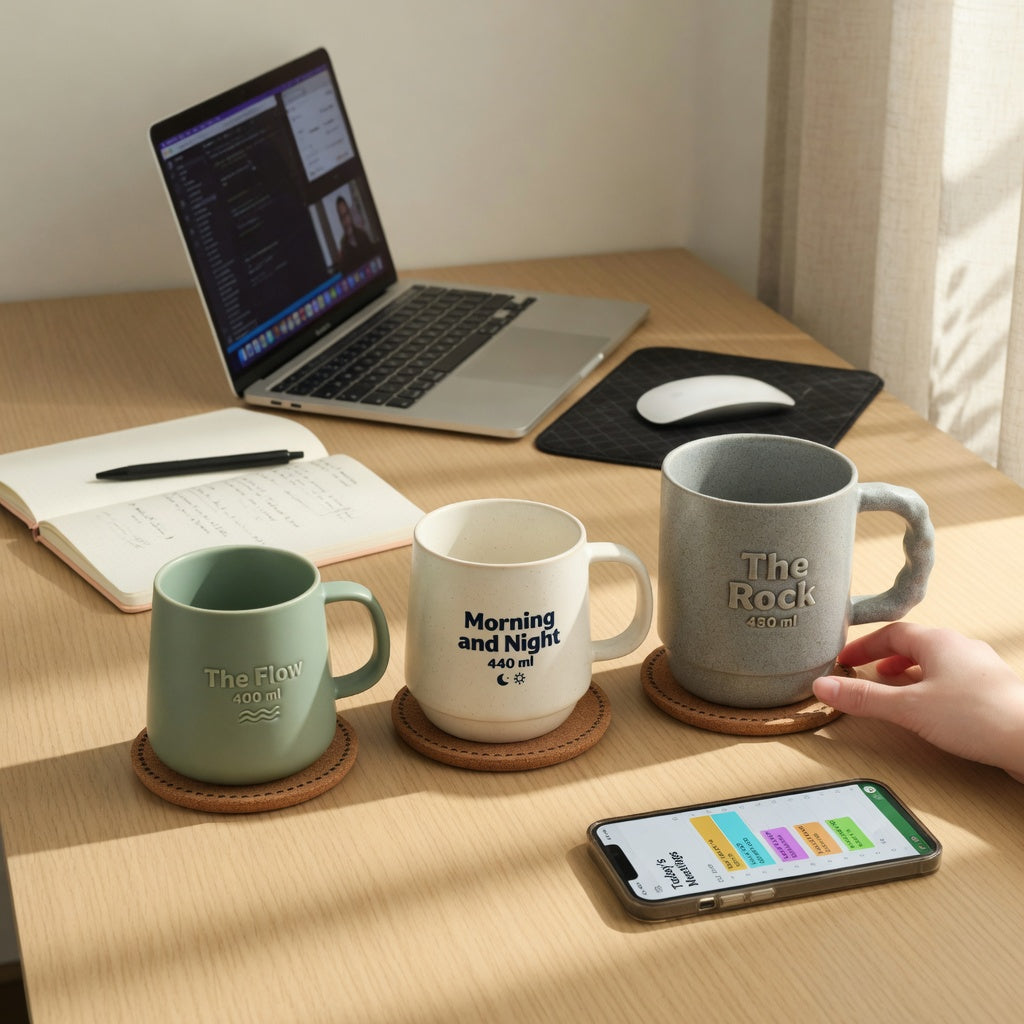
Big Latte Mug Home Office Product Shortlist Guide: 3 Desk Picks
A scenario-based shortlist for a big latte mug at a home-office desk: The Flow 400 ml, Morning and Night 440 ml, and The Rock 480 ml, each matched to a routine with a plain reason to choose or skip...
Read more
Leave a comment
This site is protected by hCaptcha and the hCaptcha Privacy Policy and Terms of Service apply.