



Ceramic Mug Shapes Morning Routine Practical Purchase Checklist
Reading time: about 11 minutes
At 6:40 on a Tuesday, nobody stands at the cupboard comparing silhouettes. You reach for the mug that did not betray you yesterday — the one whose handle took your whole hand, whose rim did not send coffee down your wrist, and which still had something warm in it when you finally sat down.
That reflex is why this ceramic mug shapes morning routine practical purchase checklist starts with timing and volume rather than looks. We sell this category every week, and the complaints that come back to us are rarely about appearance. They are about a handle that pinched, a rim that dripped, a body that would not clear the spout, or a mug that went cold with a third of the coffee left. Every one of those is measurable before you buy.
Cup or mug? What the label is actually telling you
Start with vocabulary, because the industry uses it loosely. FDA guidance for ceramic hollowware describes cups and mugs as small vessels for beverages served above room temperature, normally holding about 240 mL (8 fl oz) and normally made with a handle. In that same guidance, a cup normally has a base and curved sides, while a mug has cylindrical sides.
Read the word normally as descriptive, not as law. A 400 mL vessel with a curved belly still sells as a mug; a small straight-sided 150 mL vessel still sells as a cup. What matters at 7 a.m. is the listed capacity, converted honestly. NIST gives 1 US fluid ounce as 29.57 mL, with kitchen rounding at roughly 30 mL per ounce and 240 mL per cup. Run the arithmetic before you commit:
| Listed capacity | Approx. US fl oz | Morning fill it suits |
|---|---|---|
| 200 mL | ~6.8 fl oz | Cortado, flat white, small tea, the second cup |
| 250 mL | ~8.5 fl oz | Standard drip or filter coffee |
| 400 mL | ~13.5 fl oz | Latte, long black, desk mug for a slow drinker |
One symptom worth naming: a mug marked 12 oz that holds noticeably less than a measuring cup of water. That is headspace — the gap between the rim and a comfortable fill line. Capacity can mean to-the-brim or to-a-sensible-fill, and that gap can be a centimetre or two of depth.
How much coffee do you finish before it goes cold?
This single question eliminates more options than any other. Not how much you like coffee — how much you finish while it is still hot. Refill tolerance cuts both ways: an oversized mug leaves you drinking lukewarm coffee for the last third, while a small cup you refill twice gives you fresh hot coffee twice. We have customers who deliberately keep one of each for exactly that reason.
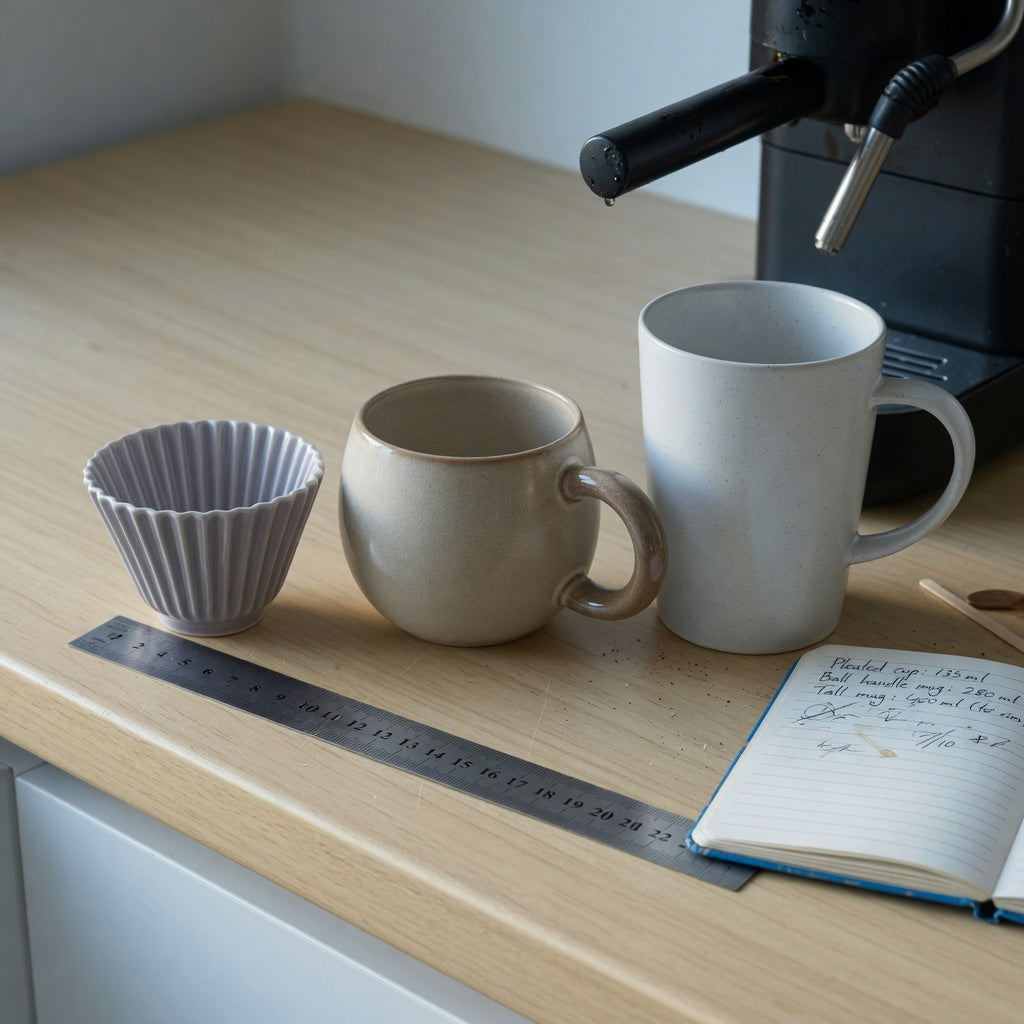
- You pour 6–8 oz and rarely refill. A smaller cup wins. At 200 mL, the pleated coffee and tea cup matches that habit, and the pleated body gives your fingers something to register against when you pick it up half-asleep.
- You pour a normal mug and carry it to a desk. 250 mL is the middle ground, which is where the ball-handled coffee and tea mug sits. The ball-form handle is the detail to check against your own grip rather than judge from a photo.
- You drink milk-based coffee or sip slowly for an hour. 400 mL, which is where The Flow coffee and tea mug lands.
If you routinely pour 250 mL, buying the 400 mL vessel means a wide liquid surface and a lot of headspace — the drink cools in the mug you chose to keep it hot. Match the pour, not the fantasy of the pour. The 200 mL pleated cup is not the right choice for a latte, and the 400 mL The Flow is not the right choice for a small black coffee you plan to finish in four minutes.
Which ceramic mug shapes clear the spout, the shelf, and the cupboard above?
Silhouette is where the fun is, but three measurements decide whether a mug disappears into your routine or annoys you daily. Take them before you shop:
- Height under the spout. Measure drip tray to spout. A tall straight cylinder can be blocked where a low bowl-shaped cup fits easily.
- Widest point, not base diameter. A belly or barrel body takes more shelf depth than its footprint suggests — the belly, not the foot, hits the shelf above.
- Handle height when stored upside down. A tall handle stops a mug sitting flat in a cupboard, which matters if you stack.
| Shape family | Best morning fit | Trade-off to accept |
|---|---|---|
| Straight-sided cylinder | Stacking, machine clearance, predictable refills | Less to grip; plainer in the hand |
| Belly or barrel | Feels generous, easy to hold with cold hands | Eats shelf depth; harder to nest |
| Tapered or flared rim | Pouring, latte work, a clean liquid break | More open surface means faster cooling |
| Bowl-shaped latte cup | Five-minute latte you drink standing up | Poor for carrying to a desk and forgetting |
| Thick diner mug | Sturdy feel, forgiving rim | Bulkier against the lip; heavier when full |
| Faceted or square body | Desk presence, gifting | Corners are awkward to sip from and to rinse |
| Handleless yunomi | Small espresso or tea volumes | Uncomfortable with a full mug of near-boiling coffee |
Faceted and heavily contoured bodies sit in their own bracket. They are the ones we most often see bought as gifts and exchanged for a plainer mug once the recipient tries drinking from a corner. Buy the sculptural shape as a piece you enjoy looking at, not as your 6 a.m. vessel. If several silhouettes pass the measurements, compare them side by side in our unique coffee mugs collection.
How much finger room does the handle need, and where should the bridge sit?
Handles are the most-returned variable in this category, and the cause is nearly always clearance rather than style. A C-handle, a D-handle and a ball-form handle can all be comfortable — the question is whether two fingers pass through the opening without your knuckles scraping hot ceramic.
- Room on both sides. A generous loop with a short bridge pins your fingers against the body. You want space inside the loop and between hand and wall.
- Balance when full. Liquid is heavy — 400 mL of coffee is roughly 400 g before the cup is counted, close to a pound held away from your body. A handle set high on a large body changes the pivot point more than people expect.
- Bridge height. A handle that sits low on the body keeps a full mug from tipping forward when you lift it; a high bridge can make a big mug feel like it wants to pitch.
Our 250 mL ball-handled mug is the one to study if you want to see how a rounded handle reads next to a rounded body. For any mug in our range, confirm the handle-opening measurement on the current listing rather than judging from the photo — rounded forms photograph larger than they feel in the hand.
Why does the rim decide whether you enjoy the first sip?
Rim geometry is the least photographed spec and the one your mouth notices first. Check three things when a mug arrives:
- Rim thickness. A thin rim feels precise and lets you drink without tilting far. A thick, rounded diner-style rim feels sturdy and forgiving, and thick edges are generally more chip-resistant — that is the honest trade for the extra bulk.
- The inner transition. A sharp corner where wall meets base traps residue and stains faster. A smooth internal curve rinses clean in seconds, which matters more than any shape claim on a product page.
- Pour lip or flared edge. If you pour out of the mug — into a thermos, a second cup, a plant — a defined lip helps. If you only drink from it, a flared rim mostly adds open surface.
Drips usually come from a rim too thick relative to your pour angle, or from residue caught on a rough glaze edge. A different silhouette will not fix either. Run a fingertip around the rim before the first fill; a rough patch or a glaze skip is easier to return before coffee has stained it.
Can a shape keep coffee hot, or is preheating the real fix?
Be sceptical here. Claims that a named silhouette keeps coffee measurably hotter are not well established, and we do not repeat them. Heat leaves a mug mainly by conduction through the wall and by evaporation at the open top. More surface area and thinner walls move heat faster; an uncovered top always loses more than a lidded one. A tall narrow cylinder exposes less liquid surface per millilitre than a low wide bowl of the same volume, so it has an edge on evaporation — but if that cylinder has thin walls, conduction can cancel the benefit. No public controlled comparison of equal-volume, equal-wall barrel, tulip and cylinder mugs exists, so treat belly-stays-hotter as a seller claim.
The intervention that works in our experience costs nothing: fill the mug with hot tap water for 30 seconds while the coffee brews, tip it out, then pour. Preheating the ceramic does more for your second sip than any silhouette choice, and it explains why a mug sitting on a chilly kitchen counter pulls the first heat straight out of your drink.
What must the clay body and glaze prove before shape gets a vote?
Shape tells you nothing about durability or safety. Body and glaze do.
- Stoneware is dense and vitrified when properly fired, which is why it dominates everyday mugs.
- Porcelain is also vitrified but can be made thinner and more translucent — elegant, and less forgiving of knocks.
- Earthenware is porous and depends on a sound glaze to hold liquid and stay food-safe. A flawless glaze matters more here than on stoneware.
On food contact, FDA's compliance policy guide for ceramic hollowware sets a lead guideline of 0.5 micrograms per millilitre of leaching solution in any one of six units tested, citing methods such as ASTM C738, which extracts lead and cadmium from glazed surfaces using acetic acid. FDA also states there is no known safe level of lead exposure, with developing fetuses, infants and children especially vulnerable. Crucially, silhouette does not change leaching — glaze chemistry and firing do. If a listing does not state that a piece is intended for food use, ask before buying, and treat decorative-only ware as decorative.
Your ceramic mug shapes morning routine practical purchase checklist
- Write down the volume you actually finish before your coffee goes cold, in millilitres.
- Convert the listed capacity at 29.57 mL per fluid ounce and confirm the two match.
- Check the height clears your machine spout with the mug on the drip tray.
- Measure the widest point against shelf depth and cupboard height.
- Confirm the handle opening fits two fingers plus knuckle room.
- Confirm the handle sits low enough that a full mug does not tip forward.
- Run a finger inside: is the base-to-wall transition smooth or a sharp corner?
- Decide whether you need a pour lip or only a drinking rim.
- Confirm the listing states food use and names the clay body.
- Check care instructions on the current listing — dishwasher and microwave guidance varies by piece and should never be assumed.
If several silhouettes pass that list, the tiebreaker is which one you would reach for without thinking. Browse the unique coffee mugs collection to compare the shapes side by side, and read our ceramic mug comparison guide if you want the broader category context around these checklist variables.
Frequently asked questions
How do I use this ceramic mug shapes morning routine practical purchase checklist in an actual shop?
Measure in this order: volume you finish, spout clearance, shelf depth, handle opening, rim feel. Volume and clearance eliminate the most candidates, so do those first. Whatever survives is a preference call.
Is a 400 ml mug too big for a normal cup of coffee?
Only if you pour 250 mL into it. A 400 mL mug holds roughly 13.5 fl oz, so a standard 8 oz pour leaves deep headspace and a wide liquid surface, which cools faster. It suits lattes and slow drinkers; for a small black coffee, a 200–250 mL cup keeps the drink hotter and the proportions right.
Do bowl-shaped latte cups really make latte art easier?
A wide, shallow bowl gives you more surface to draw into and keeps the milk closer to the surface, which genuinely helps pouring control. The trade-off is that the same wide opening loses heat quickly. If you drink the latte within a few minutes, the shape earns its place.
Can a handleless ceramic cup work for hot coffee?
Yes, at small volumes — handleless forms are common for tea and espresso. You need a body thick enough to insulate and a shape you can hold near the rim with your fingertips. For a full 250 mL mug of near-boiling coffee, most people want a handle.
Why does my mug drip down the outside even when I pour slowly?
Usually a thick rim with no defined pour lip, or a rough glaze edge that catches the last drop. Pouring more slowly does not fix geometry. A flared lip or a slightly thinner rim gives the liquid a clean break point.
Pick the mug that matches your measured pour volume, then verify handle clearance, rim feel and food-use wording on the current listing before checkout. That is the difference between a shape you admire and a mug you reach for at 6:40.
More from our blog
Ready to pick your mug? Two ways to save on today's order:
Ordering 1–3 mugs? Get an extra 10% off your 1st order with code 10_OFF Apply 10% Off & Shop Wooden-Handle Mugs →
Gifting 4+ mugs? Buy 3, Get the 4th Free applies automatically at checkout (no code needed; offers do not stack) · Free standard shipping (Nov pre-Christmas delivery: 15–20 calendar days US) · Free replacement if chipped in transit.
Popular mug buying guides: Ceramic Tea Cups & Infuser Mugs · Ceramic Mugs with Lids Compared · Wooden-Handle Tea Infuser Mugs Compared · Christmas & Secret Santa Mugs 2026 · Espresso & Cortado Cups Guide · Cup & Saucer Gift Sets · All 25 Mugs Spec Table · Mug Size Guide · Shipping & Promo FAQ
FIRST ORDER 10% OFF (CODE: 10_OFF) · OR BUY 3, GET THE 4TH FREE


Read more
Big Latte Mug Daily Use Guide: 400 vs 440 vs 480 ml
A practical daily-use comparison of 400 ml, 440 ml, and 480 ml big latte mugs, with real pour scenarios, handle and desk-footprint trade-offs, fit checks, and when a smaller cup is the better buy.
Read more
Green Waves Coffee Tea Mug for Coffee Lovers Home Decor: What to Compare
A store-side comparison of green wave mugs as drinkware and as shelf decor: printed versus embossed builds, real fill volume after headroom, dishwasher and microwave wording to verify, food-contact...
Read more
Leave a comment
This site is protected by hCaptcha and the hCaptcha Privacy Policy and Terms of Service apply.