
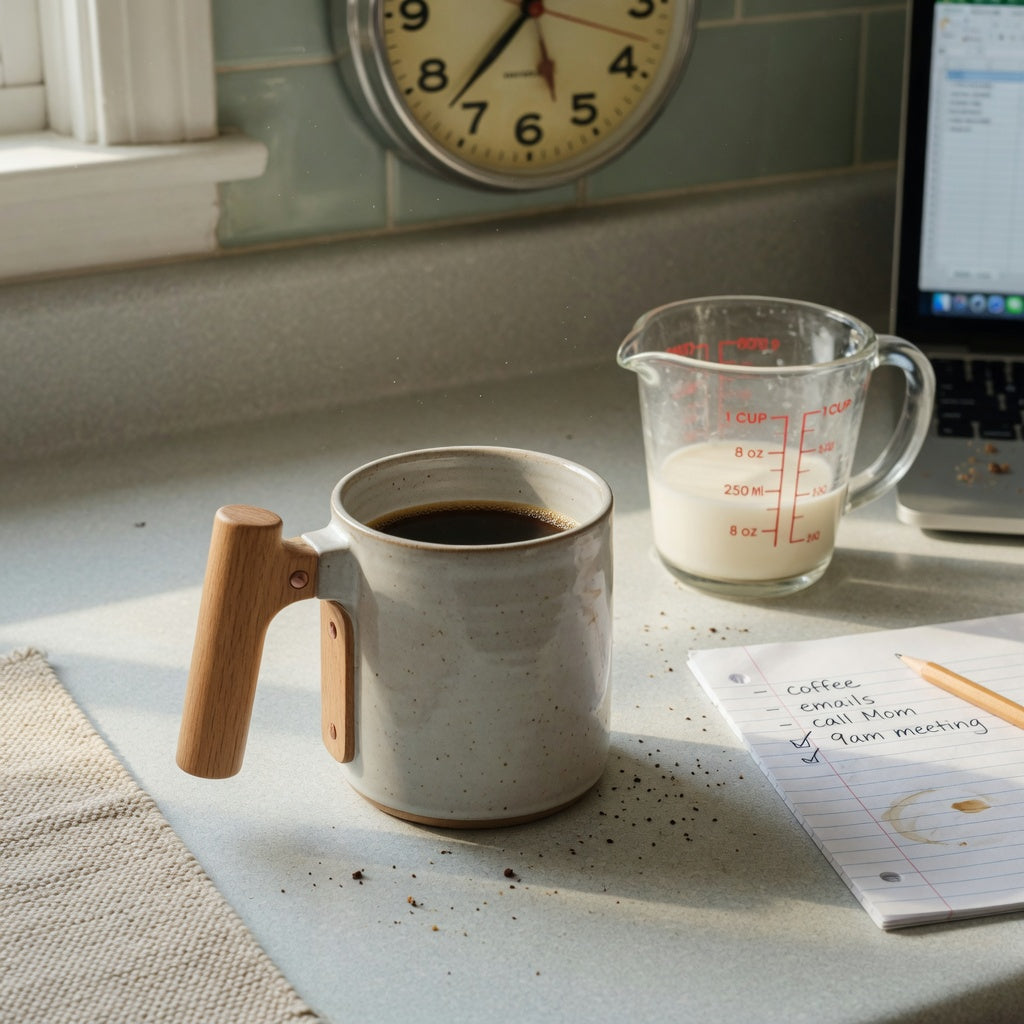
Ceramic Mug With Wooden Handle: Morning Routine Purchase Checklist
Reading time: about 11 minutes
The kettle clicks off at 7:05, the first call starts at 7:30, and the mug has to move from a crowded kitchen counter to a laptop desk. A useful ceramic mug with wooden handle morning routine practical purchase checklist starts with that sequence, not with decoration alone. The deciding variables are the minutes you have, the amount you normally pour, and the number of refills you will accept.
At CoffeifyMug, we compare this category by checking the listing first and then considering how the visible shape fits a real routine. The Mountain Sea II coffee and tea mug with wooden handle and The Cloud coffee and tea mug with wooden handle both have product titles that explicitly support a ceramic mug paired with a wooden handle.
Our claim boundary matters. The comparison points used here are listed capacity, visible vessel form, and visible handle shape. We do not infer wood species, coating, detachability, water resistance, care method, heat performance, or unlisted production details. If a detail is not stated on the product page, treat it as unresolved. Shoppers who need more shapes after setting their baseline can scan our unique coffee mugs collection without changing the checklist.
How many minutes does the mug have to work?
Count from the moment you pour until you normally finish, refill, or leave the room. This is more useful than labeling yourself a slow or fast drinker. Someone who drinks beside the kettle has a different decision to make than someone who carries the same mug to a desk and leaves it beside a keyboard for half an hour.
- Short, single-pour routine: Prioritize a listed capacity that accommodates your normal pour without requiring a refill. Compare the visible handle outline with a mug you already lift comfortably.
- Counter-to-desk routine: Check the vessel form against your available desk area and usual coaster. Product photos can show the general silhouette, but they cannot confirm an exact footprint unless dimensions are listed.
- Open-ended morning: Decide how many refills you genuinely tolerate. A smaller listed capacity may remain practical if refilling is already part of your coffee or tea routine.
Do not use timing as a shortcut for claims about heat retention. A wooden handle does not, by itself, establish how the drink or handle will perform as temperatures change. This checklist uses timing only to clarify capacity, refill, and handling priorities.
What volume do you pour before the first refill?
Measure the drink you actually make, not the maximum amount your current mug can hold. Fill your usual mug to your normal stopping point, then pour that liquid into a marked measuring cup. Record the result in ounces or milliliters. If your weekday and weekend pours differ, measure both and use the larger one unless you are comfortable refilling.
- Use the same coffee maker, kettle, or serving vessel you use most mornings.
- Stop at your normal fill line, leaving the headspace you prefer below the rim.
- Measure that pour and record whether you usually add milk, creamer, or ice afterward.
- Write down your acceptable refill count as zero, one, or more than one.
Listed capacity is a comparison figure. It should not be treated as an instruction to fill a mug to the rim, and it does not replace your preferred headspace. Use the number to eliminate obvious mismatches, then move to vessel form and handle shape.
| Morning pattern | Capacity decision | Next check |
|---|---|---|
| No refill | Look for a listed capacity that accommodates the measured pour and additions. | Compare visible handle shape with your current mug. |
| One refill is acceptable | A lower listed capacity may still fit the routine. | Decide whether the vessel form suits the counter and desk locations. |
| Several small pours | Capacity may be less important than matching the familiar grip. | Confirm that refilling is genuinely convenient during your morning. |
How should vessel form fit a counter, desk, or gift box?
Describe each mug in neutral visual terms while the product pages are open. You might note a straight-sided, rounded, tapered, broad, or compact-looking profile, depending on what the photos actually show. Use the same vocabulary for both products. That prevents a more decorative photograph from receiving an unfair advantage over a simpler product image.
Visible vessel form is useful for judging style and making a rough placement comparison. It is not a substitute for listed dimensions, and a photograph alone cannot confirm base width, shelf clearance, stability, or gift-box fit. If your counter space, cabinet shelf, or gift packaging has a hard size limit, pause the purchase until the required dimensions are explicitly available.
For a gift, first confirm that capacity and handle shape fit the recipient's routine. Only then use vessel form as the deciding aesthetic factor. The ceramic and wood contrast can be part of the visual appeal, but appearance should not override a known volume or grip mismatch.
Which visible handle shape matches your normal grip?
Handle comfort cannot be proven from a photograph, but you can make the comparison less speculative. Pick up the mug you use most often and note how many fingers pass through the opening, where your thumb rests, and whether you lift through the loop or support the body with your other hand. Then compare that familiar grip with the handle outline shown on each product page.
- Finger opening: Compare how open or compact the visible loop appears relative to the ceramic vessel.
- Curve: Look for a shape that resembles a handle you already use without repositioning your hand.
- Apparent thickness: Use it only as a visual comparison. Photos cannot establish exact measurements, edge feel, or comfort.
- Material expectations: Do not assume that a wooden handle stays cool, resists water, detaches, or requires a particular cleaning method.
If you require an exact opening width because ordinary handles do not fit your grip, product photography is not enough. Choose a mug with explicit handle dimensions or ask for clarification before buying. A different all-ceramic or oversized-handle style may be the better option.
How do Mountain Sea II and The Cloud earn a place on the shortlist?
Neither product should win based on its name or styling alone. Give each one the same three-part test: listed capacity, visible vessel form, and visible handle shape. Our team uses this order because capacity can eliminate a product immediately, while form and handle shape help resolve a closer comparison.
- For a short morning with zero refill tolerance: Open both product pages and compare each listed capacity with your measured pour. Shortlist Mountain Sea II only if its listing accommodates that routine; apply the same rule to The Cloud.
- For a grip-led decision: If both capacities work, choose the product whose visible handle outline most closely resembles a mug you already hold comfortably. The familiar shape is the reason for the fit, and the relevant product page is where you confirm the final listed details.
- For a counter or desk display: If capacity and grip both pass, use the visible vessel form to choose between Mountain Sea II and The Cloud. This is an appearance and placement decision, not proof of exact dimensions or stability.
- For a gift buyer without the recipient's measurements: Avoid guessing. Compare the recipient's current mug if possible, or use the collection to find a more conventional form with clearly stated details.
If one product wins on appearance but fails your capacity requirement, it is not the practical choice for that routine. If both pass all three checks, the decision can reasonably come down to the vessel form you prefer seeing on the counter each morning.
Ceramic mug with wooden handle morning routine practical purchase checklist
Keep both product pages open and record a simple pass, fail, or unknown for every step. Unknown is a useful result because it identifies what still needs confirmation before checkout.
- Record the minutes between pouring and finishing, refilling, or leaving.
- Measure your normal drink volume in ounces or milliliters, including the milk, creamer, or ice you usually add.
- Set your refill tolerance at zero, one, or more than one.
- Copy the listed capacity from the Mountain Sea II page without estimating from its photograph.
- Describe its visible vessel form and handle shape in one short phrase each.
- Repeat the same three notes for The Cloud.
- Eliminate any option whose listed capacity does not suit your measured volume and refill tolerance.
- Compare the remaining handle outlines with the mug you already grip comfortably.
- Mark care method, wood species, coating, detachability, water resistance, heat performance, and production details as unknown unless the product page explicitly states them.
- Use visible vessel form as the final style decision only after capacity and handle shape pass.
Used this way, the ceramic mug with wooden handle morning routine practical purchase checklist keeps attractive photography from replacing basic fit checks. It also gives you a clear reason to continue shopping if neither current option matches your actual pour or grip.
What should you inspect at unboxing?
Our store-side checks continue after a mug leaves the product page. Before the first pour, place the unpacked mug under good light and inspect the ceramic rim, interior, exterior, and foot. Shipping issues are easier to document before the mug has been washed or used.
- Look for chips, hairline cracks, or unexpected surface damage.
- Set the empty mug on a level, dry counter and check for unexpected rocking.
- Gently confirm that the handle does not show unexpected movement relative to the mug.
- Compare the delivered vessel form and handle shape with the listing photographs.
- Read any included and online care instructions before using a dishwasher, microwave, soaking method, or abrasive cleaner.
If the mug is a gift and the packaging allows inspection, complete these checks before wrapping it. Do not test an unverified care method simply because another ceramic mug in your cabinet tolerates it.
Where is this mug style a poor fit?
A ceramic mug with a wooden handle is not automatically the most practical option. The mixed-material appearance creates a distinct look, but it also raises care and construction questions that should be answered by the listing rather than assumed.
- Automatic cleaning is non-negotiable: Choose a product with explicit dishwasher instructions if a daily dishwasher cycle is central to your routine.
- Microwave use is required: Do not infer compatibility from the ceramic vessel. Use only the product's stated instructions or select a mug explicitly listed for that use.
- You commute with a mug in a bag or car: Choose drinkware explicitly designed and listed for travel and spill containment.
- Cabinet stacking is essential: Select a mug or set explicitly described as stackable rather than judging stackability from photos.
- You need exact ergonomic dimensions: A visible handle outline is not enough if opening width, clearance, or overall weight must meet a strict requirement.
- No listed capacity matches your pour: A different mug size is more practical than accepting unwanted refills every morning.
An all-ceramic mug may suit buyers who prefer a uniform material and want fewer mixed-material questions. A travel mug is better for movement and spill control. The wooden-handle style makes the most sense when its verified capacity and visible form fit a counter or desk routine and the buyer is willing to confirm any care details before use.
Frequently asked questions
What belongs in a ceramic mug with wooden handle morning routine practical purchase checklist?
Include your available morning minutes, measured drink volume, refill tolerance, the product's listed capacity, visible vessel form, and visible handle shape. Mark unlisted care, construction, wood, and heat-performance details as unknown. This keeps the comparison tied to facts that can support a purchase.
Which listed capacity is best for a no-refill morning?
The best match is the listed capacity that accommodates the amount you actually pour, including your normal additions and preferred space below the rim. Measure your existing pour instead of relying on memory. If neither product matches, compare other mug sizes rather than forcing a refill into a routine that does not allow one.
Can a ceramic mug with a wooden handle go in the dishwasher or microwave?
There is no universal answer that should be inferred from the material names alone. Follow only the care and use instructions explicitly provided for the individual product. If dishwasher or microwave use is essential and the listing does not confirm it, choose a product with clear instructions.
Does a wooden handle stay cooler than a ceramic handle?
Do not assume a specific heat result without product-level support. Handle temperature can depend on construction and use conditions that are not established by the product title or visible shape.
How should I compare Mountain Sea II with The Cloud?
Measure your normal pour, compare it with each listed capacity, and eliminate any mismatch first. Next, compare the visible handle outlines with a mug you already grip comfortably. If both options pass, choose the vessel form that better suits your counter, desk, or gift preference without inferring unlisted dimensions.
Measure your normal pour before opening the product pages, then give Mountain Sea II and The Cloud the same pass, fail, or unknown review. If neither passes, use the unique coffee mugs collection to compare additional forms while keeping the same capacity, grip, and refill criteria.
More from our blog
Read more
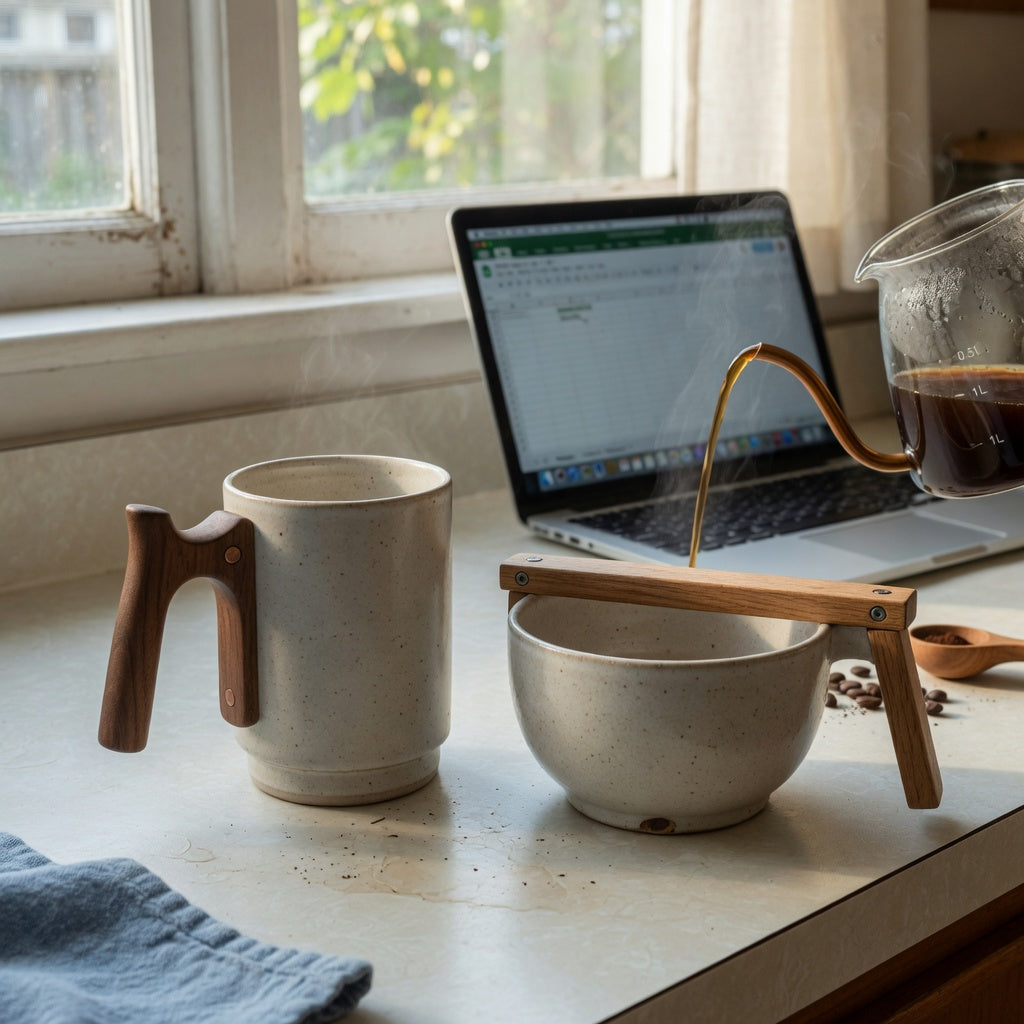
Ceramic Mug With Wooden Handle Morning Routine Product Shortlist Guide
Build a practical shortlist around your normal first pour, listed capacity, refill tolerance, vessel form, and handle shape. See when Mountain Sea II, The Cloud, or a different mug style makes more...
Read more
Ocean Coffee Mug Home Office Product Shortlist Guide: 3 Routines
Compare the Mountain Sea and Landscape ceramic mugs against solo-work, video-meeting, and break routines. This shortlist uses visible imagery, handled form, listed capacity, and care verification, ...
Read more
Leave a comment
This site is protected by hCaptcha and the hCaptcha Privacy Policy and Terms of Service apply.