



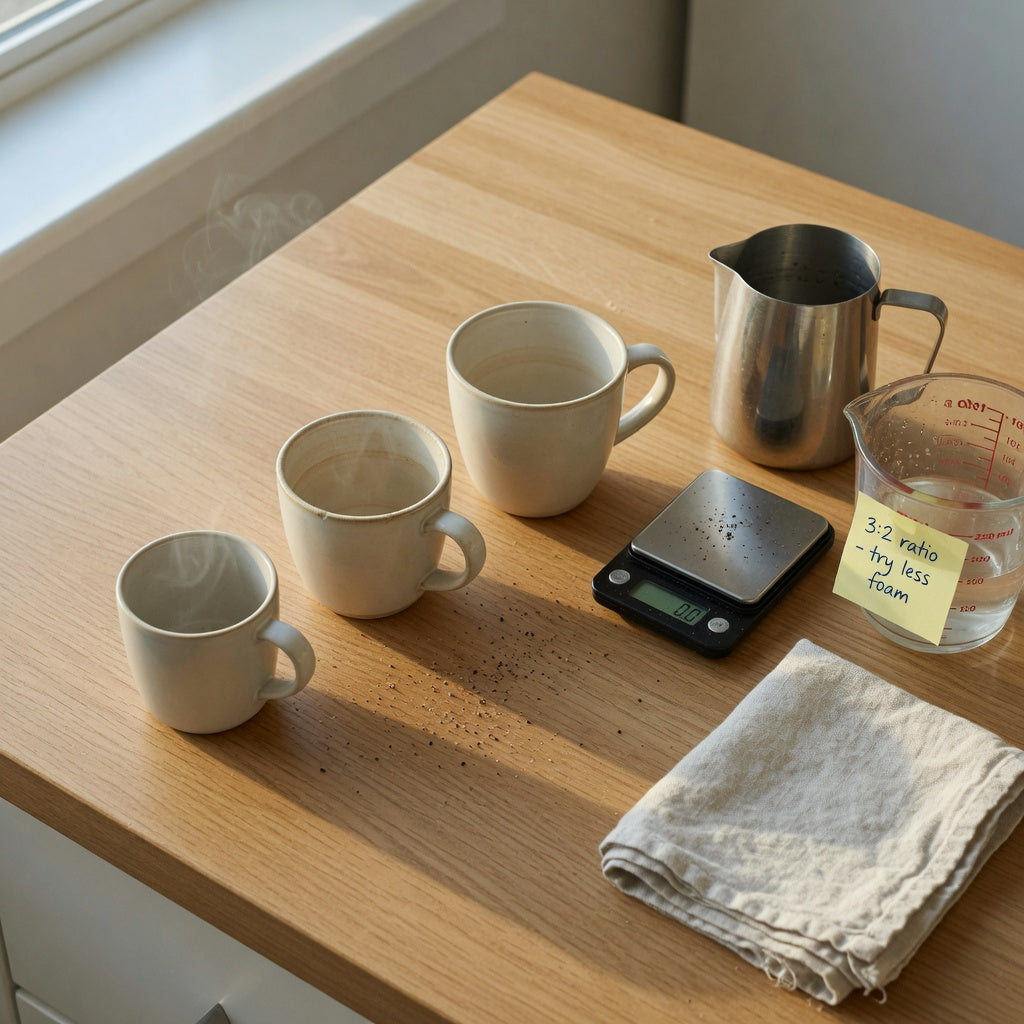
Big Latte Mug Morning Routine Practical Purchase Checklist
Reading time: about 9 minutes
At 6:55 the mug is full and the foam cap sits a finger below the rim. By 7:20 the last third is lukewarm, with a dried tide line halfway down the inside. We hear a version of that story about a week after delivery — I love it, but I only fill it two-thirds — and it is never a defect. It is a sizing decision made before anyone measured the actual morning. So here is the big latte mug morning routine practical purchase checklist we would walk you through at our counter: what to measure, which numbers on a listing to distrust, and which capacity matches the drink you really pour.
How much of a “400 ml” mug actually reaches your mouth?
Almost no listing says whether the number on the box is brim capacity or a usable pour. Assume brim, then subtract. A latte needs headroom for the foam cap, and a mug filled to the edge is one you carry two-handed across the kitchen.
Do the unit conversion once, because printed volumes are rounded inconsistently. NIST lists 1 U.S. fluid ounce as 29.57353 ml, which puts 8 fl oz at 236.6 ml and 16 fl oz at 473.2 ml. That is how a mug printed “300 ml” and one printed “10 oz” can be the same vessel described two ways — 10 oz works out to 295.7 ml.
Then take off the headroom. In our experience a comfortable fill lands around 80–90% of listed capacity, so a 400 ml mug gives you roughly 320–360 ml of drink. That is not a compromise; it is where specialty café latte cups already sit, since makers typically list those around 300–355 ml. Our guide to how many ounces in a mug of coffee works through the same arithmetic with more examples.
The big latte mug morning routine practical purchase checklist
Six checks, in the order that actually matters before the kettle boils:
- Measure tomorrow’s pour. Make the latte in a measuring jug once. Not what you would like to drink — what you actually pour. Most people land between 240 and 400 ml and are surprised by the number.
- Decide your refill tolerance. If you routinely drink half and reheat the rest, a bigger mug is just a way of storing cold coffee. If you finish 350 ml without noticing, step up.
- Test the handle with the mug full. Handle opening matters more than handle size. You want two fingers and a thumb through the gap without your knuckles pressing against the body.
- Weigh the empty mug, then imagine it full. A milk drink adds roughly its own volume in weight, so a mug that feels satisfyingly solid empty becomes a two-handed lift at capacity.
- Check three clearances with a ruler, not a guess: under the group head with a scale on the drip tray, under the shelf where it lives, and inside a car cup holder if it commutes.
- Count your shots before you count millilitres. Decide whether a bigger drink should get more milk or more espresso — that answer changes the size you need.
If you can answer the first item, the rest tend to fall into place. If you cannot, no amount of reading helps, because “big” is not a size.
Does a 480 ml mug change the latte, or just the washing up?
A latte is espresso plus steamed milk under a thin foam cap, so the espresso stays roughly constant while the milk scales with the cup. Push a double shot into 480 ml and you have built something far milkier than a café serves — pleasant, but closer to sweetened milk than to a latte. Push the same double into 300 ml and the coffee moves forward.
That is the trade-off no listing prints: a bigger mug does not hold more coffee, it holds more milk per shot. If you want a longer drink without diluting it, pull a third shot before you pour more milk. Two shots and 480 ml of milk is a different drink, not a larger one.
Which shape survives a rushed Tuesday pour: wide bowl or tall body?
- A wide, bowl-shaped mouth gives the milk somewhere to spread, which is why latte-art pours behave better in it. The cost is surface area: more of the drink sits exposed, and a half-full wide mug goes cold quickly.
- A tall, narrower body holds a long drink together and is easier to carry one-handed, but stacking foam neatly in a narrow mouth takes practice.
- For iced lattes, favour height over width. Ice displaces volume fast, and a wide mug packed with ice and milk is a spill waiting for the first tilt.
Neither shape wins outright. Match it to the drink you make most mornings, not the one you make for a photo.
Which CoffeifyMug capacity matches the pour you measured?
Our lineup runs three listed capacities, and each maps to a kind of morning rather than a kind of person. You can see them side by side in our unique coffee mug collection.
| Mug | Listed capacity | Drink at roughly 85% fill | The morning it suits |
|---|---|---|---|
| The Flow | 400 ml | ≈340 ml | One café-sized latte, no refill; the smallest of the three on a desk |
| Morning and Night | 440 ml | ≈374 ml | A 12–14 fl oz pour (355–414 ml) with sensible headroom, then an evening tea |
| The Rock | 480 ml | ≈408 ml | Long iced drinks, or a one-and-done mug you never refill |
Read that table against your measured pour rather than what sounds generous. A 350 ml pour leaves about 50 ml of headroom in The Flow and about 130 ml of empty air in The Rock — a lot of mug to carry for a drink that will cool inside it. A 450 ml pour reverses the logic entirely.
What we will not do is tell you which one keeps coffee hot longest. We have not run a controlled test, and an invented number would be worse than no number. Handle comfort is the same story: grip and balance vary with hand size, so if your hands are wide or your grip is weak, tell us before ordering and we will describe what we can from handling these daily.
Will it clear the group head, the cabinet shelf, and the cup holder?
Fit failures are the most common reason a large mug goes back, and almost none of them are about capacity — which is why clearance sits high on any big latte mug morning routine practical purchase checklist. Measure three things before you commit:
- Group-head clearance. Put your scale on the drip tray and measure from the tray to the underside of the group head. A tall mug plus a scale is exactly how people end up pulling a shot onto a mug that will not fit.
- Shelf height. Cabinets are tighter than they look once the mug has to clear the shelf above it.
- Cup-holder diameter. A 480 ml body is usually too wide for a standard car holder; a 400 ml one often is not.
We deliberately keep dimensions off this page. They belong on each current product listing, where they can be corrected when a batch changes — so check the listing before you order rather than trusting any blog post, including this one.
What do “dishwasher safe,” “microwave safe,” and “lead-free” actually promise?
Two labels do a lot of unearned work in this category. “Microwave safe” and “dishwasher safe” are claims, not certifications, and neither one promises the glaze will survive a decade of Tuesday mornings. Heat shock — a cold mug hitting hot dishwasher water, or an empty mug run dry in the microwave — is a common cause of hairline cracks, and a cracked glaze is where a mug starts to fail. Hand-washing a 480 ml body is often easier anyway, because it eats rack space.
On lead, the FDA compliance guide for ceramic cups and mugs sets a lead action level of 0.5 micrograms per millilitre of leaching solution, applied to any one of six units tested, and the agency notes that some ceramic foodware can leach lead from food-contact surfaces. “Lead-free” on a product page is marketing language; the action level is what a real test result gets measured against. If food-contact safety matters to you — and with a mug you use daily, it should — ask the seller for test documentation rather than trusting a badge.
For a wider comparison of how the three sizes sit next to each other on a shelf, our oversized ceramic mug capacity comparison puts them side by side.
Where a big latte mug is the wrong tool
Being straight about the limits saves everyone a return:
- A single espresso or a small flat white. A 480 ml mug holding 60 ml of coffee is a sad object, and the drink is cold in minutes.
- Learning latte art. Start with a 300–355 ml cup; the milk-to-surface ratio is far more forgiving.
- Small hands or a shaky grip. Full, these are heavy. If you carry coffee up stairs every morning, size down.
- Tight cup holders and shallow cabinets. A mug that lives in a box is storage, not a purchase.
- Anyone who wants a drink that stays hot for an hour. Ceramic is not a vacuum flask; if heat retention is the priority, an insulated tumbler beats a bigger mug.
If your morning is a 6 oz cappuccino, a smaller cup is the better buy. If your pour measures around 350 ml and you want one mug that handles coffee and evening tea, The Flow and Morning and Night are the two we would put in front of you first.
Frequently asked questions
How do I build a big latte mug morning routine practical purchase checklist for my own kitchen?
Start with the volume you actually pour, measured once in a jug, then work outward: refill tolerance, handle room with the mug full, filled weight, and the three clearance measurements. Capacity is the last decision, not the first.
Is a 16 oz mug really 16 oz of latte?
Usually only to the brim. 16 U.S. fluid ounces is 473.2 ml, but a comfortable fill leaves 10–20% headroom for foam and carrying. Expect roughly 380–430 ml of actual drink, so if your pour measures 450 ml, size up.
Will a big latte mug fit under my espresso machine?
Only if you measure it. Put your scale on the drip tray and check the gap to the group head — a tall mug plus a scale is the classic combination that does not fit. Confirm the height on the current product listing before you order.
Which CoffeifyMug size is closest to a café latte cup?
The Flow at 400 ml. Specialty café latte cups are typically listed around 300–355 ml, so 400 ml sits just above that range with room for a foam cap and a little extra milk.
Does a wide mouth really help with latte art?
It helps, but pitcher size matters as much as mug shape. A wide bowl gives the milk room to spread; a tall narrow mug fights you. If art is the goal, start with a 300–355 ml cup and a pitcher matched to the volume you are pouring.
More from our blog
Ready to pick your mug? Two ways to save on today's order:
Ordering 1–3 mugs? Get an extra 10% off your 1st order with code 10_OFF Apply 10% Off & Shop Wooden-Handle Mugs →
Gifting 4+ mugs? Buy 3, Get the 4th Free applies automatically at checkout (no code needed; offers do not stack) · Free standard shipping (Nov pre-Christmas delivery: 15–20 calendar days US) · Free replacement if chipped in transit.
Popular mug buying guides: Ceramic Mugs with Lids Compared · Wooden-Handle Tea Infuser Mugs Compared · Christmas & Secret Santa Mugs 2026 · Espresso & Cortado Cups Guide · Cup & Saucer Gift Sets · All 25 Mugs Spec Table · Mug Size Guide · Shipping & Promo FAQ
FIRST ORDER 10% OFF (CODE: 10_OFF) · OR BUY 3, GET THE 4TH FREE


Read more
Unique Espresso Cups Daily Use Guide: Sizes, Fit and Care
A practical look at living with unique espresso cups: how our 170, 200 and 250 ml ceramic sizes handle real double-shot routines, what actually clears a group head, why glaze colour changes how you...
Read more
Ceramic Mug Shapes Daily Use Guide: Pick by Pour, Grip, Heat
A shape-by-shape look at how listed capacity, rim style, and handle geometry change the way you actually drink — plus which of our three ceramic silhouettes matches your real pour size, and which o...
Read more
Leave a comment
This site is protected by hCaptcha and the hCaptcha Privacy Policy and Terms of Service apply.