

Ceramic Mug Shapes Comparison: 200 ml, 250 ml, or 400 ml?
Reading time: about 8 minutes
A 200 ml cup, a 250 ml mug, and a 400 ml mug can all hold coffee. They do not solve the same morning. In our store, we keep the Pleated Coffee & Tea Cup, the Ball-Handled Coffee & Tea Mug, and The Flow Coffee & Tea Mug on the same shelf, and the fastest way to choose is to start with how much you pour and how you hold the cup.
A useful ceramic mug shapes comparison starts there too: listed capacity, handle geometry, rim feel, and cleaning. Not a claim that one silhouette makes coffee sweeter. You can see the full current lineup in our unique coffee mugs collection.
What does a ceramic mug shapes comparison change at 7 a.m.?
Shape affects three things you notice immediately: fill level, grip, and how easy the cup is to sip from without a drip. The U.S. FDA guidance is a useful reality check. It describes cups as having a base and curved sides, while a mug normally has cylindrical sides and a handle. Sellers do not always use that wording, but it explains why a curved tea cup and a straight-sided coffee mug can both sit in the same ceramic drinkware category.
Capacity is the anchor. Using NIST's approximate conversion of 1 fluid ounce = 29.57 milliliters, our current options translate roughly as 200 ml = 6.8 fl oz, 250 ml = 8.5 fl oz, and 400 ml = 13.5 fl oz. Those numbers matter more than a silhouette label when you are deciding whether you will refill twice before lunch.
| Current option | Listed capacity | Silhouette or handle cue | Routine fit | Trade-off to accept |
|---|---|---|---|---|
| Pleated Coffee & Tea Cup | 200 ml | Pleated exterior; handle shape to verify on listing | Short coffee, concentrated tea, small pours, visual texture | Needs refills for large drinks; textured exterior needs careful cleaning |
| Ball-Handled Coffee & Tea Mug | 250 ml | Ball-style handle is the named handle geometry; body profile to verify | Buyers who notice handle comfort first and want a modest everyday fill | Still a small-to-medium mug; check finger clearance and balance when full |
| The Flow Coffee & Tea Mug | 400 ml | The Flow is the named model; confirm body profile and handle on listing | Long desk coffee, large tea, shared kitchen use, slower drinkers | Heavier when full; check spout clearance and cabinet height |
Which current option fits a 200 ml coffee or tea pour?
The Pleated Coffee & Tea Cup is the 200 ml option in our current lineup. That is about 6.8 fl oz, a sensible size for a short coffee, a concentrated tea, or a pour you plan to finish while it is still hot. It also suits buyers who want the cup itself to add some texture to a plain kitchen shelf.
The trade-off is straightforward: 200 ml is not a large latte or an all-morning office mug. If you usually drink 12 oz or more, you will refill this one. Check the current listing for the handle shape, rim, and interior before you commit. A pleated exterior can look great, but deep ridges need a soft brush rather than a quick rinse. This cup is not the best fit for someone who wants one vessel for a long desk session.
When is the 250 ml ball-handled mug the better grip?
The Ball-Handled Coffee & Tea Mug lands in the middle at 250 ml, or about 8.5 fl oz. The obvious differentiator is the ball handle. That matters if you have ever picked up a full mug and felt your fingers pinch, or if you prefer a rounded grip to a flat strap. A handle is not decoration; it changes how much control you have when the cup is full and hot.
Before committing, check two things on the product page: the handle opening and the balance point. A ball handle can feel comfortable with two fingers but cramped with three, depending on hand size. In our experience, shoppers who care about handle feel ask about finger room before they ask about color. And 250 ml is still a modest fill, so this is not the mug for a 16 oz coffee habit.
Who gets the most from a 400 ml The Flow mug?
The The Flow Coffee & Tea Mug is the 400 ml option, roughly 13.5 fl oz. This is the one for a long coffee at a desk, a large tea you sip slowly, or a household where one mug gets used for several drinks a day. The larger capacity reduces refill trips, which is why it often wins in home offices and shared kitchens.
Do not treat bigger as automatically better. A 400 ml mug is heavier when full, and the open top still exposes the drink to air. Check the listing for the exact body profile, handle clearance, and whether it fits under your coffee machine spout or in your cabinet. It is also overkill for espresso-sized pours. If you pour 6 oz and forget the cup for an hour, the extra volume is not helping you.
How do rim shape, handle geometry, and wall thickness change comfort before capacity?
Two mugs can both hold 250 ml and drink very differently. The rim is the first contact point. A rounded, smooth rim tends to feel easier on the lip than a thick, blocky edge, and a modest pour lip can help direct liquid instead of letting it run down the outside. Very wide, flared rims look generous, but they can make small sips less precise.
Handle geometry is the second contact point. A C-shaped handle gives finger room; a D-shaped handle can feel more controlled; a ball handle is a tactile choice that may suit shorter fingers or a pinch grip. None is universally ergonomic. We tell buyers to think about how many fingers they want through the opening when the mug is full, not when it is empty.
Wall thickness is the third variable. Thick-walled diner-style mugs feel sturdy and have more thermal mass, but they are heavier. Thin porcelain feels lighter and more refined, but it can feel hotter on the outside sooner. Shape alone does not prove heat retention. An open top adds evaporation, and preheating the mug often does more for your first sip than choosing a particular silhouette. You will see sellers claim a shape makes coffee sweeter or less acidic. We would not base a purchase on that; the stronger variables are temperature, fill level, and opening area.
What should you check on a current ceramic mug listing before checkout?
Use this checklist while the product page is open. It catches the gaps that product photos hide.
- Listed capacity: Convert it. 200 ml is about 6.8 fl oz, 250 ml is about 8.5 fl oz, and 400 ml is about 13.5 fl oz.
- Handle clearance: Ask whether two or three fingers fit comfortably, and whether the mug feels balanced when full.
- Rim and pour lip: Look for a smooth lip and a shape that directs liquid rather than encouraging drips.
- Interior corners: Pleated, faceted, or square bodies may need more careful cleaning than a smooth round interior.
- Stacking and clearance: Check cabinet height, shelf fit, and the space under your coffee or tea machine spout.
- Care instructions: Confirm dishwasher and microwave guidance on the listing rather than assuming every ceramic mug is the same.
- Food-contact status: FDA Compliance Policy Guide Sec. 545.450 sets a lead guideline of 0.5 micrograms per milliliter of leaching solution in any one of six units for ceramic cups and mugs, and cites ASTM C738 as an acetic-acid extraction test. If a listing does not clearly present a piece as food-use drinkware, treat it as decorative.
One more boundary: shape does not tell you the clay body. Stoneware, porcelain, and earthenware behave differently, and a decorative glaze is not proof of food safety. That is worth asking about directly, especially with handmade or heavily textured ceramics. If you want to compare all three current options side by side, start with the unique coffee mugs collection.
Frequently asked questions
Is a ceramic mug shapes comparison mostly about capacity?
Capacity is the first filter, but not the whole story. A ceramic mug shapes comparison should also weigh rim thickness, handle clearance, wall weight, and how easy the interior is to clean. A 250 ml mug with a pinching handle can be less useful than a 200 ml cup that fits your hand.
Will a wider mug keep my coffee hotter?
Not automatically. A wider opening exposes more surface to air, while thicker walls and preheating can help hold heat. We would not rank a named silhouette as proven hotter without controlled side-by-side testing of the same clay, wall thickness, and volume.
What size works best for tea?
For a short, hot tea you plan to finish quickly, 200 ml or 250 ml is logical. For a long desk tea or a household mug, 400 ml is more practical. Check the rim and interior first, because tea drinkers often notice lingering residue and rim comfort more than the exact silhouette.
Do I need a handle on a ceramic cup for hot drinks?
A handle helps with very hot drinks and full cups, especially if you have limited grip strength. Handleless cups can work for tea or coffee served below scalding, but they are not the safer choice for a freshly boiled pour. Match the handle to your hand and routine, not to a style label.
How do I check food safety on a ceramic mug listing?
Look for clear food-use language and ask the seller about glaze testing if it is not shown. FDA guidance for ceramic cups and mugs sets a lead guideline of 0.5 micrograms per milliliter of leaching solution, and cites ASTM C738 as an acetic-acid extraction test. If a listing does not clearly present a piece as food-use drinkware, treat it as decorative.
More from our blog
Read more

Big Latte Mug for Desk Use: Capacity, Footprint, and Handle Fit
A big latte mug for desk use usually fails on footprint and handle clearance, not volume. We compare our 400 ml, 440 ml, and 480 ml mugs by base size, one-hand carry, and refill math so you can pic...
Read more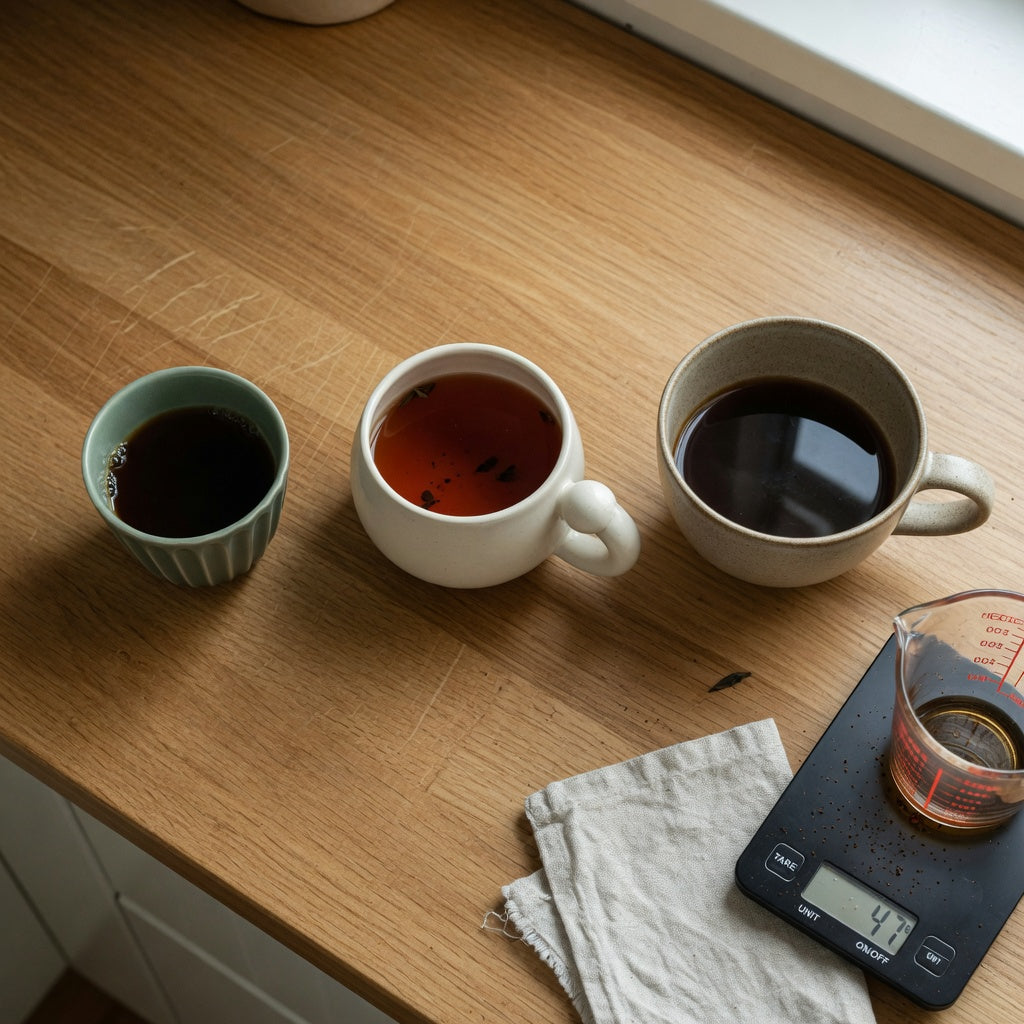
Ceramic Mug Shapes Capacity Guide: 200, 250 or 400 ml
Three current ceramic bodies, three capacities, three different morning routines. We compare the 200 ml pleated cup, the 250 ml ball-handle mug and the 400 ml The Flow by silhouette, handle geometr...
Read more
Leave a comment
This site is protected by hCaptcha and the hCaptcha Privacy Policy and Terms of Service apply.