
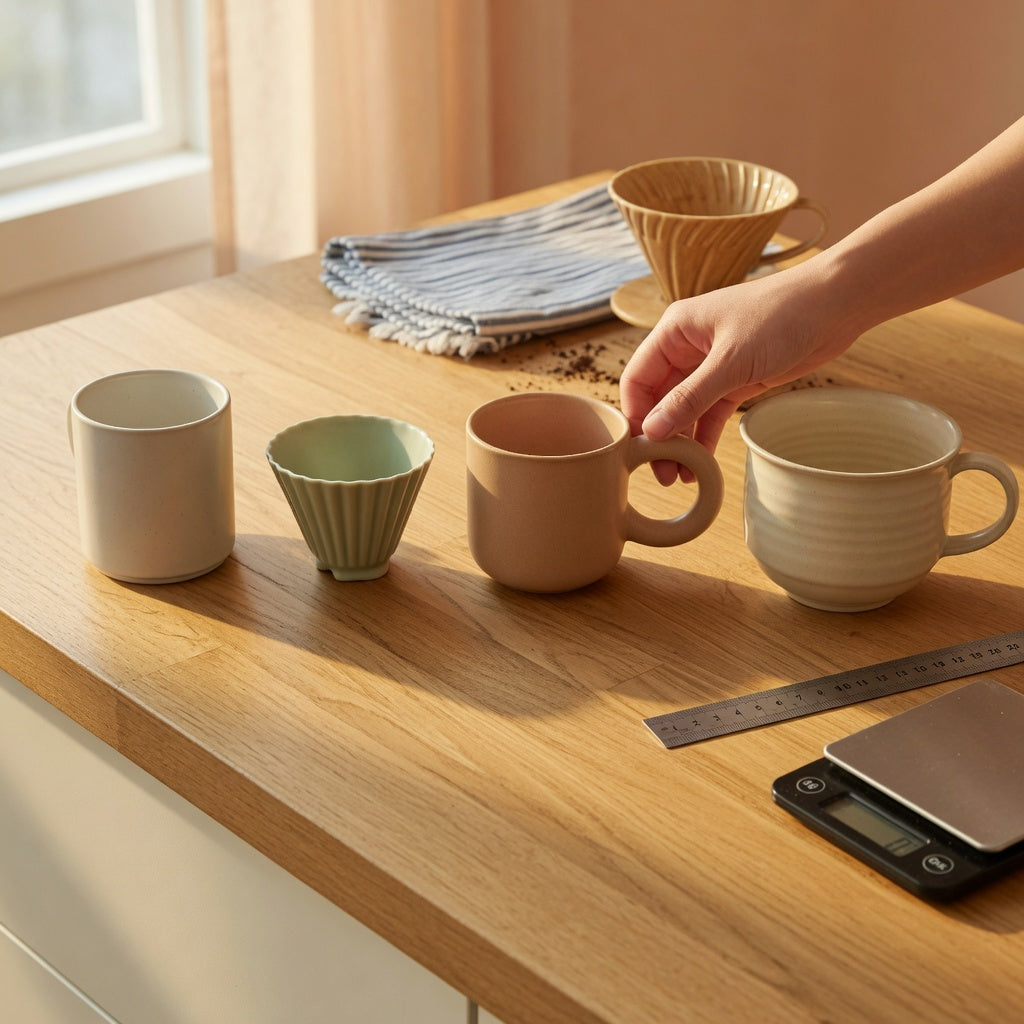
Ceramic Mug Shapes: Handle Geometry and Daily Coffee Fit
Reading time: about 11 minutes
A customer returned a 400 ml mug to us last month. Capacity was right. Glaze was right. The problem was her knuckles: whenever she lifted it full, the handle pulled her hand tight against the hot wall, and she had to set the mug down between sips. Nothing was defective. The handle geometry simply didn't suit a hand wrapping a heavy body.
That return is why we stopped treating ceramic mug shapes as a style category. Cylinder, belly, tapered, flared, pleated, handleless — the silhouette decides three things you notice twice a day: how the rim meets your lip, how fast the drink cools, and whether your hand can hold the thing comfortably at full weight. Capacity and wall thickness matter just as much, and neither shows up reliably in a product title.
Cup or mug? The wording that separates curved sides from straight ones
U.S. FDA guidance on ceramic hollowware gives a clean starting vocabulary. It treats cups and mugs as small ceramic vessels used for beverages such as coffee or tea above room temperature, normally — though not exclusively — holding about 240 ml (8 fl oz) and normally made with a handle. The split is geometric: in that guidance, a cup has a base and curved sides, while a mug has cylindrical sides.
That is labeling language, not a shopping rule. Plenty of what a retailer calls a latte mug reads as a cup under that definition, and no one enforces it at checkout. What it does give you is a way to sort the shelf into families:
- Cylindrical (straight-sided) — an even wall from base to rim. Stacks predictably, takes a lid without fuss, matches the FDA's mug wording.
- Curved or bowl-sided — belly, barrel, or tulip profiles where the widest point sits somewhere between base and rim. More open surface at the top, more contact across your palm.
- Tapered — narrow base, wider mouth. Easy to fill, easier to tip than a weighted base.
- Flared rim — the lip turns outward. Comfortable against the mouth, but the wider opening sheds heat faster.
- Pleated or faceted — flat or fluted planes instead of one smooth curve. More grip surface, more grooves where residue can sit.
- Handleless (yunomi-style) — a cup you cradle. Nothing to catch on a shelf, and nothing to insulate your fingers either.
Listings are usually metric, so convert before you compare. NIST's approximate conversion is 1 fluid ounce = 29.57 ml, and its household kitchen table rounds 1 fl oz to about 30 ml and 1 cup to 240 ml. A mug sold as "12 oz" is roughly 355 ml. A 200 ml cup is a little under 7 fl oz — right for a cappuccino, wrong for someone who drinks coffee by the pint.
Which ceramic mug shapes match the drink you pour most mornings?
Café convention already does the volume math for you. Espresso is served small, cappuccino and flat white commonly land in the 150–240 ml band, a latte runs larger, and a brewed coffee you sip across an hour usually passes 350 ml. Match the vessel to the drink and you stop overfilling — which is the most common reason people burn their fingers on a handle in the first place.
- Around 200 ml — cappuccino, flat white, or a short tea. Our Pleated Coffee & Tea Cup is listed at 200 ml. A pleated body means the wall is not one smooth curve, so you get flat planes to grip when the cup is hot and you are drinking without a saucer.
- Around 250 ml — a generous flat white, a medium latte, or tea with room to spare. The Ball Handled Coffee & Tea Mug is listed at 250 ml, and a ball-style handle changes the grip: you wrap it rather than threading fingers through a flat loop. Some hands find that steadier on a full mug; hands with limited grip strength often prefer a conventional loop.
- Around 400 ml — a large latte, iced coffee with room for ice, or brewed coffee nursed across an hour. The Flow Coffee & Tea Mug is our 400 ml option and the largest body we carry in this range.
If latte art matters to you, opening width matters more than height. A wider, rounder mouth lets the milk spread into a pattern; a tall narrow body compresses the design and forces a tighter pour. Tea drinkers often want the opposite — a narrower opening so the aroma stays in the cup between slower sips. Our comparison of ceramic mugs for coffee and tea drinkers goes deeper on that split.
How much handle clearance does a full mug demand?
Handle geometry is where most of our returns originate, and it almost never appears in a product title. Three measurements decide comfort:
- Opening height and width — the hole your fingers pass through. A two-finger handle suits a 200–250 ml cup. A 400 ml body usually wants three fingers or a tall, wide loop.
- Body clearance — the gap between handle and wall. Too tight and your knuckles rest on hot ceramic. Too wide and the mug tips forward in your grip.
- Attachment span — a handle bonded over a short vertical distance concentrates stress at two points. That is where chips and hairline cracks tend to start after a few hundred dishwasher cycles.
Balance is the part buyers underestimate. A full 400 ml mug carries roughly 400 g of liquid before you count the ceramic itself, and the handle is a lever arm. A small loop on a big body loads your wrist; a proportional handle lets the mug hang. When a listing doesn't state the opening in millimetres, treat that as an open question — ask the seller, or look for a photo with a hand on the handle at the angle you'd actually hold it.
Does a thick rim or a flared lip change the sip?
They change the feel of the sip, which for most people is close enough to taste. A thick, rounded diner-style rim spreads pressure across your lower lip and holds warmth near the edge; it can also feel bulky when the drink is nearly gone. A thin rim is precise and slightly cooling, and it chips more readily at the lip line. Neither is better — they suit different drinking speeds.
A shaped pour lip or a gentle outward flare breaks surface tension as you tip, which is what stops the thin drip line down the outside of the mug. Smooth, unflared rims on a belly-shaped body are the usual culprits. One honest caveat: seller claims that a given silhouette makes coffee sweeter, more acidic, or more floral are widely repeated but not established by the authoritative sources we reviewed. What shape reliably changes is temperature, how much aroma reaches your nose before the first sip, and how much liquid moves per tilt. Those affect perception. The rest is marketing.
Where the heat actually leaves the mug
Heat exits in three directions: through the wall, through the base into the counter, and out of the open top as evaporation. More exposed surface area and thinner walls mean faster conductive loss. An open top loses heat whether the body is a cylinder or a belly — which is why a lid does more for a 20-minute desk coffee than any silhouette decision.
Moves that beat shape shopping:
- Preheat with hot tap water for 30 seconds, then tip it out before pouring.
- Fill to roughly 80% rather than the brim; the top inch is where most heat escapes.
- Expect a wide-mouthed bowl to cool fastest, and treat that as a feature if you drink quickly.
Will the shape clear the spout, the shelf, and the dishwasher rack?
Two measurements kill more mug purchases than any aesthetic objection. First, spout clearance: measure from the drip tray to the underside of the machine's spout and compare it to the mug's full height, including a handle that arcs above the rim. A tall 400 ml body can foul a low spout even when the base fits the tray. Second, cupboard height and stacking. Straight cylinders stack; belly and tapered bodies nest less predictably and often need their own shelf line.
Handle height is the sneaky one. A tall loop that clears your knuckles can also stop the mug from sliding onto a low shelf, and an ornate handle that catches on the rack tines is a daily irritation rather than a one-time annoyance. If the shape has interior corners, feet, or deep facets, plan on a soft brush for the rinse — smooth rounded interiors rinse clean with far less effort.
Our three shapes, compared on the details that decide returns
| Shape | Listed capacity | Visible geometry | Best daily fit | Verify on the current listing |
|---|---|---|---|---|
| Pleated Coffee & Tea Cup | 200 ml | Pleated body | Cappuccino, flat white, short tea | Whether the pleats need a brush; rim thickness |
| Ball Handled Coffee & Tea Mug | 250 ml | Ball-style handle | Medium latte, everyday desk mug | Handle opening size against your hand |
| The Flow Coffee & Tea Mug | 400 ml | Largest of the three | Large latte, brewed coffee, long sessions | Full height for spout and shelf clearance |
Notice what the table refuses to do: rank them. A 200 ml pleated cup is the wrong purchase for someone who free-pours 350 ml of filter coffee every morning, and the 400 ml Flow is the wrong purchase for someone who mainly drinks espresso-based milk drinks and wants a tight crema line at the rim. Buy for the drink you make five days a week, not the one you make on a Sunday.
The rest of our unique coffee mugs collection follows the same logic — silhouette first, capacity second, handle geometry third — so you can compare within one framework instead of guessing from photos.
What should you ask about glaze and food contact?
Shape is not a safety variable; glaze chemistry and firing are. FDA Compliance Policy Guide Sec. 545.450 sets a lead guideline of 0.5 micrograms per millilitre of leaching solution for ceramic cups and mugs suitable for food use, measured across six units, and cites ASTM C738 among the test methods. That ASTM method uses an acetic-acid extraction and is described as a severe test unlikely to be matched in ordinary use — but it is the standard buyers lean on.
Why it matters: if lead in a glaze is not properly fired into the ware, it can leach into drink. The FDA states there is no known safe level of lead exposure and that developing fetuses, infants, and children are particularly vulnerable. Decorative or souvenir pieces with metallic lusters or hand-painted exteriors are the usual concern here, not the shape of the body. A faceted mug from a reputable maker is no riskier than a cylinder from the same maker, and no safer either. If a listing doesn't state food-contact status, ask before you buy.
Frequently asked questions
Do ceramic mug shapes really change how coffee tastes?
Mostly indirectly. Shape changes how fast the drink cools, how much aroma reaches you before the first sip, and how much liquid moves per tilt. Claims that a specific silhouette makes coffee sweeter or less acidic weren't supported by the authoritative sources we reviewed — treat them as marketing rather than a reason to replace a mug you already like.
How many fingers should fit through a mug handle?
On a 250 ml mug, two fingers through the opening with the index hooked is comfortable for most hands. A 400 ml body usually needs three fingers or a taller loop, because the mug is heavier when full and a small handle concentrates the load on your knuckles. Measure the opening against your own hand rather than assuming.
Is a wide mouth or a narrow opening better for keeping coffee hot?
A narrow opening reduces exposed surface area and cuts evaporation, so it holds heat longer. A wide mouth cools faster but gives you more aroma and more room for latte art. For a long desk session, a lid beats either choice.
Will our 400 ml Flow mug fit under an espresso machine spout?
We can't promise that for your machine. Measure from the drip tray to the underside of the spout, then compare it against the mug's full height including any handle that rises above the rim — and check the current listing for the exact dimensions before ordering. A tall body is fine for pour-over and wrong for a low spout.
Are handleless ceramic cups practical for very hot coffee?
Yes, with adjustments. Yunomi-style cups are usually held at the base or with fingers spread across the wall, and they work best when you don't fill them to the top, since hot ceramic at full capacity is uncomfortable to grip. If you drink scalding coffee fast, a handled mug is the safer default.
Write three numbers down before you choose
Before you add anything to a cart, note three things: the volume you actually pour on a weekday, the largest hand that will use the mug, and the tightest space it has to live in — spout, shelf, or dishwasher rack. Then check listed capacity, handle opening, and full height against those numbers, in that order.
Start with the full ceramic mug range and settle the millilitres first. Once capacity matches your pour, the shape that fits your hand and your shelf is usually obvious — and if two candidates are still tied, the one whose listing states its dimensions and food-contact status is the one we'd buy.
More from our blog
Read more

Coffee Mug Colors and Glaze Finishes: Choosing for Desk or Kitchen
The same coffee tastes sweeter from a blue mug and stronger from a white one, and the interior glaze matters more than the outside. We match coffee mug colors to desk use, kitchen routines, and gif...
Read moreCoffee Mug Colors and Glaze Finishes: Choosing for Desk or Kitchen
The same coffee tastes sweeter from a blue mug and stronger from a white one, and the interior glaze matters more than the outside. We match coffee mug colors to desk use, kitchen routines, and gif...
Read more
Leave a comment
This site is protected by hCaptcha and the hCaptcha Privacy Policy and Terms of Service apply.