
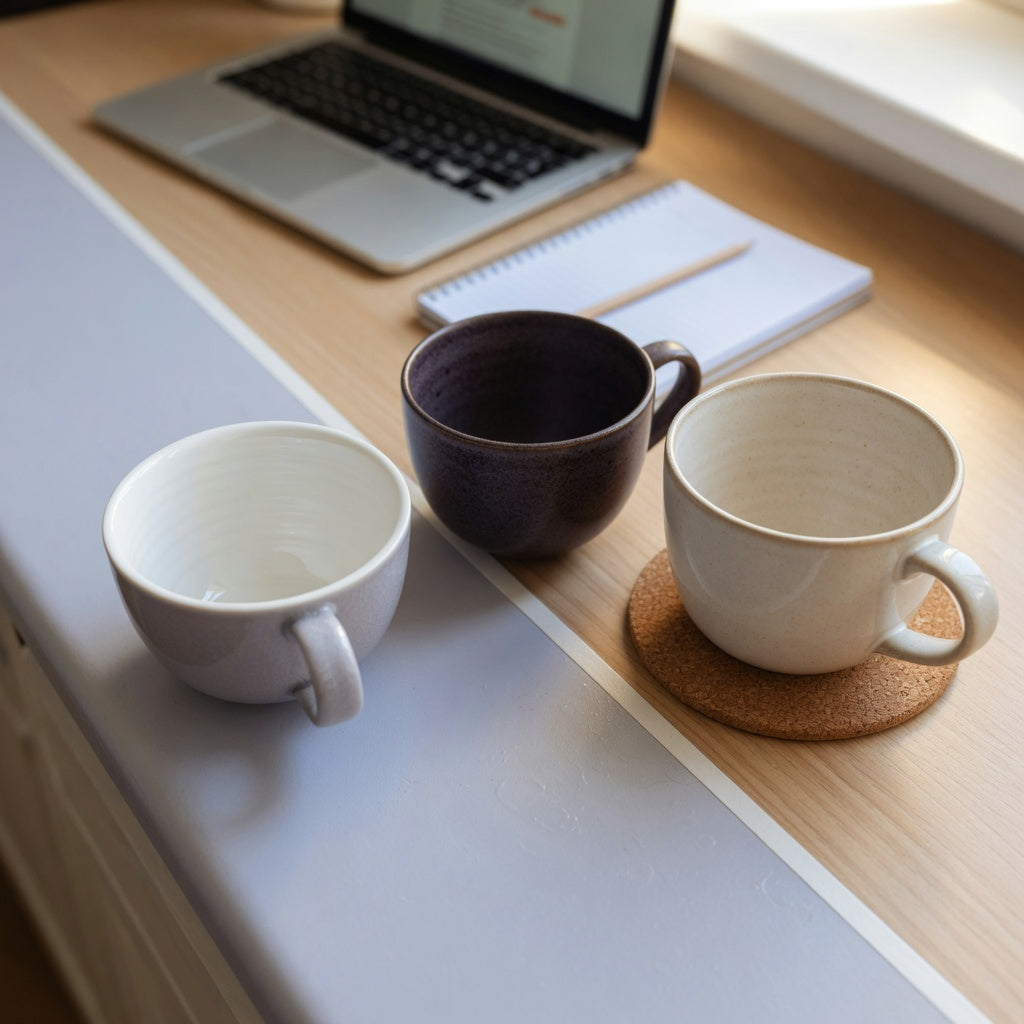
Coffee Mug Colors and Glaze Finishes: Choosing for Desk or Kitchen
Reading time: about 10 minutes
A customer ordered the same mug twice — once in cream, once in deep blue — then emailed us because the blue one, in her words, made the coffee taste stronger. She was not wrong, exactly. Nothing in the cup changed. Her perception did. That gap between how a glaze looks in a product photo and how it behaves on an actual desk is most of what we talk about when shoppers ask about coffee mug colors.
We sell ceramic mugs, so read this with that bias in mind. We pack them, we handle the returns, and we read the notes that come back — usually from someone who opened the box in a dim kitchen and found the glaze darker than the screen promised. What follows sticks to published sensory research, to what a glaze physically does to light, and to the point where color stops being cosmetic and becomes a food-contact question.
Does the color of your coffee mug actually change how the coffee tastes?
The chemistry stays put. Your rating of it does not.
The clearest experiment is a 2014 study in the journal Flavour. Researchers poured the same café latte into a white ceramic mug and a clear glass mug, and tasters rated it significantly more intense from the white one. A second experiment swapped in identical glass mugs wrapped in colored sleeves, and the coffee came back significantly less sweet from the white sleeve than from the clear or blue sleeve. The authors pointed to contrast: a dark drink against a bright white wall looks darker, and darker reads as stronger.
A 2019 study associated with the University of Oxford, 457 participants across three experiments, found that white, pink, yellow, and green cups shifted both expectations before tasting and ratings of sweetness and acidity afterward. Liking dropped when cup color and coffee profile disagreed with each other.
Two honest caveats. These are shifts in ratings inside controlled tastings, on modest samples — not new flavors appearing in the cup. Anyone promising that one mug color objectively improves coffee is selling past the evidence.
How do coffee mug colors prime sweetness, acidity, and warmth?
A 2019 review from the same Oxford research group describes cup color as a prime: it sets an expectation that can carry into the sip. The pattern our customers describe lines up closely enough to plan around.
- Pink tends to prime sweetness.
- Yellow and green tend to prime acidity or brightness.
- White raised perceived intensity and, in the sleeved-mug experiment, lowered perceived sweetness.
- Blue and clear glass read sweeter than white in that same experiment.
- Red has been linked in published work on cup color and perceived warmth to drinks being rated warmer than the same drink in yellow, green, or blue cups — again perception, not temperature.
The usable idea is congruence, not a magic color. A bright, fruit-forward light roast next to a green or yellow cup sends one coherent message. That same cup beside a heavy, chocolatey dark roast creates the mismatch that lowered liking in the Oxford work. If you drink one style most mornings, pick a color that agrees with it. If you rotate beans weekly, a neutral exterior with a light interior hedges better than committing to a strong hue.
Why the interior glaze matters more than the color on the outside
Buyer questions keep landing in the same place: the inside is where the drink lives. A white or light interior shows the true color of tea before you taste it — which is how most tea drinkers judge strength — and it makes a dried coffee ring or a milky film obvious, so you wash the mug instead of guessing.
The trade-off runs the other way. Dark interiors hide stains, genuinely useful if you drink black coffee and rinse rather than scrub. They also hide the drink, so you lose both the color check and the residue check. A dark exterior with a light interior is the compromise most of our repeat buyers land on. Browse the unique coffee mugs collection and open the interior shots rather than judging from the hero image, which is almost always the exterior.
Two details worth confirming on any mug: whether the interior uses the same glaze formulation as the exterior (a light-inside, dark-outside mug means two glazes, and they can age at different rates), and whether the rim is glazed or left bare. A bare rim is softer on the lip but more porous at the edge that touches your drink.
170 ml, 200 ml, or 440 ml: how size changes what a color does
Color reads differently at different scales, and photos hide this better than anything else. A saturated glaze on a small cup is an accent. The same glaze on a big mug becomes the loudest object on your desk. Our ceramic range covers three sizes, and each one pulls the color decision in a different direction.
- Retro Coffee and Tea Cup, 170 ml (about 6 fl oz): a short pour — espresso, cortado, a small tea service. At this scale a strong exterior or a contrasting rim reads as a detail rather than a statement, and a shelf of mixed colors looks deliberate. Confirm the interior glaze shade on the current listing before you commit.
- Pleated Coffee and Tea Cup, 200 ml (about 7 fl oz): the middle size, and the one where finish shows most. A pleated body catches light and separates a gloss from a matte glaze immediately. Check which glazes the listing offers and whether the surface is fully glazed.
- Morning and Night Coffee and Tea Mug, 440 ml (about 15 fl oz): the desk and long-session mug. Large interiors show rings and tannin film sooner, so a light interior here is a commitment to washing rather than a quick rinse. Verify the capacity against your usual pour on the listing.
One size cue shoppers consistently underestimate: footprint. A 440 ml mug takes noticeably more desk real estate than the 250 ml office mug most people picture, and if your coaster was bought for a small cup the base will overhang it. An unglazed foot ring can also scuff a wooden desk, which is a coaster problem, not a mug problem.
Desk mug or kitchen mug: where the color actually has to survive
A desk mug sits in view for hours. It gets photographed on video calls, it lives beside a keyboard, and it often waits too long between washes. Three practical consequences:
- Office lighting is warmer and dimmer than the window light in a product photo, so deep blues and greens read almost black. Ask for a photo in ordinary room light if you are matching a color to a workspace.
- A mug that appears on camera works better in a muted exterior; a saturated one pulls the eye away from your face.
- Long gaps between washes favor a light interior, because you see the film before it turns into a smell.
A kitchen mug is a shared object. Guests pull it from the cabinet, it gets used for tea as often as coffee, and a light interior pays off because whoever pours can judge strength at a glance. Our guide to the best ceramic coffee mug for a home office desk goes deeper on the desk side, and this capacity and footprint breakdown for desk mugs is the one to read if your pour sits closer to 12 oz than to our 440 ml.
Gloss, matte, crazing, and metallic rims: the finish changes the color you see
A glaze is glass. How it is fired changes how much light bounces back at you, and that changes the color before your coffee is even poured.
- Gloss reflects the room, so it reads lighter and cleaner and shifts with the light — a cream gloss near a window turns nearly white at noon.
- Matte scatters light instead of reflecting it, so the same pigment looks deeper and softer. It also shows water spots, cutlery scuffs, and tea film sooner. Matte finishes tend to show abrasion before gloss does, which matters if the mug goes through a dishwasher nightly.
- Crazing — the fine web of hairline cracks that can develop in glaze over years of hot-cold cycling — is far easier to spot on a light interior. That is a feature if you like knowing, and an irritation if you would rather not see it.
Metallic rims and color-changing finishes get a specific warning from us. We do not treat a metallic-rimmed mug as microwave-safe unless the listing says so in those words, and we suggest hand-washing rims and on-glaze decoration rather than assuming a dishwasher cycle is fine. Color-changing glazes are excellent gifts and awkward daily drivers: the effect depends on heat, and the thermochromic layer is usually the most fragile part of the mug.
Bright interior glazes and on-glaze decoration: the food-contact check most color guides skip
This is the part buyers rarely ask about until the mug is already in hand.
The California Department of Public Health is blunt: you cannot tell whether tableware contains lead by looking at it. The categories worth a closer look include bright colors or decoration on interior surfaces that touch food or drink — including the upper rim of a cup — and decoration sitting on top of the glaze rather than beneath it. Federal regulation at 21 CFR 109.16 adds that decorative ceramicware which appears suitable for food use is treated as food use unless it carries a conspicuous not-for-food-use warning or is otherwise made unsuitable for holding food.
In practice:
- Ask the seller for documentation on bright interior glazes and hand-painted rims, especially on handmade and imported ware.
- Treat anything sold as decorative-only as decorative-only, no matter how good it looks full of coffee.
- Focus your caution on the surfaces the drink contacts — interior and upper rim — rather than on a colored exterior.
- Prefer underglaze decoration and an undecorated rim if you want a lower-risk default.
We do not declare any mug lead-free in this article. That status belongs to a specific product listing and a maker's testing, not to a blog post or a glaze photo.
Frequently asked questions
Do coffee mug colors really change how the coffee tastes?
They change how you rate it, not what is in the cup. Published studies found the same coffee rated more intense from a white mug and less sweet from a white sleeve than a blue or clear one. Treat it as a real perceptual effect with modest evidence, not a flavor upgrade.
Should a coffee mug have a white interior?
If you drink tea or light roasts and want to judge color and strength, a white or light interior helps. If you drink black coffee, rinse instead of scrub, and dislike visible rings, a dark interior is more forgiving. It is a trade-off, not a rule.
Are dark coffee mugs harder to keep clean?
Easier to keep looking clean, harder to keep actually clean, because you cannot see the film forming. Dark interiors hide coffee oils and tea tannin for longer. If you want visual confirmation after washing, go light inside.
Can I microwave a ceramic mug with a metallic rim?
We do not treat a metallic-rimmed mug as microwave-safe unless the specific listing states it. Rims and on-glaze decoration are the parts most likely to be affected, and heat plus metal is not a combination to guess at.
Which size ceramic mug works best at a desk?
For a short, frequent pour, the 170 ml Retro cup keeps coffee fresh and the footprint small. For one long morning session, the 440 ml Morning and Night mug fits better. Check the interior photo on whichever listing you choose, since interior shade drives most of the daily experience.
Before you commit, run this short check:
- Which note do you want to reinforce — sweetness, acidity, or intensity?
- Is the interior light enough to read the drink, or dark enough to hide the ring you would rather not see?
- Will the mug sit in warm office light or under a kitchen window? Ask for a room-light photo if the color matters.
- Does the listed capacity match your real pour, not the pour you intend to make?
Then confirm the interior shade, the glaze type, and the capacity on the product page itself. Start with the full ceramic collection, compare interiors side by side, and buy the one whose inside you actually want to look at every morning.
More from our blog
Read more
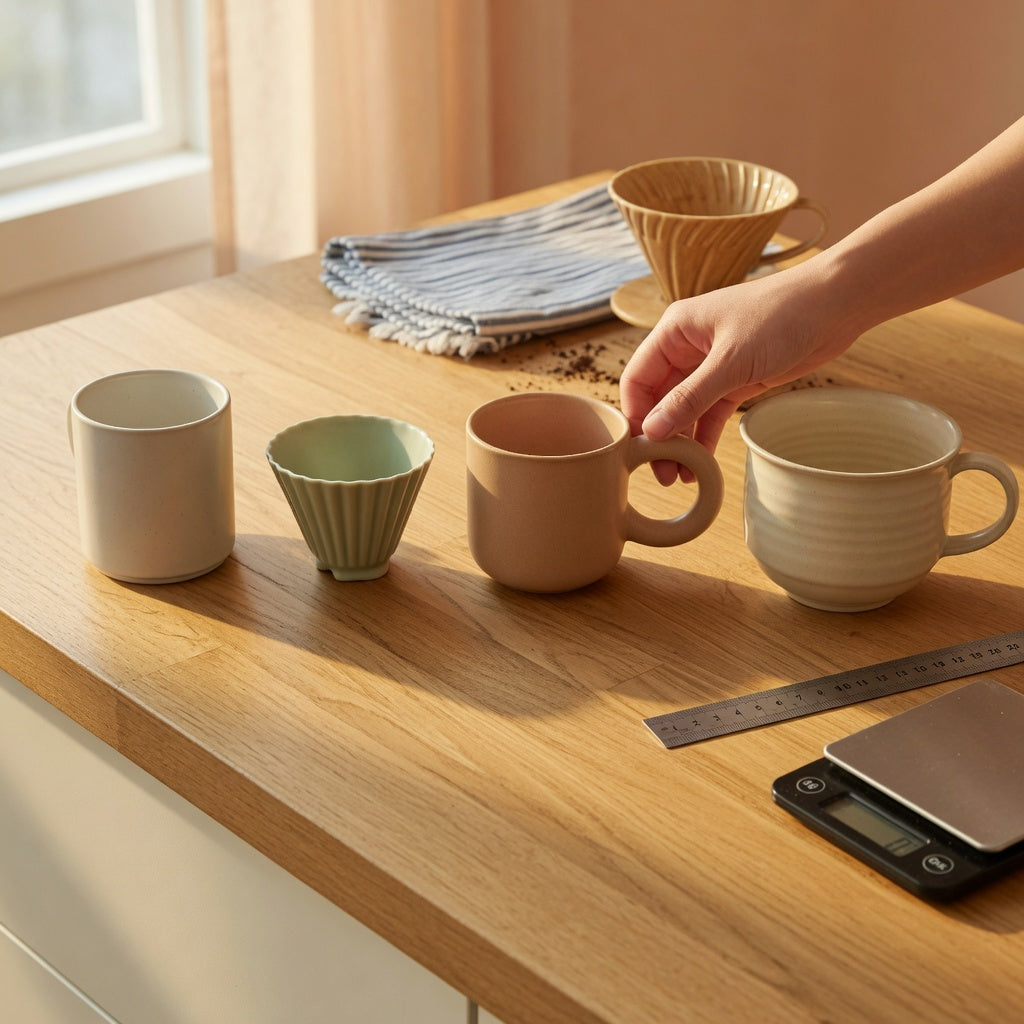
Ceramic Mug Shapes: Handle Geometry and Daily Coffee Fit
How cylinder, belly, tapered, pleated, and handleless bodies change rim comfort, heat loss, hand fit, and shelf space — plus which of our 200 ml, 250 ml, and 400 ml shapes suits which drink, and wh...
Read moreCeramic Mug Shapes: Handle Geometry and Daily Coffee Fit
How cylinder, belly, tapered, pleated, and handleless bodies change rim comfort, heat loss, hand fit, and shelf space — plus which of our 200 ml, 250 ml, and 400 ml shapes suits which drink, and wh...
Read more
Leave a comment
This site is protected by hCaptcha and the hCaptcha Privacy Policy and Terms of Service apply.