
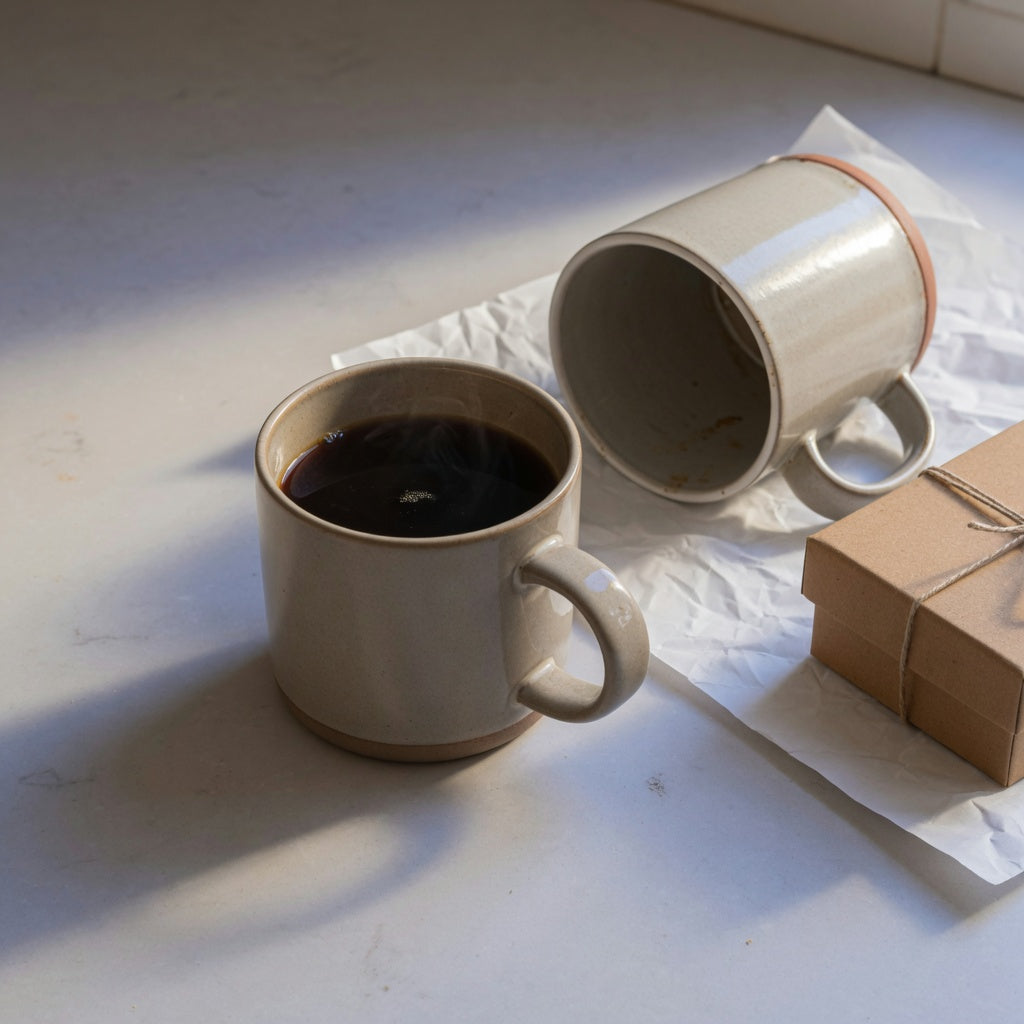
Ceramic Mug Gift for Coffee Drinkers: What to Compare
Reading time: about 14 minutes
The tissue paper is still on the counter when the real test starts. A finger hooks the handle, the mug lands beside the kettle, and the recipient checks whether Monday's pour will actually fit. That half-minute decides if a ceramic mug gift for coffee drinkers stays in the weekday rotation or becomes a pen cup by Friday. In our store, the next questions are almost always capacity, then rim and handle, then whether this listing says the piece can share the dishwasher they already run.
An open glazed mug is a table and desk object. It is a weak gift for coffee that lives in a car cup holder or a backpack. There is no lid, no seal, and no vacuum wall. Heat leaves through the ceramic, and a zipper or a hard brake can chip the rim in a week. If that commute is the real routine, an insulated bottle is the honest gift. Do not ask a ceramic cup to do a travel job.
Is a ceramic mug gift for coffee drinkers meant for the counter or the car?
Match the format to where the drink sits. Brewing at the kitchen counter, or parking a mug on an office desk between meetings, is what glazed ceramic is for. It rinses. It belongs in the dishwasher only when that exact page says so. It will not hold heat through a two-hour drive. In a car or on a train it is the wrong object: coffee sloshes, the wall cools, and nothing stops a spill when the bag tips.
We split those buyers on purpose. For one open cup meant for home coffee or tea at the table, start with our round coffee and tea mug and read the current listing for capacity, any material note, handle description, and microwave or dishwasher wording. The photograph is not a measurement. If a line is missing, treat that fact as unconfirmed. A similar mug on another site does not fill the gap.
If they care more about a graphic, an animal, or a landscape than a plain surface, compare shapes in our unique coffee mugs collection. Pick the design second. A striking exterior does not fix a handle that bites the knuckles or a foot that rocks on a laminate desk.
Which listed capacity matches black coffee, a short drink, or a latte?
Gift photos fill the frame and hide the liquid line. Read capacity in ounces or milliliters, then leave headspace. Nobody drinks a mug filled to the lip. Foam, a splash of milk, or a stir needs space above the coffee. A styled shot of a full mug often overstates what you can carry to the table without a spill.
A lab description sometimes gets mistaken for sizing advice. For lead-leaching criteria, cups and mugs are small ceramic hollowware commonly used for coffee or tea served above room temperature. They normally, though not exclusively, hold about 8 fluid ounces (240 milliliters) and have a handle. That figure describes typical ware in a test definition. It is not a recommended gift size, and a larger mug is not unsafe merely because it holds more than 8 ounces.
No federal source names a best capacity for drip coffee, milk drinks, or slow sippers. What we compare with customers is the pour they actually make:
- Black coffee or Americano. Most people want one full serving plus room to swirl, without a bowl so wide the surface cools across a huge face.
- Espresso, macchiato, or cortado. A large mug makes a short drink look lost and dumps heat into empty clay. A smaller cup keeps the proportion honest.
- Latte or cappuccino. Milk takes more volume than the coffee. A mug sized only for a straight drip serving will overflow once the milk goes in.
- Desk refills and iced coffee at a desk. A bigger mug means fewer trips to the pot, and also more weight. Iced drinks sweat onto papers without a coaster. An open ceramic mug is still a poor iced commute cup, because condensation plus no lid soaks a sleeve.
If the page never states capacity, do not estimate it from the handle in the photo. That silence is a reason to choose a listing that prints the number.
| How they drink | What the mug has to do | A poor match |
|---|---|---|
| Home drip or pour-over | Listed capacity with headspace and a stable base | A tiny espresso cup for a full pot pour |
| Short espresso drinks | A smaller interior so the drink is not lost | A wide bowl that cools a cortado |
| Latte or other milk drinks | Extra volume for milk and foam | A cup that only fits black coffee to the rim |
| Car, bike, or backpack | A sealed insulated bottle | Any open ceramic mug, including a pretty one |
Will the handle, rim, and foot survive a real kitchen?
Food-contact rules do not measure knuckles, lip comfort, or a wobble on a counter. Those details still decide whether the mug is in the sink on day eight or at the back of the cupboard.
Handle clearance should pass two or three fingers without scraping. A dainty loop looks tidy in a product photo and fails for larger hands, or for anyone who grabs a hot wall through a dish towel. Look at the join where the handle meets the body. Thin attachments are where we see stress cracks after a mug clips the sink edge. That chip usually shows up long before the pattern fades.
The rim should be smooth and even. Glaze drips, a gritty lip, or a sharp thin edge are the complaints that arrive after a few mornings, not in the unboxing photo. Some drinkers like a thicker rim because it feels steady. Others call the same rim clumsy. There is no lab score for lip feel. If this person already complains about paper cups and thin diner mugs, do not gift them a razor edge.
Balance changes once the mug is full. A heavy foot can feel planted on a busy desk. A wide mouth on a narrow base tips when someone reaches past a laptop. An unglazed foot ring is normal on a lot of tableware, and it is not, by itself, a safety failure. It should sit flat. Rocking on a level counter is a defect, not handmade charm. Buying online, you cannot see that rock in a straight-on photo. When the box arrives, set the empty mug down before you rewrap it.
Wall thickness is a trade-off, not a virtue. Thicker walls can slow how fast heat reaches the fingers and add a solid feel. They also steal interior volume and make a refilled desk mug heavier in one hand. Thinner walls can feel refined and will chip sooner at the rim against a faucet. Deep sculpted interiors, tiny mouths, and glued charms trap coffee oils. If you cannot wipe the inside in one pass, it will not stay in the rotation.
What stoneware, porcelain, and earthenware can and cannot tell you
Shoppers ask which clay keeps coffee hotter. FDA contaminant guidance does not rank stoneware, porcelain, and earthenware for heat retention, flavor, or chip resistance. We will not invent a minute count. If the gift has to stay hot in a car, stop looking at open ceramic.
When a listing names the body, this is the distinction we use:
- Porcelain is typically a fine, dense body, often bright under the glaze, and commonly high-fired. A thin rim can look crisp and chip if it hits another mug in a crowded sink.
- Stoneware is usually more opaque and heavier, and tableware versions are generally high-fired. The word does not promise survival after a drop on tile, and it does not state the ounce capacity.
- Earthenware is often lower-fired and more porous if the body is not fully vitrified. For drinking, the interior glaze has to be continuous. We are more cautious with rustic, low-fired pieces from makers we cannot identify.
Clay color does not reveal lead or cadmium in the glaze. A speckled matte mug and a glossy white mug can both be sound daily ware, or both be a poor idea, depending on formulation and firing. If the round coffee and tea mug page names a clay body, read that line. If it does not, leave the material unconfirmed.
Readers sorting a bright porcelain look from a heavier everyday cup can use our morning coffee mug comparison for the weekday routine. That is about how the mug is used, not a heat-retention ranking no agency has published.
When hot coffee meets glaze: lead, cadmium, and pieces to skip
Cups and mugs draw stricter attention than many decorative ceramics because the drink sits on the glaze, often hot, for the whole cup. A long dwell on a desk matters if the glaze was never properly made. That is a reason to avoid the categories regulators already flag, not a reason to fear every factory mug.
On cups and mugs, the FDA lead criterion is 0.5 micrograms per milliliter of leaching solution, and the limit is applied to any one of six units tested. Some ceramic foodware has leached significant lead from surfaces that touch food. The metal can move into food, and continued use of a leaching piece can contribute to chronic lead poisoning.
Cadmium is a separate limit, not a footnote on the lead test. FDA has reported significant extractable cadmium in both imported and domestic ceramic ware. Acid foods can draw it out, and continued use of a leaching piece could contribute to chronic cadmium poisoning. For small hollowware, the cadmium guideline is 0.5 micrograms per milliliter in any one of six units.
Firing is what locks a problem glaze, or fails to. If a glaze that contains lead is not fired at the proper temperature for the proper time, lead may stay available and contaminate food or drink. Washing or boiling will not remove it. A pretty exterior does not change that.
A lead-free label is not a lab report. FDA has found traditional pottery labeled lead free that still contained extractable lead comparable to lead-glazed pottery, in some cases above action levels. For a modern mug sold for everyday drinking, read what the seller states about food use. A sticker on an unmarked pot from an unknown maker is not testing. Shoppers do not have a simple official home method that verifies every imported mug beyond maker documentation or a proper laboratory test. A home swab that shows leachable lead means the piece should not be used for cooking, serving, or storing food or drinks.
Skip the gift, or ask for real documentation, when the piece is:
- Handmade, crude, or irregular, with no note on food-safe firing
- Antique or vintage
- Chipped, cracked, or worn through on the inside
- From a flea market, a street vendor, or an unknown maker
- Brightly decorated in orange, red, or yellow
- Marked not for food use, or sold as decorative only
Commercially factory-made everyday pottery is much less likely to have lead problems than those groups. That is a relative difference, not a guarantee on every mug sold online.
Pinholes and interior crazing are what handmade gifts raise after the box is open. There is no consumer eye-test that proves a pinhole is safe. Official caution centers on damaged, excessively worn, and improperly fired ware, not on a phone photo of a tiny pit. Fine crackle inside the glaze, especially on an old handmade mug that has lived in the dishwasher, is a reason to stop drinking from it. Stain collects in those lines. If you cannot explain how the piece was fired, do not give it for coffee.
Microwave metal, a hot wall, and dishwasher silence
In our store we treat microwave use as a listing fact. If the page does not say the mug is microwave safe, do not test that theory with a full cup. Microwaves are reflected by metal, pass through glass, paper, plastic, and similar materials, and are absorbed by food. Ceramic containers are used because the energy is meant to pass through them. A metallic rim, gold luster, or a sheet of foil is a different story. Reflected microwaves can heat unevenly and may damage the oven. If the listing is silent about a metal band, leave it out of the microwave.
The wall can still burn a hand. Heat moves from the drink into the ceramic, so the container can become hot even when the microwave energy is not supposed to stay in the mug. Customers describe the outside feeling hotter than the coffee after a long reheat. Use a towel or a shorter time. A mug that stays cool does not prove anything about lead or cadmium. Temperature and glaze chemistry are separate questions.
Plain water has its own burn risk. FDA has received reports of burns when superheated water erupted from a clean cup after microwave heating. The surface can look still. Lifting the cup, or stirring in instant coffee, can trigger a violent boil-over. Adding instant coffee or sugar before heating greatly reduces that risk. Stay inside the oven maker's suggested times. Most microwave injuries in that guidance are heat burns from hot containers, overheated food, or exploding liquids, not radiation injuries.
Dishwasher durability is also a listing question. There is no consumer federal cycle grade for printed or metallic decoration that matches the leaching limits above. In our experience, fading gold lines and lifted prints are what turn a pretty unboxing into an annoyance after a month of nightly loads. If the page does not say dishwasher safe, hand-wash. Silence is not permission, and a top-rack habit will not save a luster rim the maker never approved. Check that wording on the specific page, including pieces from the unique coffee mugs collection, before you assume the gift can join the rest of the kitchen.
After the unboxing: a neutral daily mug or a statement piece?
A neutral glaze wins when the shelf is already crowded and the dishwasher runs nightly. A statement piece wins when they like looking at the mug and the handle still clears their grip. Out-of-the-box charm is not week-twelve comfort. If the mug is mainly for display beside the cookbooks, treat it as decor and read our notes on unique coffee mugs chosen for the shelf before you judge it as a drinking cup.
A box and a bag of beans are presentation. They do not change capacity, firing, or appliance labels. Beans go stale. The mug remains, so spend the decision there. Shipping breakage is a packing problem, not proof that ceramic is a bad gift. What matters after the box arrives is whether the rim, handle, and interior glaze survived intact.
Ceramic is not the gift for a cup-holder commute, for keeping coffee hot for hours, or for unmarked vintage ware you cannot trace. It is a strong gift for someone who brews at home or parks a mug on a desk and will actually wash it.
Before you buy, walk this list:
- The drink lives on a counter or desk, not in a commute cup holder.
- The listing states capacity, and that size matches black coffee, a short espresso drink, or a milk drink with headspace.
- The handle clears the fingers, the rim is smooth, and the foot sits flat once you can check it.
- The interior glaze is intact, and the piece is sold for food use, not as decoration only.
- You are skipping vintage, damaged, unknown handmade, and bright orange, red, or yellow ware unless food-contact documentation is real.
- Microwave and dishwasher statements are on this listing, especially with metal, luster, or a delicate print.
- The look is one they will still want after detergent, not only in the unboxing photo.
For one home mug, open the round coffee and tea mug and confirm the facts printed on that page. If the drinker wants a clearer design difference, scan unique coffee mugs and run the same checks.
Frequently asked questions
What should I compare before buying a ceramic mug gift for coffee drinkers?
Compare where they drink, the listed capacity with headspace, handle clearance, rim comfort, and a stable base. Then check that the interior glaze is intact and whether this exact listing says microwave safe or dishwasher safe. A pattern you like is the last filter, not the first. Skip open ceramic entirely if the coffee rides in a car cup holder.
Is about 8 ounces the right gift size because test definitions describe cups that way?
No. The roughly 8 fluid ounce figure is how cup and mug hollowware is typically described for leaching tests, and it is not exclusive. Choose the size that matches black coffee, a short espresso drink, or a latte, and leave room below the rim. If the listing hides capacity, pick a page that prints it.
Does a lead-free label mean a ceramic mug is safe for hot coffee?
Not by itself. Lead can remain available if a lead-bearing glaze was not fired correctly, and traditional pottery sold as lead free has still leached lead above action levels in FDA findings. Favor commercially made ware sold for drinking, and avoid antiques, worn interior glaze, unknown makers, and anything marked not for food use.
Why can the mug feel hotter than the coffee after microwaving?
Only microwave a mug the listing marks as microwave safe, and keep metal and foil out. The container can heat up from the drink even when microwaves are meant to pass through ceramic. A cool wall does not prove the glaze is free of lead or cadmium, and a very hot wall is a burn risk, not a safety badge.
Should I gift a handmade mug with pinholes or interior crazing?
Do not assume a pinhole in a photo is either normal or dangerous. There is no consumer eye-test that settles it. Interior crazing, chips, or glaze worn through on an old handmade piece are reasons to keep it off the coffee shelf, especially after years in the dishwasher. When the firing history is unknown, choose a mug sold for everyday food use instead.
More from our blog
Read more
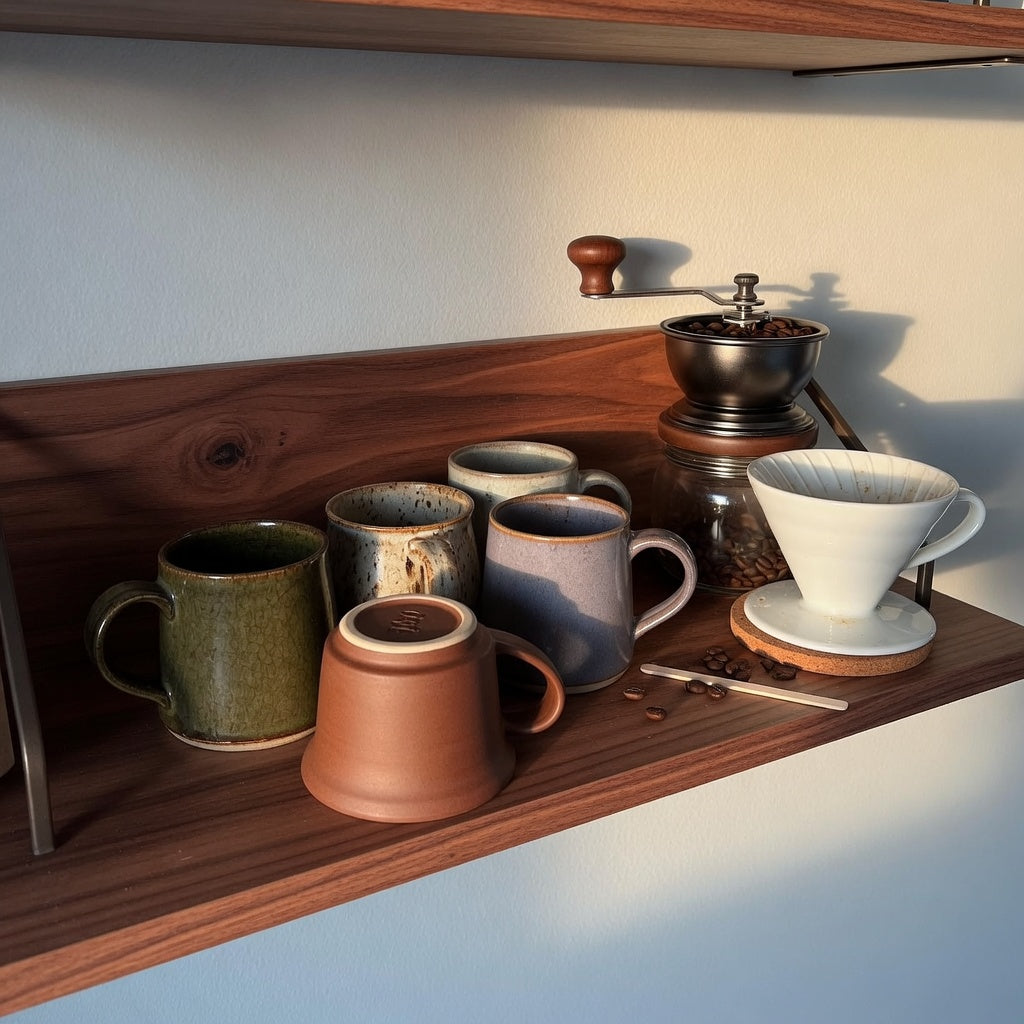
Home Decor Ceramic Mug: Safety, Fit, and Shelf Use
A home decor ceramic mug is often chosen for the shelf and only later questioned as a cup. Compare food-contact warnings, glaze risk, handle comfort, listed capacity, and display habits that chip r...
Read more
Desk Decor Coffee Mug for Coffee Lovers: What to Compare
A mug that looks right on a desk still has to hold a real pour, clear a keyboard, and survive the wash you actually use. We compare capacity, handle fit, food-contact checks, print care, and gift t...
Read more
Leave a comment
This site is protected by hCaptcha and the hCaptcha Privacy Policy and Terms of Service apply.