
Ceramic Mug Desk Tidy: What to Compare Before You Buy
Reading time: about 8 minutes
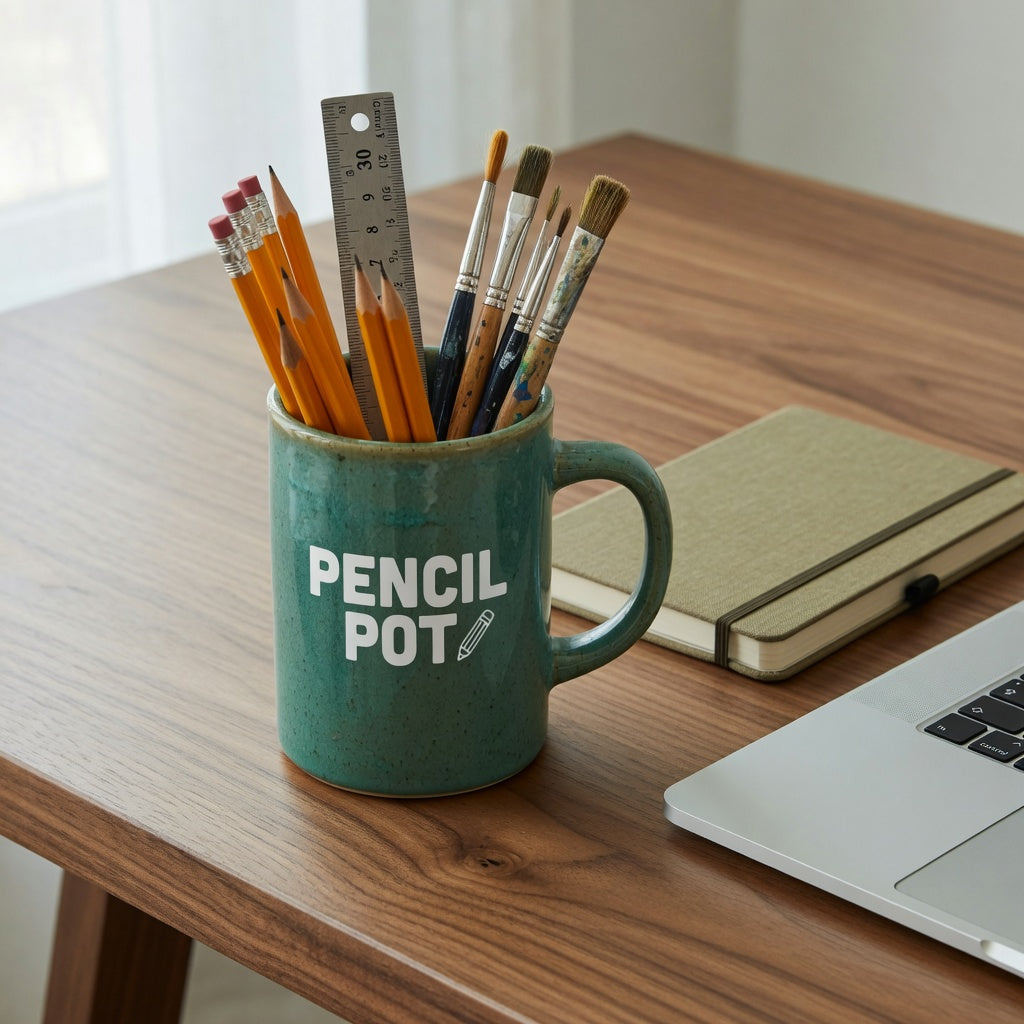
The most-used desk tidy in most homes was never sold as one. It's the mug that survived a cupboard clear-out and got reassigned to pen duty. We know the pattern from our own order book: a customer buys a mug for their morning coffee, then emails a few weeks later asking whether the same shape comes taller — because the long scissors standing in the repurposed one keep tipping out. That gap, between a mug that merely holds pens and a ceramic mug desk tidy that genuinely organises a workspace, is what this guide closes.
What exactly is a ceramic mug desk tidy?
The phrase covers three different products, and knowing which one you're comparing matters more than colour or pattern:
- A repurposed drinking mug. One open cavity, no compartments. Free if your cupboard cooperates, and for a dozen pencils it's the right answer.
- A mug-shaped tidy sold as deskware. An oversized ceramic piece, sometimes with divider inserts or tool slots, marketed as a desk accessory rather than tableware.
- A traditional compartment desk tidy. The British stationery-cupboard classic with built-in sections — what American listings call a "desk organizer". Search both terms or you'll miss half the market.
The single-cavity mug style wins on depth: long items sit upright and out of sight. It loses badly on small items — paperclips, eraser caps and SIM tools all sink into one unruly pile at the bottom. If your desk clutter is small and varied, a compartmentalised organiser is the better tool. A mug-shaped ceramic desk tidy is the better object.
Which compartment size fits your pens, brushes, and scissors?
Listings rarely print the two numbers that decide the purchase, so measure before you shop: interior mouth diameter and interior depth. Exterior height always overstates usable space — ceramic walls thicken toward the base, and a divider insert eats another centimetre or two.
| What you're storing | What to check | Where buyers get caught out |
|---|---|---|
| Pens and pencils | Mouth width versus how many you'll load | Tapered walls let long pens fan out and look messy from above |
| Makeup or paint brushes | Interior depth, if storing bristles-up | Pigment and powder residue building up inside the glaze |
| Scissors, ruler, letter opener | Depth relative to the longest handle | Long items raise the centre of gravity and tip a light tidy |
| Cables, keys, chargers | Base weight and width | Metal keys knocking against ceramic — noisy, and it wears the glaze |
Our counter rule: whatever you store tallest, the tidy's interior should be at least a third as deep as that item is long. Any shallower and you'll fight top-heaviness every time you pull something out.
Put numbers on it. A standard 30 cm ruler needs roughly 10 cm of interior depth before that rule is satisfied — and almost nobody measures before buying.
Ceramic, plastic, wood, or metal: which material earns the desk space?
- Ceramic and stoneware. The heft is functional. A loaded ceramic pot doesn't slide across the desk or topple when you yank a marker out one-handed — exactly what light pen cups do. Trade-offs: it chips on a hard floor, it costs more to ship, and an unglazed foot ring can dull soft desk finishes.
- Plastic. Cheapest, and most likely to offer true compartments. But fill a light cup with a few long items and it tips; two years of scratches and yellowing later, it reads junk drawer rather than workspace.
- Wood. Warm and gentle on desk surfaces, but open grain drinks ink from a leaky pen and swells around damp brushes.
- Metal mesh. Cheap, with full visibility of contents — yet sharp edges scuff pen barrels and mesh bottoms let slim items wedge or drop through.
In our experience, ceramic suits one specific buyer best: someone storing a modest number of longer items in a fixed spot, who wants the tidy to look intentional rather than temporary.
Can you still drink from a mug you've been using as a desk tidy?
This is the question we get more than any other, and it has two separate answers.
First, the glaze. Tableware and decorative ceramics are held to different standards. Regulators including the FDA have warned for years about lead in some glazed ceramics, which is why genuine drinkware must meet food-contact requirements while a piece labelled "for decorative use only" does not. If a mug-style tidy carries a decorative-only notice or a chemical exposure warning (common on imported pieces sold in California under Proposition 65), it's a pen pot, full stop. Listings don't always state this plainly, so read the product page before drinking from anything sold as deskware — including ours: our mugs are sold as coffee and tea drinkware, but glaze and care specifics live on each individual listing, so confirm them there.
Second, the contents. Even a fully food-safe mug that has spent a year collecting pencil graphite, dust and eraser shavings needs a proper wash before it touches your espresso: warm soapy water, a check of the interior for residue, and a full dry.
Which mug shapes work as a desk tidy — and when should you buy something else?
Map your desk situation to the shape before you commit:
- You store long items — rulers, kitchen scissors, long brushes. You want depth and straight-ish walls so handles don't splay. A tall profile like our Landscape tall coffee tea mug is the shape category to shortlist; the name tells you the silhouette and the listing gives the numbers, so compare its height against your longest tool before ordering.
- You want one stable pot for a mixed handful — pens, a marker, small scissors. A wider body lowers the centre of gravity and a broad mouth lets you grab without knocking. Our round coffee tea mug is the silhouette we'd point to for that job.
- You're still deciding. Height and mouth width vary far more than people expect across our unique coffee mugs collection. For desk duty, prioritise mouth width and base weight over handle comfort — the handle mostly becomes a cable hook anyway.
Honest limits: if your desk collects small loose items (paperclips, staples, erasers), skip the mug format entirely and buy a compartmentalised organiser. If you hot-desk or pack up weekly, the weight that stabilises ceramic becomes a daily penalty. And if you want one vessel doing both jobs, don't — dedicate it. A mug that alternates between coffee and pens never feels properly clean for either.
How do you stop a ceramic desk tidy scratching your desk?
- Check the base first. A fully glazed bottom is smooth and generally safe on hard surfaces. An unglazed bisque foot ring is mildly abrasive and, over months, can dull matte or oiled wood.
- Add felt. Self-adhesive felt pads — the kind sold for chair legs — cost very little and solve both scratching and the clonk of setting the mug down.
- Lift, don't slide. Most damage we hear about comes from dragging a ceramic base across lacquer or glass a few centimetres at a time.
- Wash it monthly. Desk dust builds a dull film inside any vessel. Treat it like drinkware: warm soapy water, dry upside down. For pieces with metallic decoration or glued-on details, hand-wash and check the listing's care note first.
We go deeper on day-to-day care in our guide to the desk-size ceramic coffee mug, and fit measurements get a full walkthrough in our seven-point checklist for a narrow tall ceramic desk mug.
Is a ceramic mug desk tidy a good gift?
For anyone setting up a home office, yes — a desk tidy gift is rare in being decorative, useful and personal all at once. Sort three things before ordering: whether the seller offers personalisation and how much it adds to dispatch (hand-painted and engraved work often takes longer, so ask rather than assume); whether the glaze is drinkware-grade, in case the recipient uses it for coffee; and whether the shape suits their desk — a narrow footprint for crowded desks, something wider for a spacious one. Our ceramic mug gifting checklist walks through the full decision.
Five checks before you order a ceramic mug desk tidy
- Measure your longest desk item, then shortlist tidies whose interior depth is at least a third of that length.
- Count what you'll store — a dozen pens needs roughly double the mouth opening of six.
- Turn the piece over, or zoom the listing photos, and check the base: fully glazed or bare bisque.
- Decide its job — desk only, or desk and drinks — and verify the glaze note on the current listing.
- Plan for felt pads on arrival. They're the cheapest upgrade in desk care.
When your shortlist is down to two shapes, compare heights and mouth widths across our unique coffee mugs side by side — that comparison settles the argument faster than any spec sheet.
Frequently asked questions
What actually fits in a ceramic mug desk tidy?
Comfortably: eight to a dozen pens or pencils, a handful of makeup or paint brushes, a standard pair of scissors handles-down if the interior is deep enough, a wooden ruler, markers, or a coiled charging cable. Poorly: paperclips, erasers and other small loose items, which sink to the bottom and need fishing out daily.
Will a ceramic mug desk tidy scratch my desk?
Usually not, but check the base. A fully glazed bottom is smooth; an unglazed foot ring is mildly abrasive and can dull soft finishes over time. Two felt pads on the base, plus the habit of lifting rather than sliding, remove the risk almost entirely.
Can I drink coffee from a mug that's been holding pens?
Yes, if two things check out: the glaze was made for food contact (read the listing — decorative-only or warning-labelled pieces should never be drunk from) and the mug gets a proper wash first. Warm soapy water, inspect the interior, dry fully.
Can a ceramic mug desk tidy go in the dishwasher or microwave?
Only if the listing says so. Genuine drinkware normally carries dishwasher and microwave guidance on its product page; pieces sold as deskware or decorative often don't, and metallic decoration or glued details should be hand-washed regardless. Where the listing is silent, hand-wash in warm soapy water — it takes a minute and removes the guesswork.
Is a mug better than a compartment desk tidy?
For longer items and a cleaner look, yes — depth keeps everything upright and hidden, and a heavy base resists tipping when you pull a marker out one-handed. For many small categories of bits, no: a compartment organiser keeps paperclips separate from USB sticks in a way one open cavity never will.
Read more

Cuppa Tea Mug Guide: Sizes, Materials, and Care for a Proper Brew
The cuppa tea mug, explained by people who sell and ship them: real capacities in oz and ml, how bone china, stoneware, and glass compare, what Prop 65 labels actually mean, and which style fits fa...
Read more
Coffee Corner Shelf for Tall Mugs: 5 Things Buyers Should Compare
Compare tier clearance, corner depth, weight load, and machine stacking height before buying a coffee corner shelf for tall mugs — with the same measuring checklist we walk customers through in-store.
Read more
Leave a comment
This site is protected by hCaptcha and the hCaptcha Privacy Policy and Terms of Service apply.