
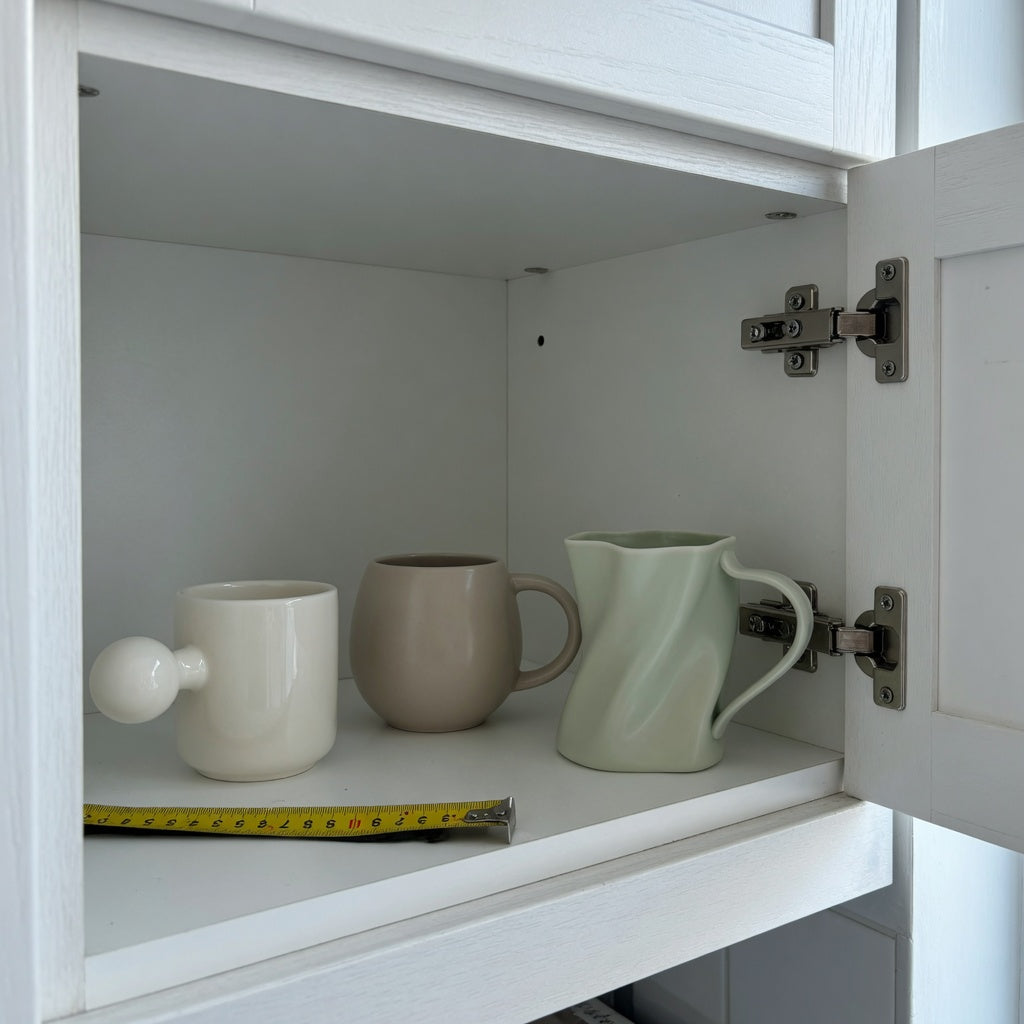
Ceramic Coffee Mug With Handle Storage Fit Guide: 3 Shapes
Reading time: about 10 minutes
A mug's base can sit fully on a shelf while the cabinet door still refuses to close. The contact point is often farther out: the handle touches the door, a hinge, or the mug beside it. Our ceramic coffee mug with handle storage fit guide starts with that overlooked outer edge, then compares the visible forms of the Ball-Handled Coffee Tea Mug, Round Coffee Tea Mug, and The Flow Coffee Tea Mug.
We sell and handle this category, and the storage questions we hear are practical. Will the mug clear a cabinet face frame? Is its rounded body wider than its base? Can the handle be turned without moving everything nearby? The current listings identify ceramic and show three distinct silhouettes, but product photography should never be converted into made-up measurements. Use dimensions and capacity shown on the exact product page when available; otherwise, treat the photos as evidence of shape, not scale.
Ceramic coffee mug with handle storage fit guide: which clearances matter?
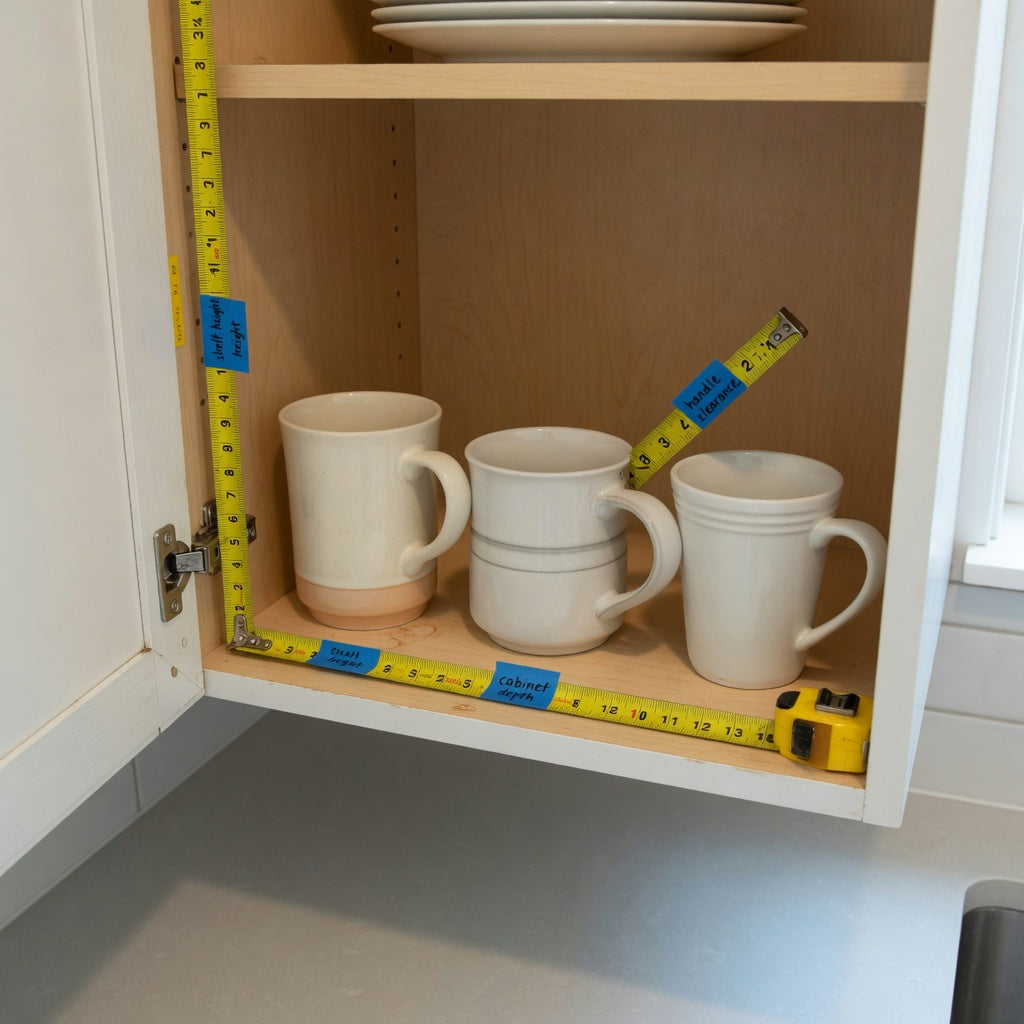
A handled mug occupies a three-dimensional outer envelope. Measuring only the circular base misses the body at its widest point and the handle at its farthest edge. For a closed cabinet, record these separate limits:
- Usable depth: Measure from the back panel to the inside plane of the closed door, not merely to the front edge of the shelf.
- Opening width: Measure the narrowest point between the cabinet face frame, door hardware, or side wall. The shelf interior may be wider than its opening.
- Usable height: Measure from the shelf surface to the underside of the shelf above, then allow enough clear space to lift the mug rather than dragging its rim forward.
- Maximum body width: Look for the vessel's fullest point. On a rounded mug, that point may be above both the base and the rim.
- Total handle projection: Use the distance to the outermost handle edge, not the size of the opening inside the handle.
Orientation changes the result. Turning a handle sideways usually increases the space used across the shelf; turning it toward the door can increase required depth. A diagonal position may fit an isolated mug, but it is a poor plan for a shared office cupboard where neighboring items regularly move. We recommend measuring the orientation you will actually use rather than assuming the mug can always be rotated later.
How do the three current mug outlines change the fit check?
All three products are listed as ceramic mugs, but their visible outlines direct attention to different measurements. This is a shape comparison, not a smallest-to-largest ranking. We do not claim that one uses less cabinet space unless comparable maximum dimensions support that conclusion.
| Current style | Visible form to inspect | Priority measurement | Do not assume |
|---|---|---|---|
| Ball-Handled Coffee Tea Mug | Distinct ball-form handle beside the ceramic vessel | Outermost ball edge in the intended shelf orientation | The decorative handle will clear a narrow side bay |
| Round Coffee Tea Mug | Rounded vessel profile with a side handle | Fullest body width plus total handle projection | The base or rim represents the mug's maximum width |
| The Flow Coffee Tea Mug | Flowing, sculptural body-and-handle outline | Maximum width and depth across the complete profile | An integrated-looking form automatically has the smallest footprint |
Where does the Ball-Handled shape make sense?
Situation: You have an open shelf, a dedicated cabinet section, or clear space beside the mug, and the ball-form detail is part of the reason you are buying it. Why it may fit: Open placement removes the cabinet door as a possible contact point and gives the projecting contour room beside neighboring pieces. Next step: Check the Ball-Handled product page for current dimensions and listed capacity, then compare the outermost ball edge with your available side or depth clearance.
This is not a reliable blind choice for a narrow, fully occupied cabinet. It should not be treated as compatible with a hanging hook or mug tree based on appearance alone either; that decision requires the clear handle opening and the hook dimensions.
What needs checking on the Round shape?
Situation: You plan single-layer shelf storage and have measured room for the vessel at its fullest point. Why it may fit: A rounded profile can be assessed against a defined cabinet bay once its maximum body width is known. Next step: Review the Round Coffee Tea Mug listing and compare any stated maximum dimensions with your shelf, including the handle rather than relying on base diameter alone.
The Round shape is not a good candidate for storage estimates made from the foot or rim. It also should not be assumed to nest with another mug. Unless a listing specifically establishes stackability, plan for each handled ceramic mug to occupy its own shelf position.
How should you plan space for The Flow?
Situation: You want a sculptural mug for an open display or have enough verified cabinet space for its complete outline. Why it may fit: The flowing body-and-handle profile is the visible design feature, so it can be evaluated as one continuous outer shape. Next step: Use The Flow product page to check the current capacity and any available measurements, then compare the greatest width and depth with your storage limits.
We would not call The Flow a space-saving option from photos alone. A handle that appears visually blended into the body can still extend the mug's total width or depth. Buyers with a strict cabinet limit need an external measurement, not an impression based on the product image.
Which shape belongs on a closed shelf, open display, or office cupboard?
The storage location changes which trade-off matters most. We use the following situation-to-product logic when helping shoppers narrow the options:
- Closed kitchen cabinet with a face frame: Prioritize the mug with verified maximum width, depth, and height that stay inside the narrowest opening. The visible Ball-Handled, Round, and Flow forms each create a different point to measure, so no shape gets an automatic fit.
- Open kitchen shelf or coffee station: A Ball-Handled mug is a reasonable candidate when its distinct side detail is the priority and neighboring clearance is available. Confirm that the shelf still supports the entire base and that the mug will not project into a walkway.
- Shared office cupboard: Choose a shape that fits in a repeatable orientation without borrowing space from the next person's mug. A dedicated measured slot is more dependable than turning the handle diagonally after every use.
- Gift for someone whose cabinets you have not seen: Do not promise storage fit. Compare the visible silhouettes in our unique coffee mugs collection, then choose for open display or ask the recipient for shelf dimensions if closed-cabinet storage matters.
- Hanging rail or mug tree: Treat compatibility as unresolved until both the handle opening and hook geometry are known. A visible side handle does not establish that it will pass over a particular hook.
For very shallow shelving, a handled mug may simply be the wrong format. A handle-free cup or a lower-projection shape can suit that space better. Choosing a different form is more practical than leaving a cabinet door partly open or permanently relocating the mug to a crowded counter.
Why do ceramic material and listed capacity not settle cabinet fit?
Each current listing identifies ceramic, which matters for storage because the body and handle are rigid. They do not fold or compress into a smaller space. Ceramic material, however, does not tell you the mug's exterior dimensions, handle projection, or ability to stack.
Listed capacity answers a separate question: how much liquid the vessel is intended to contain. It is not a shortcut for external size. A taller, narrower vessel and a shorter, rounder vessel can have similar internal volume while demanding different shelf height and width. That is why our store treats capacity and storage measurements as two separate rows in the comparison.
- Confirm the currently listed capacity for the exact product or option you are considering.
- Find total height, maximum body width, and overall depth if the page supplies them.
- Check whether a stated width includes the handle. If that is unclear, do not add a guessed projection.
- Compare the resulting outer envelope with the usable cabinet measurements, including the closed door and hinge area.
The ceramic label alone also does not establish comfort, strength, heat retention, or dishwasher and microwave suitability. Those points require explicit information on the relevant product listing. This guide makes no claim about them.
What should you do when a listing has no complete dimension set?
Product photos can reveal a rounded belly, a projecting ball, or a flowing outline, but cropping and image scaling prevent a dependable inch-for-inch comparison. Do not measure the image on a phone screen or estimate total size from capacity.
- Write down the hard limits of your cabinet before browsing.
- Measure a mug you already own from its farthest body edge to its farthest handle edge as a physical reference.
- Compare the reference mug's outline with the product photos only to identify likely pressure points, not to prove fit.
- Ask our team whether a current overall measurement is available if the fit limit is strict.
A familiar mug can help explain the space, but it cannot certify that a new shape will fit. If one critical external dimension remains unknown, the honest result is unresolved. This is especially relevant for gifts and fitted cabinet cubbies where there is little room for error.
Shelf-fit checklist before you add a mug to cart
Use this ceramic coffee mug with handle storage fit guide as a reject-first checklist. A shape should stay on your shortlist only after the relevant storage limits are accounted for.
- Measure clear depth to the inside plane of the closed cabinet door.
- Measure the narrowest opening, including the face frame and hinge intrusion.
- Record shelf height and the path needed to lift the mug out.
- Identify the body's widest point rather than using only the base.
- Decide whether the handle will face sideways, forward, or backward.
- Compare total handle projection in that orientation.
- Verify listed capacity separately from storage dimensions.
- Plan single-layer storage unless stackability is explicitly established.
If the Ball-Handled outline exceeds your side allowance, the Round body's fullest point exceeds the bay, or The Flow's complete profile cannot be verified, switch candidates. The right next product is the one whose actual outer envelope fits, not the one that merely looks compact in a cropped image.
Frequently asked questions
How do I use the ceramic coffee mug with handle storage fit guide if dimensions are missing?
Measure your cabinet's hard limits and a similar mug you already own, then use the product photos only to compare visible contours. Do not calculate measurements from image pixels or listed capacity. For a strict fit, ask our store whether current overall dimensions are available before ordering.
Which current ceramic mug is best for a shallow cabinet?
There is no supportable winner without comparable overall depth measurements in the same orientation. Check the Ball-Handled mug's outer ball edge, the Round mug's fullest body point, and The Flow's complete sculptural profile. Choose only a product whose verified depth stays inside the closed-door limit.
Does mug capacity tell me how much shelf space it needs?
No. Capacity describes internal liquid volume, while shelf fit depends on external height, maximum body width, base footprint, and handle projection. Two differently shaped vessels can require different cabinet space even if their listed capacities are similar.
Can I stack these ceramic coffee mugs?
Do not assume stackability from material or photos. Plan for single-layer storage unless the exact product listing states that the design stacks and provides enough information to verify how the rim, base, and handle align.
Are these ceramic mugs dishwasher-safe or microwave-safe?
Ceramic material alone does not establish either form of suitability. Check the care information on the exact current product page, and ask our team before use if the listing does not state it clearly.
Next step: Write down your clear cabinet depth, narrowest opening width, and usable height. Compare those limits with the exact product pages above; if a critical measurement remains unknown, pause and ask our team or review the current unique coffee mug shapes for a more suitable outline.
More from our blog
Read more
Cafe Au Lait Mug Storage Fit Guide: 3 Current Mugs Compared
Compare verified 400 ml, 440 ml, and 480 ml capacities against shelf height, cabinet depth, handle projection, and removal clearance. See which CoffeifyMug option belongs on your shortlist without ...
Read more
Lungo Coffee Cup Storage Fit Guide: 3 Shapes Compared
Compare the verified 170 ml, 200 ml, and 270 ml capacities without mistaking volume for external size. We explain how to check shelf height, cabinet depth, handle clearance, stacking plans, and eve...
Read more
Leave a comment
This site is protected by hCaptcha and the hCaptcha Privacy Policy and Terms of Service apply.