
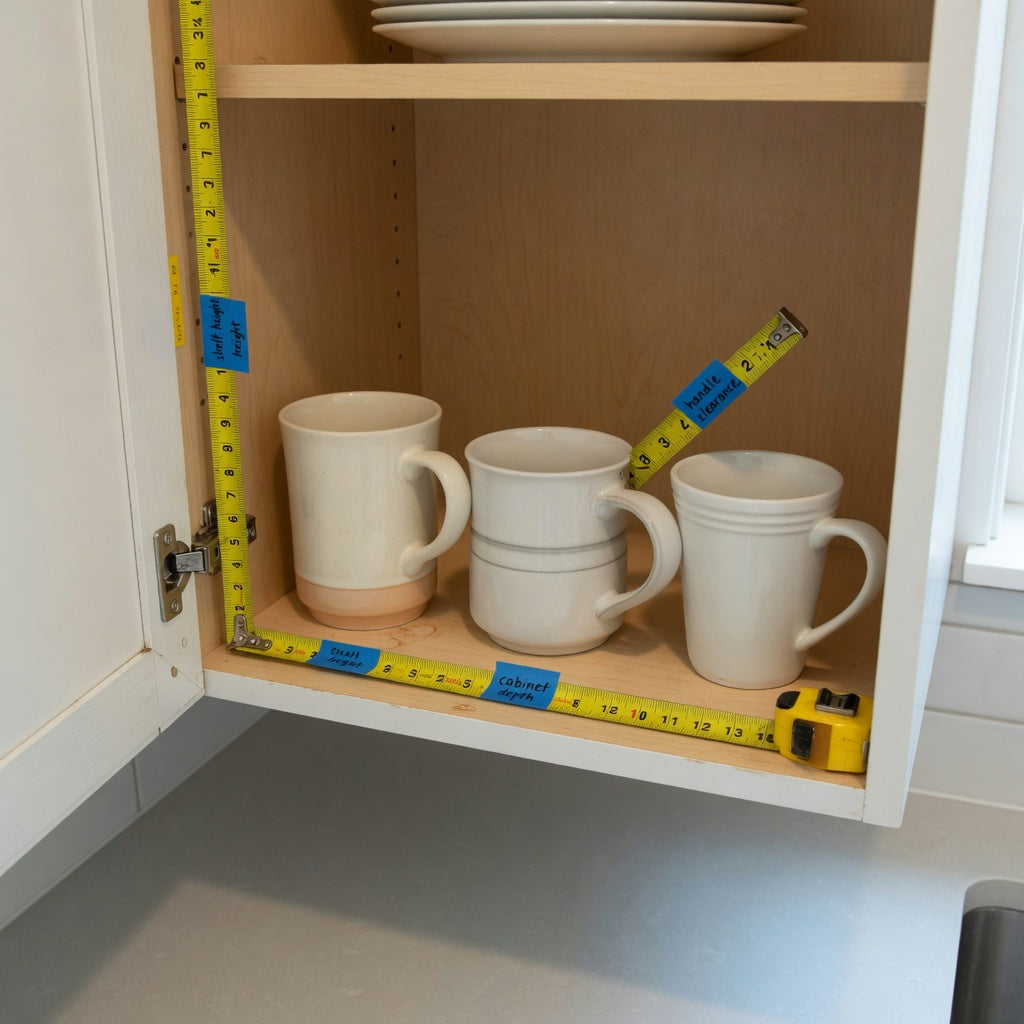
Cafe Au Lait Mug Storage Fit Guide: 3 Current Mugs Compared
Reading time: about 10 minutes
A mug can sit neatly on a shelf and still be a poor cabinet fit. The handle may catch the face frame, the door may touch its outer edge, or there may be too little room to lift the mug over the shelf lip. This cafe au lait mug storage fit guide focuses on those everyday storage problems instead of assuming that serving capacity tells you the exterior size.
In our store, we compare three current options: The Flow at 400 ml, Morning and Night at 440 ml, and The Rock at 480 ml. Those capacities are verified comparison points. They are not substitutes for height, body width, base footprint, or overall width including the handle. You can also view the three designs within our unique coffee mugs collection while checking the current listing photographs and any dimensions provided there.
Cafe au lait mug storage fit guide: measure the cabinet opening first
Cabinet fit starts at the opening, not at the empty space farther inside. A mug might have room once it reaches the shelf but still fail to pass a narrow face frame or hinge. In our experience, this retrieval path is the detail shoppers are most likely to miss.
Record these measurements in the same unit before comparing products:
- Clear shelf height: Measure from the shelf surface to the underside of the shelf or cabinet top above it. Include the vertical room needed to lift and remove the mug rather than measuring only its resting position.
- Usable cabinet depth: Measure from the back panel to the inside of the closed door. A front lip, door panel, or items stored behind the mug can reduce the usable depth.
- Clear opening width: Check the narrowest point between the cabinet frame, hinges, and neighboring items. This can be smaller than the internal shelf width.
- Overall mug width: Use the widest measurement from the far side of the body to the outer edge of the handle, not body diameter alone.
- Removal path: Notice whether you pull mugs straight out or have to tilt them around a shelf lip, coffee container, or another row of cups.
A mug you already own can provide a reliable household-specific reference. Measure its overall height, widest body point, base footprint, and full width including the handle. Note where it fits comfortably and where it catches. That comparison is more useful than trying to convert milliliters into exterior dimensions.
How do 400 ml, 440 ml, and 480 ml affect the shortlist?
The three current mugs are separated by consistent capacity steps. Morning and Night holds 40 ml more than The Flow and 40 ml less than The Rock. The Rock holds 80 ml more than The Flow. That makes the serving-size comparison straightforward, but the storage decision still depends on each mug's visible form and listed measurements.
| Mug | Verified capacity | Reader situation | Storage trade-off to check |
|---|---|---|---|
| The Flow | 400 ml | You prefer the smallest listed capacity of these three and are trying to make a tight cabinet work. | It is the conservative capacity starting point, but 400 ml does not guarantee the shortest or narrowest exterior. Confirm the current shape and handle reach on the listing. |
| Morning and Night | 440 ml | You want a middle serving size for a kitchen shelf or office station without moving directly to the largest option. | The middle capacity is useful for narrowing the choice, but cabinet fit still depends on overall width, height, and the path through the opening. |
| The Rock | 480 ml | You prioritize the largest listed serving and have a roomy shelf, lower cabinet, or open storage area to assess. | Do not assume that its 480 ml volume reveals its exact height or width. Check the full silhouette and handle projection before ordering. |
We use capacity as a serving decision first. For storage, we return to the physical envelope: the space occupied by the rim, body, base, and handle together. This avoids making an unsupported claim that the smallest-capacity mug must be the smallest in every exterior direction.
Which option suits a tight cabinet, open shelf, or office nook?
Storage location changes the recommendation. A closed upper cabinet has fixed height, hinges, and a door to clear. An open shelf removes the door issue but may sit above a busy countertop. An office nook can have generous height yet very little depth because of a monitor stand, files, or a wall-mounted shelf.
- Tight upper cabinet: Put The Flow at the top of your comparison if 400 ml meets your serving needs. It has the smallest verified capacity in this set, making it a sensible first option to investigate, but check the product listing before treating it as a guaranteed compact fit.
- Middle-capacity everyday shelf: Consider Morning and Night if you want a 440 ml serving and your current mug fits without scraping the shelf above or touching the door. Compare its visible body and handle with that known-good mug.
- Roomy open shelf or lower cabinet: Consider The Rock when the 480 ml capacity is useful and the storage area gives you freedom around the mug. It is not the logical first choice for an unmeasured, crowded cabinet simply because it holds the most.
- Office drink station: Measure depth as carefully as height. A mug handle that projects into keyboard or paperwork space can be inconvenient even if the mug fits beneath the shelf.
- Gift with unknown storage: Do not promise the recipient that any option will fit. Use the collection photographs to compare shapes, choose the serving capacity they are likely to use, and confirm dimensions if their cabinet space is a deciding factor.
The capacity trade-off is real. The Flow is not the right option for someone who specifically wants the largest listed serving. The Rock is not the cautious choice for a recipient with unknown shelf clearance. Morning and Night provides the middle capacity, but that alone cannot guarantee a middle-sized exterior.
How does handle projection change width, grip, and removal?
Handle projection is the distance the handle extends beyond the mug body. Overall width includes that projection, which is why a body-width measurement by itself can be misleading. Inside a cabinet, the handle can meet three obstacles: the face frame during removal, the mug beside it on the shelf, and the door when it closes.
Handle comfort and storage efficiency can pull in different directions. A more open handle may provide room for a different finger position, while a handle held closer to the body may occupy less shelf width. Comfort is personal, so we do not label one grip as universally better. Look at the opening inside the handle, its position relative to the rim, and the outermost edge shown in the product photographs.
Also check how you naturally place a mug down. Turning every handle sideways can reduce front-to-back projection, but it may require more width across a row. Alternating handles can sometimes use space more efficiently, although the mugs should not be pressed together. Repeated contact at rims and handles is a common source of storage damage in crowded mug cabinets.
Should these mugs be stacked, shelved, or hung?
Do not assume that mugs are stackable because one appears able to rest on another. A stable nesting design depends on the relationship between the base, inner opening, rim, and handle. The verified facts provided for these three mugs do not include a stackable claim, so our practical planning assumption is single-layer, side-by-side storage unless the current listing explicitly states otherwise.
A shelf riser can create a second level, but only if the cabinet has enough remaining height for both the mug and the lifting motion needed to remove it. Hooks create a different set of constraints: the handle opening must fit the hook, the mug must hang without meeting the cabinet door or items below it, and the hook system must be appropriate for its mounting surface and load.
For a crowded kitchen, side-by-side storage is the easiest arrangement to evaluate before purchase. It gives each mug a defined footprint and keeps the handle visible during removal. If your plan depends on stacking or hanging, verify that storage method separately rather than treating it as an automatic feature.
How can product photos reveal shape without becoming a ruler?
Listing photographs are useful for comparing visible form, but they are not scale drawings. We inspect five points: rim width, widest body point, base footprint, handle position relative to the rim, and the handle's farthest outer edge. These details show where a mug may occupy space, even when the photograph cannot provide a trustworthy numerical measurement.
Look for multiple angles on each current listing. A front view helps with overall height and handle position. A side or angled view is more useful for body depth and projection. If dimensions are listed, use those figures instead of estimating from a countertop, hand, or other object in the image, since photographic perspective can distort apparent size.
A 480 ml capacity tells you serving volume. It does not tell you cabinet height, body width, base footprint, or handle projection.
If an exact exterior measurement is unavailable and your clearance is close, pause before ordering. Compare the listing with a mug that already fits and ask for clarification rather than relying on a visual guess. This cafe au lait mug storage fit guide is meant to narrow the decision without turning incomplete information into a false guarantee.
A two-minute shelf check before ordering
- Measure clear height, usable depth, and the narrowest part of the cabinet opening.
- Measure a current mug that fits, including its handle in the overall width.
- Choose your serving range: The Flow at 400 ml, Morning and Night at 440 ml, or The Rock at 480 ml.
- Open the relevant product listing and compare the rim, body, base, and handle with your known-good mug.
- Plan for side-by-side storage unless a listing specifically confirms another storage method.
- Check the removal path with nearby mugs, hinges, shelf lips, and the cabinet door in mind.
If every millimeter of cabinet space matters, make fit the deciding factor and capacity the second filter. If the shelf is generous, choose the serving size and handle form you prefer. That order keeps a visually appealing mug from becoming one you avoid using because it is awkward to put away.
Frequently asked questions
How do I use this cafe au lait mug storage fit guide when dimensions are not listed?
Use the verified capacity to narrow the serving size, then compare the current product photographs with a mug that already fits your shelf. Measure that mug's height, widest body point, base, and overall width including the handle. Do not infer exterior measurements from milliliters alone.
Which current CoffeifyMug option has the smallest listed capacity?
The Flow has the smallest verified capacity of the three at 400 ml. Morning and Night is 440 ml, while The Rock is 480 ml. The Flow is a sensible first product to assess for limited storage, but its capacity does not by itself guarantee smaller exterior dimensions.
Does The Rock's 480 ml capacity mean it needs the tallest shelf?
No. Capacity measures how much the mug holds, not its exact height, width, or handle reach. Check the current listing for dimensions and compare the visible silhouette with your available shelf space.
Can The Flow, Morning and Night, and The Rock be stacked?
The verified product facts used here do not state that these mugs are stackable. Plan for single-layer, side-by-side storage unless the linked product listing explicitly confirms a nesting or stacking design. This also gives handles and rims more separation in a busy cabinet.
Which mug should I consider for a gift if I do not know the cabinet size?
Start by choosing the serving capacity the recipient is likely to use, but avoid promising a storage fit. The Flow's 400 ml capacity is the conservative starting point among these three, Morning and Night provides the middle 440 ml option, and The Rock offers the largest listed capacity at 480 ml. Exact cabinet fit still requires measurements.
Take four numbers to your final comparison: clear shelf height, usable depth, opening width, and the full width of a mug that already fits. Then review The Flow, Morning and Night, and The Rock together in our current mug collection and choose the capacity whose actual form works with your storage plan.
More from our blog
Read more
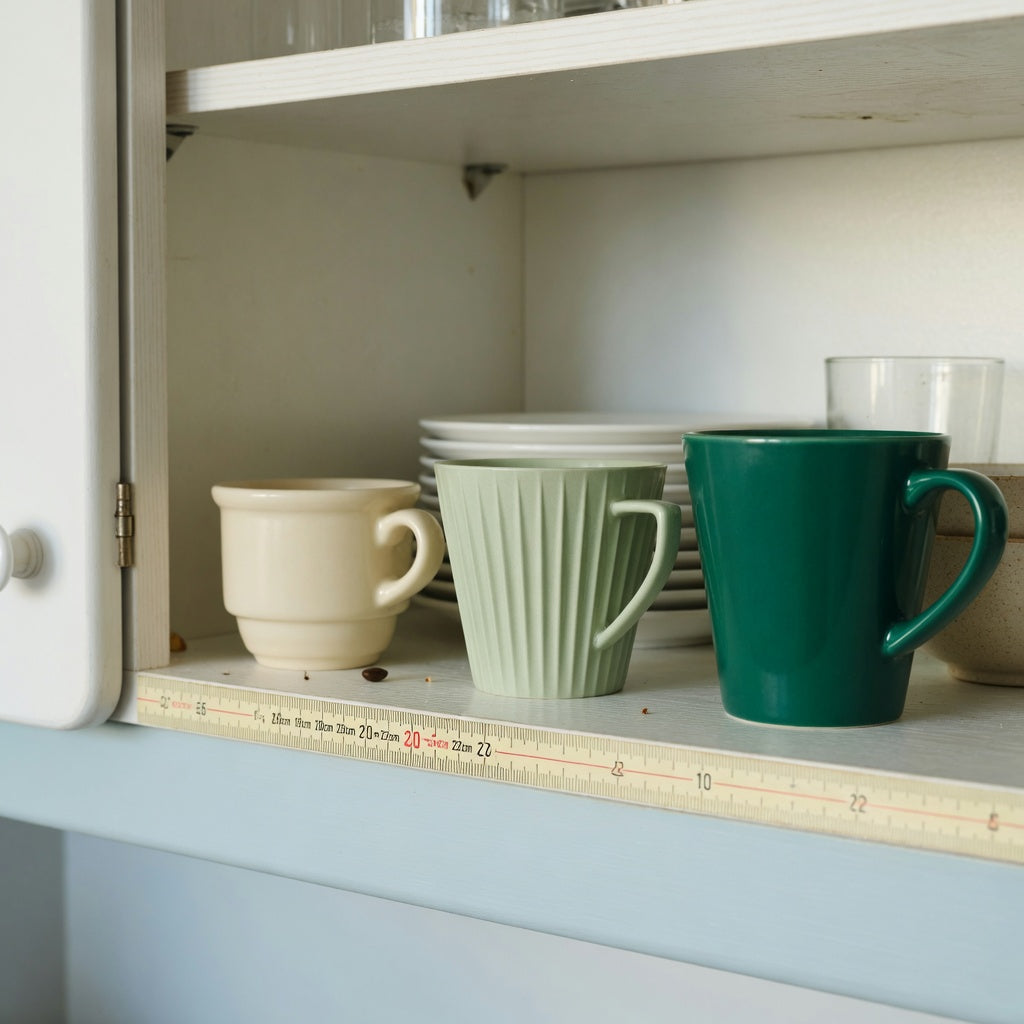
Decaf coffee cup storage fit guide: 3 shapes compared
Compare the verified 170 ml Retro, 200 ml Pleated, and 270 ml Emerald capacities against handle clearance, cabinet depth, open-shelf use, and serving preference. Includes a practical shelf test wit...
Read more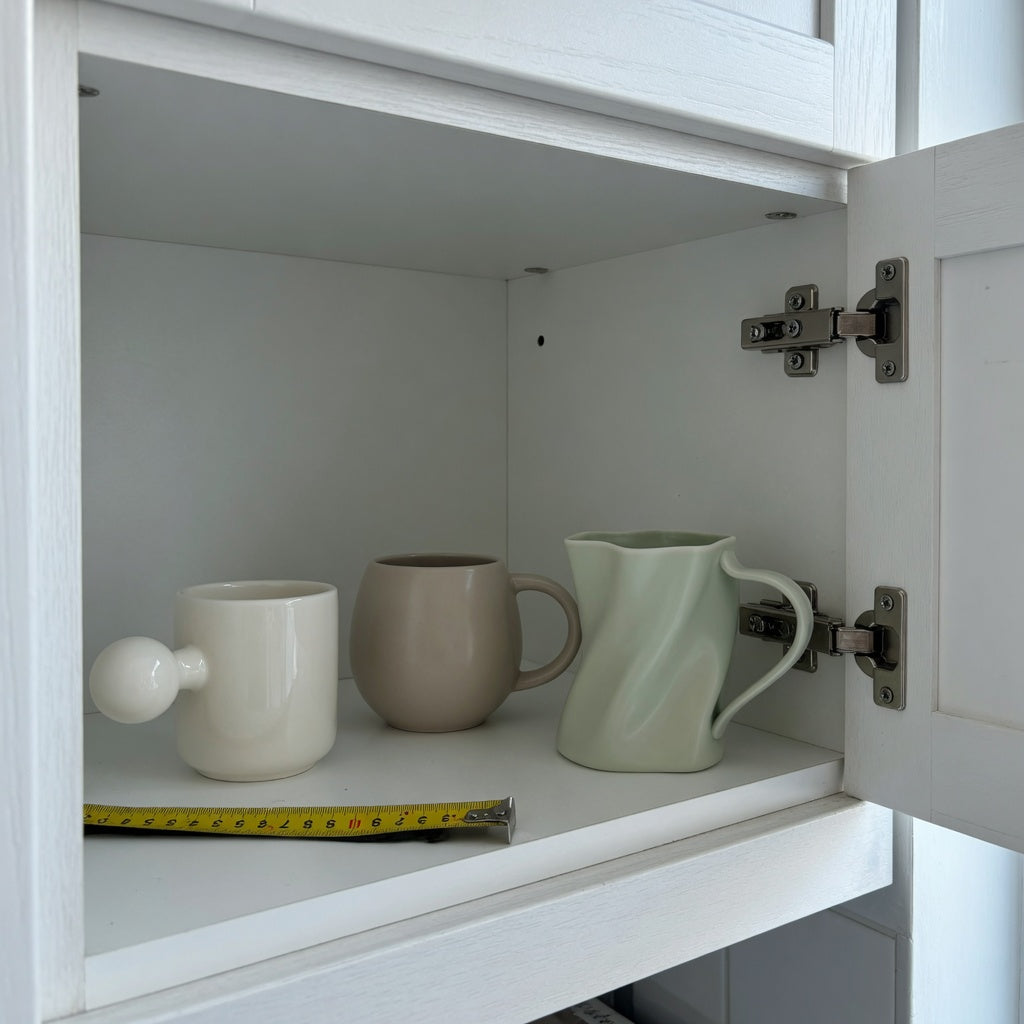
Ceramic Coffee Mug With Handle Storage Fit Guide: 3 Shapes
Compare the visible handle and vessel outlines of three current ceramic mugs against cabinet depth, height, and side clearance. Includes a practical method for shoppers when exact dimensions are no...
Read more
Leave a comment
This site is protected by hCaptcha and the hCaptcha Privacy Policy and Terms of Service apply.