
Lungo Coffee Cup Storage Fit Guide: 3 Shapes Compared
Reading time: about 10 minutes
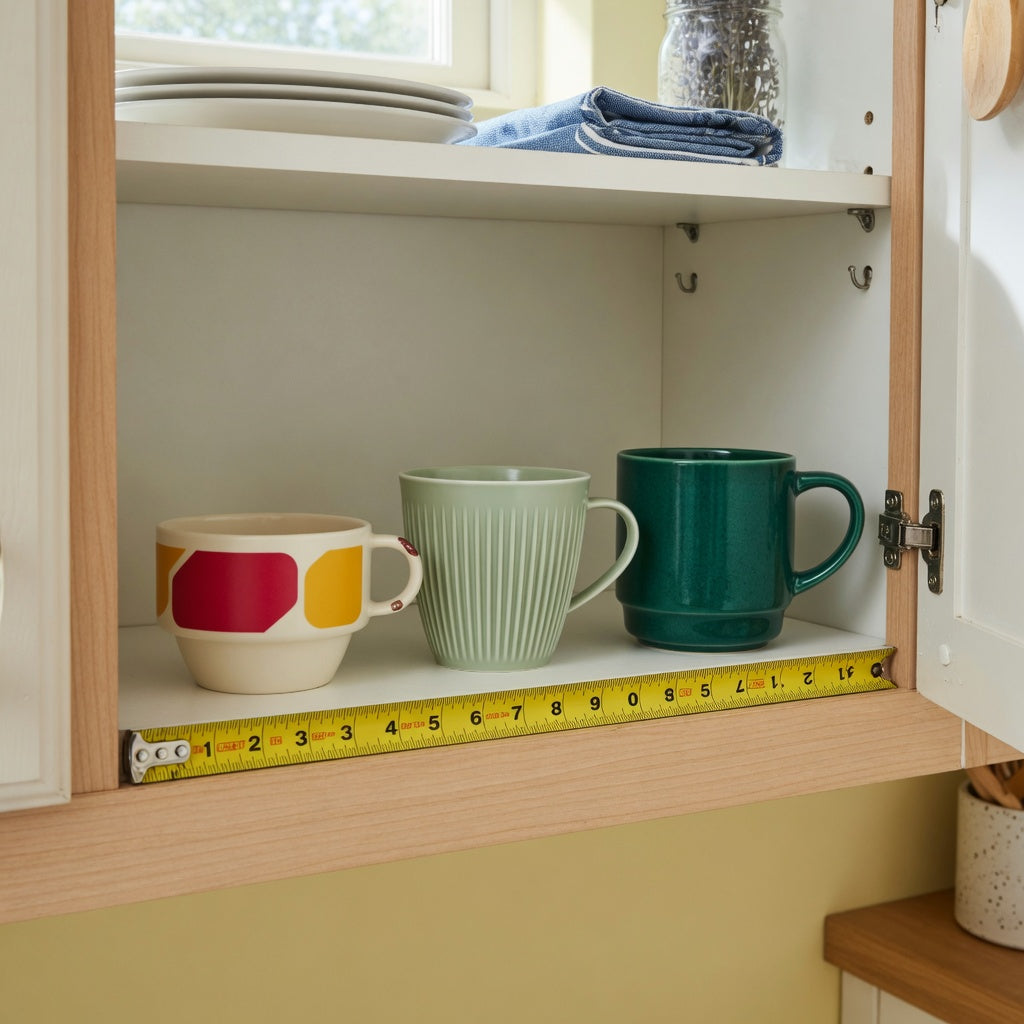
A cup can sit comfortably on a shelf and still stop the cabinet door from closing because its handle meets the face frame. We see that mismatch when shoppers compare capacity but forget to check the full outside profile. This lungo coffee cup storage fit guide compares the current Retro 170 ml, Pleated 200 ml, and Emerald 270 ml options using the facts we can verify, followed by the cabinet checks our team uses when helping shoppers narrow the choice.
The key limitation is simple: capacity is not an external measurement. A 170 ml listing does not prove that a cup is the shortest, narrowest, or easiest to stack. The same applies to 200 ml and 270 ml. A vessel can gain capacity through height, width, body shape, or a combination of those variables, so we will not turn the three listed capacities into invented dimensions or universal fit guarantees.
What can this lungo coffee cup storage fit guide verify?
The verified catalog comparison gives us three firm numbers: Retro is listed at 170 ml, Pleated at 200 ml, and Emerald at 270 ml. Those figures let you compare total listed capacity and potential cup headroom. They do not establish shelf height, cabinet depth, base width, or handle projection.
| Current option | Listed capacity | Catalog format | Decision boundary |
|---|---|---|---|
| Retro | 170 ml | Coffee and tea cup | Lowest listed capacity, but not a confirmed smallest footprint |
| Pleated | 200 ml | Coffee and tea cup | Middle capacity with a visibly pleated form to assess |
| Emerald | 270 ml | Coffee and tea mug | Highest listed capacity, but not a confirmed height or width |
Product photographs are useful for comparing visible form, handle placement, and styling. They are not scale drawings. If current external dimensions appear on a product page when you order, compare them with your own clear shelf measurements and confirm that the stated width includes the handle. If no external dimensions are listed, avoid treating the photo as a measurement tool.
Shelf height, cabinet depth, and handle projection: what do you measure?
Nominal cabinet dimensions are rarely the whole story. Face frames, hinges, shelf lips, and items stored behind the cup can reduce usable space. We measure the actual slot where the cup will live, not the outside of the cabinet.
- Clear shelf height: Measure from the shelf surface to the underside of the shelf above. Include enough open space to lift the cup without scraping its rim or your fingers.
- Usable cabinet depth: Measure from the back wall to the closed door, accounting for the face frame, hinge hardware, and any door-mounted rack.
- Full outside profile: The relevant width or depth must include the handle at its farthest point. A body-only measurement cannot confirm that the door will close.
- Removal path: Check whether the cup can move forward and upward without hitting a shelf lip, neighboring plate, or low cabinet frame.
- Row width: For multiple cups, allow room between handles rather than multiplying body width alone. Alternating handle direction may help, but only after you test the actual arrangement.
A useful home check is to place a cup you already own in the intended position, close the door, and note where clearance becomes tight. Record that cup's overall height, body width, and total width including the handle. It becomes a physical reference for evaluating a new shape, although it still cannot guarantee that another cup will match.
How do 170 ml, 200 ml, and 270 ml change cup headroom?
Capacity helps answer a different question from shelf fit: how much total room the cup offers. The Pleated has 30 ml more listed capacity than the Retro. The Emerald has 70 ml more than the Pleated and 100 ml more than the Retro.
For the same amount poured, a higher-capacity cup generally leaves more unfilled space below the rim. That can matter if you prefer visible headroom while carrying a cup from the kitchen counter to a desk. We do not prescribe a universal lungo volume, however, and listed capacity should not be treated as a required fill line. Your comfortable pour may leave more or less room.
- Choose 170 ml if you prefer the lowest total capacity of these three and do not need the additional room offered by the other options.
- Choose 200 ml if you want a middle step without moving directly from 170 ml to 270 ml.
- Choose 270 ml if extra total capacity is the priority and your measured storage space can accommodate the mug's current external form.
That last storage check matters. More listed capacity can increase the space a cup occupies, but the capacity number alone cannot tell you whether the increase appears in height, width, or both.
Retro, Pleated, or Emerald: which storage situation points where?
For a constrained cabinet where 170 ml is enough: Start with the Retro 170 ml coffee and tea cup. It has the lowest verified capacity in this group, which makes it a sensible first product to investigate when you do not want extra cup volume. We would still check its full current profile before calling it compact because lower capacity does not prove lower height or shorter handle projection.
For an open shelf where visible surface detail matters: Consider the Pleated 200 ml coffee and tea cup. Its listed capacity sits between the other two, while the pleated exterior gives shoppers a clear style reason to display it rather than hide it in a crowded row. Inspect the current side and top views before planning close nesting; an exterior detail does not establish stackability or the shape of the inside wall.
For a capacity-first setup with measured room: The Emerald 270 ml coffee and tea mug offers the most listed capacity of the three. It is the relevant next step for a shopper who wants more room in the vessel and has already confirmed cabinet or open-shelf clearance. The 270 ml figure does not, by itself, prove that the Emerald is the tallest or widest option.
If none of those situations describes your storage, compare other visible silhouettes in our unique coffee mugs collection. A different body or handle arrangement may suit the measured slot better, but every shape still needs the same height, depth, and removal checks.
Can these shapes be stacked, nested, or stored on hooks?
Do not assume stackability from a product photo. The verified facts supplied for these cups do not include a nesting claim, a recommended stack height, or hook compatibility. Our conservative storage default is a single layer unless the current product information explicitly says that a cup is designed to stack.
Nesting places contact pressure around the rim, inner wall, base, or handle. A pleated exterior also tells you nothing conclusive about how securely one cup will sit inside another. If stacking is confirmed for a product, keep rims and handles from grinding against neighboring surfaces and use a clean shelf liner or suitable separator where needed.
Handle storage has a separate limitation. A handle can project far enough for comfortable gripping without being shaped or rated for a storage hook. Confirm the clear handle opening and the support system before hanging any cup. The rail or hook also needs to hold the intended load without forcing pressure onto the handle.
The verified comparison for this article does not establish material, dishwasher status, or microwave suitability, so check the current care instructions on each product page. After washing, let cups dry fully before placing them in an enclosed cabinet. In a drying rack, keep rims and handles from knocking together; those are common contact points where breakable drinkware can develop edge or finish damage.
What changes in a small kitchen, office cupboard, or gift setup?
- Small kitchen with a face-frame cabinet: Door clearance is often the deciding variable. Shortlist the Retro if 170 ml meets your capacity needs, then verify the handle and removal path instead of assuming the lowest-capacity cup will fit.
- Shared office cupboard: Plan a stable single row with enough room for coworkers to remove one cup without shifting the rest. The Pleated offers the middle listed capacity, but the shelf measurement should decide whether its current form works in the available slot.
- Open shelf or coffee counter: Door depth is no longer a constraint, yet shelf width, edge distance, and overhead clearance still matter. The Pleated may suit a texture-led display, while the Emerald is the capacity-led option at 270 ml.
- Desk drawer: A handled cup is usually more awkward in a drawer than on a shelf because the handle can catch dividers or prevent the drawer from closing. Measure internal drawer height and the complete outside profile before choosing any of the three.
- Gift for an unknown kitchen: Do not promise that a lower-capacity cup is easier to store. Give the recipient the product link or compare several forms in the collection so capacity, styling, and cabinet constraints can all be considered.
These options are not storage canisters, travel tumblers, or confirmed nesting sets. A shopper trying to pack the maximum number of vessels into a very small cabinet may be better served by a specifically stackable, handle-free, or otherwise space-led design rather than forcing one of these forms into the slot.
The cabinet check our team uses before recommending multiples
Ordering several cups raises the cost of a small measurement mistake. In our store, we work through the storage plan in this order:
- Write down clear shelf height, usable closed-door depth, and side-to-side space.
- Decide how many cups must occupy that space at the same time.
- Check the current product information for external measurements, including the handle where stated.
- Plan a single-layer row unless stackability is explicitly confirmed.
- Leave working room for fingers, handles, cabinet hinges, and neighboring dishes.
- Choose among 170 ml, 200 ml, and 270 ml based on desired capacity and headroom only after the storage checks pass.
This sequence separates two buying decisions that are often mixed together. Capacity tells you how much total room the cup provides. External dimensions and shape determine whether it fits the shelf. Both matter, but one cannot stand in for the other.
Frequently asked questions
How do I use this lungo coffee cup storage fit guide for a shallow cabinet?
Measure from the cabinet back to the closed door, then account for the face frame, hinges, and full handle projection. Compare that usable depth with any current external measurements on the product page. If complete dimensions are not listed, do not rely on capacity or photography as a fit guarantee.
Does the Retro 170 ml take less shelf height than the other cups?
The verified 170 ml capacity does not confirm that the Retro is shorter. Capacity can be distributed through height, width, or body shape. Check the current external height before choosing it for a low shelf.
Can I stack the Pleated 200 ml cup to save cabinet space?
No stackability claim is included in the verified comparison facts. The visible pleated form should not be treated as proof that cups will nest securely. Plan single-layer storage unless the current product information specifically confirms stacking.
Does the Emerald 270 ml provide more headroom?
For the same amount poured, its higher listed capacity generally leaves more unused room than the 170 ml or 200 ml options. Actual headroom depends on how much you pour, and the 270 ml figure does not establish external shelf height. Confirm both capacity preference and storage fit separately.
Where should I compare other shapes if these cups do not fit?
Review the current unique coffee mug shapes and compare each visible body and handle against the same cabinet measurements. A different style is the better purchase if these three leave no comfortable room for door closure or removal.
Before ordering, record three numbers: clear shelf height, usable depth with the door shut, and the width available for the full row. Then select the capacity that suits you: Retro at 170 ml, Pleated at 200 ml, or Emerald at 270 ml. If the current product details cannot confirm a comfortable fit, choose another shape from the collection instead of forcing the storage plan.
More from our blog
Read more
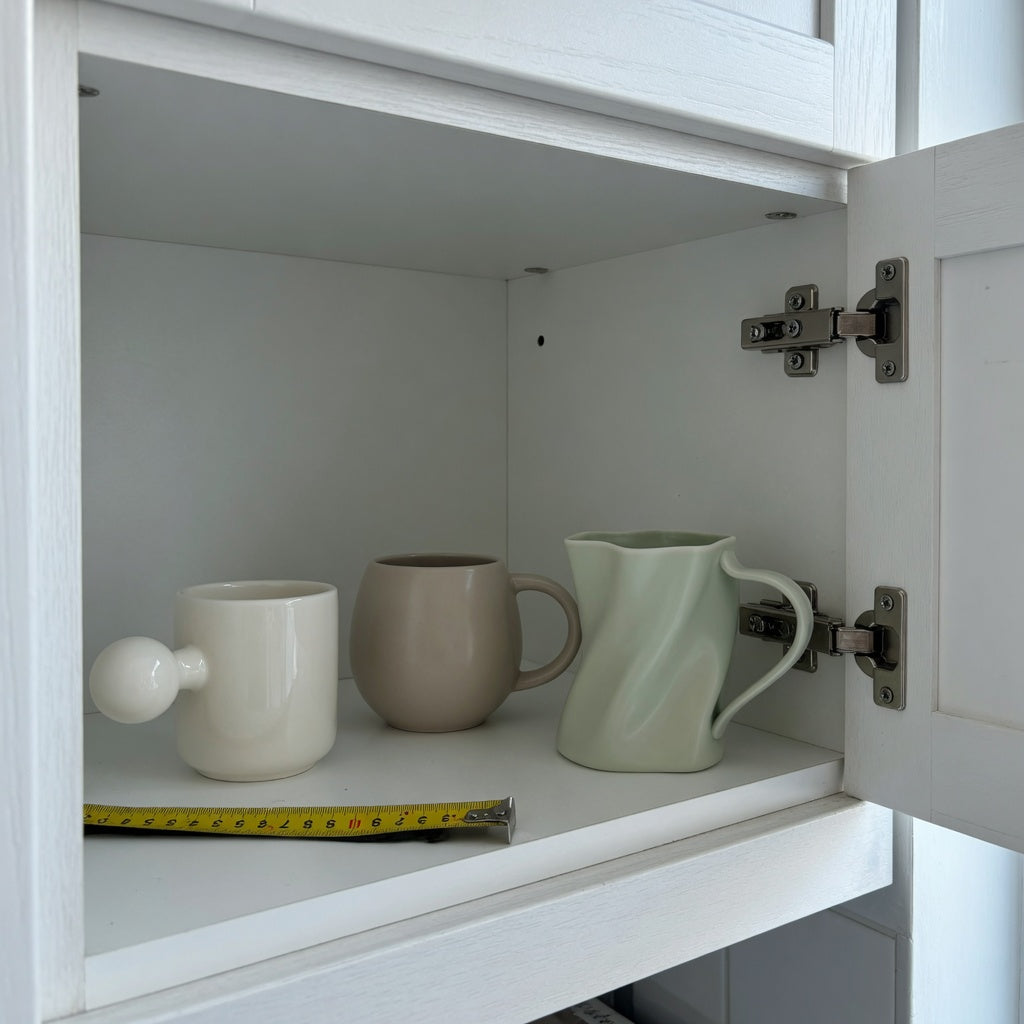
Ceramic Coffee Mug With Handle Storage Fit Guide: 3 Shapes
Compare the visible handle and vessel outlines of three current ceramic mugs against cabinet depth, height, and side clearance. Includes a practical method for shoppers when exact dimensions are no...
Read more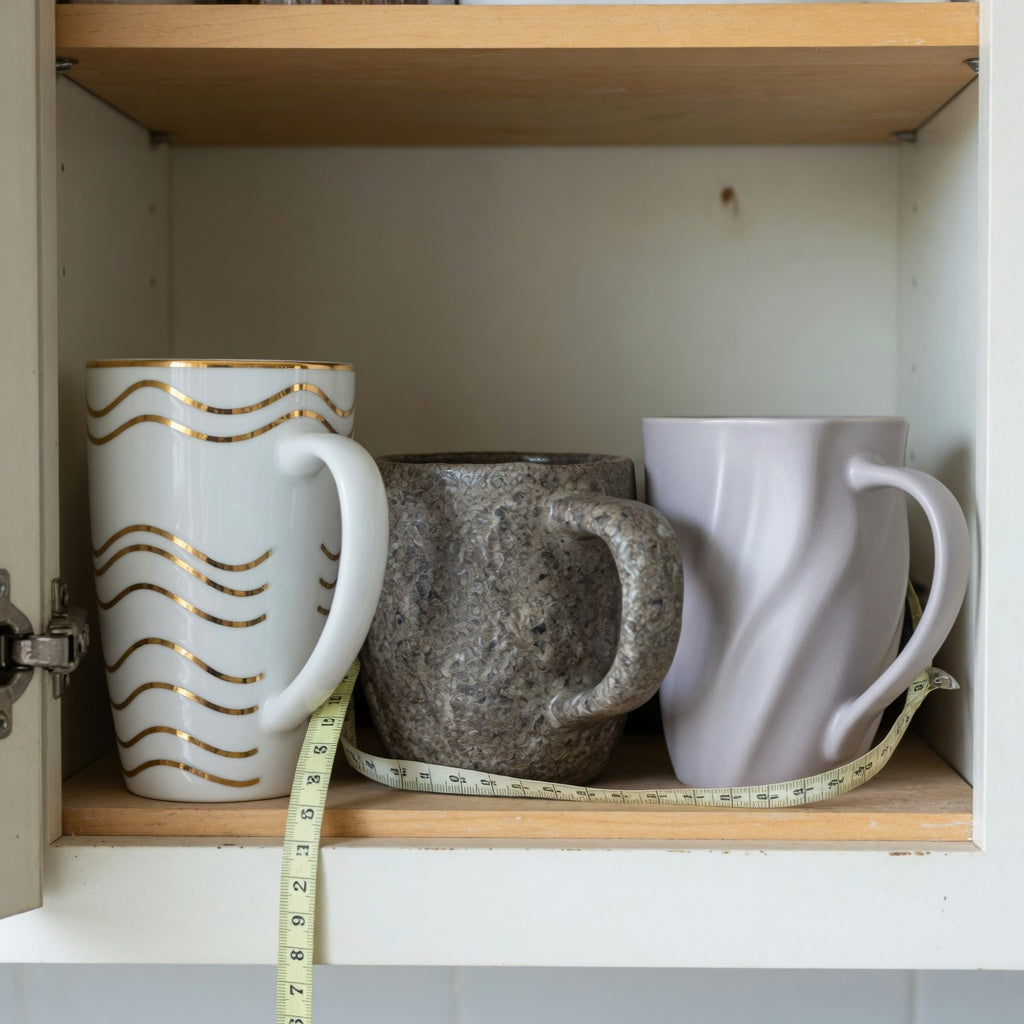
Oversized Ceramic Coffee Mugs Storage Fit Guide: Compare 3 Shapes
Compare the Flow, Rock, and White Golden Waves mug shapes against cabinet height, shelf depth, handle clearance, and real kitchen or office storage limits. Includes a practical measuring checklist.
Read more
Leave a comment
This site is protected by hCaptcha and the hCaptcha Privacy Policy and Terms of Service apply.