
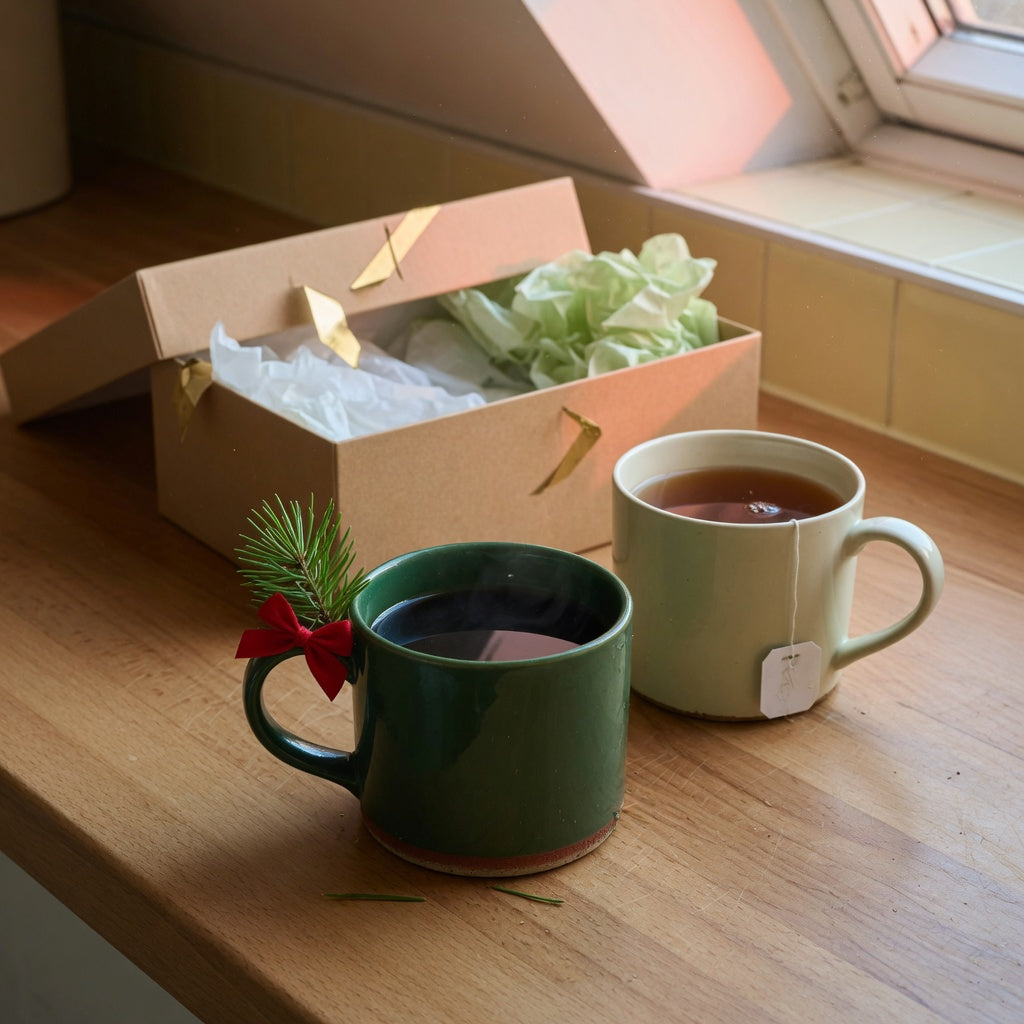
Ceramic Christmas Mug for Coffee and Tea: What to Compare
Reading time: about 14 minutes
The mug that looked perfect under the tree is usually back on the kitchen counter by the first Monday in January. Coffee before work. Tea after the dishes. By the third dishwasher cycle, the pine print is either still sharp or already lifting at the edge. A ceramic christmas mug for coffee and tea is being asked to do both jobs: hold a hot drink on a weekday, and still look like a gift when the box is opened. If the glaze, the handle, or the decoration cannot take that routine, it becomes a shelf piece.
In our store the comparison rarely starts with the illustration. Shoppers ask how much room is left once milk goes in, whether a full hand fits the handle, and whether gold, foil, or a surface print can meet a microwave and a dishwasher. Those answers decide if the mug is still in the rotation in March.
What a ceramic christmas mug for coffee and tea is asked to do
Most people are not choosing between decor and drinkware on purpose. They want one ceramic piece that photographs well and then lives on a desk without special rules. Cocoa and cider show up in the same note. Hot chocolate needs headroom. Mulled cider is often poured hotter than a careful tea steep.
That dual use sets a hard line. Ornamental ceramicware can look like a mug and still be unfinished for food. Under 21 CFR 109.16, ornamental ceramicware that looks suitable for food has to carry a conspicuous, permanent Not for Food Use warning, with wording about lead poisoning or harm, or have a hole through the surface that would hold a drink. If you see that mark, or wording that the piece may poison food, do not brew in it and do not store a drink in it. One holiday toast is not a harmless exception.
A daily mug is the opposite brief. Stable on a wood table. Honest about appliance limits. A festive print does not rescue a cup that cannot hold breakfast.
Coffee with milk, a short tea, or a full cocoa
Holiday pages throw ounce numbers around, and the number is easy to misread. In FDA policy on lead in ceramic foodware, a cup or mug is described as small hollowware normally used for coffee or tea above room temperature, commonly about 8 fluid ounces (240 mL), and usually made with a handle. That is a regulatory picture of a typical beverage piece. It is not a shopping target. Anyone adding milk or foam needs empty space above the liquid.
The pour sorts people faster than the artwork does:
- Tea or a short coffee. A smaller bowl keeps the surface modest so the drink does not cool across a wide mouth. Thick walls are easier to hold when the cup itself is not huge.
- Coffee with milk. You need unused volume so the walk from kettle to desk does not slosh. A rim filled to the lip fails that test on the first step.
- Cocoa or a large cider. These want a wider opening. A jumbo mug is a poor fit for small hands, a crowded cabinet, or a dishwasher rack already full of bowls.
Two checks we make at the counter never show up in an ounce mark. Can you get a full hand through the handle when the mug is hot, or only two fingers hooked on a narrow loop? And does a full pour feel front-heavy? Thicker walls hold a little heat in the clay. That feels pleasant for a minute and annoying if the empty mug was already heavy and the handle is skinny.
Look at the foot. An unglazed ring is normal on a lot of ceramics. Drag it across soft wood and it can leave a faint circle. A coaster stops the mark. It does not fix a sharp foot or a wobble.
If you are comparing shapes, not just one December design, look through the unique coffee mugs in our shop and set the handle openings next to the Christmas listing. Read capacity and care icons on the page in front of you. A similar photo on another site is not a spec.
Ceramic, stoneware, or porcelain on the base stamp
Titles swap those three words as if they were one material. They are related fired clays, not clones. Porcelain is typically finer, and a thin rim can look slightly translucent. Stoneware is usually thicker and opaque. On a holiday listing, ceramic is often just the umbrella word.
None of those words means dishwasher safe, microwave safe, or free of extractable metals. Turn the mug over, then match what you see to the live listing:
- A microwave mark, or a sentence that clearly allows microwave use.
- A dishwasher mark, including any top-rack limit.
- Food-use wording, or the opposite warning.
- A maker or country mark, which you will want if you later have to match a recall.
- Any age mark. That symbol is a clue about small parts or who the piece was meant for. It is not permission to hand a child boiling cocoa.
On our Christmas coffee and tea mug page, the live description is the spec sheet. If capacity, clay body, or care icons are missing, ask before you assume them. A hero photo hides the foot ring, interior texture, and metallic flecks in the print.
Fired glaze, sublimation, or gold in the dishwasher
The complaint we trust is the one that arrives after the gift is opened. The print peeled, faded, or chipped. A pattern fired into the glaze kept its color. Most product pages never say which kind of decoration you are buying, even though that is the whole care plan.
| What you can see | Dishwasher | Microwave |
|---|---|---|
| Underglaze or a high-fired glaze pattern | The version most likely to take repeated cycles. A harsh detergent can still dull a soft glaze over years. | Only if the mug is labeled for microwave use and has no metal. |
| Surface print, sublimation, or vinyl | Hand wash with a soft sponge. Heated dry is how these images lift at the edges. | Only if the listing allows it and the ink is not metallic. |
| Gold, foil, luster, or a full metallic coating | Plan on hand washing. Detergent can haze a luster. | Do not microwave. Metal trim is treated as unsafe. |
In our experience, a hangtag that says dishwasher safe is not the same thing as a fired-in pattern. If someone ordered a photo mug and the image is vinyl, keep it out of the machine. We have watched that lesson land the second Christmas, when the face on the mug is already a ghost.
Check the lip, not only the side. If the color runs over the rim, your mouth is on the decoration at every sip. A metallic lip is a hand-wash item even when the inside looks like plain white glaze. A pattern that stops below the rim is simply easier to live with.
Lids, metallic trim, and what belongs in the microwave
USDA guidance on microwave cooking is plain: only items made for microwave use should go in, and suitable glass, ceramic, and plastic are usually labeled for that oven. China with metallic paint or trim is listed as not safe. In the one-minute water check they describe, a utensil that becomes warm or hot is not microwave safe, because metal is in the body or the glaze. Do not run the oven empty to test a guess. An empty microwave can damage the oven.
Use that order on a holiday mug:
- Find a microwave statement on the base and on the current listing. Silence is not a yes.
- Take off any lid that is not ceramic, and any lid the listing does not clear, before you reheat coffee or tea.
- Never microwave gold rims, foil motifs, metallic lettering, or a full metallic coating. On March 21, 2024, the U.S. Consumer Product Safety Commission announced a recall of about 440,500 ceramic mugs with a metallic coating, sold in 2023 holiday gift sets in 11-ounce and 16-ounce sizes. Microwaved, or filled with extremely hot liquid, those mugs could overheat or break. CPSC reported 12 incidents and 10 injuries, including nine severe burns or blisters on fingers or hands and one finger cut. One of those incidents required medical attention.
- Skip the microwave for handmade, vintage, or souvenir pieces when you cannot tell how they were fired.
A standard ceramic holiday mug is also a weak travel cup. The foot rarely sits cleanly in a car cup holder, and a decorative lid often weeps on a turn. If the commute is the job, buy a travel cup that says so. Do not wedge a Christmas mug into the console.
Lead, cadmium, and a lead-free line on the box
Bright red, orange, and yellow holiday glazes are the colors people ask about. The question is fair. FDA has explained that some ceramic foodware can leach lead from surfaces that touch food or drink, that food can extract it, and that continued use can contribute to chronic lead poisoning. For cups and mugs, the action level is lead above 0.5 micrograms per milliliter of leaching solution in any one of six units tested. Cadmium is a separate policy. Ceramicware has been found with significant extractable cadmium, acid foods can pull it out, and continued food use could contribute to chronic cadmium poisoning. For small hollowware under 1.1 liters, the action level is cadmium above 0.5 micrograms per milliliter in any one of six units.
A few limits matter more than a marketing line:
- When pottery is fired correctly, lead in a glaze is essentially bound. When it is not, lead may move into food or drink. Washing, soaking, or boiling does not remove that lead.
- Everyday commercial factory pottery is much less likely to be the problem. Higher concern sits with handmade or irregular pieces, antiques, damaged or worn ware, uncertain flea-market sources, and bright orange, red, or yellow decoration.
- FDA has said ceramicware that releases extractable lead under the agency test should not be labeled lead free, and that using the term on such ware may be misleading. Passing a leach limit and printing lead free are not the same sentence.
- Properly made ceramicware that contains lead may still be sold in the United States. A not-for-food warning means the piece stays decorative, even if it is shaped like a mug.
A 2017 pilot study in the journal Food Safety and Risk tested five ceramic mugs already in use and found lead could move into both coffee and tea. Measured lead ran from 0.2 to 8.6 micrograms per liter in coffee and from below 0.2 to 1.6 micrograms per liter in tea. The amount followed the cup, not which drink was poured or how long it sat. For one of the five mugs, the estimated daily dose was above California's 0.5 microgram-per-day Maximum Allowable Dose Level. Modeled blood lead levels in that study did not rise above the regulatory or guidance values the authors used. They called the work preliminary. Treat it as a reason to retire a crazed, badly stained, or unknown vintage mug. It is not a reason to distrust ordinary factory ceramic sold for beverages and still in sound condition.
We do not put a lead-free promise on every holiday design in our shop. If the listing you are reading does not speak to food-contact status, ask before you buy it for daily coffee and tea. Keeping it as display is a different decision.
How long the drink stays hot, and what ceramic will not do
One buyer says the coffee is flat before a meeting ends. Another says a thick mug keeps cocoa pleasant through a short show. Both can be right. A single ceramic wall sheds heat into the room and into your palm. It is not a double-wall cup, and it is not a lidded bottle.
If staying hot is the requirement, a sealing lid and double-wall construction have to be named as their own features. A Christmas illustration does not include them. Lids have their own care line too. Plastic, silicone, cork, or resin lids are often hand-wash only even when the ceramic body can go in the machine.
Thermal shock is the quieter failure. Boiling water into a mug that sat in a cold car, or a hot mug dropped into a cold rinse, is how hairline cracks start. Warm the piece with tap water, then fill it. This category is not for campfire duty, freezer-to-oven tricks, or all-day heat on a commute.
Chips, crazing, sculpted bowls, and cocoa for kids
Retire the mug when the ceramic is compromised. These are the defects we see when customers bring a piece in to compare, or when a return comes back after the holidays:
- Chips on the rim or handle. Bare clay stains, holds residue, and can cut a lip.
- Crazing. A fine crack network in the glaze. If coffee or tea weeps dark lines into those cracks, stop treating the surface as clean food contact.
- Dark spots after heating tea. Some are mineral stains. Some follow a crack. If they will not scrub off, or they sit on a line, stop using the mug for hot drinks.
- Interior figures or deep sculpting. A character standing in the bowl looks charming and cleans badly. Milk film sits in the crevices. A loose figure is a cut and a choke risk.
- Metallic gift mugs that match a recall. Compare coating, size, and seller with the CPSC notice. A red-and-green palette alone does not identify the recalled pieces.
Children and hot cocoa need a separate rule. An age mark on the bottom is not a serving size for boiling liquid. Supervise the pour, choose a mug they can actually lift, and skip jumbo weights and detachable charms. For a gift that is not tied to December artwork, the same handle and capacity questions show up in our ceramic mug gift comparison.
One sculpted holiday mug is also the wrong pick when you need four matching seats. Simple profiles stack. Oversized handles and raised bows fight the shelf and the dishwasher rack. If the recipient cares more about the weekday pour than the seasonal graphic, start with everyday shapes and use the holiday design only when the listing clears the care checks.
Frequently asked questions
Is a ceramic christmas mug for coffee and tea dishwasher safe?
Only if the current listing and the base say so, and only for the decoration you actually have. A pattern fired under or into the glaze usually tolerates the machine better than vinyl, sublimation, or gold luster. If the page is silent, hand wash it. A hangtag has disappointed plenty of buyers when the image was only sitting on the surface.
Can I microwave a Christmas mug with gold, foil, or a metallic coating?
No. Metallic paint, foil, gold rims, and full metallic coatings do not belong in a microwave. USDA lists china with metallic paint or trim as unsafe there, and a 2024 CPSC recall covered metallic-coated ceramic mugs from holiday gift sets that could overheat or break with microwaving or extremely hot liquid. Take off lids that are not cleared before you heat any mug that is otherwise marked safe.
Is a bright red or handmade Christmas mug safe for daily coffee?
Treat handmade, vintage, damaged, or uncertain pieces more cautiously than everyday factory drinkware. FDA has flagged handmade or irregular ware, antiques, worn pieces, flea-market sources, and bright orange, red, or yellow decoration as the situations where leachable lead is more of a concern. Washing does not remove lead from a poorly fired glaze, and a lead-free slogan is not proof that extractable lead is absent.
What size is more sensible for tea than for coffee with milk?
Tea and a short black coffee sit better in a smaller cup so the surface stays modest. Coffee with milk, a milky latte-style pour, or cocoa needs free space above the liquid and a handle you can grip when the mug is full. Confirm the ounce mark on the listing in front of you. Do not copy a size from a different holiday mug because the artwork looks similar.
Will a normal ceramic holiday mug keep coffee hot at a desk?
Not the way a thermos does. A single wall slows cooling a little and warms your hands. It will not hold a cafe temperature through a long meeting. A lid or a double wall has to be listed as its own feature. If neither is mentioned, you are buying a regular mug with a seasonal design, which is fine for a short pour and a poor choice for a commute.
Checks to finish before the mug goes in a gift box
Run this list on the product page, then again when the parcel arrives. Shipping can nick a rim that looked perfect in the photo. If a decorative box is shown, confirm it is sturdy enough to hand over. We see plenty of sound mugs inside a plain mailer, and plenty of pretty boxes crushed at a corner.
- Confirm it is sold for food use, with no ornamental warning and no hole bored through the bowl.
- Match capacity to the real drink: tea, coffee with milk, or cocoa. Leave room for milk.
- Picture the handle in the hand that will lift it full, and notice the empty weight.
- Name the decoration: fired glaze, surface print or vinyl, or metal. Include the lip.
- Obey dishwasher and microwave statements. No metal in the microwave. Lids off unless cleared.
- Do not expect a car cup holder, a stack of four, or all-day heat unless those features are stated.
- Inspect for chips, crazing, a stable foot, and any loose interior figure before the first pour.
- For children, supervise hot drinks. An age stamp is not a cocoa recipe.
If the Christmas design is the one you want and the listing answers those points, start with the Christmas coffee and tea mug. If you are still weighing handle shapes and everyday colors, use the same checks across the unique coffee mug collection. A short seasonal graphic does not replace them. You can keep a tighter pass open while you shop with our Christmas coffee and tea mug buying checklist.
More from our blog
Read more

Large coffee mug for desk: size, spout fit, heat
A large desk mug still has to clear the brewer, stay upright beside a keyboard, and leave room for milk. We compare usable ounces, full weight, cooling, and glaze so the cup is one you will actuall...
Read more
Tall Narrow Ceramic Coffee Mug: What Buyers Should Compare
Height does not make a tall narrow ceramic coffee mug useful. Compare base width, handle height, brewer clearance, heat versus aroma, and glaze care, then match a tall cup or a round one to the num...
Read more
Leave a comment
This site is protected by hCaptcha and the hCaptcha Privacy Policy and Terms of Service apply.