

Large coffee mug for desk: size, spout fit, heat
Reading time: about 12 minutes
The mug that looked perfect on a product photo stopped against the brew head of a shared pod machine, half an inch short of a finished pour. We hear that miss whenever someone wants a large coffee mug for desk duty: one trip from the kitchenette, room for milk, and fewer mid-morning refills. The cup that wins the photo then fails the spout, the handle, or the few inches of desk left of the keyboard. Size alone does not fix any of those.
In our store, large is a shopping word, not a measured standard. People usually mean an everyday oversized mug, the kind talked about around 16 to 20 ounces, not a novelty bowl you could eat chili from. Nothing we rely on defines a retail large desk mug in ounces. FDA pottery guidance describes cups and mugs as small ceramic hollowware for hot drinks that normally, though not exclusively, hold about 8 fluid ounces (240 mL) and have a handle. That example and a jumbo listing photo are different objects.
How many usable ounces should a large coffee mug for desk hold?
Start with the pour you will drink, not the number printed near the rim. Brimful capacity and a safe fill are different. Milk, creamer, or a second short pod needs headspace, or the walk back past a laptop bag becomes a spill. We ask people to picture the liquid a finger-width below the lip, then decide whether that lower line is still enough coffee.
A bigger mug also changes how fast caffeine adds up. The FDA reference is a 12-fluid-ounce cup, not a jumbo desk mug. For most adults, the agency has cited 400 milligrams of caffeine a day, about two to three of those 12-fluid-ounce cups, as an amount not generally associated with negative effects. Sensitivity, and how quickly caffeine is cleared, varies widely. On the same table, regular brewed non-specialty coffee is listed from 113 to 247 milligrams, and both caffeine content and container size vary by product. One very full mug can move you through that daily context faster than two smaller cups. If caffeine bothers you, size the mug to the pour you intend to finish.
Three jobs get mixed up in the same search:
- A typical large desk pour. One trip, room for add-ins, and a cup you can finish while it still tastes right.
- A joke-size mug. Fine on a shelf. Awkward beside a trackpad. Many of these become soup bowls or conversation pieces, not weekday coffee.
- A smaller mug and a deliberate refill. The better call when the brewer is short, the desk is a laptop tray, or you want the second cup hotter than the cold bottom of the first.
Will the rim clear a drip spout or a pod machine?
Measure before you commit to a tall profile. Set a ruler from the drip tray or cup platform up to the lowest point of the spout. That gap is your real clearance. Compare it with mug height to the rim, then again with any lid on. A short lid collar is enough to force the brew into a carafe you did not want to wash.
Handles interfere even when the rim clears. A high loop or a wide ear can catch the machine housing. Shared-office single-serve machines produce the same story: a favorite mug that is simply too tall, so someone tilts it under the head or transfers the coffee. Transferring works. It is also another hot pour across a counter. If the machine is tight, a shorter, wider mug is the practical large cup. A tall mug is the wrong buy if it cannot sit under the spout.
Choose the White Golden Waves tall coffee and tea mug only when that taller-looking name is the desk style you want and your measured gap can take the height the current listing actually states. Read height and stated capacity on that page, then hold those figures against the spout gap. We do not treat the word tall in a name as a fit guarantee. If the listing does not publish height, measure a mug you already own that does fit, and use that height as your ceiling.
When you want several shapes side by side, start with our unique coffee mugs collection. Read the stated size on each listing before the pattern decides for you.
Wide footprint or tall walls on a crowded desktop?
A tall mug often carries the same volume on a smaller foot, so the center of gravity sits higher once it is full. On an empty counter that is a style choice. Next to a keyboard, a notebook, and a cable, it is a tip. A wider mug spends more desk and can feel bowl-like, but a forearm is less likely to send it over.
Lay the real spot out before you buy:
- Where the mug sits when you type: left of the keyboard, on a notebook, or behind the monitor.
- How wide that spot stays once the laptop is open.
- Whether you clip drinks when you stand for a call.
Marks show up later. A wet foot ring leaves a circle on wood veneer. An unglazed foot can scratch a soft finish if you slide the mug instead of lifting it. A cork pad helps with slip only when the mug actually has one. Check the listing. Do not assume a patterned cup includes a pad, and do not park a decorative glaze on a mug warmer unless that listing says the heat is fine. If the desk finish matters, use a coaster.
If you already want height and you will give up some stability, read what to compare in a tall mug for coffee and tea at a desk alongside the clearance you just measured. Spout fit and tip resistance are separate tests.
What does the mug weigh once it is actually full?
Empty ceramic feels fine in a short clip. Full ceramic is a different object. A generous pour, a thick wall, and a heavy base can make a mug you only slide, not carry into a meeting. A small handle makes it worse: two fingers pinch the ear while the mass hangs outside the grip. That is how mugs get dropped on the walk back from the microwave.
In our experience, the handle check is the one people skip. Look for a loop your fingers can pass through, not a decorative tab. A thumb rest helps if you hold the mug while you read. If the listing is silent on handle opening and weight, both are unknown. Do not guess from a styled photo.
A large open mug in this role is a stay-put cup. It is not a commute bottle, and it is a poor choice for walks between floors with the top off. Use a sealed travel cup for that, and accept a different drink. Open the Flow coffee and tea mug when how the cup sits in your hand matters more than height, then confirm material, capacity, handle shape, and any listed weight on the current page. If those lines are absent, the page has not answered you yet.
Will the last third of the cup still be warm?
An open mug loses heat at the surface. A bigger pour takes longer to drink, so the bottom is often cooler than people hope. We will not quote minutes for 12 ounces versus 20. Comparable lab times for open ceramic desk mugs are not figures we can stand behind. Handling this category shows a plainer pattern: more exposed surface and a long sit work against you. Thick walls slow the drop somewhat and also store heat, which is why the first sip can feel hotter than the liquid looked. They do not hold cafe heat through a long stretch of email.
Pick a heat plan on purpose:
- Open ceramic. The rim many people want, and simple to reheat if that exact mug is rated for the microwave. Weak if the cup sits through a meeting.
- A lid that stays on the desk. Fewer keyboard spills, slower cooling. Splash-resistant is not leak-proof. Tip it in a tote and the difference shows up on a notebook.
- Double-wall or a mug warmer. A different tool, with better retention or active heat, and often less like plain ceramic in the hand. Confirm the warmer will not scorch the glaze before a decorative cup sits on it all day.
Reheating is normal at a desk. You need a microwave-safe line on the listing you buy, not on a lookalike. Take the lid off unless that lid is explicitly microwave-safe. Metal trim on a rim can arc. Cracks and crazing hold water and heat unevenly. Dishwasher safety is a separate claim: a mug can be one and not the other. We go further into those care labels in the guide to a large ceramic mug for office desk coffee.
What should you check on the glaze before daily hot coffee?
Some ceramic foodware can leach lead from a food-contact surface. The FDA states that extractable lead can cause adverse health effects, including effects of chronic lead poisoning when that ware stays in food use. A good-looking glaze is not a test result.
Under the FDA pottery guidance, the lead guideline for cups and mugs is 0.5 micrograms per milliliter of leaching solution for any one of six units tested. Those cups and mugs are described as small hollowware that normally, though not exclusively, hold about 8 fluid ounces and have a handle. A jumbo desk mug is larger than that example, so a slogan on a box does not automatically sit on the same line. For cadmium, the related guideline is 0.5 micrograms per milliliter for small hollowware under 1.1 liters, and 0.25 micrograms per milliliter for large hollowware of 1.1 liters or more. Those numbers are enforcement levels for leach tests, not a sticker most cartons carry.
Checks we use when a customer asks about a daily driver:
- Read whether this listing says the piece is for food use. If it claims a lead-free or cadmium-safe glaze, read the exact sentence.
- Pass on a chipped lip, crazing you can feel with a fingernail, or an interior decorative glaze you cannot confirm as food-contact safe.
- Do not microwave a rim with metal decoration.
- A reactive or handmade-looking glaze can be the right gift and the wrong all-day cup if care notes are thin.
If the Golden Waves name is the one you keep coming back to, open the Golden Waves Kio coffee and tea mug and use the capacity, care, and food-contact lines as the buy-or-pass test. A gold-colored print is not the same thing as metal trim, and we will not guess which one a photo shows. If those lines are missing, treat them as missing and keep the piece off the weekday desk.
A desk checklist before the mug hits the cart
Run this when you are down to two or three listings. It keeps a large coffee mug for desk duty from turning into a shelf ornament.
| Check | Pass looks like | Fail looks like |
|---|---|---|
| Usable fill, not just brim ounces | Room for milk without a wave over the lip on the walk back | You must fill to the rim to feel the size was worth it |
| Brewer clearance | Rim and lid sit under the spout with space to spare | You pull the mug out mid-brew or tip it under the head |
| Base versus your real desk spot | Stable where you type, and you lift it instead of dragging it | Tall and narrow, parked where your elbow lands |
| Handle when full | Fingers through the loop, not a pinch grip | A small ear on a heavy body |
| Heat plan | You will finish it, cover it, or reheat a microwave-safe mug | You expect open ceramic to stay hot all morning |
| Care and glaze notes | Dishwasher, microwave, and food-contact wording match your routine | A lifestyle photo and a capacity guess |
In a shared office, pick a finish you can spot at the sink. Plain matching mugs vanish into the wrong cabinet. A lid that resists a keyboard bump is worth having on the desk. A splash lid is still the wrong tool for a commute. For size, stability, and care side by side, see how a big coffee mug for a desk compares on those same points.
Skip the oversized open mug if you need a leak-proof carry, all-morning heat with no reheating, or a cup that must slide under a very low brew head. Brew into a carafe, choose a shorter mug, or use a real travel cup. When the job matches, one generous pour, a stable seat, and a handle you can hold, verify the numbers on the listing and buy the shape that clears your machine.
Frequently asked questions
What size large coffee mug for desk use is enough for one morning pour?
Shoppers who ask us usually mean something around 16 to 20 ounces, then they still need headspace for milk or a second short brew. There is no official ounce line that makes a mug large. Match the usable fill to how much you will drink before it cools, and remember that the FDA caffeine context is built on 12-fluid-ounce cups, not on a brim-full jumbo.
Will a 20 ounce mug fit under an office pod machine?
Ounces do not tell you height. A wide 20 ounce mug can clear a spout that a tall 16 ounce mug hits. Measure from the cup platform to the spout and compare that gap with the mug height, including a lid if you brew with one on. If the listing does not give height, do not assume it fits.
Is a splash-resistant desk lid leak-proof enough to carry downstairs?
No. A desk lid slows a spill when you gesture and cuts some heat loss. It is not a sealed travel cap. If the mug goes in a bag or on a commute, use a cup built not to leak, and expect a different drink.
How can I tell a glazed mug is reasonable for hot coffee every day?
Use the food-contact wording on the exact listing, and skip a chipped lip, heavy crazing, or metal trim if you microwave. FDA lead guidance for cups and mugs is 0.5 micrograms per milliliter of leaching solution, and the agency notes that some ceramicware can leach lead. A jumbo mug may not fall in the same hollowware slot as the guide's typical 8 ounce example, so the word ceramic alone is not a test result.
Is a giant mug a bad daily driver if I sip slowly?
Often, yes. The extra coffee sits open while you work, and the last of it is cooler. A moderate large mug you finish, or a smaller one you refill, usually drinks better than a novelty size you cannot empty while it still tastes right. Giant mugs fit better as a soup bowl or a shelf piece than as the cup next to a keyboard.
Read more
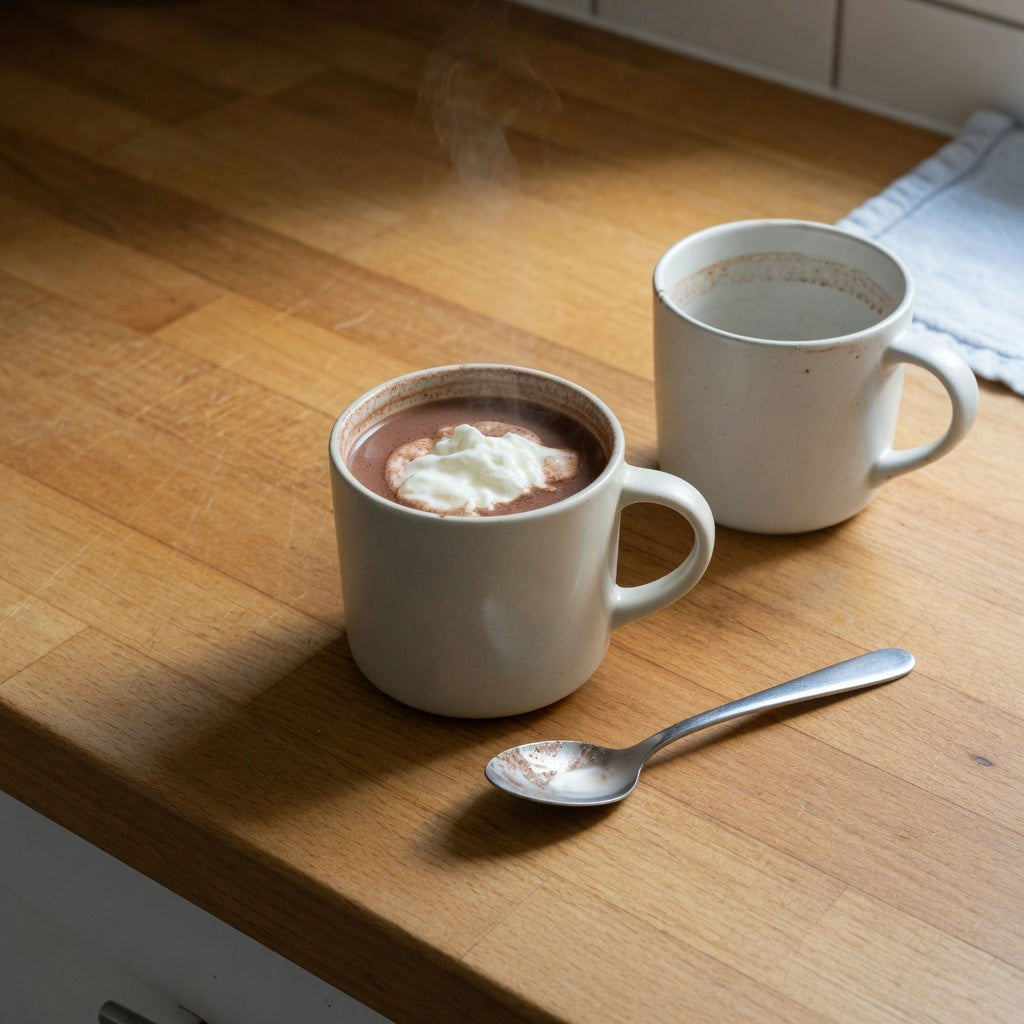
Ceramic Hot Cocoa Mug: What to Compare Before You Buy
A useful ceramic hot cocoa mug leaves room for toppings, stays comfortable to hold, and matches the microwave and glaze wording on that exact piece. We put our 400 ml and 480 ml mugs against those ...
Read more
Ceramic Christmas Mug for Coffee and Tea: What to Compare
A holiday ceramic mug has to survive weekday coffee and tea, not just the gift photo. Compare capacity, artwork durability, microwave metal, and food-contact glaze before you buy.
Read more
Leave a comment
This site is protected by hCaptcha and the hCaptcha Privacy Policy and Terms of Service apply.