
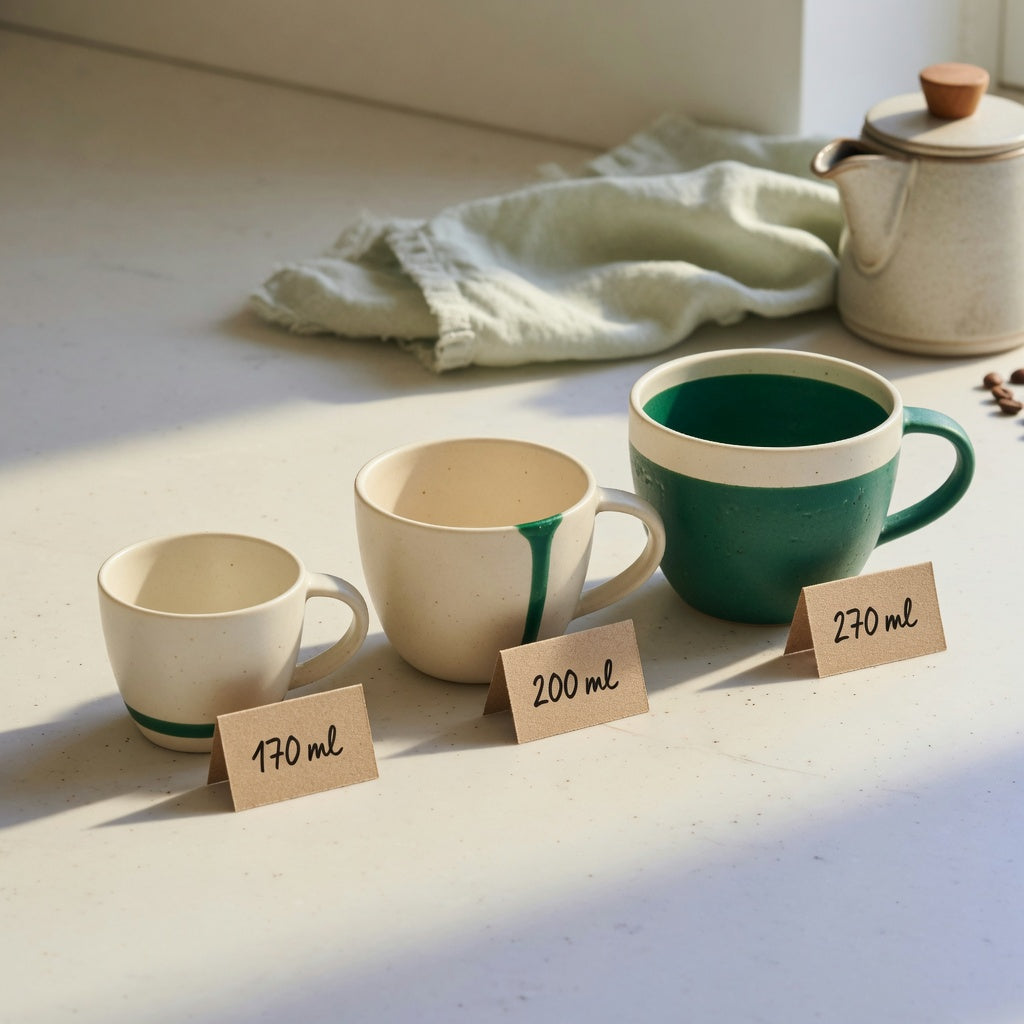
Ceramic Cappuccino Mugs: Compare 170, 200, and 270 ml
Reading time: about 9 minutes
Set a 170 ml cup beside the mug that normally sits next to a laptop and the buying decision becomes obvious. Both hold coffee, but they support different routines. Ceramic cappuccino mugs are usually photographed close-up, so 170 ml and 270 ml options can look similarly compact until the box is open.
At CoffeifyMug, we start with the listing facts we can compare cleanly: the Retro is 170 ml, the Pleated is 200 ml, and the Emerald is 270 ml. We do not treat capacity as proof that any cup was designed, tested, or certified for cappuccino, and we do not infer foam performance, heat retention, microwave safety, or dishwasher safety. This guide stays with volume and everyday fit.
Which ceramic cappuccino mugs fit the drink you actually make?
Five to six U.S. fluid ounces equals roughly 148 to 177 ml. Shoppers often use 6 oz as shorthand for a compact café-style drink, but not every café or home recipe uses the same serving size. Measure what you make instead of buying around the drink name alone.
- After your usual cup has cooled, fill it with water to the level you normally drink.
- Pour that water into a measuring jug and record the amount in milliliters.
- Decide how much empty space you prefer for carrying the cup from the counter to a table or desk.
- Compare that requirement with the listed capacity, and ask how capacity is measured if the product page does not say.
A 170 ml listing does not automatically promise 170 ml of comfortable, spill-free fill. Use capacity to compare products, but remember that the cup shape and the seller’s measurement method affect how much practical room remains below the rim.
170 ml vs 200 ml vs 270 ml: three different routines
All three options hold less than a 12 oz mug by listed volume. The 100 ml difference between the Retro and Emerald still puts them in noticeably different daily roles.
| Product | Listed capacity | Approx. U.S. fl oz | Best capacity match | Main trade-off |
|---|---|---|---|---|
| Retro | 170 ml | 5.7 oz | A measured drink close to a 5–6 oz target | Least room for a generous pour |
| Pleated | 200 ml | 6.8 oz | A buyer who wants 30 ml more than the Retro | Above a strict 6 oz target |
| Emerald | 270 ml | 9.1 oz | A roughly 9 oz small-mug routine | Too large for a 5–6 oz target and too small for a 12 oz habit |
If you deliberately make a short drink and want the closest capacity match to the 5–6 oz search, start with the Retro 170 ml coffee and tea cup. It is not the practical choice if your measured drink already approaches or exceeds 170 ml, or if you want one mug to last through a long work session.
If 170 ml looks restrictive but 270 ml is more than you need, compare the Pleated 200 ml coffee and tea cup. Its listed capacity is exactly 30 ml above the Retro. That makes it the middle option for a shopper who values extra volume more than staying within a strict 6 oz limit.
If your normal drink is closer to nine ounces, the Emerald 270 ml coffee and tea mug is the more honest fit. It provides 100 ml more listed capacity than the Retro, but the compromise is clear: it will not give you the compact scale associated with a 5–6 oz cup, and it is still smaller than a 12 oz breakfast mug.
Style should enter the decision after capacity. If none of these three volumes matches your measured drink, browse our unique coffee mugs collection and check the listed milliliters before comparing colors or profiles.
Handle clearance, rim shape, and cabinet fit before checkout
A product photo rarely provides a reliable hand or shelf scale. These are the physical details we recommend checking before a small cup reaches your kitchen counter:
- Handle opening: The outer curve does not reveal inner finger clearance. If you have larger hands or prefer a two-finger grip, look for dimensions or ask the seller rather than judging from a styled photo.
- Rim and opening: Capacity does not tell you the opening diameter or interior curve. If a broad drink surface matters to you, request measurements; a photo alone cannot establish suitability for latte art.
- Cabinet fit: Measure shelf height and the widest part of the storage space. A low-capacity cup is not automatically compact at the handle, and it is not automatically stackable.
- Saucers and quantity: Read the package-contents line. A saucer, spoon, or second cup shown as a photo prop should not be treated as included unless the listing says so.
- Base contact: After delivery, place the empty cup on a flat counter. A base that rocks may indicate an uneven foot and is worth reporting before use.
Inspect the cup under strong light before drinking from it or wrapping it as a gift. Look for chips along the lip, hairline cracks, rough interior patches, or unexpected glaze crazing, which appears as a fine web of lines in the glazed surface. Pause and contact the seller if a new cup arrives with damage or an unexplained finish issue.
We also will not rank these products by heat retention. A meaningful comparison would require verified ceramic body type, wall thickness, dimensions, and controlled test conditions. The word ceramic, or a heavy-looking product photo, is not test data.
What does “lead-free” tell you about a ceramic glaze?
A glossy or brightly colored glaze is not evidence of food-contact testing. Shoppers looking for lead-free ceramic cappuccino mugs should check the exact claim and the documentation behind it rather than treating the finish as proof.
The FDA compliance guide for lead in ceramicware sets an extractable-lead action level of 0.5 micrograms per milliliter for cups and mugs in any one of six units tested using specified methods. Separate FDA guidance on the term “Lead Free” says ceramicware exceeding applicable action levels should not carry that label because it may be false or misleading.
- Look for an explicit food-use or lead statement and ask what testing or documentation supports it.
- Do not treat words such as artisan, reactive, natural, or vintage-style as substitutes for a food-contact claim.
- If an item is labeled decorative only, do not use it for coffee regardless of its cup-like shape.
- Apply the same questions to handmade and factory-made ware. Neither production style proves safety by itself.
We do not use the FDA threshold to imply that the three CoffeifyMug products in this capacity comparison passed a particular laboratory test. This guide does not have product-specific test results to cite. If a claim is absent or unsupported, the trustworthy description is unverified, not assumed.
Dishwasher and microwave labels: what ceramic does not prove
Ceramic is an umbrella category that can include earthenware, stoneware, and porcelain. The exact body, glaze, and decoration can lead to different care instructions, so dishwasher-safe, microwave-safe, and oven-safe must be treated as separate claims. Approval for one appliance does not establish approval for another.
For the Retro, Pleated, and Emerald options, rely on the current product page and any instructions supplied in the box. If care information is missing, use a conservative routine while you request confirmation:
- Hand-wash with a soft sponge and mild dish soap.
- Avoid metal scouring pads and abrasive powders on glazed or decorated surfaces.
- Do not expose the cup to abrupt temperature changes or appliance heat based on a guess.
- Set aside a cup that develops a chip or crack, especially at the drinking rim.
One uneventful dishwasher cycle is not evidence of long-term glaze durability. For a gift, keep the care insert with the mug so the recipient does not have to infer the instructions from its appearance.
Who should skip a 170–270 ml cup?
Small ceramic drinkware is useful only when the volume matches the routine. A different format will serve you better in these situations:
- You drink 12–16 oz at your desk. Even the 270 ml Emerald is about 9.1 oz, so it will require a smaller pour or more frequent refills.
- You make iced coffee. Ice occupies much of a compact cup’s capacity, leaving less space for the drink itself. Choose a larger vessel.
- You commute with coffee. Look for drinkware that explicitly includes a secure lid and the travel features you need. Do not substitute an open table cup.
- You require a matching saucer set. Buy only from a listing that states the saucer and correct quantity are included.
- You drink espresso without much added milk or water. A smaller demitasse-style cup may fit that serving better than 170 ml.
- You need a uniform, stackable set. Confirm quantity, dimensions, and stackability rather than assuming several individually pictured cups will nest securely.
This is where honest selection prevents disappointment. A compact cup should not be stretched into the role of an iced-coffee glass, sealed commuter vessel, or all-morning office mug.
A six-point cart check for small coffee cups
- Measure the drink: Record your usual volume in milliliters instead of relying on the name cappuccino.
- Choose the capacity lane: Use 170 ml for the closest match to a 5–6 oz target, 200 ml for a little more listed volume, or 270 ml for a roughly 9 oz small mug.
- Check physical dimensions: Confirm the handle opening, overall width, height, and cabinet clearance if those measurements affect your grip or storage.
- Verify package contents: Confirm the number of cups and whether a saucer or other accessory is included.
- Read claims literally: Look for specific food-contact and care language. Do not convert the word ceramic into a safety or appliance promise.
- Inspect promptly: Before first use, check the rim, interior glaze, and base for chips, cracks, rough areas, or rocking.
Follow that order before letting color make the decision. Capacity first, physical fit second, verified care and safety wording third, then style.
Frequently asked questions
What size ceramic cappuccino mugs should I buy for a 6 oz drink?
Five to six U.S. fluid ounces is roughly 148 to 177 ml. Of the three CoffeifyMug options compared here, the Retro at 170 ml is the closest listed-capacity match. Measure your own drink and remember that listed capacity may not equal a comfortable fill line.
Is 200 ml too large for a small cappuccino-style drink?
It is above a strict 6 oz limit because 200 ml is about 6.8 U.S. fluid ounces. That extra 30 ml over the Retro may suit a buyer who wants more volume, but it will not produce the same compact size target as 170 ml. The number describes capacity, not certification for a particular recipe.
Are ceramic cappuccino cups automatically dishwasher and microwave safe?
No. Ceramic material alone does not establish dishwasher or microwave safety, and those are separate care claims. Follow the current product page and package instructions; if neither provides an answer, ask before using the cup in an appliance.
How can I check a lead-free claim on a ceramic mug?
Look for a clear food-contact statement and ask what testing or manufacturer documentation supports the claim. Color, country of origin, and a handmade appearance cannot verify lead extraction results. If the seller cannot support the wording, treat the claim as unverified.
Which CoffeifyMug capacity should I compare first?
Start with your measured drink: compare the Retro at 170 ml for the smallest option, the Pleated at 200 ml for 30 ml more, and the Emerald at 270 ml for a roughly 9 oz routine. Verify current care instructions, dimensions, and package contents before ordering. If none matches, return to the unique coffee mugs collection with your target capacity written down.
More from our blog
Read more
Espresso Cup vs Coffee Mug: Which Size Should You Buy?
Compare espresso cups and coffee mugs by capacity, heat, rim shape, grip, and care. We also explain where CoffeifyMug’s 170 ml, 200 ml, and 250 ml ceramic options fit—and where a true demitasse is ...
Read more
What size cup is best for espresso? Singles, doubles, and milk
A traditional straight espresso usually suits a 50–90 ml demitasse, while doubles and milk-touched drinks need more room. We compare that classic range with CoffeifyMug's listed 170, 200, and 250 m...
Read more
Leave a comment
This site is protected by hCaptcha and the hCaptcha Privacy Policy and Terms of Service apply.