
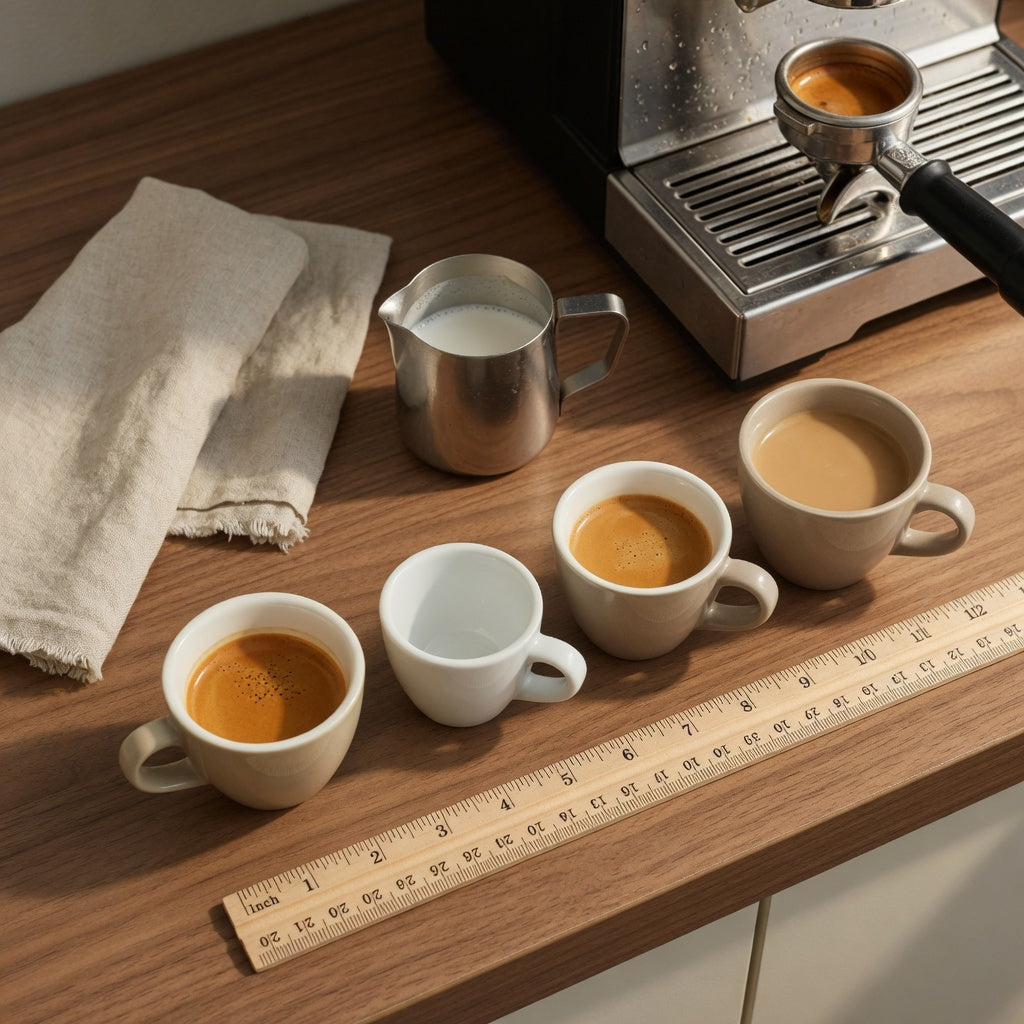
What size cup is best for espresso? Singles, doubles, and milk
Reading time: about 10 minutes
A short espresso can look almost accidental in a wide breakfast mug: a shallow pool at the bottom, crema spread across the surface, and far more cup than drink. That kitchen-counter mismatch is why shoppers ask, What size cup is best for espresso? For a traditional straight shot, a 50 to 90 ml demitasse is the familiar starting range. Many double shots suit roughly 80 to 120 ml, while larger cups make more sense once milk or added water becomes part of the drink.
At CoffeifyMug, we start with the drink rather than the handle or color. The three products covered here are listed at 170 ml, 200 ml, and 250 ml, so each is larger than a traditional single-shot demitasse. That extra capacity can be useful, but it is not ideal for every espresso drinker. We would rather point a straight-single purist toward a true demitasse than present a 170 ml cup as the same thing.
What size cup is best for espresso: single, double, or ristretto?
A common single espresso is roughly 25 to 30 ml, while a double is often around 50 to 60 ml. Recipes vary by dose, machine, and programmed output, so treat those figures as practical reference points rather than rules. Cup capacity should be larger than the liquid output because the vessel also needs room for crema and a comfortable margin below the rim.
- Ristretto or very short single: Start around 50 to 70 ml. This keeps a small extraction from looking lost while leaving usable headspace.
- Single espresso: A 50 to 90 ml demitasse is the conventional range. A 2 oz cup is about 60 ml, while a 3 oz cup is about 90 ml.
- Double espresso: Roughly 80 to 120 ml is a practical target. A 4 oz vessel is about 120 ml and gives a 50 to 60 ml drink breathing room.
- Espresso with milk or water: Size the cup around the finished drink, not the shot alone. A macchiato needs less room than a cortado-style drink, and an Americano needs more again.
Do not treat the listed capacity as a fill line. A 60 ml cup should not be filled with 60 ml of liquid right to the rim, just as a 170 ml cup does not require 170 ml of espresso. The useful capacity is the amount you can pour while retaining enough space to lift, carry, and sip without spilling.
Why do headspace, opening width, and preheating affect a short shot?
Two cups can hold the same number of milliliters and still present espresso differently. Capacity is only the first filter; the opening, bowl shape, wall thickness, and starting temperature also influence the experience.
- Headspace controls spills. Crema occupies space above the liquid, and the stream can move around as it lands. A little empty room below the rim makes the cup easier to remove from a crowded drip tray.
- Opening width changes how the surface looks. In a narrower bowl, crema has less area across which to spread. A broad cup can make the same shot appear thinner even though the extraction volume has not changed.
- A cold cup takes heat from a small drink. This is more noticeable with espresso because there is little liquid available to warm the vessel. A larger or heavier cup can make that initial heat transfer more obvious if it is not preheated.
- The rim affects aroma and sipping. A compact opening brings your nose closer to the coffee. A very wide rim can be comfortable for milk drinks but may feel oversized for a short straight shot.
Preheating does not need to become a complicated ritual. If the vessel's care instructions permit it, fill the cup with hot water while preparing the coffee, empty it immediately before extraction, and place it securely on the tray. Avoid moving a refrigerator-cold vessel directly to extreme heat, and never preheat a cup with a chip or visible crack.
How do 170, 200, and 250 ml cups compare with a demitasse?
Our listed capacities need honest context. The 170 ml Retro is the smallest of the three, the 200 ml Pleated sits in the middle, and the 250 ml Ball Handled vessel is already closer to a compact mug. None is a direct substitute for a 50 to 90 ml demitasse if your goal is traditional single-shot presentation.
| Vessel | Listed capacity | Useful situation | Main trade-off |
|---|---|---|---|
| Traditional demitasse | About 50–90 ml | Ristretto or straight single espresso | Limited room for a double or added milk |
| Retro Coffee Tea Cup | 170 ml | A double with generous headspace or a small milk-touched drink | A short single will leave a noticeable amount of empty cup |
| Pleated Coffee Tea Cup | 200 ml | A double followed by milk, or a cup shared between coffee and short tea servings | Roomier than classic espresso service |
| Ball Handled Coffee Tea Mug | 250 ml | A larger milk-touched coffee or compact mug routine | Too large for a single espresso to look nearly full |
These are capacity-based use suggestions, not claims of certified drink-specific performance or universal machine fit. The visible retro, pleated, and ball-handled forms also have different countertop and cupboard footprints, but capacity alone does not reveal their external height or rim diameter. You can compare the listed forms together in our unique coffee mugs collection.
Which cup fits a black double, milk drink, office desk, or gift?
The best recommendation changes with the routine. On a busy morning, the cup that handles your normal additions is more useful than one selected only because it resembles a café demitasse.
- You drink one short single with no milk. Choose a true 50 to 90 ml demitasse. Our 170, 200, and 250 ml options are not designed to look full with a 25 to 30 ml drink.
- You usually pull a double and want extra room around the crema. The 170 ml Retro cup is the closest of our three capacities. It will still look roomier than a classic 3 or 4 oz espresso cup, which may be a benefit or a drawback depending on your preference.
- You alternate between a double, a little milk, and short servings of tea. The 200 ml Pleated cup provides more flexibility. The trade-off is that straight espresso occupies only a small part of the vessel.
- You add a larger amount of milk or prefer a compact mug on an office desk. The 250 ml Ball Handled mug is the most spacious listed choice. It is not the right tool for traditional espresso presentation, and an open mug is not a substitute for a sealed, insulated commuter cup.
- You are buying a gift for a home espresso owner. Ask whether the recipient drinks singles, doubles, capsule lungos, or milk drinks. A beautiful 60 ml demitasse can be frustrating for someone who presses a longer programmed button every morning, while 250 ml may disappoint a straight-espresso enthusiast.
Will the cup clear your spout, scale, and two-cup tray?
Milliliters tell you how much a cup holds. They do not tell you whether it will fit under a particular machine. Before ordering, check the physical setup you use each day rather than relying on the words “espresso cup” or “coffee mug.”
- Measure vertical clearance. Measure from the drip tray to the lowest part of the group head, portafilter spout, or capsule outlet. If you brew onto a scale, include the scale in that measurement.
- Check the cup's external height. Capacity does not predict height because a 200 ml vessel can be short and wide or tall and narrow. If external dimensions are not stated, do not infer them from capacity alone.
- Account for a split portafilter spout. If both streams are going into one cup, the opening must sit beneath them without sending coffee against the rim. If you pull into two cups, check the space occupied by both handles.
- Measure the widest point. A decorative handle may affect side clearance even if the cup body fits on the tray. This also matters on narrow office shelves and crowded drying racks.
- Check storage before buying a set. Pleated exteriors, flared rims, and ball handles may not nest like straight diner cups. Do not force decorative vessels to stack if they do not sit securely.
We do not claim universal equipment compatibility for these cups because machine clearances vary. Capsule machines add another variable: an “espresso” and a “lungo” button can dispense different amounts, and programmed volumes may be adjustable. Match the cup to the drink your machine actually produces.
What should you inspect after unboxing and before dishwasher cycles?
Material names such as porcelain, stoneware, ceramic, and glass do not tell the whole thermal or care story. Wall thickness, vessel mass, decoration, and preheating all matter. Unless a product listing states otherwise, do not assume a cup is dishwasher-safe, microwave-safe, stackable, or resistant to sudden temperature changes.
- Run a finger carefully around the rim. It should feel smooth, without chips or a rough point where your lips will make contact.
- Set the empty cup on a flat counter. Check for an unstable or rocking base before filling it with a hot drink.
- Inspect the handle connection. Look for a hairline crack where the handle meets the body. Do not use a cracked vessel for hot coffee.
- Wash before first use. Follow the listing's care directions and use a soft sponge on decorative surfaces. Avoid abrasive pads that can mark a finish.
- Check before using a dishwasher or microwave. If dishwasher use is allowed, leave enough space that handles cannot strike nearby dishes during the cycle. A vessel with metallic decoration should only enter a microwave if its instructions expressly permit it.
These checks take less time than dialing in a grinder and can prevent a disappointing first use. They are especially worthwhile after gift unboxing, when decorative forms may be handled and repacked several times before reaching the final kitchen.
Five questions to answer before ordering 60, 170, 200, or 250 ml
- How much liquid does your usual single, double, or programmed capsule cycle actually produce?
- Do you add only a mark of milk, or enough milk and water to change the finished volume substantially?
- Do you want the cup to look nearly full, or do you prefer generous headspace?
- Have you measured machine clearance with your scale, portafilter, and drip tray in their normal positions?
- Will the cup fit your cupboard and care routine without unsafe stacking or unverified dishwasher use?
Our practical answer to What size cup is best for espresso is to match the vessel to the finished drink, then confirm physical fit. Choose a 50 to 90 ml demitasse for a traditional single, consider 80 to 120 ml for a close-fitting double, and move into 170 to 250 ml only when extra headspace, milk, water, tea, or a compact-mug routine justifies it. If that larger range matches your counter, compare the listed capacities in the CoffeifyMug collection before selecting a form.
Frequently asked questions
What size cup is best for espresso if I mostly pull double shots?
For a double around 50 to 60 ml, an 80 to 120 ml cup is a close-fitting starting point. Among our listed options, the 170 ml Retro is the nearest capacity, but it provides more empty space than a traditional double-shot cup. Choose a smaller demitasse elsewhere if near-full presentation matters most.
Is a 2 oz or 3 oz cup better for a single espresso?
A 2 oz cup is about 60 ml and gives a short single a compact presentation. A 3 oz cup is about 90 ml and provides more protection against spills or a slightly longer extraction. Both sit within the familiar demitasse range.
Is a 170 ml cup too large for espresso?
It is larger than a traditional single-shot demitasse, so a 25 to 30 ml espresso will look small inside it. A 170 ml cup becomes more practical for a double with generous headspace or espresso with a small amount of milk. It is not the best choice if you want a single shot to fill most of the bowl.
Will a 250 ml mug fit under my home espresso machine?
Capacity cannot confirm machine fit because height and shape vary. Measure from the drip tray or brewing scale to the spout, then compare that clearance with the mug's external height. We do not claim universal machine compatibility for the 250 ml Ball Handled mug.
Do capsule and portafilter machines need different cup sizes?
They can, because programmed capsule volumes and portafilter recipes may produce different finished amounts. Measure or check the output you use most, allow headspace, and include any milk or water you normally add. Then compare that routine with the listed 170, 200, and 250 ml vessels in our unique coffee mugs collection.
More from our blog
Read more
Ceramic Cappuccino Mugs: Compare 170, 200, and 270 ml
Compare 170 ml, 200 ml, and 270 ml options by measured drink volume, handle and cabinet fit, glaze claims, and care-label evidence. We also flag the routines these compact cups do not suit, from ic...
Read more
Tall Ceramic Mug Home Office: Capacity, Grip, and Desk Fit
Height alone does not tell you serving size or desk stability. We compare the listed 350 ml option with larger mugs, then assess headroom, full weight, handle clearance, base geometry, care claims,...
Read more
Leave a comment
This site is protected by hCaptcha and the hCaptcha Privacy Policy and Terms of Service apply.