

Cacao Cup First Time Buyer Product Shortlist Guide: 3 Sizes Compared
Reading time: about 9 minutes
A first cacao mix can expose a poor cup choice quickly: the spoon knocks the rim, added milk leaves too little headroom, or a large serving cools before the last sip. Our cacao cup first time buyer product shortlist guide begins with the details we check while handling drinkware in our store: listed capacity, any published diameter, the visible opening, grip shape, and care information that is actually confirmed.
The verified catalog facts for this comparison are deliberately narrow. The Ball Handle is listed at 250 ml with an 11.2 cm diameter, the Round at 390 ml, and the Spittoon at 400 ml. We are treating all three as everyday drinkware for cacao, coffee, or tea. We are not presenting them as traditional, ritual, certified, insulated, or purpose-built cacao vessels.
Which listing facts can you verify before checkout?
At our packing table, a clear specification is more useful than a styled photograph. A photo can help you judge shape, but it cannot confirm milliliters, internal opening width, empty weight, or dishwasher suitability. Use this five-part check before putting any cup on your shortlist.
- Listed capacity: Compare the milliliter figure with the amount you actually drink. A nominal capacity is not automatically the same as a comfortable, spill-resistant fill line.
- Diameter measurement: The Ball Handle has a listed 11.2 cm diameter. The supplied facts do not identify that number as the exact internal mouth width, so do not assume a spoon or whisk receives the full 11.2 cm of clearance.
- Visible opening: Look for a direct or top-down product image. If the opening is shown only at an angle and no measurement is published, treat mixing-tool clearance as unknown.
- Material and care: Confirm the stated material and any microwave or dishwasher instructions on the live listing. Those details are not part of the verified facts used for this comparison.
- Grip and full-cup handling: Review the handle or body shape against how you carry a warm drink from the kitchen to a desk. Product photos cannot tell you the empty weight or how the grip will feel in your hand.
Do not convert a missing specification into a favorable assumption. If material, opening size, or care compatibility will decide the purchase, verify it with our store before ordering.
Cacao cup first time buyer product shortlist guide by capacity
| Option | Verified catalog fact | Practical reason to choose | Reason to skip or verify |
|---|---|---|---|
| Ball Handle coffee and tea mug | 250 ml capacity and listed 11.2 cm diameter | Your usual serving is close to 250 ml and you prefer the option with the most published size information. | Skip it if your cacao, milk, and other additions already approach 250 ml. Verify where the diameter was measured. |
| Round coffee and tea mug | 390 ml capacity | You want 140 ml more listed capacity than the Ball Handle for milk, foam, or ice. | Skip it if an exact opening measurement is essential. That measurement is not included in the supplied verified facts. |
| Spittoon coffee and tea mug | 400 ml capacity | You want the highest listed capacity of these three and prefer the shape shown on the product page. | It holds only 10 ml more than the Round, so volume alone is a weak reason to choose it. Verify opening, material, and care details. |
The full spread from 250 ml to 400 ml is 150 ml, which can change how much room you have for additions. The Round and Spittoon are much closer to each other. Because only 10 ml separates them, compare their visible openings, grip, storage fit, and shape instead of treating the Spittoon as a major capacity upgrade.
Which cup fits your desk, kitchen counter, or gift plan?
A useful shortlist starts with the drinking situation and ends with a reason to reject an option. These three scenarios keep the choice tied to a real routine rather than the product name alone.
Your usual pour is near 250 ml and you mix at a desk
Start with the 250 ml Ball Handle mug with listed 11.2 cm diameter. It fits a smaller single-serving plan, and it is the only option here with a verified diameter figure to investigate further. Skip it if your current comfortable fill is already 250 ml before adding milk, foam, or ice because you still need space below the rim.
You add milk or ice on the kitchen counter
Shortlist the 390 ml Round mug. Its listed capacity is 140 ml above the Ball Handle, giving you a larger nominal volume to plan around when your recipe includes additions. Skip it if compact storage or a measured internal opening is non-negotiable; neither the overall storage dimensions nor an opening measurement is confirmed in the supplied facts.
You want the largest listed option or a distinctive gift shape
Consider the 400 ml Spittoon mug if the recipient likes the pictured form and normally takes a larger serving. Its advantage over the Round is primarily the design choice, since the listed capacity difference is only 10 ml. Skip it for a recipient who prefers familiar mug profiles, or if you are choosing it only because 400 ml sounds substantially larger than 390 ml.
If none of those situations match, browse our unique coffee mugs collection using the volume of a cup you already enjoy as your baseline. That gives you a concrete reference for comparing other shapes without guessing from image scale.
How should 250 ml, 390 ml, and 400 ml fit a real recipe?
The quickest test happens in your own kitchen. Do not compare the catalog capacity only with the cacao base. Include every regular addition, then leave enough room to stir and carry the drink without filling to the lip.
- Fill your current favorite cup with water to the level you normally use.
- Pour that water into a marked measuring jug and record the volume.
- Add the usual amount of milk or other liquid to the measurement. For an iced drink, remember that ice also displaces space even though the exact amount varies by cube size.
- Compare the result with 250 ml, 390 ml, and 400 ml, allowing for practical headroom rather than planning a brim-full pour.
Mixing tools matter too. A teaspoon needs less clearance than a small balloon whisk or handheld frother head. The Ball Handle's listed 11.2 cm diameter gives you a useful question to ask, but not a confirmed internal opening. The Round and Spittoon need the same photo or measurement check because no verified mouth width is available here.
Do not assume the 400 ml option retains heat longer. Heat retention also depends on material, wall thickness, opening area, starting temperature, and room conditions, none of which are confirmed by the capacity figure. A lidded insulated cup would suit long commutes, outdoor use, or slow drinking better than open everyday drinkware.
Which material and care details remain unknown?
In our store, we separate catalog facts from visual impressions. The verified information supplied for these products does not establish whether a cup is ceramic, porcelain, stoneware, glass, or another material. It also does not confirm wall thickness, empty weight, base dimensions, exact internal opening, microwave compatibility, or dishwasher compatibility.
- Do not identify the material from color or surface appearance alone.
- Do not interpret the listed 11.2 cm diameter as internal mouth width unless the live listing defines it that way.
- Do not assume a 390 ml or 400 ml cup fits a shelf, cup holder, or coffee machine without overall dimensions.
- Do not promise dishwasher or microwave use without current care instructions.
An unknown specification does not make a cup unsuitable. It means that detail still needs to be checked before it can support your decision.
Until the product page or included care card confirms otherwise, our conservative first-clean routine is mild detergent, a non-abrasive sponge, and hand washing. Avoid abrupt temperature changes and do not put a cup with unconfirmed material into a microwave or dishwasher. Once manufacturer or seller instructions are available, follow those instructions instead.
What should you inspect during gift unboxing and the first wash?
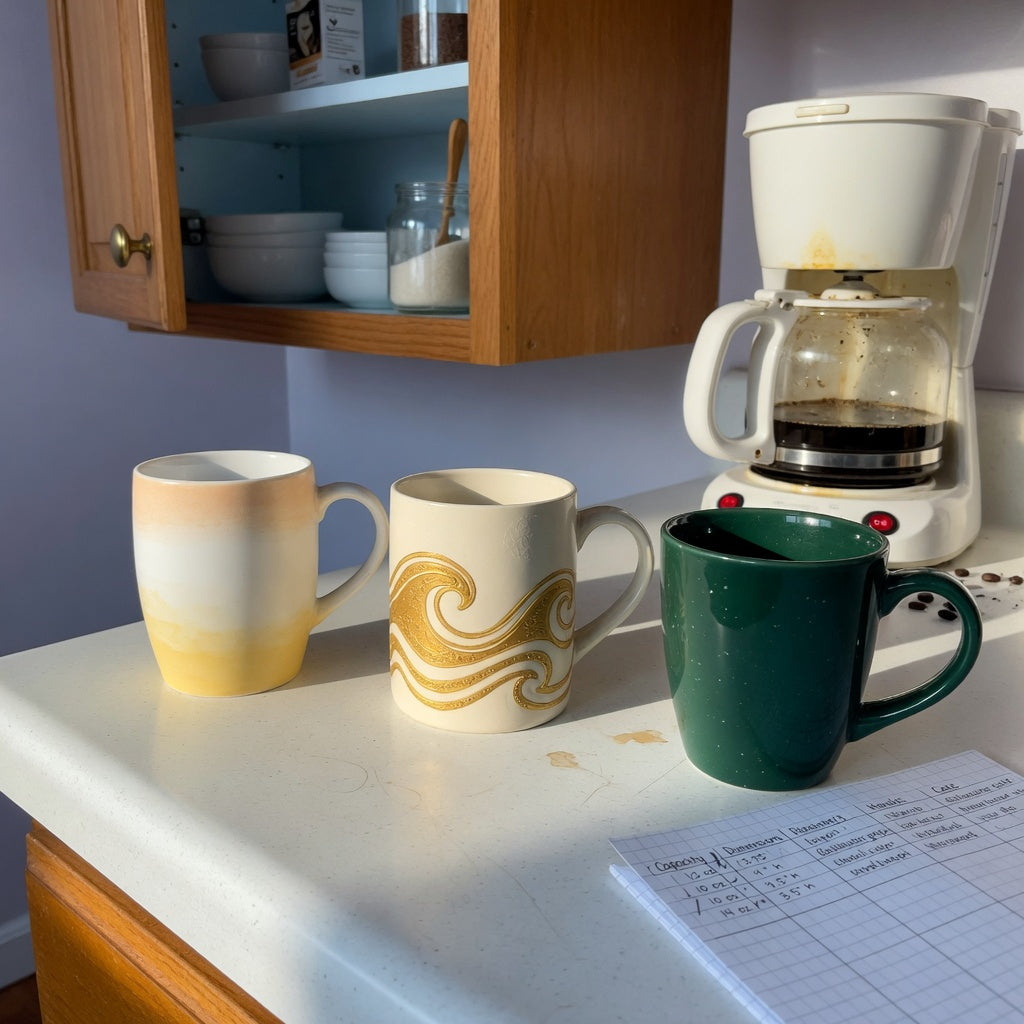
Inspect any drinkware before pouring a hot drink. Good light and a dry, flat kitchen counter make small arrival issues easier to see, especially around the rim, base, and handle connection.
- Run a visual check around the lip for chips, cracks, or sharp areas.
- Inspect the interior surface for hairline cracks or raised points that could catch a sponge.
- If the design has a handle, check the connection to the body without forcing or twisting it.
- Place the empty cup on a flat, dry counter and check for unexpected rocking.
- Wash and dry it according to confirmed instructions, then inspect it again before regular use.
If dishwasher use is explicitly approved, check the surface and handle after the first cycle. If that approval is missing, hand wash instead. These are standard drinkware arrival checks, not claims that the three shortlisted products commonly have these defects.
Use a five-point checkout filter, not the product name alone
The cacao cup first time buyer product shortlist guide works best as a filter. Before opening the cart, write down five answers that connect the listing to your actual routine.
- Your normal comfortable fill in milliliters
- The extra volume needed for milk, foam, or ice
- The spoon, whisk, or frother that must clear the opening
- The material and care methods you need confirmed
- One clear reason that would make you skip each option
A shortlist is ready when every remaining cup passes those checks. If all three fail on an essential detail, compare another shape rather than lowering a requirement that matters to daily use.
Frequently asked questions
What capacity should a first-time cacao cup buyer choose?
Use the measured volume of your normal recipe as the starting point. The 250 ml Ball Handle suits a smaller pour, while the 390 ml Round and 400 ml Spittoon leave more nominal capacity for milk or ice. Plan for headroom instead of treating the listed capacity as a target fill line.
Does the Ball Handle mug have an 11.2 cm internal opening?
The verified fact is a listed 11.2 cm diameter. It does not specify that the number is the exact internal mouth measurement. Confirm where the diameter is measured before using it to judge whisk or frother clearance.
Are the Round 390 ml and Spittoon 400 ml meaningfully different in volume?
The listed difference is 10 ml. That small gap makes shape, visible opening, grip, storage dimensions, and confirmed care details more useful decision points than capacity alone. Choose between them for those reasons, not because 400 ml appears dramatically larger.
Can these cacao cups go in a dishwasher or microwave?
Dishwasher and microwave suitability are not included in the verified facts used here. Check the current product listing or care card before using either appliance. Hand washing with mild detergent is the conservative approach while the material and care status remain unconfirmed.
What should a cacao cup first time buyer product shortlist guide verify?
It should verify capacity, any published dimensions, visible opening evidence, material, care instructions, and the way the cup will be used. It should also identify unknowns instead of turning product photos into measurements. For these options, the confirmed facts are 250 ml and a listed 11.2 cm diameter for the Ball Handle, 390 ml for the Round, and 400 ml for the Spittoon.
Measure your current comfortable fill, write down your usual additions and mixing tool, then open the CoffeifyMug unique mug collection. Shortlist the 250 ml Ball Handle, 390 ml Round, or 400 ml Spittoon only after the live listing answers the material, opening, and care questions that matter to your routine.
More from our blog
Read more
Ceramic Glazed Coffee Mugs First Time Buyer Product Shortlist Guide
Build a first ceramic mug shortlist by checking usable capacity, dimensions, handle clearance, glaze details, and care instructions. Compare three CoffeifyMug designs by real kitchen, desk, and gif...
Read more
12 Oz Ceramic Coffee Mugs: Practical Replacement Purchase Checklist
Replace a damaged or awkward 12 oz mug by comparing actual fill, brewer clearance, handle fit, shelf space, and care needs. This checklist maps those constraints to relevant CoffeifyMug options wit...
Read more
Leave a comment
This site is protected by hCaptcha and the hCaptcha Privacy Policy and Terms of Service apply.