
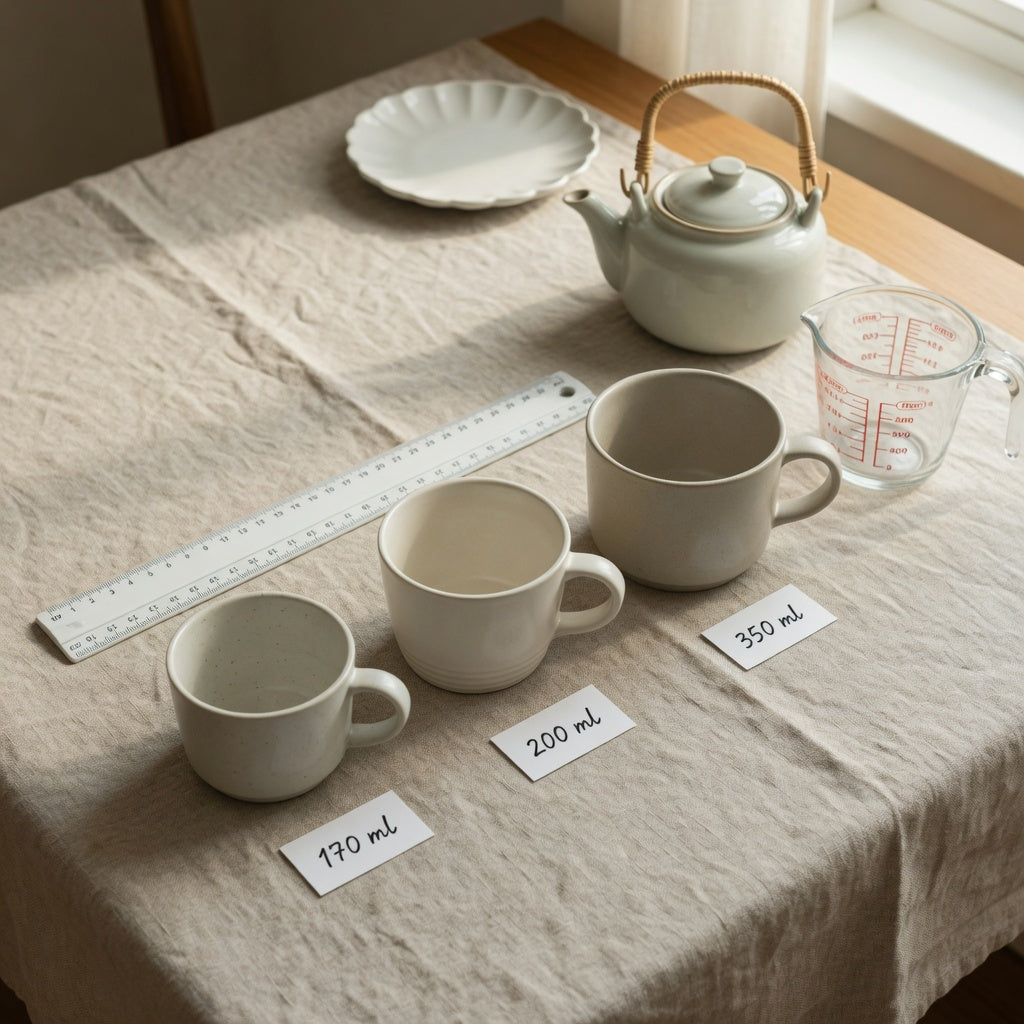
Breakfast Tea Cup: Compare Size, Footprint, and Refill Habits
Reading time: about 11 minutes
The kettle has just boiled, the toast is on the plate, and the cup is the wrong size. A 170 ml pour can feel cramped once you leave room for milk; a much larger desk mug can take the only clear patch beside the plate. That is the practical decision behind a breakfast tea cup: capacity, footprint, and refill rhythm for the way you actually start the day.
At CoffeifyMug, our team helps shoppers compare those three variables before they buy. The current catalog facts give us three clear volume points: Retro at 170 ml, Pleated at 200 ml, and Landscape Tall at 350 ml. For these listings, the details we can stand behind in this guide are the capacities; material, height, rim diameter, care, and included accessories still need to be checked on the current product page.
What capacity should a breakfast tea cup have for tea with milk?
Shoppers usually use the phrase breakfast tea cup to mean a roomier morning serving than a small afternoon pour, but sellers do not apply the label identically. The useful question is how much finished tea you drink and how much headroom you need for milk, sugar, or an infuser.
If a listing measures capacity to the brim, usable carry volume will be lower. Compare like with like and do not treat a word such as jumbo as a measurement.
| Listing | Listed capacity | Approx. US fl oz | Capacity-based buying read |
|---|---|---|---|
| Retro coffee tea cup | 170 ml | About 5.7 | Short pour; a refill is more likely if you normally drink a large mug |
| Pleated coffee tea cup | 200 ml | About 6.8 | Middle volume; still a measured cup rather than a large serving |
| Landscape Tall coffee tea mug | 350 ml | About 11.8 | Largest listed pour; compare footprint before using it on a crowded table |
The US fluid-ounce conversions are approximate and only translate the metric figures. They do not describe wall thickness, heat retention, or the amount you can comfortably carry without spilling.
- 170 ml: choose this volume if you like a compact cup, drink promptly, and already expect to return to the kettle.
- 200 ml: choose this middle point if 170 ml sounds a little tight but a full mug-style serving feels unnecessary.
- 350 ml: start here if you want the largest listed volume for a longer sit-down serving and fewer immediate refills.
For a reliable comparison, fill your current mug with the amount of tea you actually drink, pour it into a measuring jug, and compare that number with the listing. Leave the space you normally reserve for milk or an infuser; a brim measurement is not the same as a comfortable carry level.
If your target is a 15 US fl oz breakfast teacup, that is roughly 444 ml, so it is larger than the 350 ml option listed here. Translating the size into millilitres prevents the word jumbo from doing too much persuasive work.
How should height and footprint change your breakfast tea cup choice?
Capacity tells you volume, not footprint. Two vessels can hold the same amount while one spreads across the plate and the other rises higher above an office desk or breakfast tray.
- Measure the base: use a ruler to check the diameter of the cup that currently fits your table. Leave room for a coaster or saucer only if you plan to use one.
- Allow for the handle: a small base can still have a wide handle projection. Measure the space between the cup and your plate, laptop, or water glass.
- Check vertical clearance: shelves, wall cabinets, tray edges, and desk organizers can make height just as relevant as diameter.
- Recreate the breakfast setting: place the cup beside your usual plate, jam jar, and teapot before deciding that the volume is practical.
Exact height, rim diameter, and base diameter for the three linked listings are not confirmed in the supplied product evidence, so we will not invent them. The word Tall in a product name is not a substitute for a published measurement. If you are buying for a narrow tray or a small office desk, verify the current listing or ask before ordering multiples.
Also check what the product photograph is showing. A saucer, plate, teapot, milk jug, or infuser may be styling props; do not treat any of them as included unless the current listing says so. That distinction matters especially if your search is for a breakfast tea cup and saucer rather than a single tabletop vessel.
Do you prefer a hotter refill or one larger pour?
Capacity is a refill decision, not a heat-retention rating. A smaller serving can be finished sooner, which may suit someone who prefers each cup fresh, while a larger serving can reduce kettle trips but leave more tea to manage if breakfast is interrupted.
A smaller serving does not guarantee better heat retention. Starting water temperature, wall thickness, room temperature, milk, surface area, and preheating all affect the drinking experience, so capacity alone cannot settle the question.
For strong English Breakfast tea with milk, our practical map is:
- Fresh refill routine: the 170 ml volume suits a short pour and a second trip to the kettle. It is useful for someone who drinks beside the toaster rather than settling in for a long read.
- Measured middle serving: the 200 ml volume gives a modest step up without moving all the way to the largest listed option. It works best when your usual drink sits between a traditional cup and a large mug.
- Fewer immediate refills: the 350 ml volume is the first one to inspect if you want a larger morning serving. It makes sense for a newspaper, laptop, or slow breakfast, provided the table and handle dimensions work for you.
If slow sipping matters, preheat the vessel with hot water and discard that water before brewing. That is a useful home technique, not a guarantee of a particular drinking temperature. We have not run hospitality heat-retention testing on these listings, so we will not promise a minute count.
Which material and finish should you verify before checkout?
Fine bone china, porcelain, stoneware, ceramic, and glass each signal a different buying priority. In broad category terms, shoppers often choose fine bone china for a thin, formal feel, stoneware for a more substantial everyday feel, and glass when seeing the tea matters. Porcelain spans many tableware styles. These are category comparisons, not specifications for the Retro, Pleated, or Landscape Tall listings.
Wall thickness, glaze, handle construction, and the shape of the inner opening can affect hand feel and everyday use as much as the body name. If you dislike tea film or lingering flavours, inspect whether the interior appears smoothly glazed and check the care guidance rather than assuming from a product photograph.
- Is the body explicitly described as bone china, porcelain, ceramic, stoneware, or glass?
- Does the listing describe the interior glaze or any unglazed area?
- Are there metallic bands, decals, or other finishes that could change microwave instructions?
- Does the care text address dishwasher use, microwave use, hand washing, or temperature changes?
- Will the opening accept the loose-leaf infuser basket you already own?
If exact body composition, bone-ash sourcing, vegan suitability, or a certification matters to you, ask how the seller defines the material. Do not infer composition or certification from colour, translucency, or a glossy finish.
Gift unboxing creates another easy mismatch. If the recipient expects a breakfast tea cup and saucer, confirm that the listing is for a set before ordering; a styled photograph does not establish what is included.
What should you check after the first dishwasher cycle?
Dishwasher and microwave compatibility are listing-specific purchase filters. The capacities are clear, but appliance use, decoration, and long-term care still need to be verified on the exact product page.
- Read the care line first: if dishwasher or microwave use is not stated, treat it as unconfirmed and ask rather than relying on a category assumption.
- Inspect the rim and handle join: before first use, check for chips, hairline cracks, rough glaze, or a sharp edge around the drinking surface.
- Check the foot ring and finish: look for damage where the vessel meets the table and for printed or metallic decoration that appears loose or marked.
- Avoid sudden temperature changes: do not move a cold vessel directly into boiling water or place a hot vessel on a cold, wet surface unless the care guidance allows it.
- Deal with tea film gently: rinse promptly and use a soft sponge. For a plain glazed interior, some households use a mild baking-soda paste, but avoid abrasive pads on printed or metallic decoration.
Crazing is the fine network of hairline lines that can develop in a glaze. If you notice extensive crazing, a sharp rim chip, or a crack through the food-contact area, stop using the piece and ask the seller for product-specific advice. In our store, a missing care line is a reason to pause, not a reason to assume the most convenient setting.
Which CoffeifyMug size fits your morning routine?
Our product map uses only the confirmed capacity figures. Use the current listing to settle the remaining questions about dimensions, material, care, and included pieces.
- Small table, teapot already nearby, and you like a second pour: Start with the Retro coffee tea cup at the listed 170 ml. It is the smallest confirmed volume, so it aligns with a short-pour routine; verify dimensions and care before checkout.
- You want a little more room without jumping to a large mug: Compare the Pleated coffee tea cup at 200 ml. It is the middle listed capacity, which makes it a sensible fit for a measured serving; compare it with the amount you already drink rather than guessing from the name.
- You want fewer immediate kettle trips: Inspect the Landscape Tall coffee tea mug at 350 ml. It is the largest listed capacity and the logical first comparison for a larger morning pour; verify base, height, handle, and care rather than treating Tall as a measurement.
- You are buying a gift: Match the recipient's usual volume and confirm whether the current listing is for a single vessel or a set. If a breakfast tea cup and saucer is essential, the word cup alone is not enough.
These are volume-based matches, not promises about physical shape, heat retention, or accessories. That distinction keeps the recommendation useful without turning an unconfirmed detail into a product claim.
When is a breakfast tea cup not the right format?
A tabletop cup can be the wrong tool for a very specific routine. Check for a different format if any of these situations describe your morning:
- Sealed commuting: if the cup must travel in a bag, you need a confirmed lid and leak-resistant design rather than capacity alone.
- Built-in brewing: if you want to steep loose leaf inside the vessel, verify an included infuser or plan to use a separate basket. Do not assume one is built in.
- Formal matching tableware: if a matching saucer is part of the gift or place setting, buy a listing that explicitly identifies the set.
- Iced coffee or a large amount of ice: compare opening width, ice clearance, condensation handling, and usable volume instead of choosing by millilitres alone.
Frequently asked questions
What is the difference between a breakfast tea cup and a regular teacup?
The names are not applied consistently, so capacity is a more reliable comparison than the label. Shoppers usually use breakfast tea cup for a roomier morning serving, while a regular teacup may suit a smaller pour. Here, the practical choices are the listed 170 ml, 200 ml, and 350 ml volumes.
How large should a breakfast tea cup be for tea with milk?
Start with the amount you actually finish and leave headroom rather than filling to the rim. The 170 ml option is compact, 200 ml gives a modest step up, and 350 ml is the largest listed starting point for a bigger serving. Check how the current listing defines capacity if that detail is provided.
Is a 350 ml breakfast tea cup too large for a small desk?
Not necessarily, but volume does not tell you base diameter, height, or handle projection. The 350 ml listing can suit someone who wants fewer refills, while a 170 ml or 200 ml option may be easier to place if the desk is crowded. Measure the available space and verify the current dimensions before buying.
Are the CoffeifyMug cups dishwasher and microwave safe?
The evidence used for this guide confirms capacities, not appliance compatibility. Read the care instructions on the exact product page; if dishwasher or microwave use is not stated, treat it as unconfirmed and ask before running a cycle. Do not infer appliance safety from the material name or product photo.
Does a breakfast tea cup include a saucer or infuser?
There is no universal inclusion rule. A lifestyle photo may show a saucer, teapot, milk jug, or infuser as a separate prop, so check the exact listing for included pieces. If the page is silent, treat the accessory as unconfirmed.
Before you add a breakfast tea cup to your cart, check these five lines:
- The listed capacity against the amount of tea you actually finish.
- Height, rim diameter, base diameter, and handle clearance for your table or desk.
- Headroom for milk and compatibility with the infuser you already own.
- Material, finish, dishwasher guidance, microwave guidance, and temperature-care notes.
- Included pieces, especially a saucer, lid, or infuser, if any of them matters to the purchase.
Once those answers are clear, choose Retro for the shortest listed pour, Pleated for the middle volume, or Landscape Tall for the largest listed pour. If you want to compare additional styles for a kitchen, office, or gift, continue to the unique coffee mugs collection. A good breakfast tea cup is the one that fits the amount you drink and the table you actually have.
More from our blog
Read more

Ceramic Matcha Latte Mug: Compare Capacity, Shape, and Care
Compare 250 ml, 390 ml, and 400 ml options using your actual recipe, then assess opening shape, glaze evidence, care instructions, and use-case limits. We separate confirmed listing facts from deta...
Read more
What Size Mug for Chai Tea? Compare 400, 440, and 480 ml
This practical guide answers what size mug for chai tea by comparing small reference servings with 400, 440, and 480 ml everyday mugs, then maps each capacity to masala chai, chai lattes, desk use,...
Read more
Leave a comment
This site is protected by hCaptcha and the hCaptcha Privacy Policy and Terms of Service apply.