
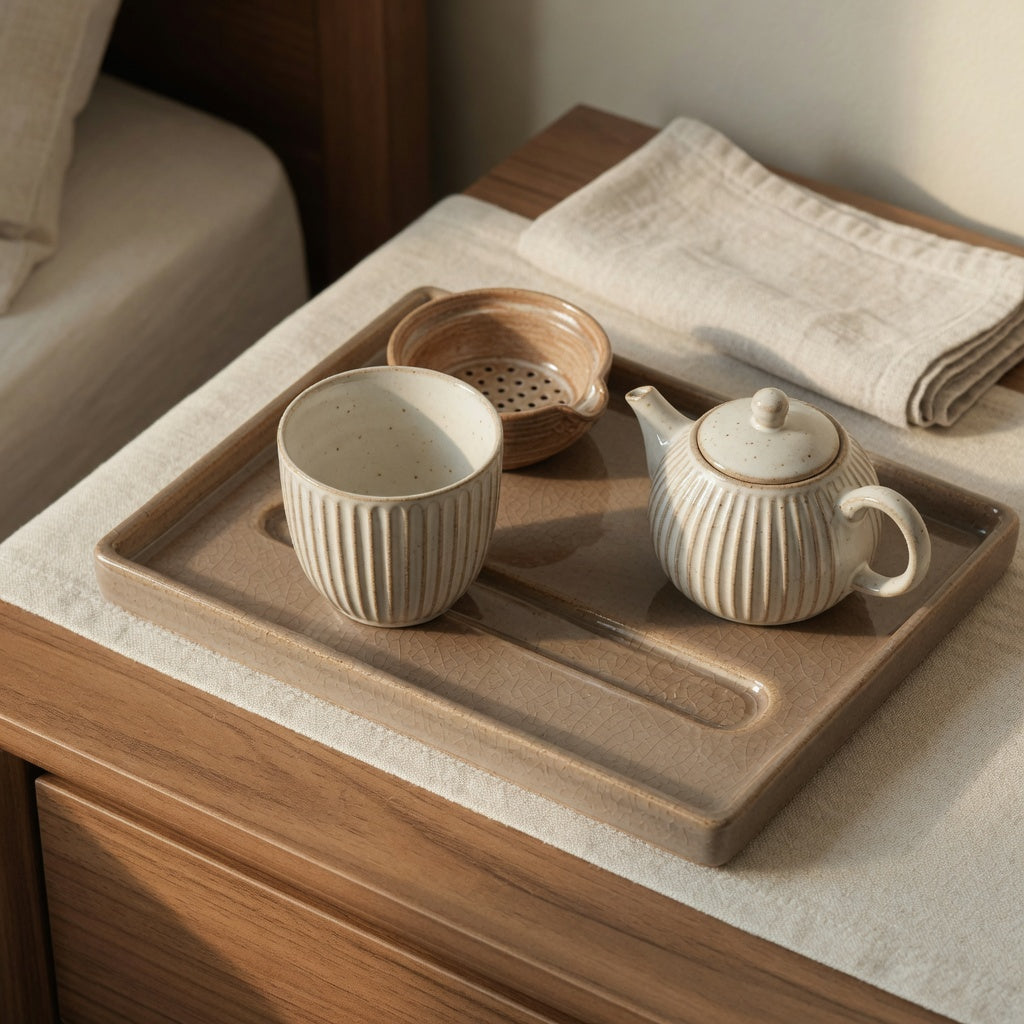
Pleated Ceramic Cup Tea Tray: Fit, Care and Material Checks
Reading time: about 10 minutes
A cup can fit on a tray in a styled photo and still make the tray frustrating to use. We see the problem as soon as we stage a guest-room setup on a real nightstand: the pleated body crowds the teapot, the infuser has no dry landing spot, or the cup's foot ring rests partly on a raised border. A pleated ceramic cup tea tray pairing works only when the cup's full outline, the tray's usable surface, and the serving routine agree.
In our store, we judge sculptural cups as drinkware first and decor second. The pleated coffee tea cup is the relevant next step if texture is the point of the setup, but use the live product page to confirm its current dimensions, capacity, and care directions before choosing a tray. If you are shopping for another household and do not know their drinkware habits, our coffee mugs for gifts collection lets you compare styles after deciding between compact tea service and everyday mug use.
Pleated ceramic cup tea tray: how much working space is enough?
Start by confirming what the listing includes. A tray, spoon, or teapot shown in a lifestyle photo may be a styling prop rather than part of the package. The written package contents should control the buying decision.
Next, compare usable measurements rather than relying on the tray's advertised outer length. Raised rims, recessed wells, drain slots, and decorative borders all reduce the area where a cup can sit safely. The cup's base diameter can be misleading too, because a flared pleat or handle may extend beyond the foot.
- Tray inner length and width: Measure inside the raised lip or border, not from outside edge to outside edge.
- Cup maximum width: Use the widest body point, including any handle or outward-facing fold.
- Base and foot-ring diameter: Confirm that the entire contact surface lands on a flat part of the tray.
- Cup height: Check clearance beneath shelves and against the teapot spout during a pour.
- Companion footprint: Add the pot, infuser dish, spoon, sweetener, and any second cup the tray must hold.
Our most useful no-cost test is a paper mock-up. Mark the tray's usable rectangle, then cut or draw the maximum outlines of the cup and teapot. Move them through the pour: the hand should reach the cup without brushing another hot vessel, and the infuser or lid should have a flat place to land.
A successful pleated ceramic cup tea tray does not need a universal size. It needs a clear pour lane and one genuinely empty working zone. Gongfu service usually puts more vessels and more water on the tray, so drainage and reservoir space become more important than they are for a dry guest-room setup.
Pleated cup or round mug: which shape fits the drink and hand?
Texture changes more than appearance. It affects the outer footprint, finger contact, cleanup, and how tightly several cups can sit in a cupboard. Compare the actual design rather than assuming every pleated cup is small or every round mug is large.
| Buyer check | Pleated ceramic cup | Round mug |
|---|---|---|
| Tray planning | Measure the widest fold because the outline may be irregular | A circular outline is generally easier to position on a narrow tray |
| Serving size | Confirm the listed capacity suits tea, coffee, or the intended refill routine | Confirm capacity rather than assuming the familiar shape holds more |
| Grip and rim | Ridges can provide finger purchase, but deep folds may feel pronounced | A smooth body is easy to rotate; handle opening and rim thickness still need checking |
| Cleanup | Grooves require a narrow brush or careful cloth work | A smooth exterior is faster to wipe after daily use |
| Storage | Irregular forms may not nest or line up tightly | The predictable footprint is easier to plan around, although stacking depends on the design |
| Gift fit | Best for someone who enjoys visible texture and will use the stated serving size | A lower-risk choice for someone with a straightforward daily coffee routine |
Choose the pleated style if the tray is part of the room's decor and the live listing confirms that its capacity and dimensions suit the drink. Choose the round coffee tea mug if a familiar silhouette, simpler tray placement, or quicker exterior cleanup matters more. Neither style automatically guarantees a particular capacity, handle fit, or dishwasher status.
On arrival, place the empty cup on a level counter and press lightly near four points around the rim. If it rocks, test the tray and cup separately to find the uneven surface. Also inspect the drinking lip, handle junction, interior glaze, and foot ring for chips, cracks, sharp glaze drips, or rough contact points that could scratch a tray. An irregular silhouette can be intentional; an unstable base or sharp lip is a usability problem.
Which tray material suits guest rooms and gongfu spills?
The best tray material depends on how much water reaches it and how promptly it will be dried. We separate dry serving trays from trays designed to manage repeated pouring.
- Glazed ceramic or porcelain: Straightforward to wipe and visually cohesive with ceramic cups. It can be heavy or breakable, and a flat tray still needs to be emptied if water pools inside its rim.
- Wood or bamboo: Warm-looking and often lighter to carry. Seams, slats, handles, and the underside need thorough drying because moisture can remain where a quick top wipe does not reach.
- Stone or composite: Stable on a dedicated tea table but often heavier for a nightstand. Check for furniture-protecting feet and confirm whether the design actually drains or merely contains a shallow spill.
For a guest room, we prefer a tray that can be carried level with one hand and wiped completely after checkout. For a wet gongfu setup, choose a purpose-built drainage or reservoir design. A decorative ceramic serving plate does not become a wet tea tray simply because it has a raised edge.
Odor and mold are often drying problems rather than material labels alone. Remove wet tea cloths, empty any reservoir, wipe the underside, and air-dry wood or bamboo on edge before storage. Do not leave a damp napkin trapped beneath the cup.
How much cleaning do deep pleats add?
Pleats add a real maintenance step. Tea film, drips, and guest-room dust can settle in the valleys while a flat sponge passes over the raised ridges. The job is manageable, but only if the cleaning tool reaches the texture.
- Remove tea leaves or the used tea bag before residue dries against the interior.
- Rinse promptly once the cup is cool enough to handle safely.
- Use mild dish soap and a soft, narrow brush on the exterior grooves.
- Run a fingertip around the rim and handle junction to catch residue a sponge may miss.
- Rinse away soap, then dry the fold valleys and unglazed foot ring with a clean cloth.
- Use a dishwasher only if the current listing expressly permits it. If machine washing is allowed, position the cup so raised folds cannot knock against neighboring dishes during the cycle.
A cup left on a guest tray for several idle weeks still needs attention. Wipe the exterior, rinse the interior with hot water, and dry it before the guest arrives. Avoid metal tools and abrasive pads, which can mark a glaze or catch on raised details.
This style is not the strongest choice for a high-turnover rental, a shared office sink with no small brush, or a household that expects every mug to stack tightly. If low-effort cleaning is the priority, a smooth round mug is the more practical purchase.
What should a food-use ceramic listing tell you?
Decorative appearance cannot establish that a ceramic piece is intended for drinks. In the United States, the FDA sets action levels for extractable lead in ceramicware; ceramic foodware exceeding those levels when tested may be considered adulterated under federal law.
ASTM C738 is the standard test method for determining lead and cadmium extracted from glazed ceramic surfaces using acetic acid. That describes a testing method, not a blanket certification for every item labeled ceramic or porcelain. Product-specific evidence must come from the seller or manufacturer.
The FDA also explains that ceramicware resembling foodware but intended solely for ornamental use must carry both a conspicuous stick-on label and a permanent statement on the exterior base. If a piece is marked decorative or display only, do not use it for tea or coffee.
- Look for an explicit statement that the cup is intended for beverage or food use.
- Confirm the current capacity, maximum dimensions, and package contents.
- Follow only the microwave and dishwasher claims written on the live listing.
- If testing is claimed, look for the named method, tested item, and scope rather than relying on a generic badge.
- Keep care instructions with the order details so gift recipients know how to use the cup.
Which setup gives a pleated cup the right job?
- Compact guest-room tray: A pleated cup fits when its maximum outline leaves room for a small pot or infuser dish. The texture gives the setup a focal point without requiring extra decoration; compare the current details on the pleated cup product page.
- Daily office or breakfast coffee: A round mug is usually the more direct choice if the drinker refills often, carries the mug between rooms, or values a smooth exterior. Review the live specifications for the round mug option before deciding.
- Gongfu tea table: Lay out every cup, pot, pitcher, strainer, and lid rest before prioritizing one sculptural shape. The cup fits only if the complete service still leaves a safe pour path and the tray can manage water.
- Housewarming or host gift: Choose texture for a recipient who displays ceramics or serves tea; choose a familiar mug for someone focused on everyday coffee. Our gift-ready mug collection is the practical next step once that habit is clear.
A pleated cup is not a substitute for a sealed travel mug, a tightly stackable set, or an oversized drink vessel. It earns its space when tactile ceramic design matters and the buyer is willing to clean the folds.
Frequently asked questions
Is a pleated ceramic cup tea tray practical for a guest room?
Yes, if the cup's widest point leaves a clear place for the teapot, infuser, or used tea bag. Keep the setup to the pieces a guest can use without rearranging hot ceramics, and avoid balancing accessories on the tray rim.
How do I know if a pleated cup will fit a small tea tray?
Compare the tray's inner usable area with the cup's maximum width, not just its base diameter. Make a paper template of the cup and other serving pieces, then check that a hand and teapot spout can move through the layout safely.
Is a pleated ceramic cup better than a round mug?
A pleated cup is better when visual texture and tactile detail justify extra cleaning. A round mug is usually better for predictable placement, frequent refills, and fast wipe-downs. Check the two live listings because shape alone does not determine capacity or care requirements.
Can a pleated ceramic cup go in the dishwasher or microwave?
Only if the current product listing expressly says it can. Ceramic material alone does not confirm appliance compatibility, especially if the piece has decorative finishes, irregular details, or an unglazed foot ring.
Can I give a pleated ceramic cup as a housewarming gift?
It suits someone who enjoys tea service, textured ceramics, or styled kitchen shelves. A round mug is a safer alternative if the recipient prefers large everyday drinks, simple cleaning, or cupboard stacking. If you do not know their tray dimensions, give the cup without assuming a displayed tray is included.
Run this five-minute check before ordering:
- Verify whether the listing includes a cup, tray, or complete set.
- Compare current capacity with the recipient's usual serving size.
- Measure the widest pleat, foot ring, and tray's inner surface.
- Leave a clear pour lane and a dry place for the infuser or lid.
- Plan how the grooves, tray seams, and underside will be dried.
- Confirm beverage use and follow the stated appliance-care directions.
If the paper mock-up leaves working space and the texture suits the room, review the pleated coffee tea cup. If familiar handling and simpler cleanup win the comparison, move to the round coffee tea mug. For a gift, settle the recipient's serving habits first, then compare the options in our coffee mugs for gifts collection.
More from our blog
Read more

Golden Waves Kio Mug: Compare Finish, Care, Size, and Fit
Compare the Golden Waves Kio Mug by the details that affect daily use: decoration type, microwave and dishwasher wording, usable pour, handle clearance, and wear points. We also explain who will be...
Read more
Ceramic Cup Coffee Tray Guest Room: 7 Checks Before Buying
A ceramic cup coffee tray guest room setup succeeds or fails on footprint, handle clearance, brewer output, glaze condition, and the cleaning routine. Compare pleated and round profiles, plus cases...
Read more
Leave a comment
This site is protected by hCaptcha and the hCaptcha Privacy Policy and Terms of Service apply.