
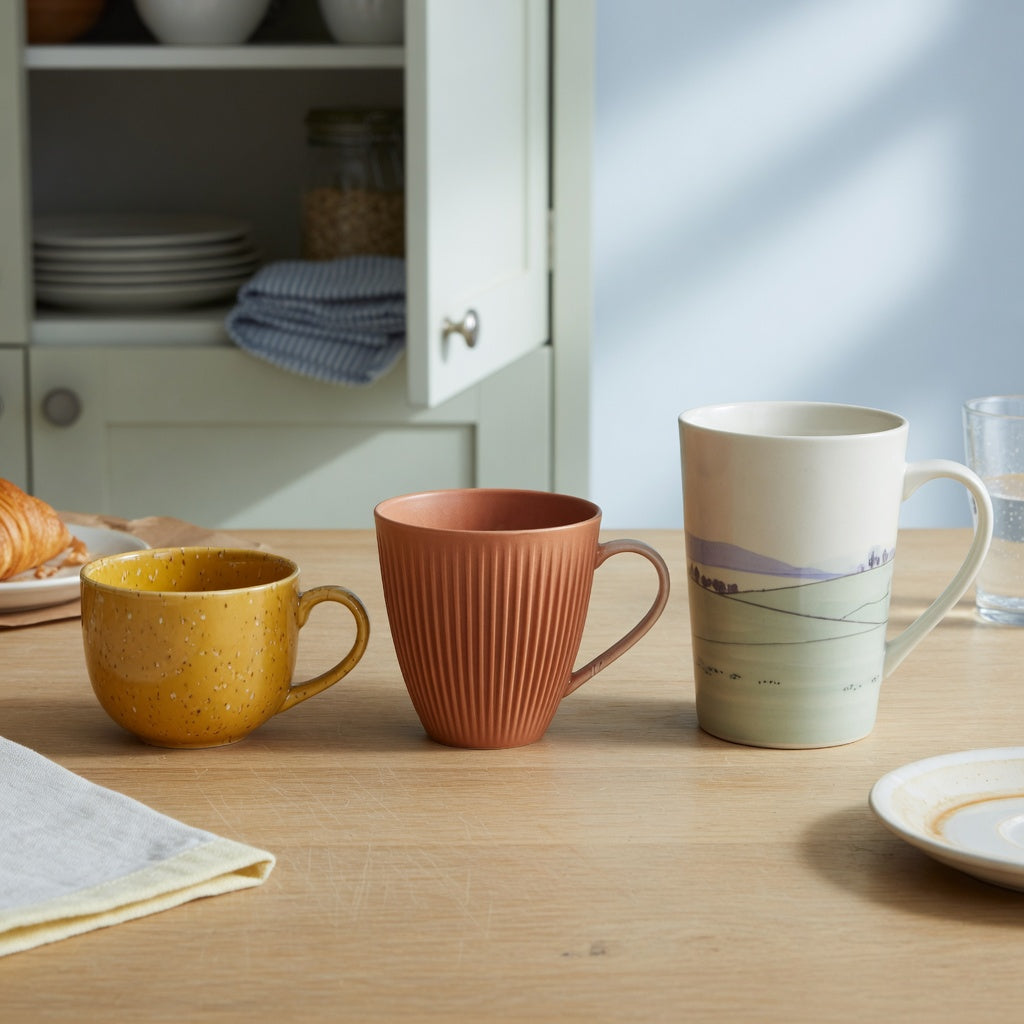
Breakfast Coffee Cup Everyday Mug Rotation Product Shortlist Guide
Reading time: about 9 minutes
A cup can look right on an open shelf and still miss every weekday breakfast. At 7:15, the useful cup is the one that is clean, easy to place beside a plate, and sized for the amount you actually finish. Our breakfast coffee cup everyday mug rotation product shortlist guide starts with that repeated-use reality rather than display appeal.
For this comparison, the confirmed product facts are the listed capacities: the Retro coffee and tea cup at 170 ml, the Pleated coffee and tea cup at 200 ml, and the Landscape Tall coffee and tea mug at 350 ml. We use those numbers to compare pour habits, likely storage demands and refill preference. We do not turn them into unsupported claims about durability, dishwasher life or resistance to chips.
The breakfast coffee cup everyday mug rotation product shortlist guide: three filters
Customers often begin with color or shape, but the cups that stay in rotation usually pass three less glamorous tests. We ask shoppers to replay one ordinary breakfast, including where the coffee maker sits, what else is on the table and when clean cups become available again.
- Measure the normal pour. Fill your current cup to the level you actually drink, using cool water, then transfer that water to a measuring jug. Do not measure to the rim because milk, foam and carrying headroom also need space.
- Mark the cup zone. Check the table area left beside your usual plate, bowl, laptop or newspaper. A cup footprint includes the base, widest part of the body and handle projection.
- Follow the wash cycle. Note how long a used cup waits before it is hand-washed or, where its care instructions permit, returned from the dishwasher. That interval determines how many cups need to be active.
A practical rotation gives each cup a job. One may handle short weekday pours, another a larger weekend serving. Buying several cups with no distinct role usually recreates the crowded cupboard problem the shortlist was meant to solve.
170 ml, 200 ml or 350 ml: where is the useful capacity jump?
Listed capacity is a comparison point, not necessarily a comfortable fill line. A 200 ml cup filled with 200 ml of liquid may leave little carrying room, depending on how the capacity is measured. Shoppers who add milk should include that volume before deciding that a smaller option is sufficient.
| Product | Listed capacity | Best-fit breakfast routine | Footprint check | Reason to skip |
|---|---|---|---|---|
| Retro | 170 ml | Short serving with a refill source nearby | Smallest listed volume, but confirm the external base, body and handle measurements | Refilling interrupts the meal or your drink needs substantial headroom |
| Pleated | 200 ml | Moderate pour when 170 ml feels slightly tight | Compare directly with the Retro because 30 ml of extra capacity does not establish a smaller or larger external footprint | You expect a major reduction in refill frequency |
| Landscape Tall | 350 ml | One larger serving intended to last through breakfast | Reserve vertical shelf clearance and verify body width and handle projection | Table space, shelf height or the weight of a fuller cup is a concern |
The difference between the Retro and Pleated is 30 ml. That is a modest change, so style, hand comfort and confirmed external dimensions may decide more than capacity. The Landscape Tall adds 150 ml over the Pleated and 180 ml over the Retro, making it the meaningful step for someone who wants fewer refills.
Is the Retro 170 ml the right front-shelf cup?
The Retro 170 ml cup fits a routine built around shorter servings. Choose it if the coffee maker is close, you enjoy returning for a fresh pour, or your measured drink stays comfortably below the listed capacity after allowing headroom.
- Choose it for: quick weekday breakfasts, intentionally small servings and routines where refilling is easy.
- Skip it for: one-and-done mornings, larger milk-based drinks or a breakfast setup located far from the coffee maker.
Do not assume that the smallest listed capacity automatically has the smallest external dimensions. If table space is the deciding factor, compare the base, widest body point and handle reach shown on the current product page or ask our store before ordering.
Does the Pleated 200 ml earn a separate role?
The Pleated 200 ml cup is the middle option, but middle does not automatically mean universal. It suits a shopper whose usual serving feels constrained in 170 ml yet does not justify moving to 350 ml. The extra 30 ml can provide useful room for a slightly larger pour or added milk, provided the normal drink still leaves carrying space.
- Choose it for: moderate servings, a compact daily rotation and shoppers who want a small capacity increase rather than a dramatic change.
- Skip it for: routines where 170 ml already works or where the real goal is eliminating a refill.
We would not add both the Retro and Pleated solely to create capacity variety. Their listed volumes are close. Give them separate roles based on measured footprint, preferred style or different users in the household.
Who should reserve space for the Landscape Tall 350 ml?
The Landscape Tall 350 ml mug is for a noticeably larger pour. It makes sense when you want to sit down once, carry breakfast to an office desk, or avoid returning to the kitchen before the meal is finished.
- Choose it for: longer breakfasts, a larger measured serving and routines where a refill is inconvenient.
- Skip it for: shallow shelves, tightly arranged breakfast tables, short drinks or mornings when you regularly leave part of a large serving unfinished.
A 350 ml liquid load also weighs more than a 170 ml or 200 ml load before the weight of the mug itself is considered. Shoppers who prefer a light cup in hand should account for filled weight, not capacity alone. We do not claim that the tall format keeps coffee hot longer because that would depend on material, wall construction, lid use and other factors not established by capacity.
How do table footprint and cupboard clearance change the shortlist?
Capacity describes internal volume. It does not tell you the base diameter, maximum body width, handle projection or total height. Those four measurements control whether a cup sits comfortably beside breakfast dishes, clears the shelf above it and can be lifted without catching a neighboring handle.
For a crowded table, mark an available rectangle with a ruler and include room for your fingers around the handle. For a cupboard, measure from the shelf surface to the underside of the shelf above. The word Tall in Landscape Tall is a prompt to verify vertical clearance, not proof that its base is wider than either smaller cup.
We also avoid assuming that cups stack or nest. Unless the current product information explicitly confirms stackability, plan to store each cup on its own base. Stacking incompatible forms can place pressure on rims and makes the cup at the bottom less convenient to reach.
Once you know the capacity and external space your rotation can support, browse our unique coffee mugs for everyday breakfast rotations. Use the measurements and role you have already selected to filter the styles, rather than restarting the decision from appearance alone.
How should washing and unboxing affect an everyday rotation?
A favorite cup is not available if it is still beside the sink or waiting in yesterday's dishwasher load. If you wash by hand after each breakfast, one primary cup and one backup may cover the routine. If cups remain in a machine until a later cycle, count how many breakfasts pass before they return to the cupboard.
Check the current material and care directions on each linked product page before assuming microwave or dishwasher compatibility. Appearance alone does not establish either. If dishwasher use is permitted, check rack height, spray-arm clearance and whether handles touch neighboring dishes during the cycle.
For any shipped cup, including one intended as a gift, inspect it before first use or wrapping:
- Run a fingertip carefully around the rim to check for a chip or rough spot.
- Look around the handle attachments for a visible hairline crack.
- Place the empty cup on a flat, dry counter and check for unexpected rocking.
- Follow the stated care guidance and use a non-abrasive cleaning tool unless the product instructions say otherwise.
These are standard receiving checks for any shipped drinking cup, not a claim that these products commonly arrive with defects. They help catch a transit issue before the cup enters a daily washing cycle.
What two- or three-cup rotation avoids redundant purchases?
Used well, this breakfast coffee cup everyday mug rotation product shortlist guide gives each purchase a specific reason to exist. Start with the scenario that describes most of your week, then add another cup only if it covers a genuinely different routine.
- Short-pour and refill-friendly: Put the Retro 170 ml in the primary role. Consider the Pleated only if the extra 30 ml solves a measured headroom problem.
- Moderate weekday and larger weekend: Use the Pleated 200 ml for the usual breakfast and the Landscape Tall 350 ml for longer meals or desk use.
- One larger serving every day: Start with the Landscape Tall 350 ml and skip both smaller options unless another household member prefers short pours.
This is a shortlist of individual products, not a bundled set. You do not need all three capacities. The most practical next purchase is the one that matches your normal pour and fits the storage path from cupboard to table to washing area.
Frequently asked questions
How should I use a breakfast coffee cup everyday mug rotation product shortlist guide?
Measure your normal pour, the available table area and your shelf clearance before comparing styles. Then choose the capacity that covers your most frequent breakfast and add a second option only if it serves a different routine.
Is 200 ml meaningfully larger than 170 ml for breakfast coffee?
The difference is 30 ml, so it is a modest increase rather than a major capacity change. It may help with headroom or a little added milk, but shoppers seeking substantially fewer refills should compare the 350 ml option.
Does a 350 ml mug always take up more table space?
Not necessarily. Capacity does not establish base diameter or handle projection, and a tall form can distribute volume vertically. Check the current external measurements against the exact area available beside your breakfast plate.
Can I assume these cups stack or go in the dishwasher?
No. Do not infer stackability, microwave compatibility or dishwasher suitability from a product photo or capacity. Follow the current product page care instructions and plan separate shelf positions unless stacking is explicitly confirmed.
What should I check immediately before choosing a cup?
Write down your normal pour in milliliters, available shelf height and usable table area including handle room. Compare those numbers with the Retro 170 ml, Pleated 200 ml and Landscape Tall 350 ml, then review the unique coffee mug collection for the style that fits the role you have already defined.
More from our blog
Read more

Cacao Cup Everyday Mug Rotation Practical Purchase Checklist
Compare the verified 250 ml Ball Handle, 390 ml Round, and 400 ml Spittoon by the amount you finish, available storage, and details still worth confirming. Includes rotation, care, and arrival-insp...
Read more
Ceramic Glazed Coffee Mugs: Everyday Rotation Purchase Checklist
Build a rotation from the mugs you actually use between washes, not an arbitrary set count. Compare pour volume, handle clearance, cabinet footprint, glaze care, and designs suited to specific dail...
Read more
Leave a comment
This site is protected by hCaptcha and the hCaptcha Privacy Policy and Terms of Service apply.