
Breakfast Coffee Cup Size Decision Guide: 170, 200, or 350 ml?
Reading time: about 8 minutes
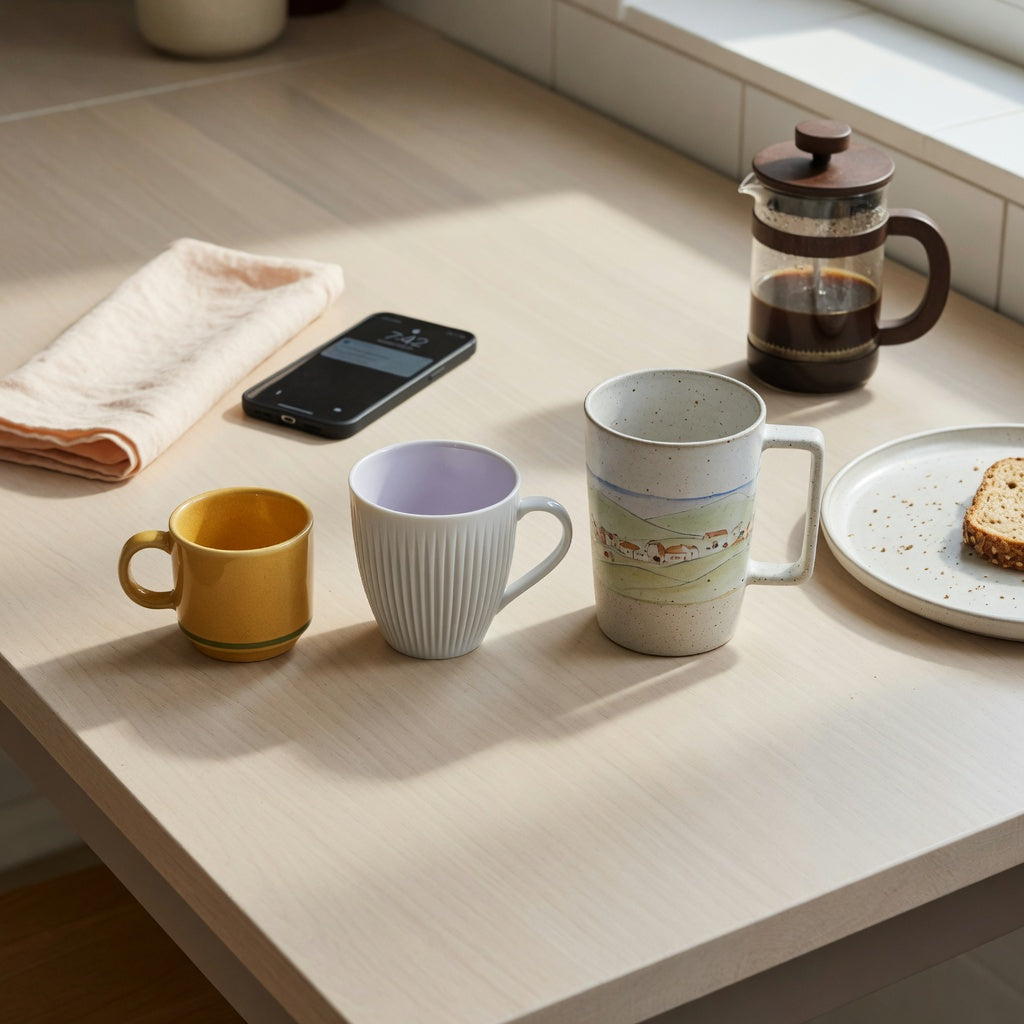
A breakfast plate, cutlery, phone, and jam jar can leave surprisingly little room for a cup. That is where capacity stops being an abstract number and becomes a practical table decision. This breakfast coffee cup size decision guide compares CoffeifyMug's three current listed capacities: Retro at 170 ml, Pleated at 200 ml, and Landscape Tall at 350 ml.
In our store, we see one comparison mistake repeatedly: shoppers use capacity as a shortcut for outside size. The two are not interchangeable. Capacity tells you how much the vessel is listed to hold, while table fit also depends on body width, handle projection, and enough clearance to lift the cup without clipping a plate. We separate those variables before recommending a smaller or larger option.
A breakfast coffee cup size decision guide for capacity, footprint, and refills
The three capacities do not form evenly spaced steps. Pleated is only 30 ml above Retro, while Landscape Tall is 150 ml above Pleated. That makes the real choice less about small, medium, and large labels and more about whether you need a modest increase or a substantial one.
| Current option | Listed capacity | Reader situation | Trade-off to check |
|---|---|---|---|
| Retro Coffee Tea Cup | 170 ml | Your measured pour is small and refilling is convenient | Your breakfast total may require more than one pour |
| Pleated Coffee Tea Cup | 200 ml | You need slightly more than 170 ml but do not want a 350 ml vessel | The extra 30 ml may be too small a change for a large-pour habit |
| Landscape Tall Coffee Tea Mug | 350 ml | You prefer a larger single pour and have a clear placement zone | The tall format and outside dimensions need checking |
Listed capacity is not a recommended drink serving, a heat-retention claim, or an outside measurement. It also does not tell us how much milk, ice, or other additions you use. Include everything that normally goes into your breakfast drink when comparing your routine with these numbers.
What does your usual breakfast pour actually require?
You do not need to guess. We recommend one simple kitchen test before choosing a product page:
- Set out your breakfast as usual, including the plate, cutlery, jars, phone, book, or laptop that normally shares the surface.
- After using your current cup, refill it with water to your normal drink level and transfer that water to a marked measuring jug.
- Count how many top-ups you make over two or three ordinary mornings rather than judging from an unusually rushed or leisurely day.
- Measure the widest space occupied by your current cup, including the handle and room for your fingers.
If your regular pour sits comfortably within 170 ml and you already refill, the smallest listed option may be enough. If it falls just beyond that point, 200 ml deserves a closer look. A routine that needs substantially more capacity points toward 350 ml.
Retro 170 ml: smaller pours with an easy refill nearby
The Retro Coffee Tea Cup is the smallest current option at 170 ml. It fits a shopper whose measured pour is comfortably within that capacity and who keeps the pot, kettle, or coffee machine close enough that a second pour is not disruptive. This can work well at a busy two-person breakfast table or a kitchen counter where several items compete for space, although you should still verify the cup's outside dimensions rather than assuming capacity guarantees a narrow footprint.
Retro is not the practical choice for someone who wants the entire breakfast drink in one uninterrupted pour and routinely needs more than 170 ml. It can also be frustrating at an office desk if every refill means leaving a call or walking to another room. The trade-off is straightforward: choose the smaller listed capacity only if its refill pattern matches your morning.
Pleated 200 ml: a 30 ml step, not a halfway size
The Pleated Coffee Tea Cup holds 200 ml. Its most useful role is specific: your normal pour is a little too large for 170 ml, but 350 ml is more capacity than you want. For a shopper making that exact adjustment, the extra 30 ml can resolve the mismatch without moving to the largest current option.
Do not treat 200 ml as an automatic compromise simply because it sits between the other products in the catalog. Numerically, it remains much closer to 170 ml than to 350 ml. It is not a good fit if your measurement test shows that you need a major increase or if avoiding a refill is your main priority.
Landscape Tall 350 ml: a deliberate jump for a larger pour
The Landscape Tall Coffee Tea Mug has a listed capacity of 350 ml. That is 150 ml more than Pleated and 180 ml more than Retro, so this is a meaningful change rather than a small step up. It suits a solo breakfast, reading session, or home-office morning where you want a larger pour and have a dedicated place for the mug away from plates, papers, and electronics.
The extra capacity can reduce refills only when your normal total drink fits into the amount you choose to pour at once. It is not a guarantee that every shopper will make one drink last through breakfast. Landscape Tall is also not the obvious choice for a crowded shared table, a low cabinet shelf, or anyone who deliberately prefers separate smaller pours. Because it is a tall-format product, check storage height and full outside width before ordering.
How much breakfast-table space does a cup really need?
At our packing and comparison tables, we assess fit at the widest occupied point, not just at the base. The handle can be the part that reaches a plate, placemat edge, or laptop, and your hand needs additional room to approach it comfortably.
- Shared table: Place both breakfast settings before measuring. Empty space seen before the second plate arrives is not usable space.
- Kitchen counter: Check the distance from the cup position to appliance doors, cabinet edges, and the area where you prepare food.
- Office desk: Include the handle and lifting path, then keep the drink in a separate clear zone from the keyboard and charging cables.
- Storage and washing: Check shelf height and dishwasher-rack clearance if those are part of your routine. Capacity alone cannot confirm either fit.
Product photography can help you compare style, but camera angle is not a reliable measuring tool. Use current dimensions on the relevant listing where available, and ask our store before ordering if a specific shelf, machine area, or table opening creates a hard limit.
What should you verify about care, damage, and included items?
Capacity does not establish material-specific care. Check the current product listing before using a dishwasher or microwave, and follow the instructions given for that individual cup or mug. Do not assume all three products share the same care limits simply because they appear in the same size comparison.
At unboxing, inspect the rim, the handle attachment points, and the base for chips or cracks that may have occurred in transit. A damaged piece should not be used. Breakfast food, coffee, tea, plates, saucers, and other styling props should not be assumed to come with the cup or mug; rely on the product listing for exactly what is offered.
Your 60-second decision checklist
- Choose Retro 170 ml if your measured pour fits comfortably, refilling is easy, and you do not need a large uninterrupted drink.
- Choose Pleated 200 ml if 170 ml falls slightly short and an additional 30 ml addresses the actual gap.
- Choose Landscape Tall 350 ml if you need a substantial capacity increase, prefer fewer interruptions, and have verified its physical fit.
- Measure outside space separately from capacity, including the handle, hand clearance, cabinet height, and dishwasher position where relevant.
- For a gift, measure a cup the recipient already uses or ask about refill habits. The middle catalog option is not automatically the safest choice.
Once you know the capacity range that matches the shopper, compare the available shapes and finishes in our unique coffee mugs collection. Capacity should narrow the field before appearance makes the final decision.
Frequently asked questions
Is a 170 ml cup too small for breakfast coffee?
It is too small only if your preferred single pour does not fit comfortably or you dislike refilling. The Retro 170 ml option makes more sense for modest pours and mornings when the pot or machine is nearby. Measure your current pour instead of relying on a general drink-size label.
Is the 200 ml Pleated cup halfway between the other sizes?
No. It is 30 ml above the 170 ml Retro cup but 150 ml below the 350 ml Landscape Tall mug. Choose it for a small capacity increase, not because you assume it is an even midpoint.
Should I buy the 350 ml mug if I want to avoid breakfast refills?
Choose it if your measured total drink fits within the capacity you are comfortable pouring and the mug fits your table and storage space. It gives you 180 ml more listed capacity than Retro, but it cannot guarantee a refill-free breakfast for every drinking habit.
Does cup capacity tell me how much table space it needs?
No. A reliable breakfast coffee cup size decision guide treats capacity and outside footprint as separate measurements. Check the widest span, including the handle, and leave enough room for your hand, plate, and other breakfast items.
Can all three options go in a dishwasher or microwave?
Do not infer dishwasher or microwave suitability from capacity, shape, or appearance. Review the current care information on the individual product page before use. If the listing does not answer a care question that affects your routine, contact our store before ordering.
For the clearest next step, measure one normal pour and one fully set breakfast place. Then select 170 ml for smaller refill-friendly servings, 200 ml for a modest step up, or 350 ml for a larger pour with enough verified space.
More from our blog
Read more
Piccolo Cup Size Decision Guide: Compare 170, 250 and 270 ml
Compare the verified 170 ml Retro, 250 ml Ball Handle and 270 ml Emerald capacities against your finished pour, desired headroom, storage and care needs. This guide also explains when none of the t...
Read more
Eggnog Mug Buying Priorities: Capacity, Shape, and Space
Compare the Retro 170 ml, Pleated 200 ml, and Emerald 270 ml by the factors that affect daily use: pour size, visible profile, and available shelf or tray space. Includes a practical measuring chec...
Read more
Leave a comment
This site is protected by hCaptcha and the hCaptcha Privacy Policy and Terms of Service apply.