

Rustic Ceramic Mugs For Gifts: 7 Things To Compare Before You Buy
Reading time: about 9 minutes
Every Saturday morning, our packing table looks about the same: a row of speckled stoneware wrapped in kraft paper, half of it headed to birthdays and housewarmings, and at least one order note that reads, "He drinks a lot of coffee — will this actually be big enough?"
That question, in some version, is the one we answer most. And the honest reply is: it depends on three or four things a product photo can't show you.
Buying rustic ceramic mugs for gifts online means judging clay, glaze, capacity, and care from a screen. Our team packs and inspects this drinkware every day, and we've learned which comparisons actually predict whether a gift becomes someone's favorite mug or a cabinet orphan. Here's the checklist we'd walk through with a friend.
What actually makes a ceramic mug "rustic"?
The word covers a lot of ground, from hand-thrown studio pottery to molded stoneware with deliberately uneven glazes. Three construction details do most of the visual work:
- Clay body. Stoneware is fired hot — most stoneware kilns run well above roughly 2,100°F — which vitrifies the clay into a dense, chip-resistant body. It's the standard for daily-use rustic mugs. Earthenware fires cooler, so it's lighter but more porous and easier to chip against a faucet. Porcelain is strong and refined, which is exactly why it rarely reads as rustic.
- Reactive glaze. Those gradients where brown bleeds into cream or sage green happen because glaze minerals melt and flow unevenly in the kiln. Every piece emerges slightly different. That's the appeal — and the trade-off we'll get to below.
- Exposed clay foot. Many rustic mugs leave the bottom quarter unglazed. It adds grip and visual weight, but that raw ring holds water, so the mug needs to dry fully before it goes back in the cabinet.
Which rustic mug fits which recipient? Three scenarios from our counter
Style does more work in this purchase than buyers admit. A gift mug has to feel chosen, not just functional. Three situations we see again and again, and where we'd point you:
- The new homeowner who serves coffee to guests. A landscape motif starts conversations. Our Mountain & Sea Coffee & Tea Mug is built around a mountain-and-sea scene, and it suits kitchens that run earthy or coastal. Confirm the current capacity and care notes on the listing before ordering.
- The outdoors person who already owns too many plain mugs. The Elk and Moon Coffee Tea Mug goes for a night-sky, wildlife feel instead of abstract glaze — an easy match for cabin decor and early-morning hunters. Same rule: read the listing for volume and care specifics rather than assuming.
- The person whose hands are always cold or who hates hot handles. Our Mountain Sea II Coffee Tea Mug With Wooden Handle pairs a ceramic body with a wooden handle that stays comfortable against your palm. The trade-off is real, though — wood changes the washing rules, which we cover below.
Still deciding? Browse the full range of unique coffee mugs to compare finishes side by side. If the occasion is a birthday and you're picking by personality, our guide to the best ceramic mugs for birthday presents breaks that decision down separately.
One honest note: we won't quote exact ounce capacities or dishwasher labels for individual pieces here, because sizes, finishes, and care guidance get updated between production runs. The current product listing is always the source of truth.
How many ounces does your recipient actually drink?
Capacity is the number one cause of gift-mug regret. Match the volume to the drink, not to the shelf photo:
- Espresso, cortado, concentrated pour-over: roughly 4–6 oz.
- Standard drip coffee or plain tea: 10–12 oz is the everyday sweet spot.
- Lattes, milky drinks, large herbal teas, even soup: look at 14–16 oz so foam and steamed milk fit without overflow.
Too small and the mug becomes the backup; too big and full stoneware gets heavy fast. Shopping for an espresso sipper? Our guide to small ceramic coffee mugs for gifts covers that corner of the category in detail.
Handle clearance and weight: will an older recipient still use it?
Ergonomics decide whether a mug gets used or displayed. We tell gift buyers to check three things:
- Finger clearance. Aim for roughly an inch to an inch and a half of space between the handle and the mug wall so fingers aren't pressed against hot ceramic. Narrow ring handles also tend to twist under a full load; wider, flatter handle tops spread weight across the hand.
- Weight. Thick stoneware holds heat beautifully, but chunky pieces can weigh close to a pound before you pour anything. For anyone with arthritis or wrist stiffness, that's the difference between a favorite mug and shelf decor. Check the listed weight — or ask us.
- Base width. A slightly wider foot resists tips on a crowded desk far better than a tapered, top-heavy silhouette.
Is the glaze food-safe? Lead, cadmium, and vintage cautions
This is the question serious gift buyers ask quietly, so we'll answer it plainly. Glazes that are formulated or fired incorrectly can leach trace metals such as lead or cadmium — particularly into hot, acidic drinks like coffee — and lead-glazed pottery is a recognized exposure source that public health agencies have warned about for decades.
The practical takeaway: buy new pieces from sellers who state their glazes are food-safe, and read any safety warnings on the listing. Treat unmarked vintage or "decorative use only" ware as exactly that — decorative. The rustic aesthetic overlaps heavily with the vintage market, which is charming until you remember that old glazes weren't held to modern standards. For a gift, new and labeled beats old and mysterious.
Dishwasher, microwave, and thermal shock: care questions to ask first
Care mismatches end more gift mugs than drops do. Before you order:
- Microwave: only mugs the maker designates microwave-safe should go in one, and metallic luster accents or rims rule a mug out entirely.
- Dishwasher: fully glazed stoneware without mixed materials usually tolerates a dishwasher, but wood handles and delicate matte finishes change the math. Wooden-handled mugs like our Mountain Sea II need hand-washing — prolonged soaking and dishwasher heat can swell and split natural wood over time.
- Thermal shock: sudden temperature swings crack ceramic. Don't pour boiling water into a mug that just came in from a cold car, and don't drop ice into hot, empty stoneware. A few seconds of warm tap water first prevents the micro-fractures that become cracks months later.
- Drying: unglazed feet hold water. Air-dry the mug completely before storing it, or it sits damp in the cabinet.
Why the mug may not match the photo (and when that's a problem)
Reactive glazes vary from batch to batch. Kiln position, cooling speed, and small shifts in the raw clay all move the final color, so the piece that arrives may be deeper, lighter, or differently speckled than the listing photo. Responsible listings disclose this; good gift buyers plan for it and can even frame it as a feature — nobody else owns that exact cup.
Here's the honest trade-off: if your recipient wants a matching set of identical mugs, a mass-produced uniform line will serve them better than anything rustic. Handmade-style variation is the appeal or it isn't — there's no halfway. If your person prefers softer, tidier aesthetics, our guide to cute ceramic coffee mugs for gifts points you toward gentler styles.
Rustic ceramic vs. glass, enamel, and stainless steel gifts
Not sure ceramic is the right material call? These are typical tendencies, not guarantees — individual products vary:
| Material | Heat retention | Durability | Typical care | Gift feel |
|---|---|---|---|---|
| Rustic stoneware | High — thick walls hold heat | Decades of use; chips on hard drops | Often dishwasher-safe if fully glazed (verify per listing) | Warm, textured, one-of-a-kind |
| Double-wall glass | Moderate | Fragile against knocks and sudden heat | Hand-washing is common | Modern, shows the drink; no rustic warmth |
| Enamelware | Low — rim heats fast | Drop-resistant, but chips expose metal | Hand-wash to protect the coating | Campfire nostalgia; metallic feel on the lip |
| Insulated stainless | Very high | Nearly indestructible | Hand-wash protects coatings | Utilitarian; some drinkers notice muted flavor |
Your pre-order checklist for rustic ceramic mugs for gifts
Run these seven checks before checkout and you'll avoid nearly every return reason we see:
- Capacity vs. their drink: espresso-sized, everyday, or oversized?
- Care labels: dishwasher and microwave status, especially with wood or metallic trim.
- Food-safe glaze statement: stated clearly on the listing, not implied.
- Handle clearance and listed weight: matter most for older recipients.
- Photo-variation disclaimer: reactive glazes shift between batches.
- Motif match: mountain scenes, wildlife, or plain speckle — pick for their kitchen, not yours.
- Order timing: leave a buffer for careful packing, transit, and a replacement if a breakage happens before the big day.
When you've narrowed the field, browse our unique coffee mugs collection and compare the finishes side by side. The right gift is usually the one that matches how the person actually drinks.
Frequently asked questions
Are rustic ceramic mugs for gifts safe in the microwave and dishwasher?
It depends on the specific mug's glaze and materials. Fully glazed stoneware without mixed components usually handles both, but wooden handles and metallic luster accents do not — wood needs hand-washing, and metal trim belongs nowhere near a microwave. Only use a microwave if the maker designates the mug microwave-safe, and confirm on the product listing before you buy.
Is it safe to drink from a vintage rustic mug picked up secondhand?
Treat it with caution. Older glazed ware — especially unmarked pieces — may have been made with lead- or cadmium-bearing glazes that can leach into hot, acidic drinks. Unless the piece is tested or clearly labeled food-safe, use it as decor and gift a new mug with a stated food-safe glaze instead.
What size rustic mug should I give someone who drinks lattes?
Look in the 14–16 oz range so steamed milk and foam fit without overflowing. Standard drip or tea drinkers do well with 10–12 oz, and espresso drinkers need only 4–6 oz. When you're torn between sizes, go slightly larger — but check the weight, since big stoneware mugs get heavy once full.
Why does the mug I received look different from the listing photo?
Reactive glazes melt and flow differently in every kiln firing, so color depth, speckling, and drip patterns shift from batch to batch. That variation is normal for rustic stoneware and usually isn't a defect. If the piece you received looks dramatically off from the listing, contact the seller before gifting it.
How far ahead should I order a ceramic mug before a holiday or wedding?
Order early enough to cover packing, transit, and — worst case — a replacement shipment if the first mug arrives broken. Handmade-style pieces aren't always instantly restocked, so a buffer of extra days is cheap insurance for a date-specific gift.
Read more
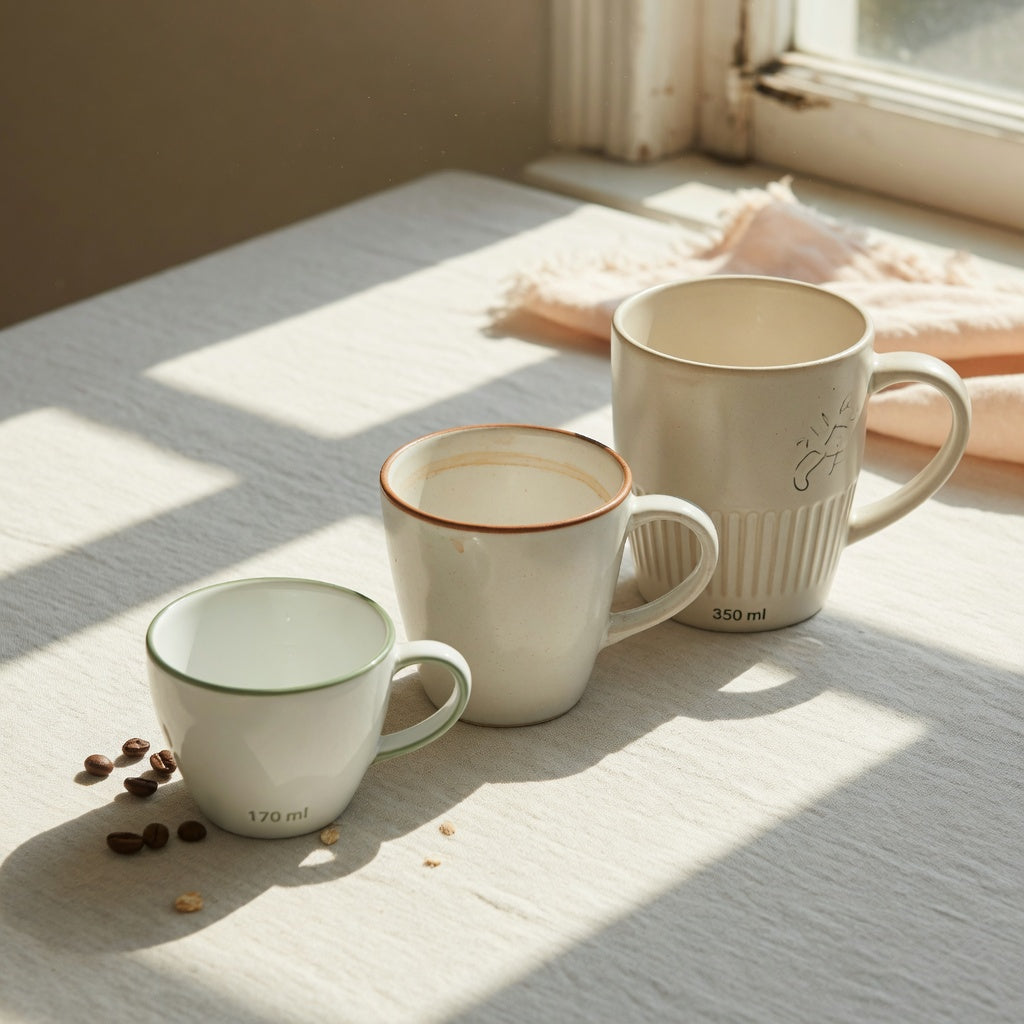
Breakfast Coffee Cup Size Guide: 170 vs 200 vs 350 ml Compared
A store-side breakfast coffee cup size guide comparing the Retro 170 ml, Pleated 200 ml, and Landscape Tall 350 ml cups by table footprint, refill trips, and brewer clearance — plus where each size...
Read more
Pleated Coffee Cups Vs Tea Cups: Which One Fits Your Routine?
We handle pleated cups daily, so this comparison covers what photos hide: the capacity ranges that actually fit espresso, cappuccino, or loose-leaf tea, why tannins settle into the ridges, and the ...
Read more
Leave a comment
This site is protected by hCaptcha and the hCaptcha Privacy Policy and Terms of Service apply.