

Piccolo Cup Size Decision Guide: Compare 170, 250 and 270 ml
Reading time: about 8 minutes
A prepared drink that measures 245 ml leaves very little theoretical capacity in a 250 ml cup, but more room in a 270 ml one. That difference becomes practical during the walk from a kitchen counter to an office desk, especially after milk, water or another addition has increased the original pour. This piccolo cup size decision guide helps you compare the listed capacities against the drink you actually make.
In our store, we handle compact cups and hear the same mismatch repeatedly: a shopper knows the coffee portion but has never measured the finished drink. The verified current options are the Retro at 170 ml, the Ball Handle at 250 ml and the Emerald at 270 ml. We use piccolo as useful shopper language here, not as a certification. We do not assign these cups a fixed coffee-to-milk ratio or claim barista testing, cafe provenance or a universal drink standard.
Piccolo cup size decision guide: which capacity solves which problem?
Start with the distinction between listed capacity and personal headroom. Capacity is the stated volume of the vessel. Headroom is the empty space you choose to leave below the rim so you can add milk, accommodate foam or carry the cup without filling it to its limit. The three listed capacities are useful comparison points, but they are not promised carry-safe fill lines.
| Current option | Listed capacity | Capacity difference | Most practical when | Main limitation |
|---|---|---|---|---|
| Retro | 170 ml | Starting point | Your complete drink sits comfortably below 170 ml | Additions can use the remaining capacity quickly |
| Ball Handle | 250 ml | 80 ml more than Retro | You need a meaningful step up without choosing the largest current option | A drink close to 250 ml may leave too little personal headroom |
| Emerald | 270 ml | 20 ml more than Ball Handle and 100 ml more than Retro | The 250 ml option is just too close to your usual finished volume | It is still a compact 270 ml option, not a large mug |
Capacity alone does not establish external height, diameter, base width, wall thickness, weight or thermal behavior. It also cannot confirm material-specific care, microwave compatibility or dishwasher suitability. Those details should be checked on the current product page instead of inferred from the volume or the product photograph.
Is 170 ml enough for a short coffee or tea pour?
The 170 ml Retro coffee tea cup is the most logical choice when your complete drink, including every addition, remains comfortably below its listed capacity. It gives you 80 ml less capacity than the Ball Handle and 100 ml less than the Emerald, so the decision should be intentional rather than based only on the compact appearance.
- Choose it if a larger mug regularly sits mostly empty after you prepare your normal drink.
- Consider it for repeat short pours that do not need substantial space for milk, water, foam or toppings.
- Use it as a gift only when you know the recipient prefers small servings rather than assuming smaller is universally more convenient.
The Retro is not a practical match for a drink that already approaches 170 ml before it is carried. It is also risky to assume that the lowest capacity automatically means the shortest cup or narrowest shelf footprint; external dimensions, including the handle, must be checked separately.
When does the 250 ml Ball Handle provide useful headroom?
The 250 ml Ball Handled coffee tea mug makes sense when your finished drink exceeds the comfortable range of the 170 ml option but remains clearly below 250 ml. The 80 ml increase is the largest step between adjacent products in this comparison. That makes it useful for a coffee with added milk, a longer tea pour or an office drink that needs some space below the rim while it is moved around a keyboard and monitor.
The ball handle is a separate buying variable. Its distinctive form may appeal to shoppers who want something less conventional, but we would not claim that one grip works for every hand. Someone with limited finger mobility or a strong preference for a conventional loop should inspect the product images and compare the handle with a cup they already lift comfortably. If your prepared drink is already close to 250 ml, this option may still feel constrained.
Is the extra 20 ml in the Emerald cup enough to matter?
The 270 ml Emerald coffee tea mug is only 20 ml above the Ball Handle, so it should not be treated as a dramatic size upgrade. That small difference matters most when a 250 ml cup is narrowly below the capacity you need. It can also be the better choice when your coffee and tea pours vary and you want the largest of these three current options.
- Choose it when your measured drink crowds the 250 ml option but remains below 270 ml with acceptable headroom.
- Consider it when the Emerald design is your preference and its listed volume also matches your routine.
- Skip it as a size upgrade if your actual drink already exceeds 270 ml.
The Emerald is not the practical answer for a large iced coffee or a long milk-based drink. Ice occupies part of the available volume, and 20 ml does not turn the Emerald into a full-size mug. If your measurement exceeds all three capacities, move beyond this compact comparison and browse our collection of unique coffee mugs in other styles.
How do machine clearance, shelf space and care affect the choice?
In our experience, a capacity question often reveals a different constraint after the shopper looks at the counter, cupboard or dishwasher. Check these practical details before treating any volume as the final answer:
- Coffee machine clearance: Measure vertically from the installed drip tray to the dispensing point. Use the machine configuration you operate every day, then compare that clearance with current product dimensions if they are published.
- Cupboard space: Measure shelf height and usable depth, including room for the handle. A 170 ml capacity does not prove that every external measurement is smaller than those of a 250 ml design.
- Dishwasher loading: Confirm that the product's current care directions permit dishwasher use. If they do, leave enough rack clearance to prevent the rim or handle from knocking adjacent drinkware during a cycle.
- Microwave use: Check the listed material and decoration guidance. Capacity provides no evidence that a cup or its finish is microwave compatible.
- Gift suitability: Match the recipient's serving size and cleaning habits. A style that requires care they will not follow is unlikely to become their everyday cup.
Rim impacts and knocks around the handle are familiar damage points for breakable drinkware in sinks and crowded racks. Avoid wedging a cup against metal cutlery, a faucet or another heavy item. These handling habits matter regardless of which capacity you select.
How should you measure your finished drink before ordering?
You do not need a prescribed piccolo recipe. A marked kitchen measuring jug and the drink you already make provide a more relevant answer.
- Prepare the complete drink in your usual vessel, including coffee, tea, milk, water and any topping that occupies cup space.
- Transfer it to a marked measuring jug on a level counter and read the volume at eye level.
- Repeat the check for your largest common variation, such as the version with milk rather than the smallest black coffee pour.
- Decide how much empty space you personally prefer below the rim, especially if you carry the cup between rooms.
- Compare the resulting requirement with 170 ml, 250 ml and 270 ml, then check external dimensions and care information on the relevant product page.
If your complete drink sits comfortably below 170 ml, start with the Retro. If it is too large for that option but clearly below 250 ml, compare the Ball Handle. A pour that makes 250 ml feel too close but remains workable within 270 ml points to the Emerald. Above 270 ml, a different mug style is the honest recommendation.
Frequently asked questions
Which option does this piccolo cup size decision guide suggest for a 245 ml drink?
Of these three, the 270 ml Emerald is the more practical starting point because a completed 245 ml drink is very close to the Ball Handle's listed 250 ml capacity. The nominal difference between 245 ml and 270 ml is only 25 ml, so measure any foam, ice or top-up too. If those additions push the drink past 270 ml, choose a larger style.
Is 170 ml the official size for a piccolo coffee?
No universal or certified piccolo size is being claimed here. The Retro is listed at 170 ml, and we recommend it according to the volume a shopper actually prepares. Recipe names and milk-to-coffee ratios are not the basis of this comparison.
How much larger are the 250 ml and 270 ml options?
The Ball Handle provides 80 ml more listed capacity than the 170 ml Retro. The Emerald adds 20 ml over the Ball Handle and is 100 ml larger than the Retro.
Can these cups go in a dishwasher or microwave?
Do not infer dishwasher or microwave compatibility from cup size or appearance. Review the current care and material details on the individual product page before use. If dishwasher use is permitted, give the rim and handle clearance from nearby items to reduce impact during a cycle.
What should I check immediately before ordering a compact cup?
Measure your complete drink at least twice, choose the headroom you need for carrying it, and verify machine clearance, cupboard space and current care directions. Then select the 170 ml Retro, 250 ml Ball Handle or 270 ml Emerald only if both the volume and physical design fit. If your drink exceeds 270 ml, use the unique coffee mugs collection as the next comparison step.
More from our blog
Read more
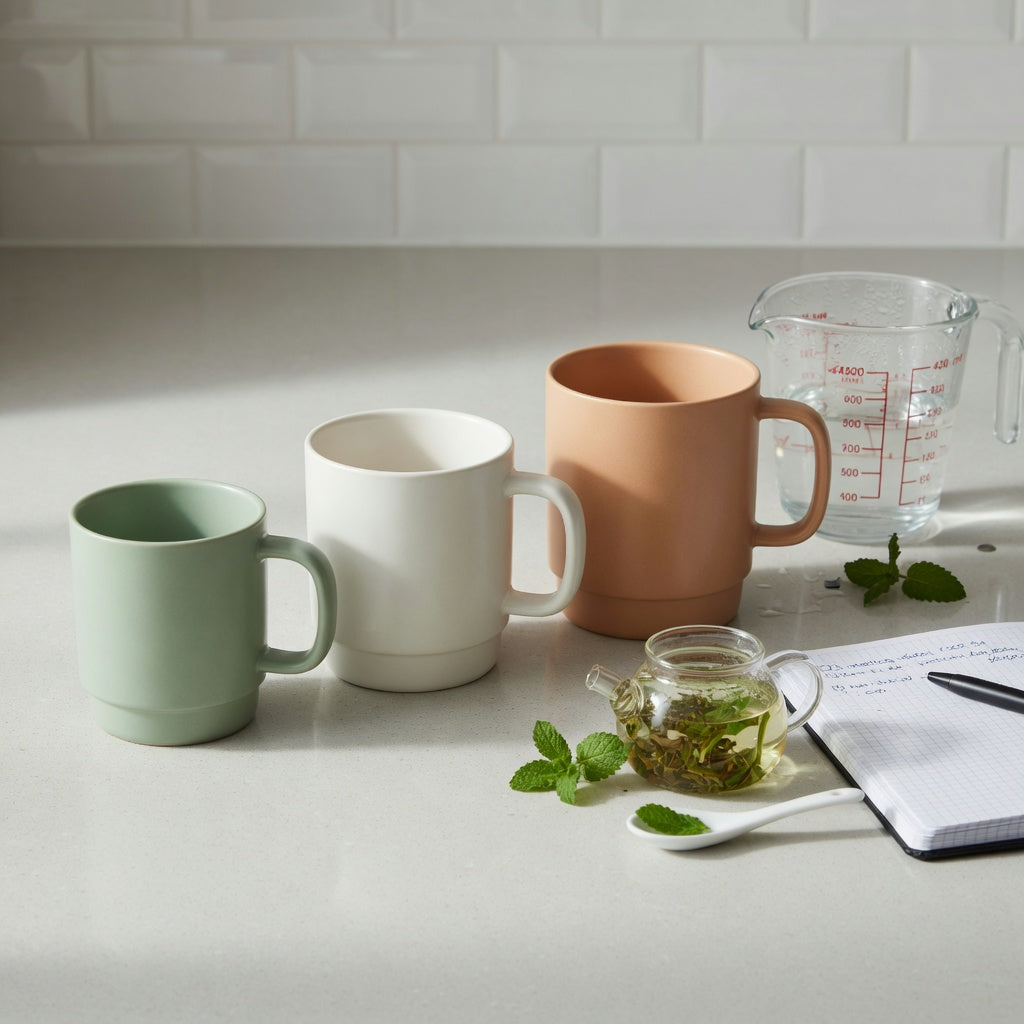
Peppermint Tea Mug Size Decision Guide: 400, 440 or 480 ml
Compare CoffeifyMug's current 400 ml, 440 ml, and 480 ml options using your normal pour, refill habits, carrying routine, and preferred handle feel.
Read more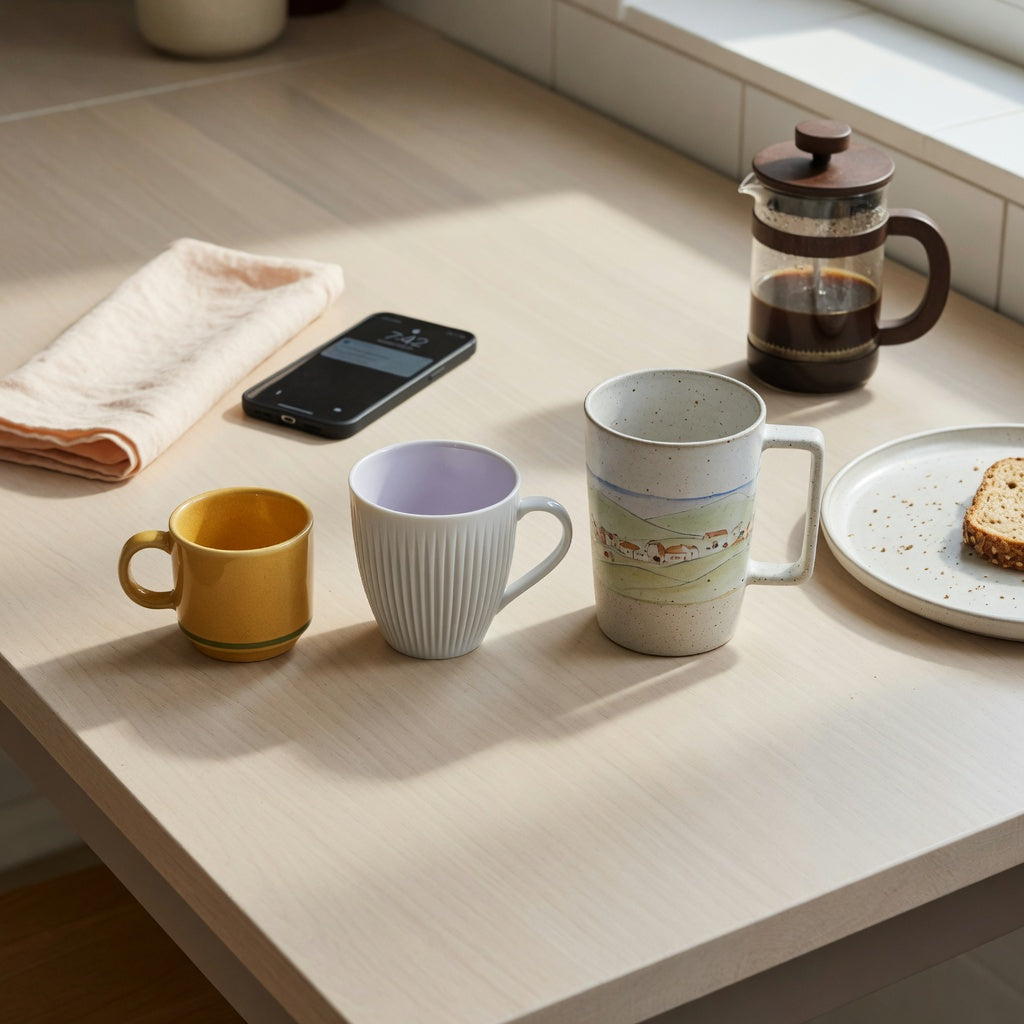
Breakfast Coffee Cup Size Decision Guide: 170, 200, or 350 ml?
Compare the Retro 170 ml, Pleated 200 ml, and Landscape Tall 350 ml by actual pour size, table footprint, and refill preference. Includes clear trade-offs for shared tables, desks, gifts, and quiet...
Read more
Leave a comment
This site is protected by hCaptcha and the hCaptcha Privacy Policy and Terms of Service apply.