
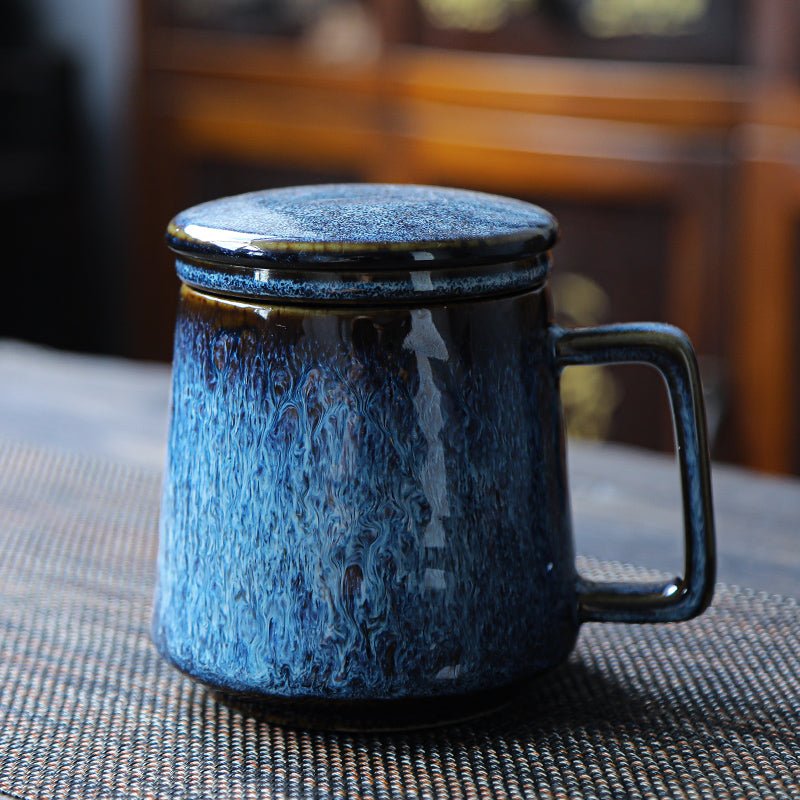
Mocha Mug Compact Kitchen Practical Purchase Checklist: 400–480 ml
Reading time: about 9 minutes
A mug can hold the drink you want and still be wrong for the room: the handle catches a cabinet door, the body crowds the only open shelf, or the mug has to live beside the sink because it blocks access to the coffee maker. This mocha mug compact kitchen practical purchase checklist starts with verified capacity, then treats storage fit as a separate decision.
At CoffeifyMug, we separate catalog facts from assumptions. The verified options here are The Flow at 400 ml, Morning and Night at 440 ml, and The Rock at 480 ml; their catalog descriptions support coffee and cocoa use. Exterior dimensions, material, weight, stackability, dishwasher or microwave compatibility, and heat-retention performance are not among the facts supplied for this comparison, so we will not infer them from photos or capacity.
Here, mocha mug means a mug selected for a coffee-and-cocoa drink. It does not imply included ingredients, a recipe, café testing, or a claim about drink authenticity.
What does the mocha mug compact kitchen practical purchase checklist verify?
It verifies one buyer variable that can be compared cleanly: listed capacity. The options rise in even 40 ml steps, with an 80 ml difference between the smallest and largest. That helps you choose drink volume, but it does not establish which mug has the narrowest body or shortest handle.
| Mug | Verified capacity | Buyer situation it suits | Limit to check |
|---|---|---|---|
| The Flow | 400 ml | Your usual serving sits at the lower end of this three-mug set, and you do not want to buy extra capacity by default. | Lowest capacity is not proof of the smallest exterior footprint. Verify height, body width, and total width including the handle. |
| Morning and Night | 440 ml | You want a middle position: 40 ml more than The Flow and 40 ml less than The Rock. | The midpoint in drink volume may still have a body or handle that conflicts with your storage space. |
| The Rock | 480 ml | You consistently prioritize the most listed drink capacity available among these three options. | It is not a good default if smaller servings suit you or essential cabinet measurements remain unknown. |
If none of those capacity positions solves the shape or storage question, compare other forms in our unique coffee mugs collection. Use the live listing for exterior measurements and care details, and contact our store if a dimension essential to your cabinet is not shown.
Shoppers who want a deeper routine comparison can also use our Mocha Mug Daily Use Guide: 400 ml to 480 ml Fit. This page stays narrower and focuses on the compact-kitchen pass or fail.
Will the mug clear your counter, shelf, and cabinet?
A capacity label measures beverage volume, not the mug’s storage envelope. In our experience, handle projection is one of the easiest details to miss: the body may sit on a shelf while the handle touches the door, face frame, neighboring mug, or appliance. Write down the actual available space instead of judging a product image.
- Record the complete product envelope. From the current product information, note overall height, the widest body point, and total width from the outer handle edge to the opposite side. If a figure is missing, ask rather than inferring it from capacity.
- Measure usable shelf depth. Measure from the back panel to the plane of the closed door or cabinet face frame, not just the full depth of the shelf board. The handle must clear that closing path.
- Check the vertical entry path. A mug can fit once it is inside yet fail to pass comfortably beneath a cabinet lip or the shelf above, especially when other cups limit the angle of entry.
- Rehearse the counter workflow. Put an existing mug in the intended spot, then open the coffee maker reservoir, nearby cabinet door, and drawer. A mug that blocks a daily movement does not have a practical home.
- Count accessible shelf positions. A space is not truly useful if you must move two other cups every morning to reach it. Compact storage should reduce reshuffling, not create more of it.
- Check the dishwasher rack only after verifying care instructions. If dishwasher use is permitted, dry-fit the empty mug and confirm that the handle does not collide with adjacent items and that the spray arm can turn freely.
Our Best Ceramic Mug for a Small Kitchen Coffee Shelf explains shelf-layout constraints in more detail. Treat it as a storage framework, not evidence that any of the three mugs here is ceramic or guaranteed to fit your shelf.
Which capacity fits your daily coffee-and-cocoa drink?
Use the mug you already reach for as your benchmark. Check its labeled capacity or measure your normal pour with a kitchen measuring jug; appearance is unreliable because wall thickness, taper, and handle size change how large a mug looks. Choose for repeat use, not one occasional oversized serving.
- You want the lowest verified capacity: Start with The Flow 400 ml mug. It has 40 ml less listed capacity than Morning and Night and 80 ml less than The Rock, so it suits a shopper trying to avoid sizing up unnecessarily. It is not automatically the smallest cabinet fit.
- You want the midpoint: Consider Morning and Night at 440 ml. It fits the situation where 400 ml feels limiting but moving directly to 480 ml does not match your normal drink. Exterior clearance still needs separate verification.
- You consistently want the most room in this set: Open The Rock 480 ml mug. Its verified advantage is capacity, making it the relevant next step when drink volume outranks the desire to stay at 400 ml or 440 ml. It is not suited to shoppers seeking the smallest serving or guaranteed compact storage.
- You need less than 400 ml, guaranteed stackability, or travel-cup performance: None of these three can be recommended from the verified facts alone. A lower-capacity mug, a stackable cup, or a purpose-built travel vessel may suit the constraint better.
Listed capacity is not the same as your comfortable working fill. If you prefer room below the rim for carrying or stirring, account for that in your routine rather than assuming a 400 ml mug delivers a full 400 ml working serving. We do not rank these mugs for heat retention or café-style results.
If 400 ml already exceeds your usual drink size, the Abstract Coffee Mug Daily Use Guide: 250 ml or 400 ml? provides a lower-capacity comparison before you commit to this 400–480 ml group.
What should you check at the rim, handle, base, and care label?
Compact-kitchen suitability does not stop at cabinet fit. A mug that requires inconvenient handling, occupies scarce drying-rack space every day, or arrives with damage can be a poor practical choice. When our team inspects a mug, we start with the drinking rim, each handle attachment point, and the base before focusing on decoration.
- Rim: Look and feel for chips, sharp rough areas, or visible hairline cracks before use. Do not use a mug with damage at the drinking edge.
- Handle: Hold the empty mug and check for movement, clicking, or a visible crack where the handle meets the body. A secure handle can still project too far for your cabinet, so strength and fit are separate checks.
- Base: Set the empty mug on a flat, dry counter. If it rocks, first remove any label, packaging residue, or debris, then check the base again.
- Surface: Inspect the interior and exterior for cracks, chips, sharp raised areas, or finish damage, especially around drink-contact surfaces.
- Care instructions: Confirm the current product page or packaging directions before using a dishwasher or microwave. Do not assume compatibility because the mug resembles one you already own.
- Order match: Confirm that the product name and listed capacity match what you selected before discarding the packaging.
Keep the packaging until the first inspection is complete, especially for a gift order. If something looks wrong, photograph the mug, packaging, and shipping label before use and contact the store; that creates a clearer record than a description made after the box is discarded.
For care, follow only the current product instructions. If dishwasher use is confirmed, check rack clearance while the mug is empty; if it is not confirmed, do not treat a dishwasher cycle as a test. The same caution applies to microwave use and resistance to abrupt temperature changes.
Counter-to-cabinet pass-or-fail checklist before checkout
Use these checks in order. A no at any essential storage or care step is a reason to pause, even if the design is the one you like most.
- Choose 400 ml, 440 ml, or 480 ml based on your normal drink rather than occasional maximum capacity.
- Open the exact product page and confirm its current listed capacity.
- Record any listed exterior height, body width, base width, and total width including the handle.
- Ask our store about any essential product measurement that is not shown.
- Compare the product measurements with usable shelf depth, vertical opening, cabinet lip, and closed-door path.
- Rehearse nearby appliance lids, cabinet doors, and drawers with the intended counter space occupied.
- Confirm that the approved washing method works with your dishwasher rack, sink, and drying area.
- If 400 ml is already too much or a must-have fit detail remains unknown, select another mug style rather than guessing.
The practical next step is to take your measurements first, then open the linked 400 ml, 440 ml, or 480 ml product page with those figures beside you. Capacity narrows the choice; verified exterior fit makes it purchase-ready.
Frequently asked questions
Is a 400 ml mocha mug automatically best for a compact kitchen?
No. The Flow has the lowest listed capacity among these three, but capacity does not reveal exterior height, body width, or handle projection. It is the best starting page only if lower drink volume is your first filter and its current dimensions fit your measured space.
How do I use the mocha mug compact kitchen practical purchase checklist?
First select among the verified 400 ml, 440 ml, and 480 ml capacities using your normal serving as the benchmark. Then verify exterior measurements, cabinet clearance, counter workflow, and care instructions instead of assuming that lower capacity always means a smaller mug.
What mug measurements do I need for a small cabinet?
Record overall height, widest body width, total width including the handle, and any base measurement shown on the current listing. Compare those figures with usable shelf depth, the vertical opening, cabinet lip or face frame, and the closed-door path. Ask our store if a critical product measurement is not shown.
Can I assume these mugs are dishwasher or microwave safe?
No. Check the current product page and packaging for the care directions that apply to the exact mug ordered. If a use is not confirmed, do not use a dishwasher or microwave cycle to test compatibility.
Which CoffeifyMug option should I open first?
Start with The Flow for the lowest listed capacity, Morning and Night for the 440 ml midpoint, or The Rock for the highest listed capacity in this set. Compare current exterior details with your written cabinet and counter measurements before checkout. If no option passes those checks or 400 ml is already too much, move to the unique coffee mugs collection rather than guessing.
Read more

Cappuccino Coffee Mug Compact Kitchen Practical Purchase Checklist
Compare the verified 170 ml Retro, 200 ml Pleated, and 270 ml Emerald capacities against cabinet clearance, handle space, serving volume, and care requirements. This checklist also shows which prod...
Read more
The breakfast coffee cup morning routine practical purchase checklist
Match a breakfast cup to your actual drink volume, time at the table, refill tolerance, and available space. We compare CoffeifyMug's listed 170, 200, and 350 ml options and flag material, care, an...
Read more
Leave a comment
This site is protected by hCaptcha and the hCaptcha Privacy Policy and Terms of Service apply.