
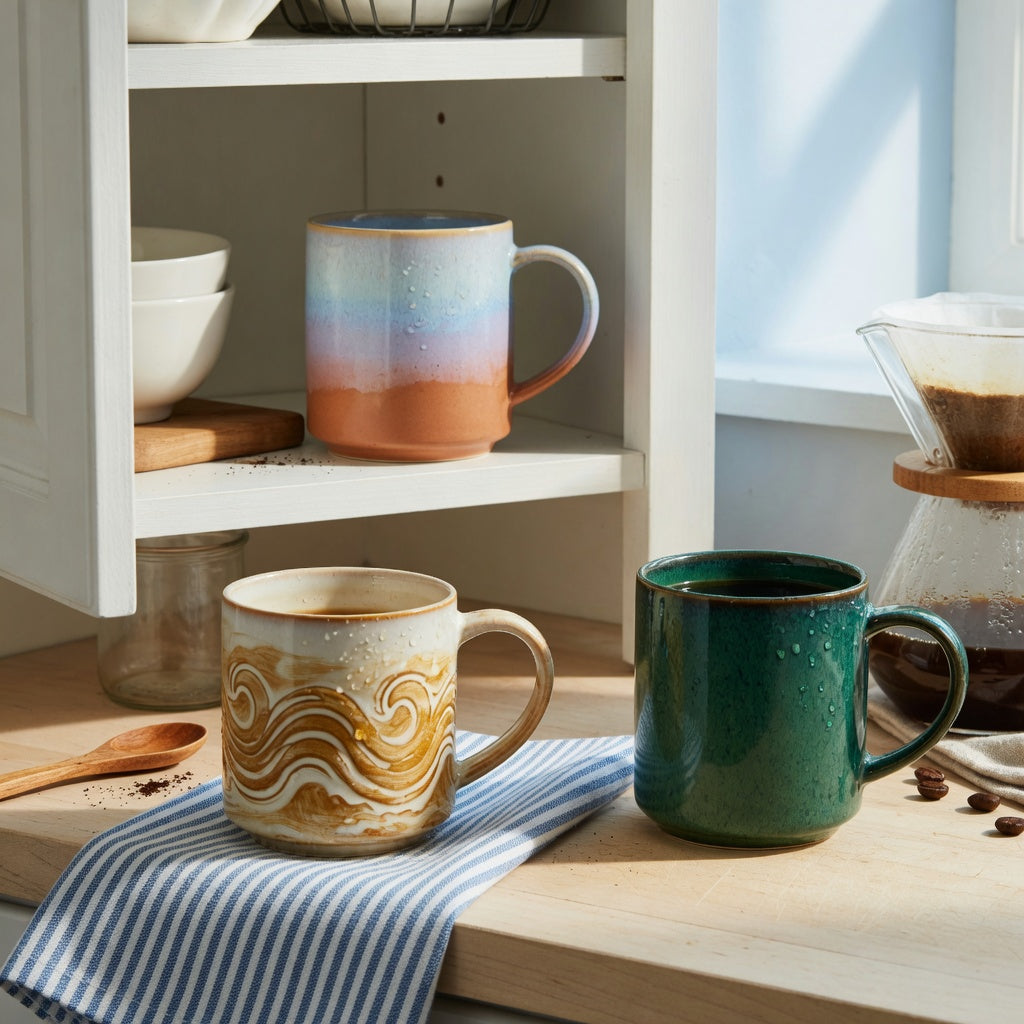
Ceramic Glazed Coffee Mugs: Everyday Rotation Purchase Checklist
Reading time: about 10 minutes
A mug can photograph beautifully and still spend every weekday behind the same two cups. On kitchen counters and office desks, the mug picked repeatedly usually creates the least friction: it accommodates the normal pour with headspace, clears the cabinet shelf, feels controlled when full, and suits the household's wash routine. We built this ceramic glazed coffee mugs everyday mug rotation practical purchase checklist around those repeat-use decisions. In our store, we inspect the rim, handle joins, foot ring, glaze surface, and stated care before treating a design as an everyday candidate. We also separate facts confirmed on a product page from details shoppers still need to measure at home.
How many mug slots does your wash cycle actually require?
The useful number is not the total drinks consumed during a week. It is the highest number of mugs simultaneously in use or waiting to be washed. Track that count across three representative days, including the busiest morning and at least one normal dishwasher or hand-washing cycle. A person who rinses and reuses one cup all day creates a different rotation from a household where coffee, tea, and cocoa each get a clean mug.
- One mug remains on a home-office desk: count it as unavailable until it returns to the kitchen, then decide whether one deliberate spare prevents interruptions.
- Different drinks need separate cups: count those roles independently if flavor carryover makes reuse undesirable.
- Guests are occasional: keep guest pieces outside the daily count unless they regularly compete for the same cabinet space.
- The dishwasher runs less than daily: count the mugs accumulated before the next cycle rather than relying on a standard set size.
Set the planned rotation at that observed peak, plus only the spare you can name a use for. Then cap the number at the available shelf slots. This avoids unsupported rules about how many mugs a household should own and exposes the real trade-off: a larger rotation reduces washing pressure but consumes more storage and leaves more pieces unused.
Will the mug fit your pour, hand, desk, and cabinet?
Start with the mug you already reach for. Fill it with your normal drink, including milk, foam, or ice, then transfer that amount to a measuring vessel. This gives you a practical serving volume rather than a brim-filled figure. A listed capacity does not always explain how much comfortable headspace remains, so compare your measured pour with the wording and dimensions on each current product page.
- Overall height: measure from the foot ring to the rim and compare it with the lowest point of the shelf above.
- Total width: include the handle projection, not only the body diameter. This is the dimension that often blocks a cabinet door or neighboring mug.
- Base footprint: trace the base of your current mug if it regularly sits beside a keyboard, notebook, or coffee machine.
- Handle opening: note how many fingers fit without pressing against hot ceramic and whether the opening accommodates the way you grip a full mug.
- Usable pour: include ice displacement for iced coffee and room for carrying the drink without sloshing over the rim.
A product photograph cannot establish these measurements reliably. If a needed dimension or weight is absent from a listing, mark it as unknown rather than estimating from styling images. That is especially relevant for compact cabinets, narrow desks, and buyers with a strong preference for a two-finger or full-hand grip.
Do not assume a decorative mug is stackable. A stable stack requires compatible body taper, rim, foot ring, and handle placement; an upper mug should not rest its weight on another mug's handle. Many ceramic pieces also have an intentionally unglazed foot ring. That is not automatically a defect, but the ring should be checked for roughness before the mug is dragged across a finished desk or shelf.
Which glaze finish earns a daily slot rather than a display shelf?
General category guidance: a ceramic glaze is a fired surface layer over the ceramic body. It provides the finished color and surface character, but it does not make the mug impact-proof. Finish type alone also cannot establish dishwasher tolerance, microwave suitability, or resistance to chipping. Those are product-specific questions.
- Glossy glaze: reflects light and can make saturated colors appear more vivid, but dried droplets and fingerprints may be more visible under direct kitchen lighting.
- Matte or satin glaze: creates a quieter surface, though metal utensil marks and abrasion can be more noticeable on some finishes. Use only the cleaning method stated for the product.
- Gradient treatment: gives a small rotation more visual change without adding another shape. Compare the listing photographs for the location and direction of the color transition.
- Patterned or golden-colored details: create a statement role, but color is not proof that an accent contains metal. Check the current care statement before microwaving it.
At our inspection table, we use bright side light to examine the rim, handle joins, and glaze. Specific warning signs include a sharp rim chip, a hairline crack crossing a handle joint, or unexpected pinholes and fine glaze lines that are not described as intentional. Fine networks of glaze lines are called crazing; some ceramic styles use a crackle effect deliberately, so the product description matters. For a gift unboxing, make this inspection before wrapping the mug rather than leaving the recipient to discover a concern at the first pour.
There is a practical visual trade-off. A mixed rotation with one gradient or patterned mug can feel varied even when the set is small. A tightly matched set looks orderly in open shelving but may make individual pieces harder to distinguish on a shared counter. Neither approach predicts durability.
Can your dishwasher, microwave, and stacking routine support it?
Dishwasher-safe and microwave-safe are separate product claims. We do not infer either one from the word glazed, from a glossy appearance, or from the color of a decorative detail. Use the care information on the linked product page as the authority. If the page does not state that an appliance use is supported, treat that point as unknown.
General care practice, not a product-specific promise: if dishwasher use is permitted, place mugs so the rims and handles cannot knock neighboring pieces during the cycle. For hand washing, use a nonabrasive sponge and avoid metal scouring tools unless the maker's instructions say otherwise. Let mugs dry fully before placing them in close contact or stacking them.
Care fit is a purchasing variable, not an afterthought. A hand-wash-only finish is a poor daily choice for a household that relies on every dishwasher cycle. Conversely, someone willing to wash a statement mug separately may reasonably prioritize its surface treatment. Avoid moving a very cold ceramic mug directly into extreme heat unless the current product instructions expressly support that use.
If tight storage requires stacking every piece, an explicitly stackable set may suit the kitchen better than individually shaped decorative mugs. If microwave reheating is non-negotiable, shortlist only pages that clearly address it. This removes attractive but impractical options before they occupy cabinet space.
Which CoffeifyMug design fits the open role?
Our recommendations here are based on the visual role shown by each linked design, not an unverified ranking of strength or longevity. The current product page remains the source for listed material, dimensions, capacity, care, and other specifications. Confirm those details before purchase because a product name or photograph cannot fill every information gap.
| Your rotation situation | Why the design fits the role | Relevant next step |
|---|---|---|
| A small rotation feels visually repetitive | A multi-tone look can create contrast between pours without requiring several unrelated shapes. | Review The Gradient Coffee Tea Mug product page, then verify its current dimensions and care details against your checklist. |
| Most existing mugs are plain and one decorative slot is open | The wave-led design supplies a distinct patterned option for a counter, desk, or style-conscious gift. | Check the Golden Waves Kio Coffee Tea Mug. Confirm the care statement rather than assuming what the golden color is made from. |
| The kitchen or desk rotation needs an emerald-focused color role | An emerald-led design can coordinate with a color-based set while remaining easy to identify among neutral mugs. | Compare the current specifications for the Emerald Coffee Tea Mug with the pour, handle, and storage measurements you recorded. |
| Shape and finish matter more than choosing one named design | Comparing several silhouettes together makes handle projection, visual weight, and finish preferences easier to narrow down. | Browse the unique coffee mugs collection, then open the individual pages for specification and care checks. |
These are situation-to-style matches, not a required three-mug set. Start with the design that fills a real opening in the rotation. Adding one mug and watching where it sits through a complete wash cycle gives better evidence than buying several because their colors work together in a photograph.
Ceramic glazed coffee mugs everyday mug rotation practical purchase checklist
Use this sequence while comparing product pages. A blank answer is an unknown to resolve, not permission to assume.
- Count the highest number of mugs in use or dirty before the next normal wash cycle.
- Name the role of the new mug: first coffee, tea, iced drink, office desk, guest service, or visual variety.
- Measure the normal pour and preserve enough headspace for milk, ice, and carrying.
- Record cabinet height, shelf depth, total mug width including the handle, and the available base footprint.
- Compare handle opening and listed weight with the grip you find comfortable when a mug is full.
- Confirm dishwasher and microwave statements separately. Do not infer them from glaze, color, or product name.
- Choose a finish that suits the amount of wiping, careful washing, and visual variation you actually want.
- Assume side-by-side storage unless the shape and product information support stacking.
- On arrival, inspect the rim, handle joins, glaze surface, and foot ring in good light before the first drink or gift wrapping.
- Use the mug through a normal rotation before adding another design in the same role.
This approach is deliberately narrow. Glazed ceramic is not the best answer for a mug carried loose in a commuter bag, a sealed drink beside electronics, frequent drop exposure, or keeping a beverage insulated for hours. A lidded travel mug or insulated vessel fits those situations better. An explicitly stackable set is also more practical if every centimeter of cabinet space must support vertical storage.
Frequently asked questions
How many ceramic glazed coffee mugs do I need between dishwasher cycles?
Count the greatest number in use or waiting to be washed before the next normal cycle. Add one spare only if you can identify a recurring need, such as a mug stranded at a desk or a regular second drink. There is no responsible universal set count because washing frequency and reuse habits differ.
How should I use the ceramic glazed coffee mugs everyday mug rotation practical purchase checklist?
Begin with your actual wash-cycle count, then measure the pour, handle clearance, and cabinet slot already working for you. Compare those results with each current product page and treat missing specifications as unknown. Eliminate any mug that conflicts with a non-negotiable care or storage requirement.
Are glazed ceramic mugs automatically dishwasher-safe and microwave-safe?
No. Glazing alone does not confirm either appliance claim, and dishwasher and microwave suitability must be checked separately. Follow the current care text for the specific mug rather than applying a category-wide assumption.
Does a golden-colored mug detail mean it contains metal?
Not necessarily. Golden can describe color or appearance without identifying the material, but a photograph cannot settle the question. Check the product page's material and microwave guidance before reheating a mug with decorative details.
Should decorative glazed mugs be stacked in a small cabinet?
Only if their shape nests without forcing the rim, glaze, or handles into pressure points and the product information supports that use. Otherwise, upright side-by-side storage reduces contact between pieces. Buyers who must stack every mug should prioritize an explicitly stackable shape over a decorative individual design.
For the next step, place your current favorite mug on the counter and record three facts: its normal filled volume, its total width including the handle, and the available cabinet height. Take those numbers to the CoffeifyMug unique coffee mugs collection and shortlist only the designs whose current pages answer your non-negotiable fit and care questions.
More from our blog
Read more

Breakfast Coffee Cup Everyday Mug Rotation Product Shortlist Guide
Compare the Retro 170 ml, Pleated 200 ml and Landscape Tall 350 ml by breakfast role, refill preference, table footprint and cupboard clearance. See clear reasons to choose or skip each option.
Read more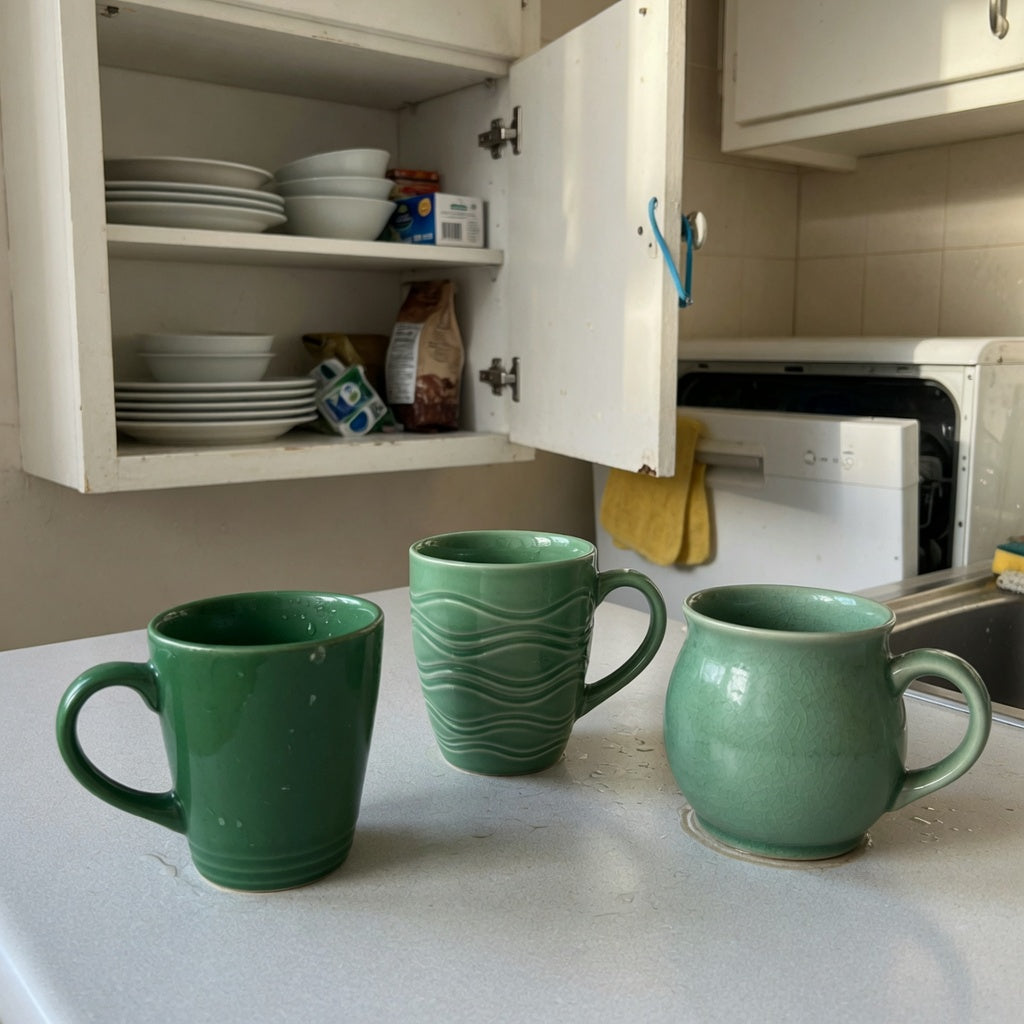
Green Ceramic Coffee Mugs: Everyday Rotation Purchase Checklist
Build a mug rotation around how often you brew, wash, and store cups. This checklist separates general ceramic buying checks from the style cues shown on CoffeifyMug's Emerald, Green Waves, and Rou...
Read more
Leave a comment
This site is protected by hCaptcha and the hCaptcha Privacy Policy and Terms of Service apply.