
Breakfast Coffee Cup Compact Kitchen Product Shortlist Guide: 3 Sizes
Reading time: about 9 minutes
The kettle, toaster, and drying rack can leave one safe parking spot for a cup, and that spot is often directly below a cabinet door. If the handle blocks the door or the cup has nowhere to go after washing, a good-looking purchase becomes a daily obstruction. This breakfast coffee cup compact kitchen product shortlist guide starts with that real morning squeeze.
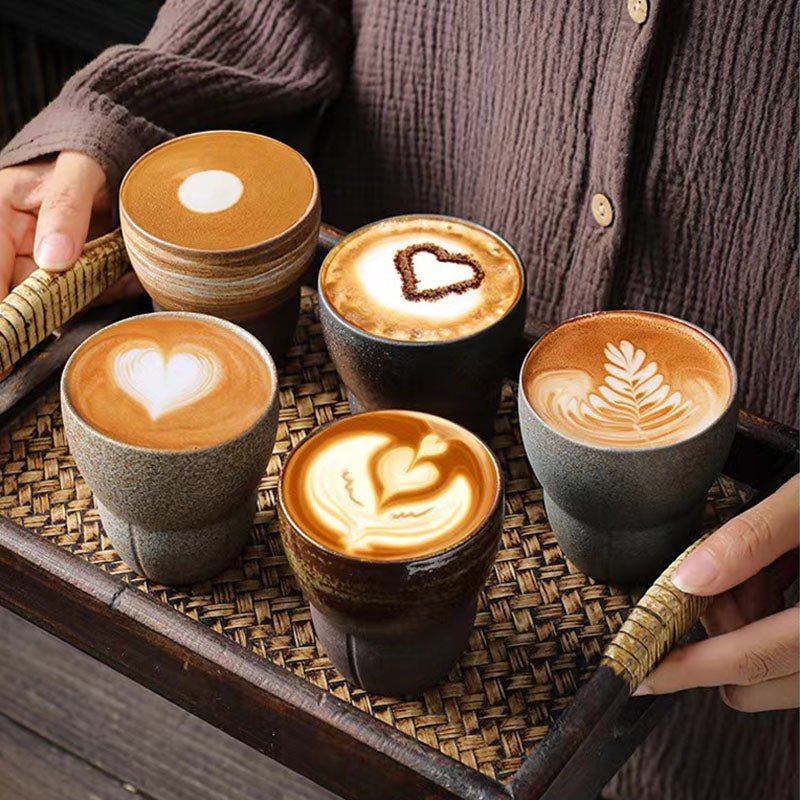
In our store, we separate two questions shoppers often combine: how much coffee the cup holds and how much working space the whole cup uses. The verified catalog choices are the Retro Coffee Tea Cup at 170 ml, the Pleated Coffee Tea Cup at 200 ml, and the Landscape Tall Coffee Tea Mug at 350 ml. We do not turn capacity into guessed width or height; milliliters describe volume, not base diameter, handle span, or cabinet clearance.
If you want to compare more shapes after these three, keep the same measurement method while browsing our unique coffee mug collection. Start with fit and routine, then let style break the tie.
Which three kitchen zones decide if a breakfast cup fits?
A compact-kitchen footprint is larger than the circle touching the counter. We use the working footprint: the cup body, handle, finger room, and the path needed to lift it without clipping an appliance or cabinet door.
- Counter parking zone: Return the kettle, toaster, and coffee maker to their normal positions. Open any appliance lid or cabinet door that moves during breakfast, place your current cup in the remaining space, and trace the body, handle, and grip area on paper.
- Cabinet storage zone: Check the clear shelf height, usable shelf depth, and door opening. Turn your current cup into the position you would actually use for storage. Do not assume a lower-capacity cup will stack or fit better.
- Breakfast-table zone: Set out the plate or bowl you normally use and test the route of your dominant hand. A cup can fit beside the kettle yet still crowd your elbow or compete with the plate at the table.
Product photos help with shape, but perspective can distort scale. If an exact physical dimension is essential and the current product page does not provide it, ask us before ordering rather than estimating from capacity.
Breakfast coffee cup compact kitchen product shortlist guide by refill style
Capacity is most useful when tied to a morning scenario. This table shows who each option suits, why it stays on the shortlist, and the reason we would remove it.
| Cup | Listed capacity | Reader situation | Choose because | Skip because |
|---|---|---|---|---|
| Retro Coffee Tea Cup | 170 ml | Your pot or brewer remains nearby, and you prefer a short first pour. | It has the lowest listed capacity of the three and suits an intentional refill routine. | Your normal drink will not fit within 170 ml, or returning for more interrupts breakfast. |
| Pleated Coffee Tea Cup | 200 ml | You want a modest step above the Retro without moving to a 350 ml serving. | It provides the middle listed capacity and may better match a moderate everyday pour. | Both 170 ml and 200 ml would produce the same refill pattern for you. |
| Landscape Tall Coffee Tea Mug | 350 ml | You want to sit down with a larger drink and reduce the chance of a refill. | It offers the most listed capacity of the three. | The Tall format conflicts with your cabinet or drying-rack clearance, or a fuller cup feels cumbersome. |
Footprint boundary: This table ranks capacity and refill fit, not unlisted dimensions. A 170 ml cup is not automatically narrower than a 200 ml cup, and a tall silhouette is not automatically smaller at the base.
Used properly, the breakfast coffee cup compact kitchen product shortlist guide removes options for a reason: capacity mismatch, storage conflict, or an unwanted refill pattern. It should not declare a footprint winner without measurements.
Which cup matches a short-pour, middle-size, or one-sit morning?
Retro 170 ml: the planned-refill option
Reader situation: Your coffee source remains within reach, and you intentionally pour a short serving while breakfast cooks. Why it fits: At 170 ml, the Retro has the lowest listed capacity and is the clearest candidate for a short-pour routine. Choose or skip: Choose it if smaller servings are the point; skip it if returning to the brewer breaks your routine or your measured drink will not fit. Review the Retro 170 ml cup details and compare the current silhouette with your paper footprint.
Pleated 200 ml: the measured middle option
Reader situation: You want more listed capacity than the Retro but do not need a 350 ml serving. Why it fits: The Pleated sits between the two other options and may suit a moderate pour without a large capacity jump. Choose or skip: Choose it only if 200 ml meaningfully matches your usual drink; skip it if it causes the same refill as 170 ml or still leaves too little room for your additions. Open the Pleated 200 ml cup page to verify current product and care details.
Landscape Tall 350 ml: the fewer-refill candidate
Reader situation: You prepare the drink once, move away from the brewing area, and prefer not to get up again. Why it fits: The Landscape Tall has the largest listed capacity in this shortlist. Choose or skip: Choose it if drink volume matters more than keeping the serving small; skip it if low cabinet clearance, limited drying space, or the feel of a fuller mug is a concern. Check the Landscape Tall 350 ml mug before treating the word Tall as a substitute for an exact height.
How do 170 ml, 200 ml, and 350 ml change your refill plan?
A catalog capacity is a selection point, not an instruction to fill a cup to the rim. Your comfortable working fill may leave headspace, especially if you add milk or carry the cup across a crowded counter.
- Prepare your normal breakfast drink in the cup you already own, including the additions you usually make.
- Transfer that drink into a marked measuring jug and record the actual amount you consume, not the cup's brim-full limit.
- Compare that amount with the three listed choices: 170 ml, 200 ml, and 350 ml.
- Count the refills you make during an ordinary breakfast and decide whether a planned refill is acceptable.
If 170 ml and 200 ml create the same refill pattern, let verified footprint, storage fit, and design decide between them. If 350 ml reduces a refill but fails the cabinet check, it is not the practical winner. A different cup style will suit the kitchen better.
Will it fit the cabinet and drying rack after breakfast?
In our experience, storage can eliminate a cup even when the open counter looks adequate. The post-breakfast routine deserves the same attention as the first pour.
- Read the current care directions: Do not assume dishwasher or microwave suitability from appearance. Follow the instructions on the product page or packaging.
- Check drying clearance: If you hand-wash, make sure the cup can stand securely in the rack without hitting a low shelf or blocking the path to the faucet.
- Do not force stacking: Unless the design or listing supports it, stacking can put the rim, base, or handle in hard contact with another cup and create chip points.
- Inspect before first use: Check the rim, base, and handle junction in bright light for chips or hairline cracks. Set the empty cup on a level surface to check for rocking, and contact us before use if it arrives damaged.
- Confirm what is included: Styled images may show food, drink, saucers, or utensils. Only the current product listing defines the item supplied, so do not assume those extras form a bundle.
We deliberately do not label these three cups dishwasher-safe, microwave-safe, stackable, or bundled with tableware because those claims are not established by the verified capacity facts used for this shortlist.
Which needs should remove all three cups from the shortlist?
These options focus on breakfast-table capacity. A different product category is more practical if any of these requirements are non-negotiable:
- You need a sealed or leak-resistant travel mug for a commute.
- You need documented insulation or a specific heat-retention claim.
- Your usual drink needs more capacity than 350 ml, particularly if you add substantial ice.
- You require confirmed stackability or exact physical dimensions that are not available on the current listing.
- You are shopping for a coordinated saucer, utensil, or breakfast tableware set.
If that removes all three, browse the full unique coffee mugs collection with your counter outline and cabinet measurements in hand. The right next step may be a different shape, not a compromise on daily fit.
The checkout check for a compact kitchen
Before placing an order, run the remaining option through this sequence:
- Reset the counter with every appliance in its normal breakfast position.
- Confirm the working footprint, including the handle, fingers, open doors, and appliance lids.
- Measure your real drink rather than guessing from the size of your current cup.
- Match the routine to 170 ml for a short pour, 200 ml for the middle option, or 350 ml for more capacity.
- Verify current dimensions where listed, care directions, and exactly what the product page says is included.
If the checklist points to a short pour with a planned refill, start with the Retro. If it points to moderate capacity, compare the Pleated. If avoiding a refill is the priority, check the Landscape Tall—and confirm vertical clearance before committing.
Frequently asked questions
Which breakfast coffee cup is best for a compact kitchen?
No single capacity guarantees the smallest physical footprint. The Retro 170 ml suits short pours and planned refills, the Pleated 200 ml is the middle-capacity option, and the Landscape Tall 350 ml suits shoppers prioritizing a larger serving. Confirm counter and storage clearance before making the final choice.
Is 170 ml enough for breakfast coffee?
It can be enough if you prefer a short serving and keep the brewer or pot nearby. It is not a good fit if your usual drink exceeds 170 ml or you dislike getting up for more. Measure your current pour before choosing the Retro based on the word small alone.
Does a 200 ml cup take less counter space than a 350 ml mug?
Not necessarily. Capacity describes the volume held, while counter fit depends on the base, body shape, handle span, and room needed for your hand. Compare current product details with a traced working footprint rather than ranking physical size from milliliters.
Will the Landscape Tall 350 ml mug fit under my cabinet?
Capacity alone cannot answer that question. Measure the clear vertical opening with cabinet doors and nearby appliance lids in their usual positions, then compare it with current product details. The word Tall is a prompt to verify clearance, not an exact height measurement.
What should I check before ordering a coffee cup for a small kitchen?
Use the breakfast coffee cup compact kitchen product shortlist guide as a sequence: trace the working footprint, check cabinet and drying clearance, measure your normal drink, and decide how many refills you accept. Then open the matching product page for the Retro, Pleated, or Landscape Tall. If none clears every check, compare another shape in our unique coffee mugs collection rather than forcing a poor fit.
More from our blog
Read more
Green Ceramic Coffee Mugs Compact Kitchen Practical Purchase Checklist
Measure shelf clearance, door swing, handle projection, foot-ring space, and care requirements before buying. We compare Emerald, Green Waves, and Round without guessing at unlisted specifications.
Read more
Abstract Coffee Mug Compact Kitchen Practical Purchase Checklist
Measure the cabinet, counter, pour size, and cleaning setup before choosing an abstract mug. This checklist compares the verified 250 ml Rhombus, 400 ml Gradient, and 400 ml The Flow while flagging...
Read more
Leave a comment
This site is protected by hCaptcha and the hCaptcha Privacy Policy and Terms of Service apply.