
Desk Shelf for Coffee Mug Home Office: What to Compare
Reading time: about 14 minutes
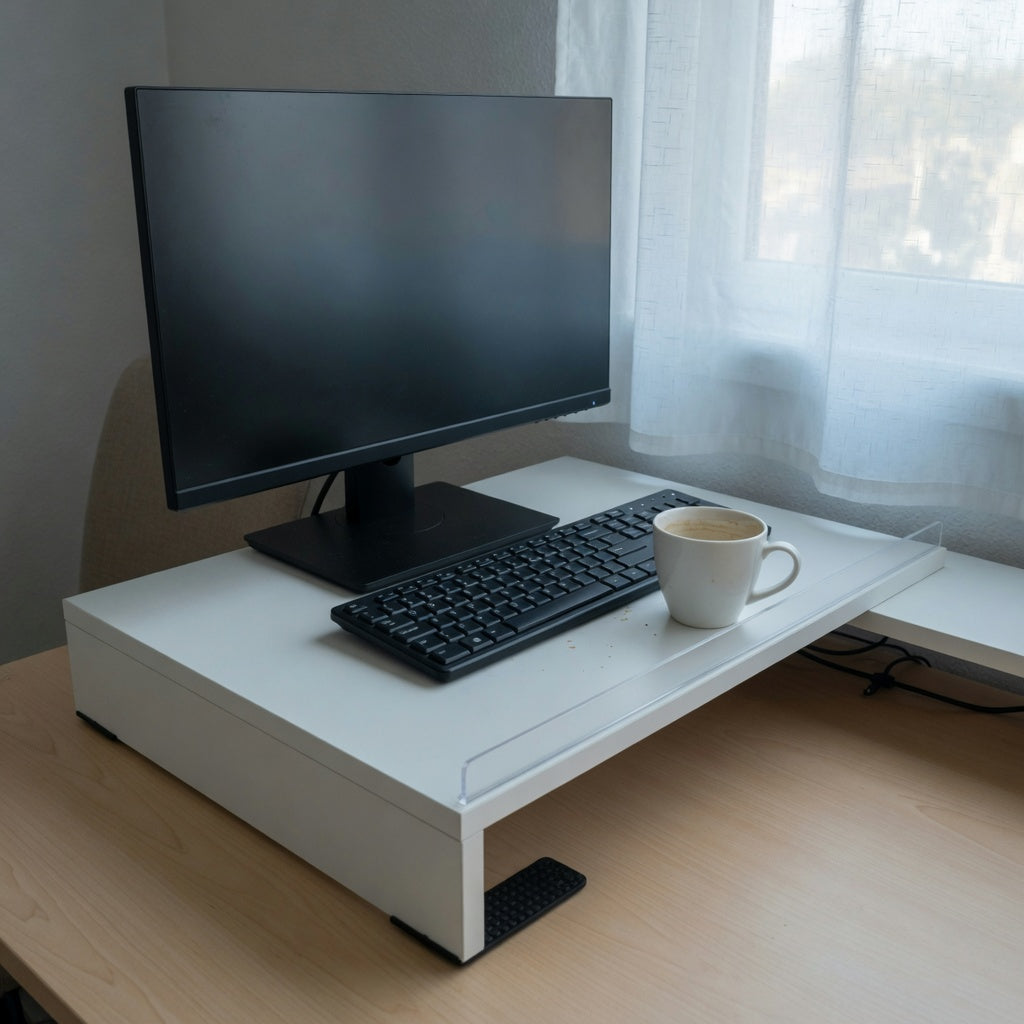
The mug that lived on the kitchen counter is the one that knocks the mouse the first week it moves to a shallow home-office desktop. We see the same sequence after orders leave our store: the shelf looks right in a photo, then the handle will not pass under the riser, the clamp cannot grab a desk with no overhang, or the screen sits above eye level. A desk shelf for coffee mug home office use has a narrow job. Keep one daily cup in reach. Do not push the keyboard, mouse, and display into awkward spots to do it.
Start with the cup you actually drink from, not the shelf photo. If our landscape tall coffee and tea mug is on your shortlist because the name sounds like a taller daily cup, measure from the foot to the top of the handle and set that number against the open space under the shelf. If you are comparing the round coffee and tea mug, check diameter and how far the handle sticks out on that listing. A rounder body is often limited by footprint and handle swing rather than by height alone. Height, diameter, and handle projection are not things we will guess. They belong on the current listing. Confirm them there before you count how many cups a rack will hold. If you are still choosing the daily cup, browse our unique coffee mugs and measure the finalist against your shelf gap, not against a kitchen-bar photo.
Where should a desk shelf for coffee mug home office sit so the mouse stays put?
Reach is the filter we use when a customer describes a crowded desk. University of California San Francisco ergonomics guidance keeps frequently used items within one forearm's reach, less frequent items within a full arm's length, and rarely used items far enough out that you stand and walk. A Vermont workstation checklist makes the same point from the chair: often-used items stay in easy reach with the elbows close to the body, occasional items can sit near a full arm's reach, and a telephone is generally placed within 18 to 20 inches. A mug you sip through a work block is used at least that often. It belongs in the easy-reach zone, not at the back edge behind the monitor.
That does not put the mug in the exact center. Center placement looks tidy and then steals the zone where the keyboard and mouse need to stay. OSHA workstation guidance says frequently used devices such as the keyboard, phone, and mouse belong in the primary work zone, and that a cramped desktop pushes those items into awkward positions. Cornell's computer-workstation checklist asks the practical question: is the surface deep and wide enough, and can you reach the object without an extended, repetitive, or long-duration reach? If the honest answer is no, the shelf is in the wrong place even if the desktop looks organized.
A split that holds up on the desks customers describe:
- Inside a forearm's reach, elbows in: keyboard, mouse, and the mug if you sip through the work block.
- A comfortable arm's length: a second empty cup, a notebook, or the upper tier of a small shelf.
- Past arm's length: spare mugs, a pour-over kit, or a full coffee-bar tray you can stand up for.
A shelf that holds a row of mugs is a kitchen tool sitting on a desk. For a seated workday, one cup in easy reach beats a display line that forces the mouse outward.
How much open gap does the mug and handle actually need?
Listing copy often quotes a shelf-to-shelf height. That number is not the height your mug needs. If the handle rises above the rim, measure to the top of the handle, then leave enough room to lift the cup out straight instead of threading it in at an angle. On a monitor riser, also check depth. A deep platform can hide the mug so far back that you drag it forward and clip the keyboard.
In our experience, four measurements prevent most bad fits:
- Desk depth from the front edge to the monitor base or the wall.
- Edge thickness, plus any lip, and anything under that edge: a frame, modesty panel, or cable tray.
- Mug height from the foot to the top of the handle, not just to the rim.
- The open gap under a shelf you already own, measured on the path the handle travels, not at the tallest open corner.
Large cafe-style cups need more width and more hook spacing than small cups. If a rack advertises a high count, count the mugs you own, not the cups in the photo. One tall mug can take the space of two small ones once the handle is included. Advertised capacity on marketplace listings is inconsistent, and we do not treat that count as a promise.
Hanging storage under the desktop is a different miss. OSHA puts leg clearance under the work surface generally at 20 to 28 inches (50 to 72 cm) high, and says that space should stay free of stored files, books, and similar items so you can change posture. A mug rack under the top may clear the cup and still block your knees. If the clutter is a kitchen cupboard, a stacker or an under-shelf hook solves that problem in the cabinet. Do not spend knee room on it.
Clamp, freestanding shelf, wall, or hooks: which failure are you avoiding?
Mount type decides whether the piece fits the desk you have. We sort the options by the complaint that shows up after unboxing, not by the photo on the box.
| Mount | Fits when | Fails when |
|---|---|---|
| Freestanding tier | You can spare footprint and may rearrange the desk | The only free spot is the mouse zone, or a light rack walks when the chair bumps it |
| Clamp-on edge holder | The desktop is full and the edge has a real overhang inside the clamp's stated range | There is no lip, the top is thicker than the opening, or a frame or cable tray adds thickness |
| Monitor riser or hutch | You still have eye-level room to give away and the underside is open on the handle's path | The screen is already at eye level, or the riser is a solid box with no mug gap |
| Wall shelf | You want the work surface clear and will hang empty mugs | It is hung too high to reach, or you load it with full, hot cups |
| Under-shelf hooks | The job is a kitchen cabinet, or one empty mug under a hutch | You are lifting a hot, full cup one-handed over a keyboard |
A freestanding rack needs no drill, and you can slide it when the layout changes. The cost is footprint. On a shallow return shared with two monitors, a two-tier piece can take the only spot left for the mouse. Non-slip feet matter, because a chair bump or a laptop lid will walk a light rack toward the edge. A raised lip helps. It is not a lock. A full mug can still tip if the shelf itself slides.
A clamp-on holder is what people want when the desktop is already full. It fails on desks with no overhang for the clamp to bite, on tops thicker than the stated range, and on edges where a steel frame or cable tray makes the real thickness larger than the wood. Read the range on the current listing and measure your edge with the frame included. No-drill does not mean it fits every top. A clamp that only pinches a thin lip can also twist if one heavy mug sits out on a long arm.
A wall shelf clears the work surface. It can also move the mug out of forearm reach if you hang it high for looks. U.S. Consumer Product Safety Commission guidance on tip-overs is written for televisions and furniture such as bookcases, not for a tiny mug rack. The habit still applies to anything you fasten high or stack: anchor into structure where the hardware calls for it, and keep heavier items low. A wall shelf of full, hot mugs is a bad idea. Hang empties if you want a display. Drink from a cup that stays on the desk.
Under-shelf or cabinet hooks belong inside a kitchen cabinet. Under a desk hutch they can hold one or two empty mugs if the hooks clear the handle and you are not hitting them with a headset. They are a weak spot for a hot, full cup. You are lifting above a keyboard, one-handed, with no rail.
Will a riser shelf put the monitor above eye level?
OSHA's monitor guidance is specific enough to use as a check before you buy storage that doubles as a stand. The top of the screen should sit at or slightly below eye level, and the center of the screen should normally be about 15 to 20 degrees below your horizontal eye line. You should also be able to view the monitor at least 20 inches (50 cm) away, generally straight in front of you.
A riser adds its own height on top of the monitor stand. If your eyes already meet the top bezel, that extra height is too much. People tilt the panel and crane their neck, which undoes the reason they bought the shelf. Sit in your chair, look straight ahead, and mark eye level before you order. If the shelf would put the top bezel above that mark, pick a shelf that does not raise the display. Side placement beats a riser you will resent by the end of the week.
Depth makes this worse. A deep platform plus a large mug can leave the keyboard hanging off the front edge. That is not a storage win. A desk shelf that also lifts the screen is the wrong tool when the only problem was a mug with nowhere to sit.
Wood, bamboo, laminate, or coated metal after coffee spills?
Coffee is wet and hot, and it does not stay in the cup. In our store we care more about what you can wipe tonight than about a finish name on a label. None of these materials is proven by a marketing line, and none of them is a reason to set a very hot cup over a keyboard.
- Solid wood still moves. Oregon State University Extension notes that dried wood keeps shrinking and swelling as it loses or gains moisture, and that paint or varnish slows that exchange without stopping it. We will not quote a damage rate for steam under a shelf. Leave a drip gap, and do not press a hot mug against a raw underside.
- Engineered wood and laminate wipe clean while the film is intact. A chipped edge lets liquid into the core. A thin laminate riser is not a coaster and not a cutting board.
- Bamboo shows up on a lot of coffee-station shelves. Treat it like finished wood: standing liquid still sits at the joints and along the grain. Check whether the feet are rubber or bare plugs that stamp the desk.
- Coated metal shrugs off a splash and often includes a guard rail. The trade-off is noise, a colder look, and pads that scratch once they fall off. A light wire rack can also twist if heavy mugs hang on one side. Metal is often the calmer neighbor next to a keyboard. It is not automatically stronger.
Washington State scald-prevention material says coffee, tea, and similar hot drinks are usually served at 160°F to 180°F and can cause nearly instantaneous burns, and that a liquid at 140°F can cause a serious burn in five seconds or less. The part that transfers to a desk is practical: use a spill-resistant travel mug when you are carrying the drink, and do not leave a hot cup unattended. A lidded mug is the better tool over a keyboard. An open cup is a poor fit for a wobbly clamp arm or a shelf you bump when you stand. If you want an open cup for the workday, use a stable surface with a lip, not the highest tier.
A desk shelf is not a full coffee bar. A kettle, a row of syrups, and three spare mugs belong on a sideboard or a cart. It is also a poor home for an uncovered iced drink that sweats through a napkin onto engineered wood. Match the cup to the shelf only after both sets of measurements are in front of you. If a shorter or more stable cup is what the gap allows, that is a cup decision, not a reason to force a bad mount.
Is a lip or rail enough to keep the mug off the keyboard?
A raised lip stops a slow slide. It does not stop a shelf that walks, a clamp that rotates, or a mug set down half off the edge while you type. On freestanding pieces we look for non-slip feet, a level top, and a rail on the keyboard side. On a clamp we look for a pad that will not polish the desk edge, and a stated opening that matches the real thickness.
Weight ratings on small mug shelves are inconsistent from one listing to the next, and there is no single home-office furniture number we can hand you. Skip a listing that omits a limit, and do not load a light wire shelf with a row of full mugs over a laptop. One daily mug, and maybe a second empty one, is the honest load for most clamp-on holders.
If you already own a shelf, test it empty. Nudge the desk the way you do when you pull the chair in. If the shelf creeps, add a pad or retire it before the coffee goes in. Scratch risk is the same test: bare plugs and fallen clamp pads mark a finished top faster than a careful full mug does.
Frequently asked questions
Will a desk shelf for coffee mug home office use fit a tall mug with a handle?
Only if the open gap is taller than the mug measured to the top of the handle, with room to lift it out straight. A shelf-to-shelf number in a listing skips the handle. Measure your cup, then compare it to the gap on the handle's path. If you are ordering a mug, confirm height and handle projection on the current listing before you assume it slides under a riser.
Will a clamp-on cup holder fit a desk with no lip or a thick frame?
Often it will not. The clamp needs an overhang it can bite, and the opening has to clear the top plus any frame or cable tray. Measure that stack, then read the thickness range on the listing. A slab with no overhang, or a top with a deep steel apron, usually needs a freestanding shelf instead.
Can the mug sit in the center if that is the only open spot?
It can, and plenty of desks end up that way. The center is also where the keyboard wants to live. If the mug pushes the mouse outward or makes you reach with an elbow flared, move the cup to the side and keep it inside a forearm's reach. Standing up for a spare mug is better than stretching for it all day.
Does steam from a hot mug ruin a wood or laminate shelf?
We cannot quote a damage rate, and finishes differ. Dried solid wood still takes on and gives off moisture, and paint or varnish only slows that exchange. A finish is not a full stop against repeated steam and spills. Leave a little air under the shelf, wipe standing liquid, and do not park a steaming mug against raw or chipped engineered wood.
Should I buy a shelf that also lifts my monitor?
Only if the screen can spare the height. The top of the monitor should stay at or slightly below eye level, with the center of the screen about 15 to 20 degrees below horizontal, and the display at least 20 inches away. If a riser would push the bezel above eye level, use a side shelf or a clamp and leave the monitor where it is.
Six checks before the shelf goes on the desk
Run these on the desk you have, with the mug you will use this week:
- Mug height to the top of the handle, plus lift clearance, versus the real gap.
- Desk depth, edge thickness, lip, and anything under the edge a clamp would hit.
- Mug location inside a forearm's reach, without pushing the mouse out of the primary zone.
- Eye level versus where the monitor would sit if the shelf is also a riser, with at least 20 inches of viewing distance.
- Feet, a lip, or a rail on the keyboard side, and a surface you can wipe after a splash.
- One working mug, not a kitchen display. Heavier extras stay low or off the desk, and leg room under the top stays open.
If the shelf only works with a shorter or more stable cup than the one you own, change the cup or change the mount. Do not force both. Verify size and handle details on the current listing for the landscape tall coffee and tea mug or the round coffee and tea mug, then keep the shape that clears your gap. When the real question is which cup can live on that shelf all day, start with our unique coffee mugs and measure the winner against those six checks.
More from our blog
Read more

Golden Waves Ceramic Coffee Tea Mug: What to Compare
Shoppers comparing a golden waves ceramic coffee tea mug are often choosing among printed art, metallic gold, and a gold-colored pattern. We cover capacity, microwave risk, dishwasher wear, and foo...
Read more
Mountain Coffee Tea Mug for Coffee Lovers Home Decor: Compare
A mountain mug has to work on a cabin shelf and through weekday coffee. We compare format, usable ounces, artwork durability, and food-contact limits before you buy one as a gift or a daily cup.
Read more
Leave a comment
This site is protected by hCaptcha and the hCaptcha Privacy Policy and Terms of Service apply.