



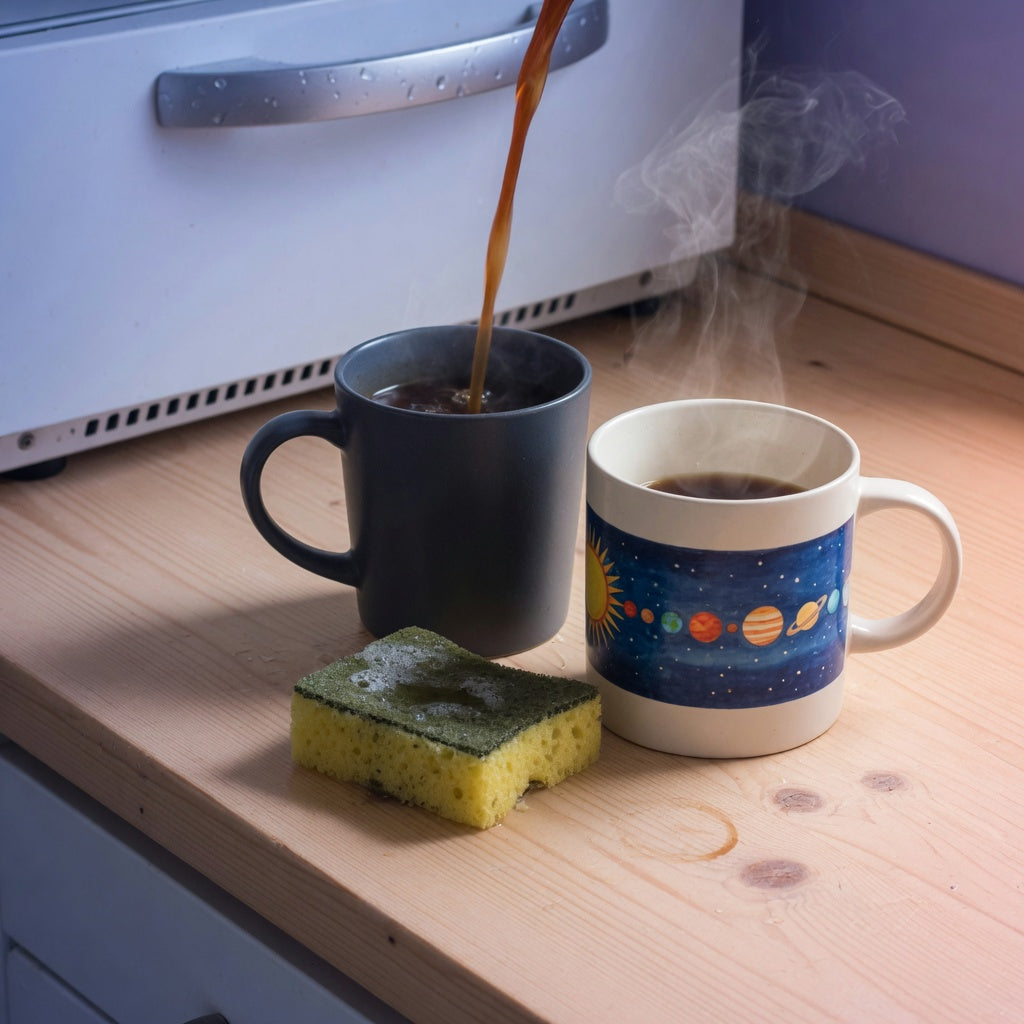
Planet Mug for Coffee Lovers: What Buyers Should Compare
Reading time: about 11 minutes
Two mugs came back to our counter in the same week. One still had a clean lip, and the artwork snapped into view when we poured hot water. The other had a pale ring where a scrub pad had worked, and the planets showed only in patches. Both had been bought as a planet mug for coffee lovers. The glaze color was not the difference. The washing routine was.
In our store that split shows up constantly. One shopper wants a desk piece for an astronomy friend, a teacher, or anyone who will stop and read a caption. Another wants a cup that can live in the kitchen they already run. Those are different purchases. We send both people to the planet coffee tea mug, then we ask them to read the listing before it goes in the cart. A photo of a similarly named cup does not move one fact onto this page.
A desk cup and a shared-kitchen cup are not the same purchase
On a desk the mug mostly waits. Coffee goes in, the art gets a look, and a rinse happens before the laptop closes. A shared kitchen is less gentle. The cup sits in a puddle next to cereal bowls. A green pad hits the rim. It soaks while people argue about who is loading the machine.
Heat-reactive decoration is a surface coating that answers to temperature. It is not the same thing as art fired under a glaze. In our experience the damage is ordinary: color lifting at the lip, a scrubbed patch that stays dull, and a reveal that returns blotchy after a few hot cycles. A spoon that always taps the same spot will mark the rim too. If the whole house treats every cup the same way, a trick coating is a poor daily driver.
A printed solar-system mug trades away the surprise and keeps the picture. Planets stay visible on an open shelf, which is what a lot of decor-minded buyers wanted, and nobody waits on the kettle. The cup can still chip if it slides off a stack of books, and a thin transfer can wear at the lip. The design does not need a hot drink to be worth owning. If the gift must look finished while it is empty, choose print.
Heat-reveal coating, or art you can see on an empty mug?
Shoppers hunting a planet mug for coffee lovers usually meet one of two objects. The first looks plain or dark until a hot drink is supposed to clear a thermochromic layer and show planets plus short captions. The second is a printed space mug. A lively photo can describe either one. Only the listing text separates them.
Heat-changing drinkware is usually described as a reversible thermochromic coating, often built around leuco dyes. The dye shifts as it warms, color or opacity changes, and it shifts back as the mug cools. We will not name a temperature for that change. A number taken from a different cup, or from a classroom demo, does not describe the mug you are buying. Many makers never publish a threshold, or how long the image stays as the drink cools. If the page does not say the art appears with a hot drink, assume it does not. A dramatic photo is not a care label.
| What you are buying for | Heat-reveal style | Printed solar-system mug |
|---|---|---|
| Empty mug on a shelf | Often plain until a hot drink hits it | Art stays visible between pours |
| Gift unboxing | Strong if the coating still works | The picture itself is the present |
| Daily dishwashing | Usually a poor match; confirm the care line | Only if that exact listing says dishwasher safe |
| Shared office kitchen | Risky unless the owner hand-washes it | Better when that print is rated for a machine |
| Captions | Useful only while the drink is hot enough to show them | Readable any time, so mistakes are easier to catch |
Neither style suits every buyer. A teacher who wants students to watch the planets appear will accept fussy washing. A person with one favorite mug and a dishwasher will resent the coating quickly. When the astronomy idea is right and this format is not, our unique coffee mugs hold other shapes and prints for the same kind of shopper.
Dishwasher, microwave, and the care lines that do not transfer
Counter questions stay short. Can it go in the dishwasher? Can it go in the microwave? How do you wash it so the picture does not peel in an ordinary sink?
The honest answer is on the exact product page. Care rules do not carry over from a mug with a close name, a marketplace photo, or a gift a friend already owns. Before you buy, find three lines.
- Dishwasher. If the page does not say dishwasher safe, treat the mug as hand wash. One cycle with a heated dry is a common way a coated rim starts to lift.
- Microwave. A coating that reacts to hot coffee is not a microwave rating. Heat from a drink and energy from a microwave are separate claims. If the listing is silent, do not microwave the mug.
- Hand-wash method. Warm water, mild soap, a soft sponge, then a towel dry. Skip scouring pads, baking-soda paste, and an overnight soak. Water left against a decorated lip is a regular way coatings and transfers let go.
Hand washing can still ruin the art if you scrub. What it avoids is the long, hot, alkaline wash an office machine is built to deliver.
If the care line is missing, we treat the mug as hand wash only and we write that in the gift note.
A box with no warning often goes into the dishwasher the next morning. We would rather gift a plainer cup that gets used than a clever one retired after one cycle. Tell the recipient the rule when you hand it over.
Eight planets, ice giants, and the Pluto line on the cup
Astronomy buyers read the tiny type. NASA describes eight planets. Mercury, Venus, Earth, and Mars are the inner terrestrial planets, and they have solid surfaces. Jupiter and Saturn are gas giants. Uranus and Neptune are ice giants. Alongside that set, NASA recognizes five dwarf planets: Ceres, Pluto, Haumea, Makemake, and Eris.
In 2006 the International Astronomical Union adopted a three-part test. A planet orbits the Sun, is nearly round because its own gravity overcomes rigid-body forces, and has cleared the neighborhood around its orbit. That test leaves eight planets. Pluto falls into the dwarf-planet class. A mug that still calls Pluto a planet is telling an older story. Some recipients want that older story on purpose. Teachers often want the current class names instead.
Lifestyle photos almost never list every caption, so the words solar system on a box do not settle it. We have not found one diagram that locks the facts on every planet mug in the market. For the cup you are about to buy, the current listing is the only source that counts.
On the page, check four things:
- Eight bodies, or a ninth?
- If Pluto is pictured, is it labeled a planet or a dwarf planet?
- Do the short lines follow the rocky-inner versus giant-outer split, or are they jokes and slogans?
- If the art appears only while the drink is hot, can anyone actually read those lines during a normal cup, or only during a short window you cannot time from the outside?
Moon counts are a special trap. They keep shifting as observations improve, and a sentence on a mug is frozen on the day it was printed. Treat the cup as science-themed decor, not as a reference card, unless the buyer wants the teaching moment and accepts the freeze date.
Capacity, handle, and the weekday pour
A handsome mug with a small pour disappoints the person who fills one large cup before work. A very large cup looks clumsy on a bookshelf. We are not assigning an ounce size here. Capacity has to be read on the current page, then matched to the drink they actually make.
- Morning pour. If they empty a full serving into one cup, a small decorative mug becomes a sample and then a shelf ornament.
- Tea versus coffee. Tea drinkers often want room for a bag or an infuser. If the listing does not include an infuser, one is not hiding in the box.
- Handle and weight. Use any dimensions the page prints. A tight opening fights larger hands and a cold-office grip. A heavier cup often sits more steadily than a thin souvenir mug, and either one chips if it falls off a laptop stand. Missing dimensions are a question for the listing, not a guess from the photo.
- Gift packaging. Trust ready to give only when the listing says the mug ships in a gift box. Plain corrugated is fine for a self-buy. It is a flatter unboxing for someone else.
This format is a poor match for iced coffee. A heat-reveal layer may never react to a cold drink, and ice water plus condensation is a messy way to treat decorated ceramic. It is also the wrong tool for someone who needs one mug to move from microwave to dishwasher to the car. Buy a plainly rated daily cup for that circuit. Leave the planet design on the desk.
New artwork will not fix a handle that twists, a cup that feels too heavy in wet hands, or a grip that already hurts. Shape comes first. This is not a travel mug and not a cup-holder mug.
What we check on a planet mug for coffee lovers before it leaves the shop
Food-contact safety gets skipped because the object looks like an ordinary cup. U.S. FDA compliance guidance for ceramic cups and mugs sets a lead guideline of 0.5 micrograms per milliliter of leaching solution, applied if any one of six units exceeds that level when tested by the specified methods. That is a screen for extractable lead. It is not a seal you can assume on every illustrated mug, and it is not a lab report for a maker that has not published one.
A space drawing is not proof of a food-safe surface. Pieces sold for display can be made differently from drinkware. On the listing, look for a plain statement that the mug is for drinks. If the copy only describes a shelf object, do not drink from it.
Our pass before we gift one is short:
- Sold as a drinking mug, not display-only.
- Dishwasher and microwave lines are present. Silence means do not assume yes.
- Stated capacity matches the real pour. If capacity is missing, confirm it before you buy.
- You know whether you need Pluto, the eight-planet set, or just a strong graphic.
- You know whether the art must show while the mug is empty.
- If the page says the mug is heat-reactive, the recipient will hand-wash it, and you will tell them so.
- You are not buying it for travel, iced drinks, or a kitchen where nobody hand-washes.
Then open the planet coffee tea mug listing and score those seven against the words on the page today. A review of a different planet mug is not this product. Specs change, and a marketplace photo is not our page.
Frequently asked questions
Is a planet mug for coffee lovers dishwasher safe?
Only if the listing you are buying says so. Heat-changing mugs in this category are often sold as hand wash only, because machine detergent and a heated dry are hard on thermochromic coatings and on many surface prints. If the page does not say dishwasher safe, use a soft sponge, mild soap, and warm water, and do not leave it soaking. An icon on a different brand's box does not apply to this mug.
Will the planets show up in any hot coffee or tea?
Not every planet mug changes with heat, and the ones that do rarely publish an exact temperature or how long the image holds as the drink cools. If the listing never mentions a hot-drink reveal, do not expect one. If it does, pour a drink that is actually hot, watch what happens as the cup cools, and leave the microwave alone unless microwave safety is written as its own line.
Does the design include Pluto or only the eight planets?
Use the photos and the description on the current page. Since the 2006 International Astronomical Union definition, there are eight planets, and Pluto is a dwarf planet along with Ceres, Haumea, Makemake, and Eris. A teacher may want that wording, while a friend who never accepted the vote may want Pluto named anyway. Either preference is fine, but guessing from the title is not.
Are decorated ceramic coffee mugs safe to drink from?
Decoration is not a safety test. FDA guidance for ceramic cups and mugs uses a lead guideline of 0.5 micrograms per milliliter of leaching solution, applied if any one of six units exceeds it under the stated methods. Buy a piece the listing clearly sells as drinkware. We would not put coffee in something described only as a shelf object.
Who should skip a planet mug?
Skip it for someone who runs every cup through the microwave and the dishwasher, who needs a lidded travel cup, or who mostly drinks iced coffee. Skip it if they want a large all-morning mug and the listing shows a small capacity, or if capacity is not stated and you cannot confirm it. It fits an astronomy fan who will keep it on a desk, like the graphic, and wash it gently.
If the listing clears that pass, order from the planet coffee tea mug page and put the care line in the card. If capacity or washing is wrong for the person, stay in the rest of our unique coffee mugs and choose a cup they will still reach for in six months. Artwork they love, paired with a routine they will ignore, is how these gifts end up at the back of the cupboard.
More from our blog
Ready to pick your mug? Two ways to save on today's order:
Ordering 1–3 mugs? Get an extra 10% off your 1st order with code 10_OFF Apply 10% Off & Shop Wooden-Handle Mugs →
Gifting 4+ mugs? Buy 3, Get the 4th Free applies automatically at checkout (no code needed; offers do not stack) · Free standard shipping (Nov pre-Christmas delivery: 15–20 calendar days US) · Free replacement if chipped in transit.
Popular mug buying guides: Wooden-Handle Tea Infuser Mugs Compared · Christmas & Secret Santa Mugs 2026 · Espresso & Cortado Cups Guide · Cup & Saucer Gift Sets · All 25 Mugs Spec Table · Mug Size Guide · Shipping & Promo FAQ
FIRST ORDER 10% OFF (CODE: 10_OFF) · OR BUY 3, GET THE 4TH FREE


Read more
Best Everyday Mug for Apartment Kitchen: What to Compare
A small apartment kitchen runs out of shelf before it runs out of pretty mugs. Compare footprint, usable capacity, microwave labels, and hot-drink safety before you choose a daily cup.
Read more
Ceramic Mountain Tea Mug Home Decor: What Buyers Compare
We compare ceramic mountain tea mug home decor the way we check a piece before it leaves the bench: food-contact glaze, usable volume once any infuser is seated, mesh that matches the leaf, and car...
Read more
Leave a comment
This site is protected by hCaptcha and the hCaptcha Privacy Policy and Terms of Service apply.