



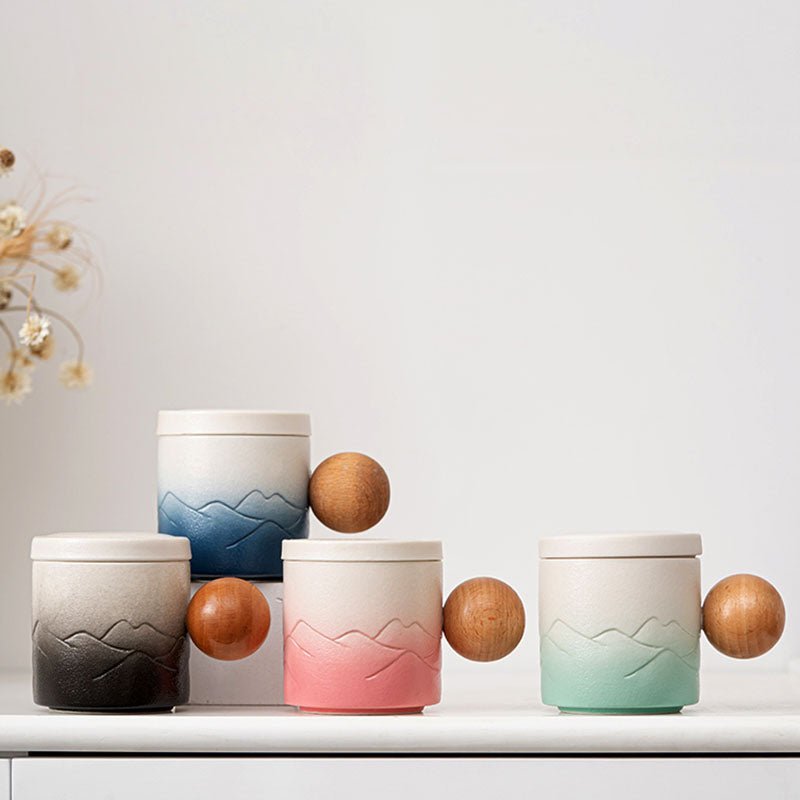
Ball Handled Ceramic Mug Comparison: What Buyers Should Compare
Reading time: about 10 minutes
Pull a ball handled mug out of a warm dishwasher, fill it to the brim, and carry it across the kitchen with wet hands. That ten-second walk tells you more than any studio photo. We handle this style every week, and the questions that come back to us are rarely about glaze color. They are about whether the ball fits a larger hand, whether the joint traps water, and whether a full mug tips forward when you lift it. A practical ball handled ceramic mug comparison starts with grip and balance, and only then moves on to finish.
Why a full mug exposes what an empty ball handle hides
An empty mug flatters every handle shape. Ceramic at rest is light, and the balance point sits wherever the body happens to be heaviest. Add a full pour of coffee and the physics changes. A ball handle concentrates the load on a small contact patch, usually the thumb and the inside of the index finger, so a full mug asks more of a narrow grip than a wide loop does.
Test it before you buy anything. If you already own a mug with a round knob, fill it with water to the level you would really pour, then hold it at the handle for a slow thirty count. Watch for three things: whether your fingers curl around the ball or the ball presses into your palm, whether your thumb has a flat landing spot, and whether your knuckles graze the mug wall.
- Finger position: a ball that is too wide forces your hand open; one that is too narrow digs into the webbing between thumb and finger.
- Thumb rest: a slight flat spot or indent on top of the ball gives your thumb a job and reduces slip when your hands are damp.
- Knuckle gap: the space between the ball and the body rarely shows in a side-on photo. Ask for it in inches or millimeters and compare it to a mug you already use.
- Carry style: a loop handle lets you hang the mug off one finger while your other hand carries a plate. A ball handle is a pinch grip, and pinch grips get awkward when your hands are full.
In our store, the handle is the first thing we ask customers about, because it is the one part of a mug you cannot adapt to. You can change how you pour, how you clean, and where you store it. You cannot change your hand.
The ball handled ceramic mug comparison table we use behind the counter
Treat this as a script of questions for the seller, not a spec sheet. If a listing cannot answer an item, that silence is itself useful information.
| What to compare | Why it decides the purchase | How to verify it |
|---|---|---|
| Handle opening and body gap | Knuckle room and control on a full mug | Ask for the inner opening measurement and compare it to a mug you own. |
| Balance point when full | A front-heavy mug tips toward the lip | Fill your current mug with water and lift it the way you would at a desk. |
| Handle joint finish | The main wear and water-trapping point | Ask for a close-up photo and whether the joint is smoothed and filled. |
| Rim glaze coverage | Staining and lip feel | Check whether the rim is fully glazed and how the seller describes the finish. |
| Foot ring texture | Counter scratches and water rings | Ask whether the foot is glazed or bare clay, and whether it feels smooth. |
| Stated capacity | Brim ounces mislead | Confirm the ounce rating and ask where a realistic fill line sits. |
| Care wording | Whether the mug fits your routine | Read the dishwasher and microwave wording on the exact listing, not a category page. |
Notice what is missing from the table: color, pattern, and box presentation. Those matter, but they come later. Finish is easy to choose at checkout and impossible to fix at your kitchen sink.
Handle joint, rim, and foot ring: the wear points we inspect first
On a ball handle, the knob is attached to the body at a small footprint, often one contact area rather than the long seam a loop handle gives you. That joint is where we look first. A smooth, filled transition wipes dry easily. A visible pinhole or a sharp seam is not automatically a defect, but it is a place where dishwater sits and where glaze can thin over time. Ask for a macro photo of the joint before you commit.
The rim comes second. A fully glazed rim is easier to wipe and less likely to hold tea tannins. Where decoration sits on top of the glaze rather than under it, care advice usually changes, and metallic trim almost always does. Read the exact wording on the product page rather than inferring it from a photo.
The foot ring is the quiet one. Many ceramic mugs leave the foot unglazed so the piece sits flat in the kiln, and that is normal. What matters is whether the bare clay is smooth or abrasive. Run a thumb across it if you can. A rough foot leaves a ring on a wooden table and a scuff on a stone countertop.
Crazing is the third thing to watch over months of use: the fine web of cracks that can develop in glaze. It is not always a structural failure, but it makes a mug harder to clean and less pleasant to drink from. If long-term glaze stability matters to you, ask the seller directly instead of assuming from a stock photo.
Does capacity or wall thickness change how the handle feels?
Yes, more than most shoppers expect. Two mugs can both be listed at the same ounce rating and feel completely different in the hand, because wall thickness and handle mass shift the balance point. A thick-walled mug holds heat longer but sits heavier at the end of a long desk session. A thin-walled mug feels light and responsive but passes heat to your fingers faster.
Capacity has the same trap. Brim capacity is not usable capacity. The number that matters is how much you can pour and still carry the mug across a room without sloshing. Tea drinkers who leave room for a steep basket and coffee drinkers who add milk both lose usable volume, so confirm the fill line rather than the maximum.
- Desk and office: you lift the mug dozens of times a day, so a balanced handle matters more than raw ounces.
- Kitchen counter: measure the clearance between shelves, then check whether the ball will catch on the shelf above.
- Gift box: a heavier mug reads as substantial, but it also changes shipping weight and how the parcel feels when it is handed over.
If you are weighing two sizes, our ball handled coffee tea mug page is the place to confirm current capacity, glaze description, and care wording before you compare it with anything else. We would rather you read those details on the exact listing than assume them from a photo or from another mug that looks similar.
When a ball handle is the wrong pick for your kitchen
Not every hand and not every kitchen wants a knob. Skip this style in four situations.
- You hang mugs from hooks. A loop handle takes a hook; a ball usually will not sit securely on one.
- You have limited grip strength. A pinch grip loads the thumb and index finger. A wide loop spreads that load across four fingers.
- Your cupboard is tight. A ball juts outward, so stacked mugs with protruding knobs need more vertical clearance and more care when you slide them in.
- It lives in a shared break room. Rough communal dishwashing is hard on any ceramic mug, and a joint with a small attachment footprint deserves the most conservative care.
Naming those limits is not a knock on the design. A ball handle is a compact, precise grip that plenty of people prefer for tea and slow morning coffee. It is simply a different tool from a loop, and the worst purchase is the one that fights your hand every day.
Care steps that protect the glaze and the handle joint
Care instructions are product-specific, so the only reliable source is the listing for the exact mug you are buying. Open the page, read the care section, and treat dishwasher and microwave claims as belonging to that item alone.
- Confirm the claim first. Do not infer dishwasher or microwave suitability from the shape, the color, or a similar mug in the same collection.
- Warm the body before boiling liquid. Rinsing a cold mug with warm tap water before pouring boiling water is cheap insurance against thermal shock.
- Use a soft sponge. Abrasive pads dull the glaze at the rim and around the handle joint, which is exactly where you want the surface intact.
- Dry the foot ring. Water trapped under bare clay can leave a ring on wood or stone, so towel-dry the base instead of leaving it upside down on a wet rack.
- Do not stack by the handle. Stack body to body, or put a cloth between mugs, so the knob never carries the weight of the mug above it.
Shortlisting for an office desk, a gift box, or a tight cupboard
Start with the job, then pick the finish. For a desk, prioritize a stable base and a handle that still feels right at the fifth refill, not the first. For a gift, confirm the boxed presentation and whether the recipient will hand-wash, because a mug that needs careful washing is a different gift from one that goes straight into the dishwasher. For a small cupboard, measure shelf clearance before you fall for a silhouette.
If you are still deciding between shapes, browse our unique coffee mugs collection and compare handle profiles side by side. Seeing a loop, a ball, and a squared handle in the same grid does more for the decision than another paragraph of description.
One last check before you order the ball handled coffee tea mug: open the listing, confirm capacity and care wording, and check whether handle dimensions are published. If a detail is missing, ask. A seller who answers a measurement question quickly is usually a seller who answers a problem quickly too.
Frequently asked questions
What should a ball handled ceramic mug comparison cover first?
Handle clearance, balance with a full mug, and the exact care wording on the listing. Color and glaze style come after those, because they are easy to change and a handle that does not fit your hand is not.
Is a ball handle harder to hold than a loop handle?
It depends on hand size and how you carry the mug. A ball gives a compact pinch grip between thumb and fingers; a loop lets you hang the mug off four fingers or a hook. Try a full mug with wet hands before you commit.
Can a ball handled ceramic mug go in the dishwasher?
Only if the current listing says so. Glaze type, metallic trim, and handle construction vary between mugs, so treat dishwasher and microwave claims as product-specific and confirm them on the exact page.
Is a ball handled mug a good gift for a tea drinker?
It can be, especially if the rim feels comfortable and the handle suits the recipient's hand. Check the gift packaging and care card first, since a mug that needs hand-washing is a different gift from one that is dishwasher-safe.
How do I judge handle strength before buying online?
Ask for a close-up of the handle joint and whether it is smoothed and filled. Treat any visible pinhole or sharp seam as a question for the seller, and note that thin attachment points deserve gentler handling over time.
More from our blog
Ready to pick your mug? Two ways to save on today's order:
Ordering 1–3 mugs? Get an extra 10% off your 1st order with code 10_OFF Apply 10% Off & Shop Wooden-Handle Mugs →
Gifting 4+ mugs? Buy 3, Get the 4th Free applies automatically at checkout (no code needed; offers do not stack) · Free standard shipping (Nov pre-Christmas delivery: 15–20 calendar days US) · Free replacement if chipped in transit.
Popular mug buying guides: Ceramic Tea Cups & Infuser Mugs · Ceramic Mugs with Lids Compared · Wooden-Handle Tea Infuser Mugs Compared · Christmas & Secret Santa Mugs 2026 · Espresso & Cortado Cups Guide · Cup & Saucer Gift Sets · All 25 Mugs Spec Table · Mug Size Guide · Shipping & Promo FAQ
FIRST ORDER 10% OFF (CODE: 10_OFF) · OR BUY 3, GET THE 4TH FREE


Read more
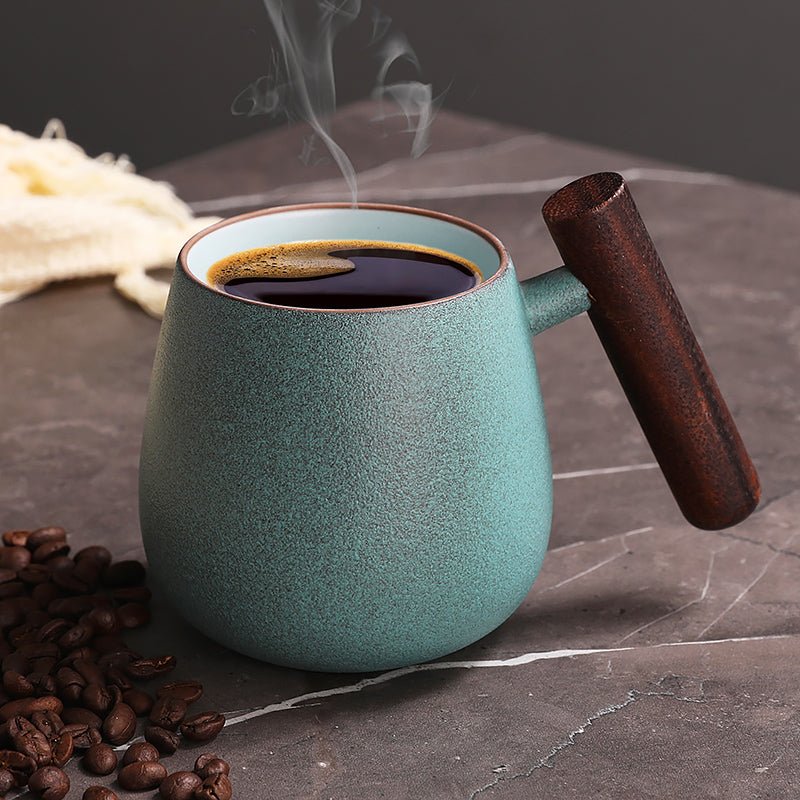
How to Choose Ceramic Mug for Home Reading Nook and Coffee: 5 Checks
Rim width, handle clearance, body weight, capacity and what an unglazed foot ring does to a wooden side table — the five physical checks that separate a nook mug from a kitchen mug, plus the four d...
Read more
Gift Ceramic Small Coffee Cup Breakfast Tray: What Buyers Compare
A practical comparison of cup capacity, tray footprint, glaze and rim quality, care needs, and box presentation — written for shoppers buying a small ceramic cup and breakfast tray as a present.
Read more
Leave a comment
This site is protected by hCaptcha and the hCaptcha Privacy Policy and Terms of Service apply.