
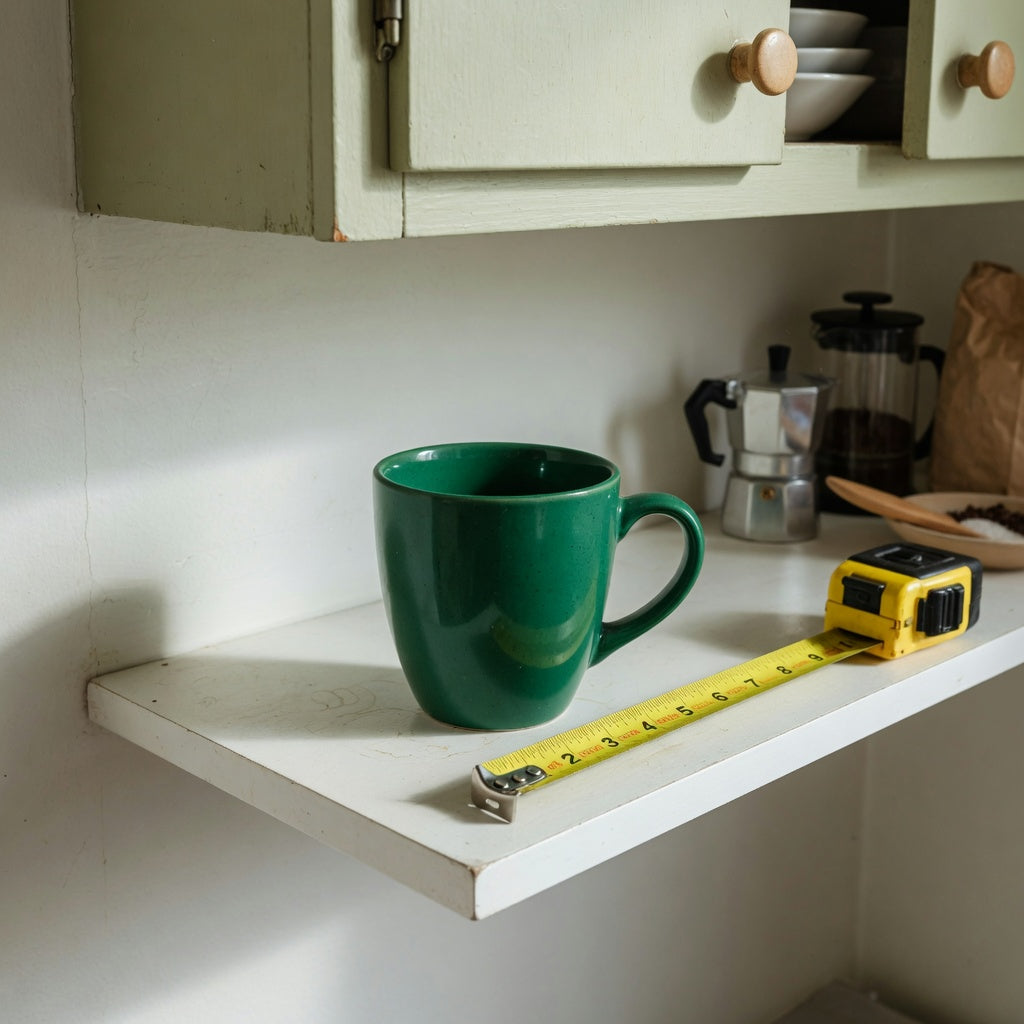
Emerald Green Coffee Mug Compact Kitchen Product Shortlist Guide
Reading time: about 9 minutes
A mug can clear the front of a shelf and still stop the cabinet door from closing because its handle crosses the door line. It can also fit under a cabinet but leave no working room beside the kettle. Our emerald green coffee mug compact kitchen product shortlist guide starts with those everyday fit failures, then narrows the options by current color information, listed capacity, visible form, and handle shape.
In our store, we find that a useful shortlist begins with the exact place where the mug will live. Product photos help us compare silhouettes, but we do not use them as rulers. We also do not make assumptions about material, glaze chemistry, care ratings, durability, stacking, or shade consistency when those details are not part of the listed comparison.
Which compact-kitchen measurements eliminate a mug fastest?
Measure the storage position before opening several product tabs. Generic cabinet dimensions are not reliable enough because shelf lips, hinges, door thickness, and nearby appliances reduce the space you can actually use.
- Usable opening height: Measure from the shelf surface to the lowest obstruction above it. Include a coaster or saucer if it will stay under the mug.
- Usable shelf depth: Measure from the back panel to the closed-door line, not just to the front edge of the shelf.
- Body-and-handle allowance: Record the space from the far side of the mug body to the outer edge of the handle in its normal storage position.
- Row width: Measure the gap between neighboring mugs, jars, or shelf supports. A form that fits alone may fail once the full row is returned.
- Counter clearance: Check the mug position beside the brewer, kettle, pour-over stand, or drying rack rather than measuring an empty counter.
A practical test is to place your current mug in the intended spot, turn its handle in the direction you normally grab it, and close the cabinet slowly. Mark that footprint on paper. If a product page does not list a measurement that is essential to your setup, do not estimate it from an unscaled image.
Emerald green coffee mug compact kitchen product shortlist guide: evidence limits
We use four pieces of product evidence for this shortlist:
- The color name or color option currently shown on the product page.
- The capacity currently listed for the mug.
- The body form visible in the product images, such as straighter sides or a rounded profile.
- The visible handle shape and its relationship to the mug body.
Capacity numbers and color availability should be checked on the live listing immediately before purchase. We deliberately avoid copying an unverified measurement from memory. This shortlist is also not suitable for a decision that depends on a dishwasher rating, a particular material, guaranteed durability, or an exact shade match across screens.
Three compact-kitchen scenarios and the shortest useful shortlist
1. Exact emerald color is the first requirement
Reader situation: You want the named emerald option, store mugs upright, and have room for a conventional outward handle. The images for the Emerald Coffee Tea Mug show a relatively straight-sided form with a C-shaped handle, making it the direct product page to inspect first.
Why it fits: This route keeps the color search focused, and the straight visible form is easy to compare with an existing upright mug. Choose it only if the capacity shown on the current listing suits your normal serving and the handle stays inside your measured shelf or door boundary.
Why to skip it: It is not a good choice if the C-shaped handle enters a hinge path, crowds the neighboring mug, or requires an unlisted projection measurement to confirm fit. Skip it as well if you need a guaranteed match to other emerald dishes; screens and room lighting are not dependable color-matching tools.
2. A rounded body is more important than choosing color first
Reader situation: Your current straight-sided mug feels visually or physically awkward beside round jars, a compact brewer, or a curved shelf corner. The Round Coffee Tea Mug provides a visibly rounder body and a curved handle to compare with the emerald mug's straighter form.
Why it fits: Choose this route when the rounded silhouette works better with the objects already occupying the shelf and when its currently listed capacity suits your serving. Confirm the available color on the live page rather than assuming the round form is offered in the exact emerald shown elsewhere.
Why to skip it: Round does not automatically mean narrower, shorter, or easier to stack. The fullest part of a rounded body may become the limiting point in a close row, and an image without scale cannot prove that its handle projects less. Skip it if exact emerald availability is non-negotiable and the current page does not show that option.
3. Neither product resolves the critical fit question
Reader situation: One mug has the preferred color but an uncertain handle fit, while the other has the preferred form but not the required current color or capacity. At that point, the practical route is the unique coffee mugs collection, where you can compare other visible forms and handle shapes.
Why it fits: A broader collection is useful when form or handle clearance matters more than staying with one product page. Open only the listings that show a suitable current color, state a workable capacity, and provide enough visual or listed information for your measured space.
Why to skip an option: Do not let a close color substitute override a failed cabinet measurement. If a listing leaves a must-have capacity or dimension unresolved, removing it from the shortlist is more practical than hoping it will fit after delivery.
Which handle shape works beside cabinet doors and neighboring mugs?
The handle can be the widest part of a mug, so body width alone does not settle shelf fit. On the emerald listing, inspect the outer curve of the C-shaped handle. On the round listing, inspect how the curved handle follows the body. Product photos can identify those shapes, but they cannot establish exact projection or finger clearance unless measurements are listed.
- For a shelf behind a hinged door, mark the closed-door plane and keep the entire handle behind it.
- For a tight row, compare the handle's outer edge with the next mug's widest point.
- For a corner cabinet, test the path used to remove the mug, not just its resting footprint.
- For an under-cabinet hanging rail, require enough information about the handle opening; a front photo alone is not sufficient.
A large loop may suit someone who wants more visible finger space but use more storage width. A handle that appears closer to the body may conserve space, yet it can feel restrictive for larger hands. That trade-off cannot be settled by color or capacity.
How should listed capacity change a small coffee station?
Capacity describes volume, not exterior size. Two mugs with similar listed capacities can distribute that volume through different heights, body curves, or rim widths, so a capacity match does not prove a cabinet match.
Fill your current favorite mug to the level you actually drink from, then transfer that serving to a marked measuring vessel. Compare the result with the capacity on each live product page. Keep your preferred headroom in mind, and do not assume a listed total capacity is the same as a comfortable fill line unless the listing specifically says so.
A smaller regular serving can make excess capacity unnecessary in a crowded coffee station. Milk drinks, tea with room for additions, or iced drinks may call for more volume, but you still need to verify the mug's physical fit separately. If the mug must sit under a single-serve brewer, measure the brewer opening and drip-tray position as their own constraints.
Can emerald green work as the only strong color on a small shelf?
Emerald can provide one clear accent when only a few objects remain visible in a compact kitchen. It is less useful if you are trying to match an existing green set exactly or if several strong colors already compete on the same shelf.
Judge the current product images on more than one screen and, where available, under more than one photographed lighting condition. That can help you decide whether you like the general color direction, but it cannot guarantee a screen-to-product or mug-to-mug shade match. If form and capacity matter more than exact color, use the collection as the next comparison point.
A five-minute checkout sequence for cabinet, shelf, and counter fit
- Write down usable opening height, shelf depth, row width, and the closed-door line.
- Measure the amount you normally drink and compare it with each product's current listed capacity.
- Open the emerald mug listing and the round mug listing side by side.
- Compare the straight and rounded visible forms, then inspect each handle against your tightest storage point.
- Verify the current color information on the exact product page you intend to buy from.
- Reject any candidate that leaves a critical fit requirement unanswered.
- If neither works, return to the current unique mug selection with the same measurements beside you.
Use this emerald green coffee mug compact kitchen product shortlist guide as a rejection sequence. One failed must-have measurement should remove a mug from the list, even if its color is the strongest match.
Frequently asked questions
What should an emerald green coffee mug compact kitchen product shortlist guide compare?
It should compare current color information, listed capacity, visible body form, and handle shape against measurements from the exact storage location. It should also identify unresolved details instead of treating product photos as scaled drawings.
Is the Emerald Coffee Tea Mug automatically best for a shallow shelf?
No. Its direct emerald listing and straighter visible form make it a logical first candidate, but the C-shaped handle must remain inside your usable depth and door line. Confirm the current listed capacity and any available dimensions before deciding.
Does the Round Coffee Tea Mug use less cabinet space?
Not necessarily. A rounded profile distributes its width differently, but round does not prove smaller, shorter, or more stackable. Compare its fullest visible point and handle shape with your measured shelf rather than relying on the form name.
Will the emerald mug match the green shown on my screen?
An exact match cannot be guaranteed from a screen image. Display settings, ambient light, and product photography can change how the color appears, so use the page as a guide to the general color direction rather than a calibrated shade sample.
What should I do if a product page does not list a measurement I need?
Do not infer a critical dimension from an unscaled photograph. Remove that option from the shortlist or open the unique coffee mugs collection and compare another listing with your written cabinet, shelf, capacity, and handle requirements beside you.
More from our blog
Read more

Art Coffee Mugs Compact Kitchen Practical Purchase Checklist: 7 Checks
Measure cabinet openings, shelf depth, handle clearance, and your usual pour before comparing the Mountain-Sea, Koi Fish, and Crane mugs. This checklist separates listing-backed facts from details ...
Read more
Tall Ceramic Coffee Mugs Home Office Product Shortlist Guide: Desk Fit
Compare three tall ceramic mug designs against home-office constraints that matter before checkout: shelf room, handle clearance, published capacity, care guidance, and visual fit. Every pick inclu...
Read more
Leave a comment
This site is protected by hCaptcha and the hCaptcha Privacy Policy and Terms of Service apply.