
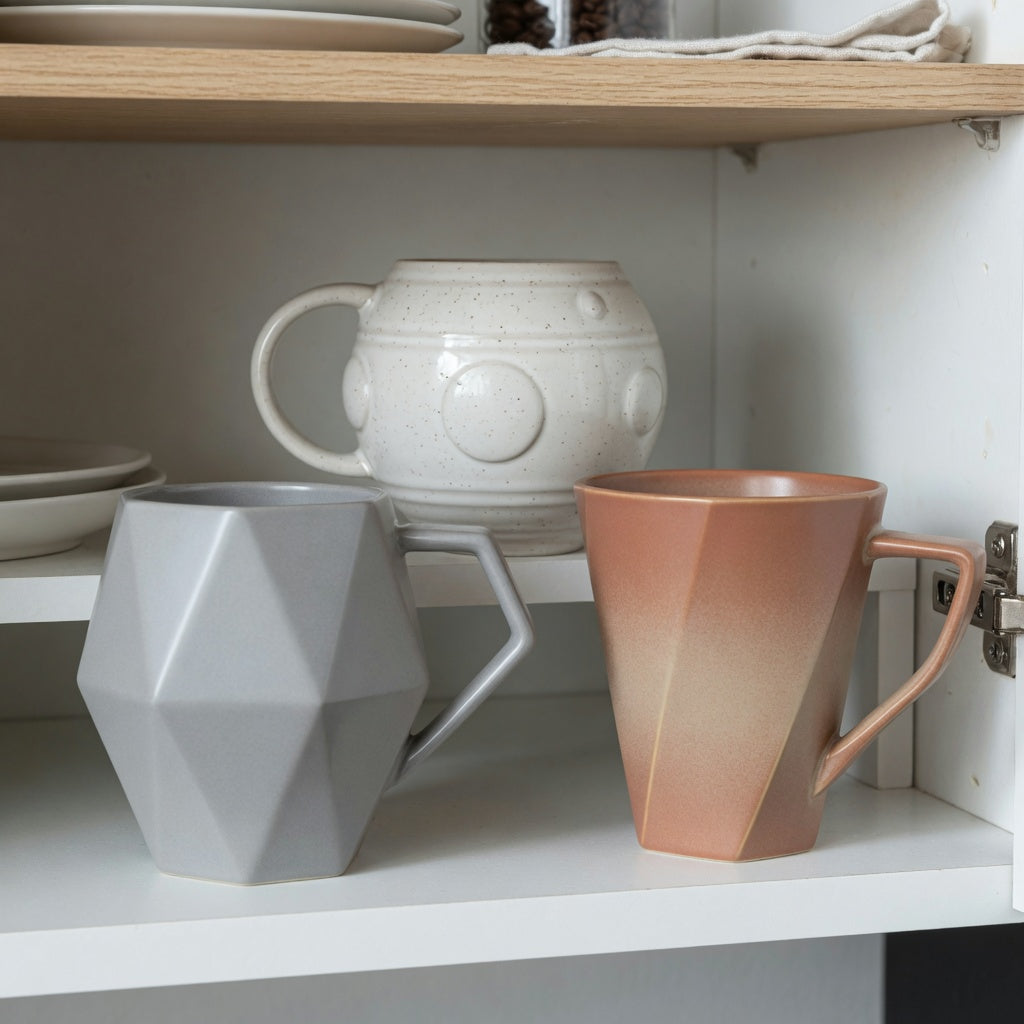
Geometric Coffee Mug Storage Fit Guide: Shelf Fit by Shape
Reading time: about 8 minutes
A mug can sit fully on a cabinet shelf and still prevent the door from closing because its handle reaches into the door plane. We also see shelf risers fail in the opposite direction: the width is fine, but a faceted shoulder clips the riser above. This geometric coffee mug storage fit guide compares the current Rhombus, Planet, and Gradient forms around those practical fit points.
We sell and handle this category, so we keep visible form separate from unverified specifications. The current products are ceramic coffee and tea mugs, but each live product page should remain your source for listed capacity, dimensions, variant details, and care directions. We will not infer a measurement from a photograph. Capacity tells you how much a mug holds; it does not reveal exterior width, handle projection, or usable cabinet depth.
Geometric coffee mug storage fit guide: which cabinet measurements matter?
Measure the space the mug must actually occupy, not just the shelf board. In a closed cabinet, usable depth ends at the inside face of the closed door. A face frame, hinge, raised shelf lip, or overhanging riser can reduce that space further.
- Usable depth: Measure from the back panel to the nearest obstruction at the front, with the door closed.
- Overall width: Compare the mug's widest body point through the outer edge of its handle, not the body alone.
- Clear height: Measure from the shelf surface to the shelf or riser above. Include any downward-projecting hardware.
- Base support: Check how much flat shelf area sits under the mug, especially on wire racks or narrow shelf risers.
Write each measurement in the same unit used on the product page. If the listing gives one maximum width rather than separate body and handle measurements, use that larger figure for planning. A paper or cardboard rectangle cut to the listed maximum dimensions is useful when clearance is close. For particularly tight cabinets, compare other silhouettes in our unique coffee mugs collection before committing to a form that needs extra room around its corners.
Rhombus, Planet, or Gradient: how does each visible form use space?
The product name is only a starting point. The widest part of the body, the handle's outer edge, and the path used to remove the mug determine real storage fit.
| Mug | Visible form | Storage check | Best-fit situation |
|---|---|---|---|
| Rhombus Coffee Tea Mug | Faceted body with pronounced angular planes | Measure the furthest corner and full handle span. Leave side clearance so the mug can lift out without scraping a neighbor. | Open or glass-front shelving where the facets can be seen and lateral room is available. |
| Planet Coffee Tea Mug | Rounder, more continuous body profile | Check the broadest body diameter as well as the handle. Test whether it can rotate between nearby mugs. | Mixed cabinet storage or a desk where a smoother perimeter is easier to retrieve regularly. |
| The Gradient Coffee Tea Mug | Tapered or stepped multi-plane profile | Measure the widest level rather than using the base alone. Check whether the chosen handle direction changes front clearance. | Open shelves, risers, or desk trays where you can control the mug's orientation. |
Shape names and product photos are comparison cues, not substitutes for listed dimensions. A rounded body can still be wider than a faceted one, and a compact-looking base does not guarantee that the upper body will clear a riser. Compare the current listed capacity and dimensions for the exact product you are considering. All three use ceramic, so the practical differences come from the listed size, visible body profile, and handle position rather than material alone.
Why ceramic and listed capacity do not settle shelf fit
Ceramic is rigid. It will not flex around a shelf lip or neighboring handle, and repeated edge-to-edge contact can chip a rim or a pronounced corner. We leave a small retrieval gap between shaped ceramic mugs instead of packing them tightly. A non-slip shelf liner can also keep a smooth foot ring from sliding when another mug is removed.
Capacity and exterior footprint are separate variables. Two mugs can hold a similar amount while gaining volume through different combinations of height, width, and taper. A larger listed capacity does not automatically mean a wider base, and a smaller capacity does not guarantee shallow cabinet fit. Check the maximum exterior dimensions after comparing the liquid capacity that suits your coffee or tea routine.
At gift unboxings, or before the first use at home, inspect the rim, visible corners, handle attachment points, and foot ring under good light. Rim chips and hairline marks near the handle are the places we check first on shaped ceramic pieces. For care, follow the product-specific directions. If dishwasher use is not clearly stated, hand washing with a nonabrasive sponge is the cautious option, and sudden hot-to-cold temperature changes should be avoided with ceramic.
Will these mugs work on hooks, risers, wire shelves, and dishwashers?
A cabinet shelf is only one storage system. Fixed hardware introduces clearances that standard width and height figures may not fully describe.
- Under-cabinet hooks: Measure the handle opening, hook thickness, and any enlarged end stop. Also confirm the hanging mug will not hit the backsplash or counter appliance below.
- Shelf risers: Check both the clear height under the riser and the front rail. A mug may fit underneath but catch that rail during removal.
- Wire shelves: Make sure the base is supported across multiple wires. If the mug rocks or a foot edge drops between wires, add a flat shelf liner.
- Dishwasher racks: Use a dishwasher only when the product's care guidance permits it. Position the mug so the handle does not wedge around a tine and the body clears the spray arm and nearby glassware.
Do not assume these forms will nest or stack securely. Unless a listing specifically describes a mug as stackable, single-layer storage is the lower-risk setup for ceramic. Buyers who depend on narrow fixed hooks, compact vertical stacks, or a crowded office break room may be better served by a simpler cylindrical mug.
Which shape fits a closed cabinet, open shelf, office desk, or gift?
Match the product to the storage situation first. The shape you prefer visually still needs a practical path into and out of its daily space.
- Open or glass-front display shelf: The pronounced planes of the faceted Rhombus mug are visible from several angles. It fits this situation when you can allow side clearance around the corners and handle.
- Closed cabinet shared with other mugs: The rounded Planet mug profile has fewer pronounced body corners to catch neighboring pieces. Its listed maximum dimensions still decide whether the door closes.
- Shelf riser or dedicated desk tray: The Gradient coffee and tea mug suits a space where its tapered or stepped profile can be oriented deliberately. Measure the widest level before using the narrower-looking base as your guide.
- Very shallow cabinet or narrow hook rail: Do not force a geometric mug into marginal clearance. Start with a more compact profile from the broader unique mug collection and compare the live dimensions.
- Gift for someone else's kitchen: Ask about cabinet depth, open shelving, or desk use before selecting the most angular option. If their storage is unknown, a less projecting body and handle are generally easier to place.
These mugs are not intended to solve travel storage or high-volume stacking unless a product page explicitly states otherwise. They make more sense for a home shelf, office desk, or display cabinet where the visible shape is part of the appeal and there is enough room to handle the mug without repeated contact.
A five-minute shelf test before placing the order
Use this sequence for the exact cabinet, shelf, or desk where the mug will live:
- Empty the intended spot and identify the inside door plane, shelf lip, riser, or nearby appliance that limits space.
- Measure usable depth, clear height, and available side-to-side width.
- Check the selected product page for current capacity, ceramic material details, maximum dimensions, and care guidance.
- Include the handle in the footprint. Do not compare body diameter alone with total shelf width.
- Make a cardboard template if the listed measurements sit close to your available clearance.
- Test the removal path with one hand. A mug that fits only after moving three neighboring cups is not a practical daily fit.
If every check passes, choose among the Rhombus, Planet, and Gradient forms based on the profile you want to see and use each day. If any measurement is close, prioritize clearance over appearance and compare another shape in the collection rather than relying on a photograph to settle the fit.
Frequently asked questions
How do I use this geometric coffee mug storage fit guide if handle width is not listed?
Use any listed maximum overall width instead of the body diameter. If the page does not provide an overall measurement, do not calculate it from capacity or estimate it from a styled photograph. Compare the product images for orientation, then confirm the missing measurement before buying for a tight cabinet.
Can a geometric coffee mug fit in a standard kitchen cabinet?
Many can, but there is no single standard usable cabinet depth because doors, face frames, hinges, and shelf lips differ. Measure to the inside face of the closed door and compare that figure with the mug's maximum exterior depth, including its handle orientation.
Can I stack the Rhombus, Planet, or Gradient mugs?
Do not assume they nest securely based on appearance. Faceted, rounded, and stepped profiles can create unstable contact points between the base of one mug and the rim of another. Unless the relevant product listing says the mug is stackable, store it in a single layer or on a shelf riser.
Are these ceramic geometric mugs dishwasher safe?
Dishwasher suitability should be confirmed on the individual product page because material alone does not establish the full care instructions. If dishwasher use is approved, keep the mug stable between rack tines and clear of the spray arm. Hand wash with a nonabrasive sponge when the care guidance is unclear.
Which option should I buy for a very shallow shelf?
Choose by the smallest verified overall depth, including the body and handle, rather than by the shape name. If none of the three current forms leaves comfortable door clearance, use the measurement checklist above and compare a less projecting option in the CoffeifyMug unique coffee mugs collection.
More from our blog
Read more
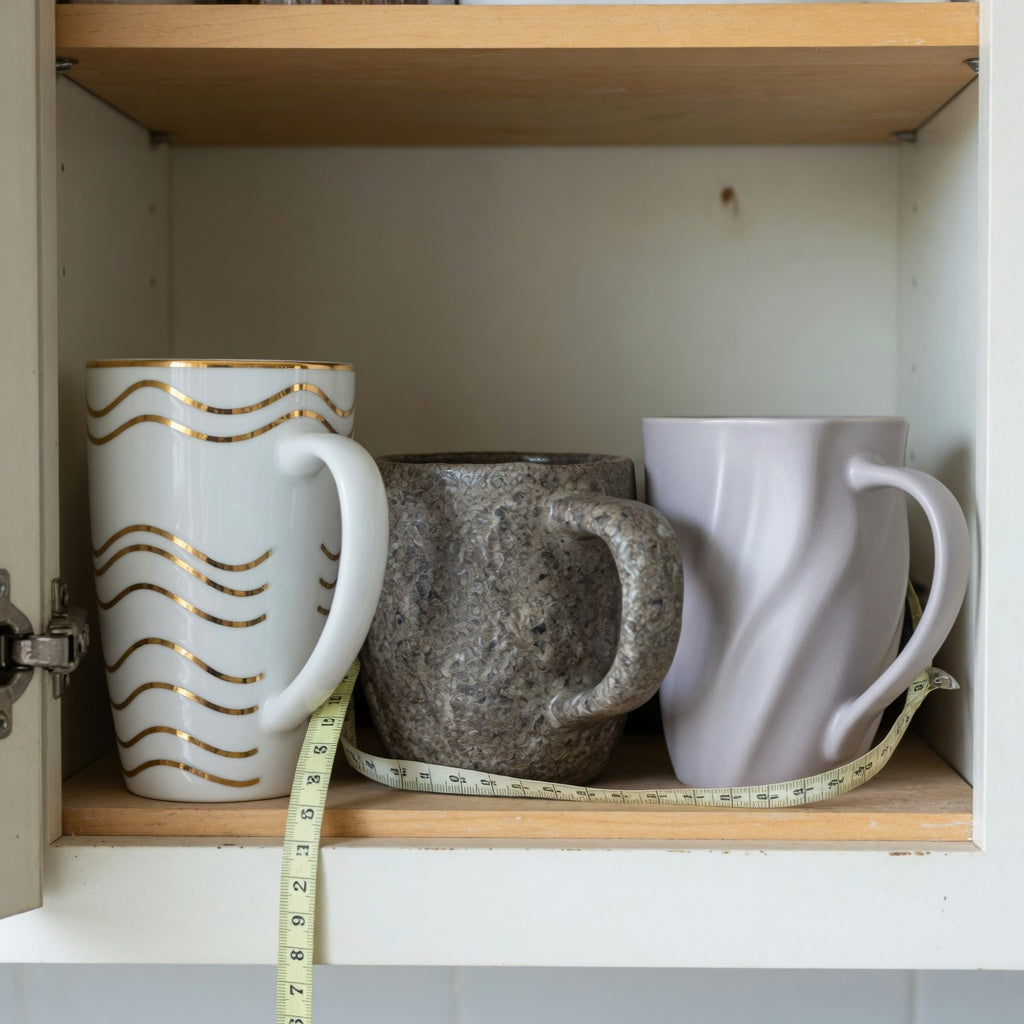
Oversized Ceramic Coffee Mugs Storage Fit Guide: Compare 3 Shapes
Compare the Flow, Rock, and White Golden Waves mug shapes against cabinet height, shelf depth, handle clearance, and real kitchen or office storage limits. Includes a practical measuring checklist.
Read more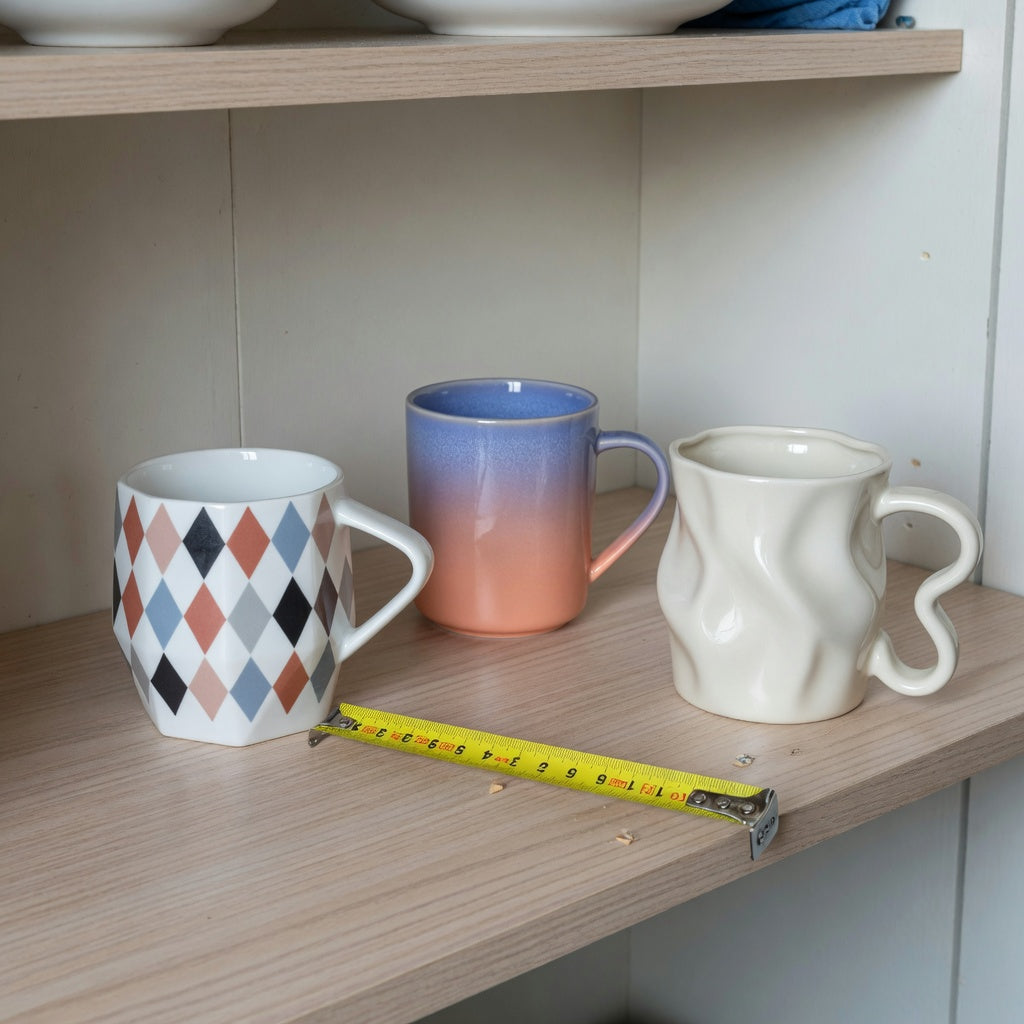
Abstract Coffee Mug Storage Fit Guide: Shapes and Shelf Space
Compare Rhombus, Gradient, and The Flow by verified capacity and visible form. Use practical shelf, cabinet, handle, stacking, and care checks without guessing at unlisted dimensions.
Read more
Leave a comment
This site is protected by hCaptcha and the hCaptcha Privacy Policy and Terms of Service apply.