
Abstract Coffee Mug Buying Priorities: Capacity, Shape, Space
Reading time: about 11 minutes
A mug decision often goes wrong at 8:45 a.m.: the coffee maker has produced more than the new cup can hold, the mug has no confirmed clearance under the machine, or its outline occupies the coaster differently than the product photo suggested. Those are routine problems, not style problems. Our abstract coffee mug buying priorities therefore begin with the amount you pour, the shape you can see, and the space you can measure.
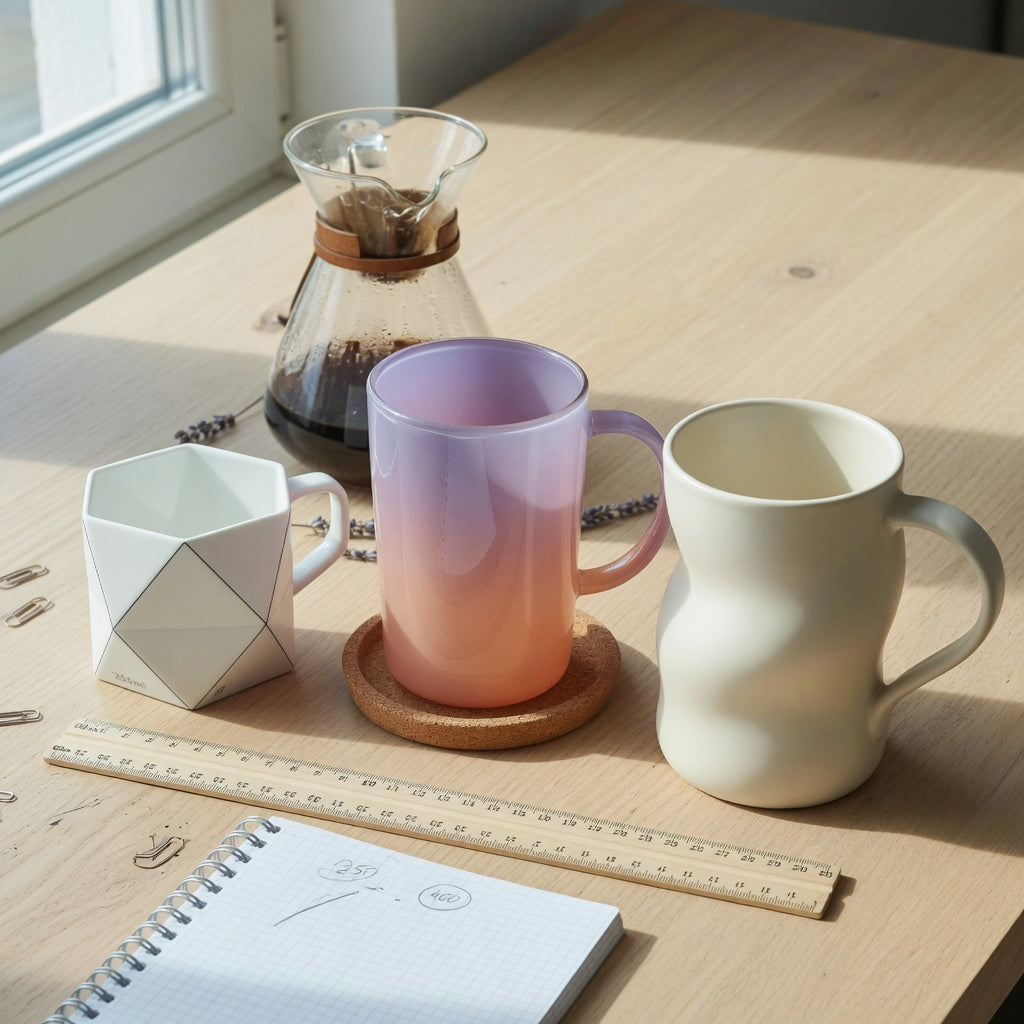
At CoffeifyMug, we keep this comparison within the catalog facts we can verify. The Rhombus is listed at 250 ml with a geometric form, the Gradient at 400 ml with a color-transition finish, and The Flow at 400 ml with sculptural curves. Exact outer dimensions, material, weight, handle clearance, and appliance compatibility should be confirmed on the current product page when listed. We will not fill those gaps with guesses.
Abstract coffee mug buying priorities: which variable should lead?
Start with the variable that can make the mug unusable. In our experience answering product-fit questions, capacity usually belongs first because a beautiful mug cannot hold a drink that exceeds its listed volume. Shape comes next because it determines the visual character you will see every day. Space is the final gate, and it must be based on external measurements rather than an assumption that lower capacity always means a smaller footprint.
- Final drink volume: Measure what actually lands in the cup after adding water, milk, foam, or ice. Do not use the coffee dose or brewer setting as a substitute for finished beverage volume.
- Visible form and finish: Decide whether you want the Rhombus geometric form, the Gradient color transition, or The Flow sculptural curves.
- Measured placement: Check the space beside your keyboard, under the coffee machine, inside the cabinet, and on your usual coaster.
- Material and care requirements: Confirm these on the live listing. Appearance alone does not establish material, dishwasher compatibility, or microwave compatibility.
This order keeps the decision commercial and practical. Color and shape can separate two mugs that both fit your drink, but they should not override a capacity mismatch or an unverified fit in a fixed storage space.
Is 250 ml or 400 ml closer to your normal pour?
The Rhombus capacity is 250 ml, which is about 8.5 US fluid ounces. The Gradient and The Flow are each listed at 400 ml, or about 13.5 US fluid ounces. Those figures create a meaningful difference during a workday: a drink that fits within 250 ml can suit the Rhombus, while a larger recipe may require one of the two 400 ml options.
Measure your completed drink at least once before ordering. If you brew coffee and then add milk, measure after the milk goes in. If you make iced coffee or tea, remember that ice occupies part of the mug's capacity. A recipe containing 400 ml of liquid plus ice needs more room than a 400 ml mug can provide.
Headspace matters too. Listed capacity does not automatically tell you how much liquid you can carry comfortably without filling to the rim. If your recipe lands exactly at the mug's stated capacity, you may need to reduce the pour or select a larger vessel.
- Short coffee, smaller tea serving, or frequent fresh refills: A measured drink that fits comfortably below 250 ml makes the 250 ml Rhombus coffee and tea mug the relevant starting point.
- Longer desk drink or a recipe above 250 ml: Compare the two 400 ml options, then use finish and form to choose between them.
- Drink larger than 400 ml: None of these three capacities is the right match. Do not buy a 400 ml mug expecting it to replace a larger iced-drink cup or high-volume tumbler.
The 250 ml option is not simply better for light coffee drinkers, and the 400 ml options are not automatically better for everyone. A smaller pour can stay closer to the routine of someone who prefers frequent fresh refills, while a larger mug may suit a person who wants to leave the kettle and work through one drink.
Do you prefer geometric form, color transition, or sculptural curves?
After capacity, compare only the visible design facts. Abstract is a shopper's style lens here. It is not a claim about a named art movement, creator attribution, limited edition, or institutional provenance.
| Current option | Verified catalog detail | Question to answer before buying |
|---|---|---|
| Rhombus | 250 ml capacity and geometric form | Do you want angular visual structure enough to verify the widest points against your storage space? |
| Gradient | 400 ml capacity and color-transition finish | Is a changing color effect your main visual priority once the 400 ml capacity passes your pour test? |
| The Flow | 400 ml capacity and sculptural curves | Do you prefer a visibly curved silhouette, and can you confirm its maximum external width where required? |
Shape photographs can help you judge appearance, but they cannot establish grip comfort for every hand. They also do not reveal exact weight, wall thickness, thermal performance, or material unless the listing supplies those facts. We avoid claiming that one form is more comfortable or stable without the measurements and handling conditions needed to support that comparison.
The Gradient and The Flow make the cleanest capacity comparison because both are listed at 400 ml. Choose the 400 ml Gradient mug if the color-transition finish is the feature you want to see on your desk or counter. Choose The Flow coffee and tea mug if sculptural curves matter more than a color-transition effect.
Will the mug fit your desk, coaster, cabinet, and coffee station?
A capacity figure is not an exterior dimension. Two mugs can hold the same amount while using different combinations of height and width, and a lower-capacity mug is not guaranteed to have the smallest external footprint. Because exact dimensions are not among the verified facts used for this comparison, we do not rank Rhombus, Gradient, and The Flow by desk space.
Use a ruler or tape measure at the places where the mug will actually live. Office buyers should check the clear area between the keyboard, mouse, monitor stand, and charging cables. Kitchen buyers should check shelf height, cabinet opening, coaster size, and clearance below the coffee machine or pour-over stand.
- Measure the maximum free width and depth on the desk or counter.
- Check the product page for maximum external width, including the handle if present, rather than relying only on base diameter.
- Compare mug height with the cabinet shelf and the space below your brewer.
- Check whether the full base sits inside the usable surface of your coaster.
- Allow room to lift and turn the mug without striking a monitor, shelf, tap, or neighboring cup.
Visible form tells you where to pay attention. For the Rhombus, confirm the widest part of the geometric outline. For The Flow, look for the maximum width created by the sculptural curves. The Gradient still needs the same dimensional check even though its defining catalog feature is the color-transition finish.
If the mug must fit a fixed slot and the required dimensions are not provided, pause the purchase rather than estimating from a styled photograph. Product images can include perspective and surrounding objects that make scale difficult to judge.
Which current CoffeifyMug option fits your routine?
Each recommendation below starts with a shopper situation, explains the fit using verified facts, and points to the relevant next step.
- Your completed drink fits comfortably within 250 ml, and you want a geometric form: The capacity matches the smaller pour and the visible shape matches the style preference. Review the Rhombus 250 ml product details, then confirm dimensions and care information before checkout.
- Your drink needs up to 400 ml, and the finish is your main design priority: The Gradient provides the listed 400 ml capacity with a color-transition finish. Check the live Gradient listing for the remaining material, size, and care details your routine requires.
- Your drink needs up to 400 ml, and you prefer a sculptural silhouette: The Flow matches that capacity with visible sculptural curves. Confirm its maximum dimensions if it must fit a specific coaster, shelf, or work surface.
- Your desk or cabinet has strict clearance limits: Capacity and photographs are not enough to recommend one of the three. Choose only after the required external measurements are available and fit your recorded space.
- You need more than 400 ml, a commuting lid, or confirmed cup-holder compatibility: These verified facts do not establish that fit. A different mug or drinkware style is the more responsible choice unless a current listing explicitly confirms those features.
The choice between Gradient and The Flow should not be presented as a capacity contest because both are listed at 400 ml. It is a choice between a color-transition finish and sculptural curves, followed by confirmation of any dimensions or care requirements that can make or break the purchase.
Which material, care, and arrival details need confirmation?
A finish is not a material specification. A product photograph cannot reliably tell you whether a mug is porcelain, stoneware, glass, or another material, and it cannot prove that the item is dishwasher or microwave compatible. Read the live product details for an explicit material and care statement rather than assigning properties based on appearance.
Before the first dishwasher cycle or microwave reheat, confirm that the current listing allows that use. If care instructions are unavailable, the conservative routine is to hand wash with a soft, non-abrasive sponge, avoid abrasive scouring pads on the finish, dry the mug fully, and avoid abrupt hot-to-cold temperature changes. That is a precaution, not a product-specific compatibility claim.
Unboxing deserves the same attention, especially when the mug is a gift. Check the rim and body for chips or hairline cracks, inspect the handle connection if a handle is present, and place the empty mug on a level counter to check for an unexpected wobble. Photograph shipping damage before using or washing the item. This takes less time than discovering a rim chip after the gift has been wrapped or the first drink has been poured.
- Material: Look for an explicit listing rather than inferring it from color or finish.
- Care: Confirm dishwasher, microwave, and cleaner compatibility separately.
- Dimensions: Prioritize maximum width, total height, base size, and handle clearance when supplied.
- Weight: Check empty weight if hand fatigue or carrying the mug between rooms is a concern.
- Condition: Inspect the rim, body, base, and any handle joint before first use.
When is a different mug style the better purchase?
Choose a different style if your priority is a leak-resistant lid, car cup-holder fit, nesting or stacking, a drink larger than 400 ml, or confirmed compatibility that the current product details do not provide. An abstract form should not override a non-negotiable functional requirement.
You can compare the broader unique coffee mug collection when none of these three combinations matches your routine. Treat the collection as a wider starting point, then verify the capacity, dimensions, material, and care details on each individual listing. Do not assume every mug in a visual collection shares the same specifications.
Use this five-minute pre-checkout comparison
- Measure the final drink, including milk, water, foam, or ice.
- Decide whether 250 ml or 400 ml leaves enough practical headspace.
- Choose geometric form, color transition, or sculptural curves.
- Measure the desk, coaster, cabinet, and brewer clearance.
- Confirm listed dimensions, material, weight, and care requirements.
- Skip the option if any non-negotiable detail remains unconfirmed.
This sequence keeps the visual decision in the right place. First make sure the mug can hold the drink and fit the space. Then choose the abstract form you will enjoy seeing in the kitchen or beside your laptop.
Frequently asked questions
What are the main abstract coffee mug buying priorities for daily use?
Start with the finished beverage volume, then compare the visible form and the measurable space where the mug will sit. Confirm material, dimensions, and care requirements before checkout rather than inferring them from photographs. These abstract coffee mug buying priorities prevent style from hiding a basic capacity or fit problem.
Is a 250 ml mug large enough for coffee with milk?
It can be, but measure the completed drink after adding the milk. If the total fits comfortably below 250 ml with room to carry the mug, the Rhombus capacity may work. Move to a 400 ml option if your usual recipe exceeds that amount.
Which 400 ml mug should I choose, the Gradient or The Flow?
Both are listed at 400 ml, so choose by the verified visual distinction. The Gradient has a color-transition finish, while The Flow has sculptural curves. Confirm dimensions and care details separately because capacity does not establish those specifications.
Which abstract coffee mug is best for a small desk?
We cannot responsibly rank these three by footprint without verified external dimensions. Measure the available desk area and compare it with the maximum width and height on the current listing when supplied. Do not assume the 250 ml Rhombus is automatically the smallest outside.
Can I assume these mugs are dishwasher and microwave safe?
No. Shape, finish, and capacity do not prove appliance compatibility. Check the current product page for explicit care instructions, and use conservative hand washing until that information is confirmed.
Next step: Write down your measured drink volume and available space, then open the product page that matches your preferred form. Proceed only after its current specifications pass your capacity, shape, space, and care checks.
More from our blog
Read more
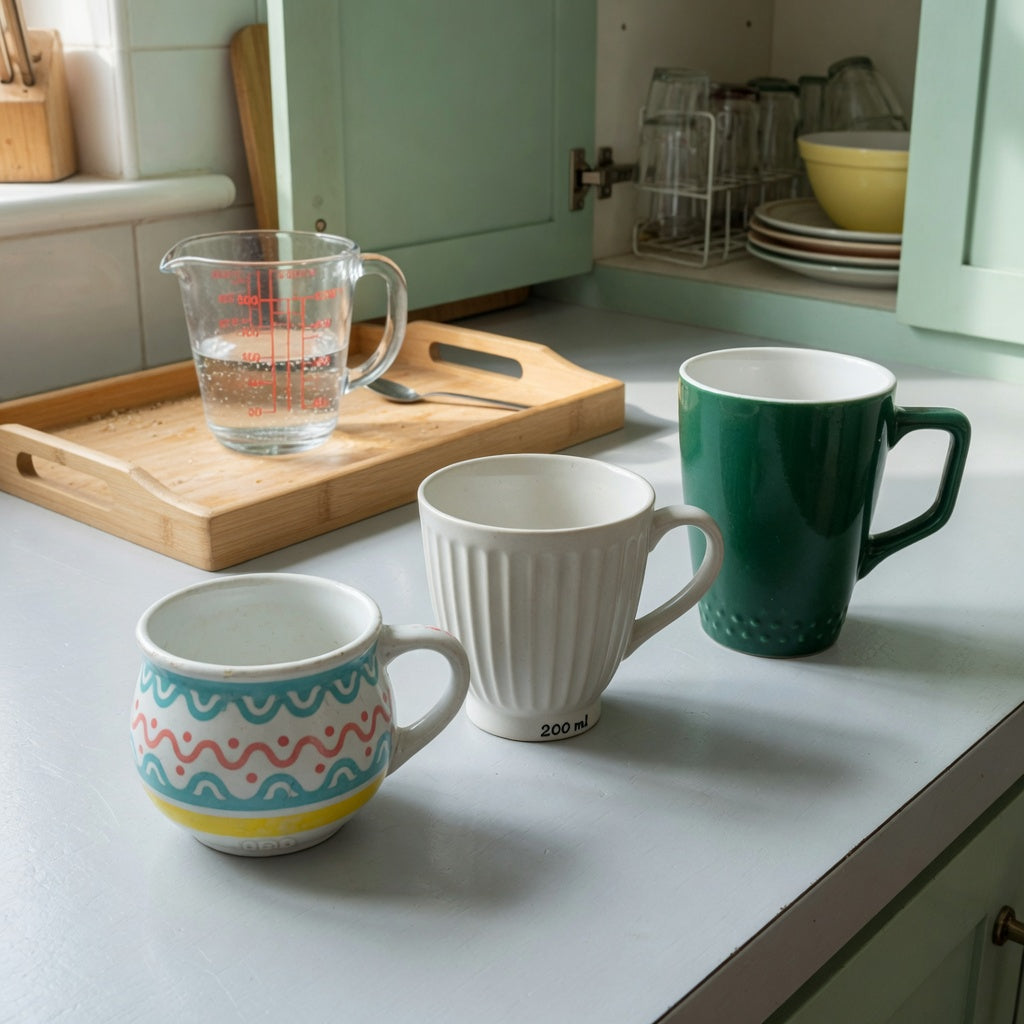
Eggnog Mug Buying Priorities: Capacity, Shape, and Space
Compare the Retro 170 ml, Pleated 200 ml, and Emerald 270 ml by the factors that affect daily use: pour size, visible profile, and available shelf or tray space. Includes a practical measuring chec...
Read more
Chai Tea Mug Size Decision Guide: 400, 440, or 480 ml?
Compare The Flow 400 ml, Morning and Night 440 ml, and The Rock 480 ml by measured pour, refill habits, storage checks, care needs, and gifting context. The guide also explains what capacity cannot...
Read more
Leave a comment
This site is protected by hCaptcha and the hCaptcha Privacy Policy and Terms of Service apply.