



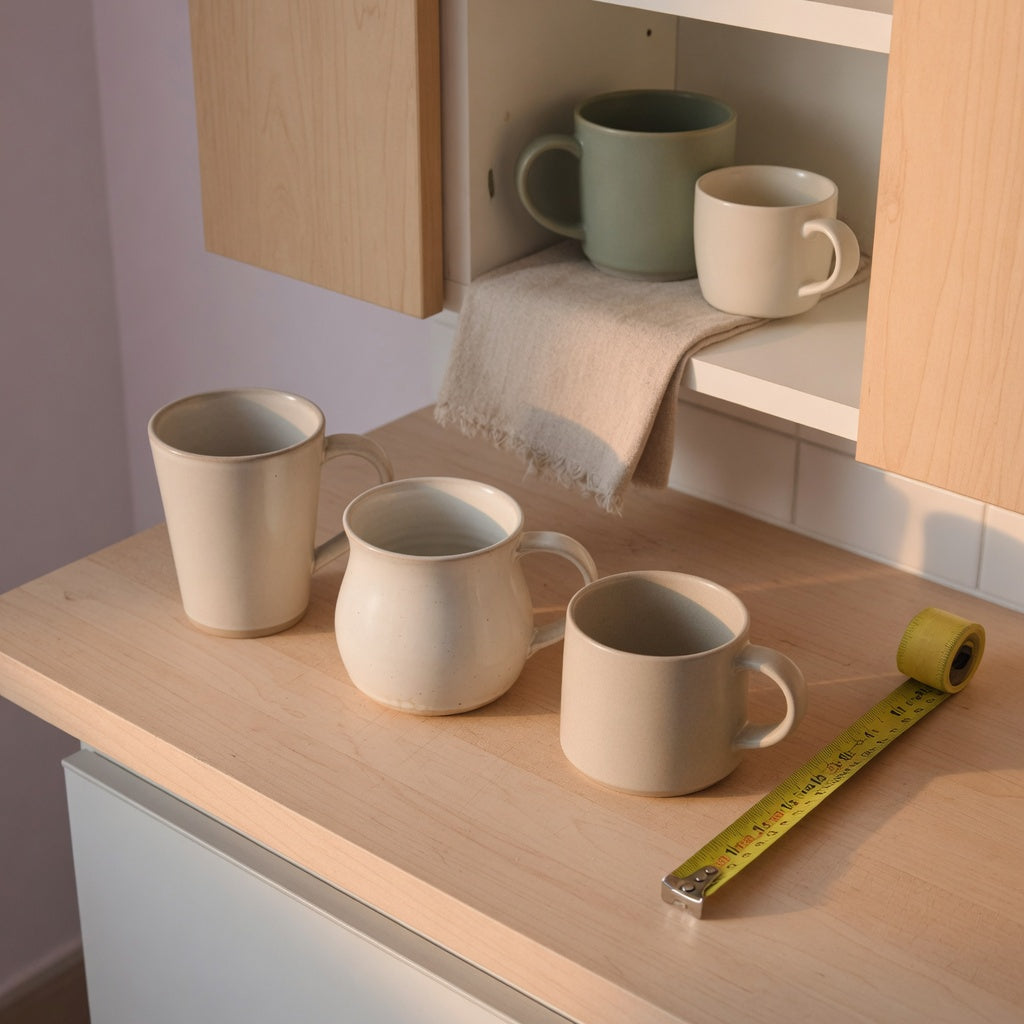
15 Oz Ceramic Coffee Mugs Compact Kitchen Product Shortlist Guide
Reading time: about 10 minutes
When a mug comes back to us, it is almost never about the coffee. It is the handle that clipped the cabinet door, or a body that sat a quarter inch too tall under the shelf above the counter. That is why this 15 oz ceramic coffee mugs compact kitchen product shortlist guide starts with a tape measure rather than a finish swatch: capacity is the number printed on the box, but clearance is the number that decides whether a mug gets used every morning or gets returned.
We pack and ship these mugs every week, and the questions we field before an order are remarkably consistent. Will it fit? Will it feel too heavy when it is full? Can it go in the dishwasher? So here is the short answer we give: three sizes, three kitchen situations, and a clear reason to skip each one.
What does a 15 oz label actually deliver once the mug is full?
Fifteen US fluid ounces is about 444 ml. That is brim capacity — the mug filled to the lip, which nobody drinks from.
Leave half an inch to an inch of headspace for cream, foam, or a spoon and you get roughly 12 to 13 oz of drinkable liquid. Still a big mug. Not the two full cups the label implies.
There is also no regulated definition of a 15 oz mug. FDA guidance describes ceramic cups and mugs as small hollowware normally around 240 ml (8 fl oz), usually with a handle. Fifteen ounces is a retail size class, not a standard, so two mugs sold at that size can differ by a meaningful margin — and one listing may quote brim volume while another quotes usable volume. Read the measured figure, not the lifestyle photo.
- 12 oz drip plus a splash of milk: comfortable at this size class.
- 16 oz iced coffee with ice: already too small — go bigger.
- Latte with a foam cap: workable, but tight once the foam settles.
Which three measurements rule a large mug out of a compact kitchen?
Take these before you shortlist anything. A tape measure costs less than return shipping, and it takes four minutes.
| Measure | Where to take it | What it rules out |
|---|---|---|
| Interior shelf gap | Underside of the shelf above, down to the shelf surface | Mugs you must tilt to remove — the tilted mug is the one that chips on a shelf edge |
| Handle projection | From the cabinet back wall to the widest point of the handle | Mugs that stop the door closing, or snag your knuckles when you reach past |
| Full weight | Empty mug weight plus about 444 g of liquid | Mugs that feel fine empty and awkward one-handed after the first few sips |
Then check shelf depth. A big mug parked at the front of a shallow shelf fouls the door swing; pushed back, it fouls the shelf above when you lift it out. If the gap over a mug is barely a finger's width, treat it as a counter mug and leave the cabinet for something shorter.
Building the 15 oz ceramic coffee mugs compact kitchen product shortlist guide around three sizes
None of our three core mugs is labelled exactly 15 oz, and that is deliberate. We publish millilitre capacity because that is the figure we can state exactly. Here is where each one earns a place on the shortlist — and where it stops being the right answer.
The Flow, 400 ml (~13.5 fl oz): for tight shelves and lighter lifting
This is the smallest of the three, and the one we suggest first when the shelf gap is marginal or the mug gets lifted one-handed most mornings.
- Choose it if your cabinet clearance is tight, your shelf is shallow, or you want a mug that still feels light when it is three-quarters full.
- Skip it if you routinely pour more than 13 oz, or you build milk-heavy lattes — you will be back at the kettle before the mug has cooled.
See The Flow coffee and tea mug and read the capacity line before you fall for a finish.
Morning and Night, 440 ml (~14.9 fl oz): the closest match to a 15 oz pour
At 440 ml this is 14.9 fl oz — inside the 15 oz size class by a rounding error. For most compact kitchens it is the everyday answer: large enough for a 12 oz brew plus cream, and still a mug you can lift with one hand while the kettle is in the other.
- Choose it if you want one mug covering black coffee, tea, and a modest latte without drifting into oversized territory.
- Skip it if a single mug has to carry a 16 oz iced drink, or if your shelf gap is genuinely marginal — drop to 400 ml rather than gambling.
Height and handle projection are product-specific, so compare the measurements on the Morning and Night mug listing against your own numbers. We publish capacity precisely; we cannot promise a fit we have not measured in your kitchen.
The Rock, 480 ml (~16.2 fl oz): the big-pour option, headroom permitting
480 ml works out to 16.2 fl oz, just over the class. It suits a 12 oz brew with a generous milk addition, or one large morning pour you would rather not refill. It is also the mug that punishes a low shelf hardest.
- Choose it if you have vertical clearance, you drink from a desk or sofa where a wider footprint helps, or you simply want the biggest single pour we make.
- Skip it if the mug lives on a low shelf, if it will be lifted by someone with grip or wrist limits, or if your cabinet doors are shallow.
See The Rock coffee and tea mug. If none of the three suits your shelf, browse the full unique coffee mugs collection and shortlist by capacity first, shape second.
Will a full 444 ml mug feel too heavy in one hand?
The liquid alone is about 444 g. Add the empty mug and you have a load plenty of people notice by the last third of the cup. Empty weights vary widely between mugs of identical capacity, and many listings omit them entirely — if the number is missing and you have grip or wrist concerns, ask before you buy.
Handle fit matters more than weight for a lot of buyers. Run the finger test on a mug you already own: your index finger should pass through the opening past the first knuckle without scraping. A narrow handle on a heavy body is the combination that ends up parked at the back of a cupboard.
- Smaller hands or arthritis: favour the 400 ml size and a generous handle opening over a thick-walled body.
- Standing at the counter: lighter wins — you are lifting one-handed and not looking.
- Desk or sofa: a wider foot is harder to knock over, and you pay for that stability on every lift.
One honest limit: ceramic is not insulated drinkware. If coffee needs to stay hot for two hours, a double-walled tumbler is the right tool and a ceramic mug is not.
Do 'lead free' and 'microwave safe' mean the same thing on a mug listing?
No, and the two get conflated constantly. A microwave-safe claim tells you the piece tolerates heating. It says nothing about glaze chemistry.
What the regulators actually set out: FDA guidance for ceramic cups and mugs uses a lead guideline of 0.5 micrograms per ml of leaching solution, judged on any one of six units, with test methods including ASTM C738 and AOAC 973.32 and 973.82. Cadmium guidance for small hollowware — anything under 1.1 litres, which covers every mug on this shortlist — is 0.5 micrograms per ml on the same basis. FDA also states that ceramicware containing extractable lead should not be labelled 'Lead Free'.
The California Department of Public Health adds a detail that matters specifically to coffee drinkers: lead cannot be seen in a glaze, coffee and tea are acidic and leach lead from a contaminated piece faster than non-acidic drinks, heat speeds the process, and repeated dishwashing can damage a glaze and make later leaching more likely. The same source notes lead is rarely found in plain white dishes — one quiet argument for a simple glaze over a heavily decorated one.
What to do with that in practice:
- Ask for finished-mug test results when a listing makes a strong lead claim; the wording alone is not the test.
- Read the care line item by item. Metallic trim and some printed decoration are commonly hand-wash only, and only the listing's own care instructions settle it for your specific mug.
- If a piece carries the FDA-required 'Not for Food Use' warning on the base, it is decorative — do not drink from it, however good it looks on an open shelf.
Where does a 15 oz mug actually live in a compact kitchen?
Mugs compete with plates for the same shelf, so storage belongs in the buying decision, not in the afterthought column.
- Nest handles inside handles rather than stacking body on rim — more mugs per shelf, less stress on rims.
- Cap stacks at two or three. Weight on the bottom mug is how rims chip.
- Hang the two mugs you use daily under the shelf above the counter and keep the cabinet for the rest.
- Put the tallest mug on the top shelf, where clearance is usually best.
In our experience, tapered bodies nest more predictably than straight-sided ones, and wide-bottomed mugs look stable on the counter while quietly eating shelf depth inside the cabinet.
The four-line checklist that closes out the shortlist
- Exact capacity in ml, not the rounded ounce figure.
- Height and handle projection, checked against your measured shelf gap.
- Care marks: microwave, dishwasher, or hand-wash only.
- Published leach testing, or a plain undecorated glaze you trust.
Four lines, four minutes, far fewer returns. If you would rather skip to a size, start with the unique coffee mugs collection and filter by capacity before you look at colour.
Frequently asked questions
Does a 15 oz mug actually hold 15 oz of coffee?
Only to the brim. Once you leave headspace for cream, foam, or stirring, expect roughly 12 to 13 oz of drinkable liquid. If you want a true 15 oz pour plus milk, buy into the 16 oz class — our 480 ml mug is 16.2 fl oz.
Is 440 ml close enough to 15 oz?
Yes. 440 ml converts to about 14.9 fl oz, which sits inside the 15 oz size class by a rounding error. It is the size we point most compact-kitchen buyers toward when they want one mug that covers drip coffee, tea, and a modest latte.
How do I check that 15 oz ceramic coffee mugs will fit my cabinet before I order?
Measure the interior shelf gap, the handle projection to the cabinet wall, and the shelf depth, then compare each against the measurements on the listing. Capacity alone will not decide it — a 400 ml and a 480 ml mug can share a footprint and differ in height. That is the whole method behind this 15 oz ceramic coffee mugs compact kitchen product shortlist guide: measure first, choose a finish last.
How much does a full 15 oz ceramic mug weigh?
The liquid alone is about 444 g at 15 fl oz. Add the empty mug, which varies with body thickness and is often missing from listings — ask for that number if you have grip or wrist concerns.
Are these mugs microwave and dishwasher safe?
It depends on the individual mug and finish, not the category. Check the care marks on the listing you are buying: metallic trim and some printed decoration are commonly hand-wash only, and a microwave-safe claim confirms nothing about lead or cadmium in the glaze. If clearance is your tightest constraint, start with The Flow at 400 ml; to weigh the range side by side, see the full collection.
More from our blog
Ready to pick your mug? Two ways to save on today's order:
Ordering 1–3 mugs? Get an extra 10% off your 1st order with code 10_OFF Apply 10% Off & Shop Wooden-Handle Mugs →
Gifting 4+ mugs? Buy 3, Get the 4th Free applies automatically at checkout (no code needed; offers do not stack) · Free standard shipping (Nov pre-Christmas delivery: 15–20 calendar days US) · Free replacement if chipped in transit.
Popular mug buying guides: Ceramic Tea Cups & Infuser Mugs · Ceramic Mugs with Lids Compared · Wooden-Handle Tea Infuser Mugs Compared · Christmas & Secret Santa Mugs 2026 · Espresso & Cortado Cups Guide · Cup & Saucer Gift Sets · All 25 Mugs Spec Table · Mug Size Guide · Shipping & Promo FAQ
FIRST ORDER 10% OFF (CODE: 10_OFF) · OR BUY 3, GET THE 4TH FREE


Read more
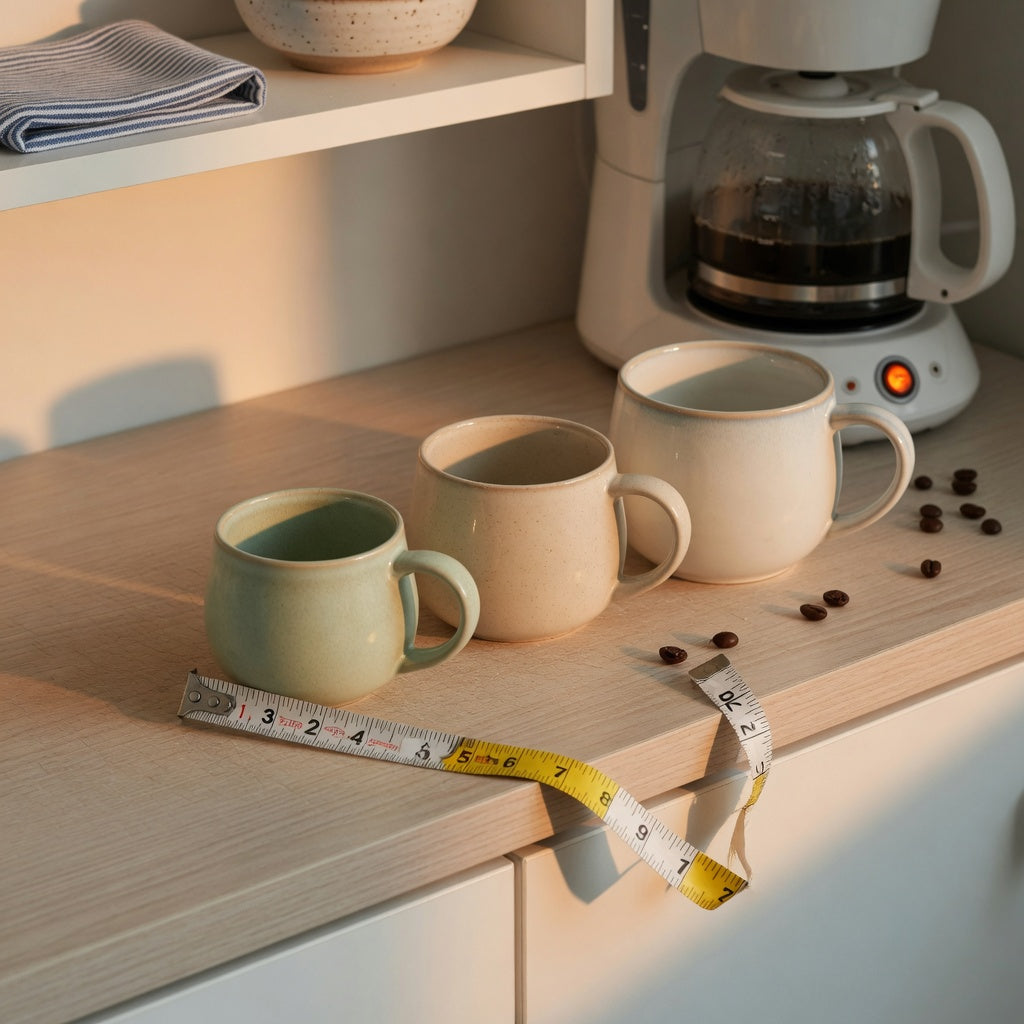
Large Round Coffee Mugs Compact Kitchen Product Shortlist Guide
A shortlist built around real constraints: how our 400, 440 and 480 ml round mugs fit shallow shelves, low spouts and one-handed grips — plus the fit checks and care details worth confirming before...
Read more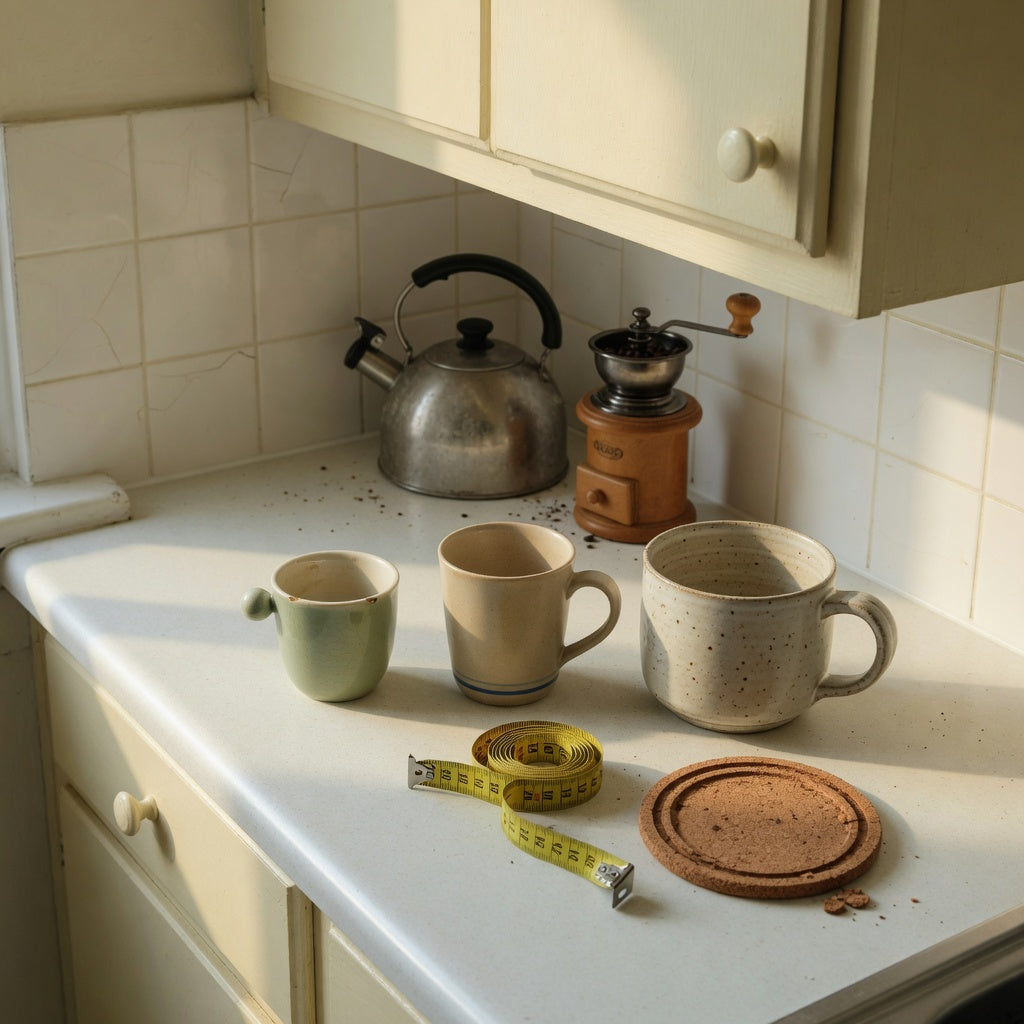
Wide Based Coffee Mugs Compact Kitchen Product Shortlist Guide
Three mugs, three listed capacities, and the tape-measure checks that decide which one survives a small kitchen. A scenario shortlist with explicit reasons to choose or skip each option.
Read more
Leave a comment
This site is protected by hCaptcha and the hCaptcha Privacy Policy and Terms of Service apply.