



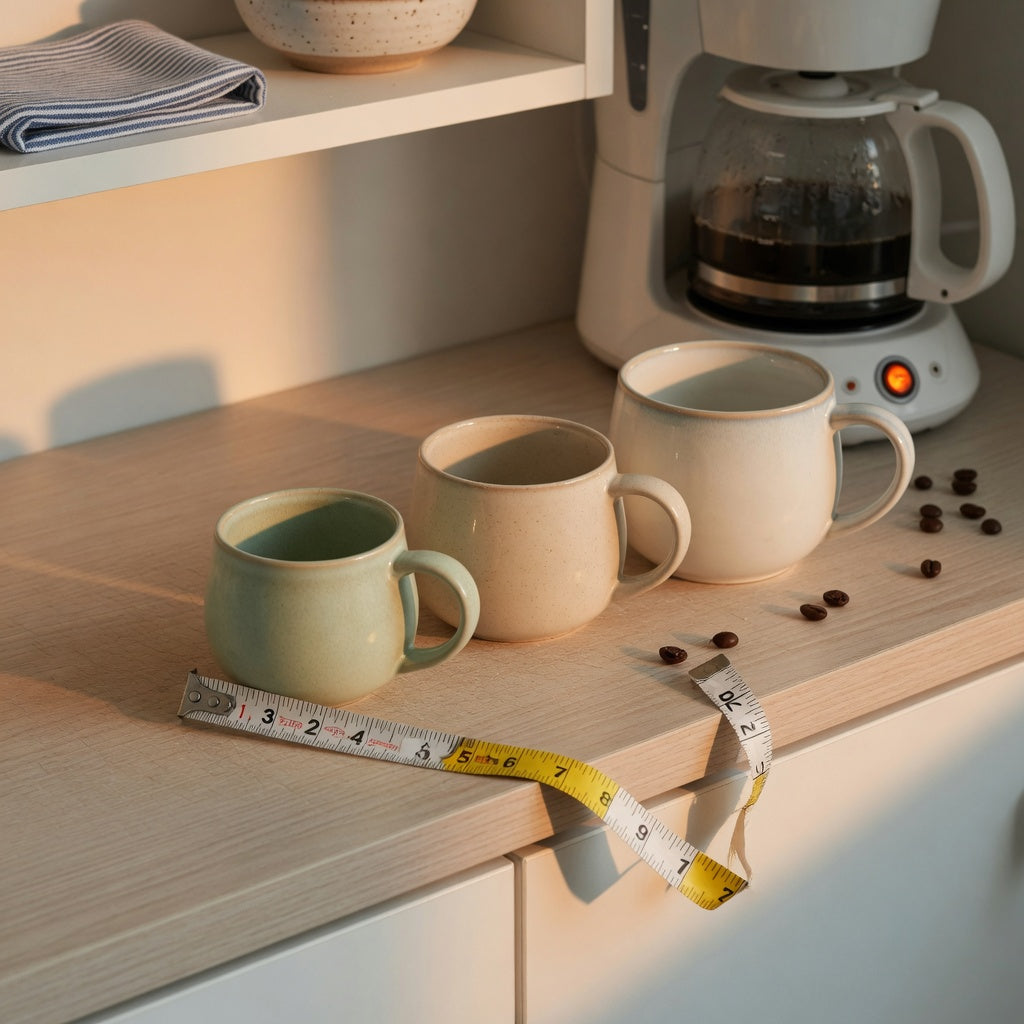
Large Round Coffee Mugs Compact Kitchen Product Shortlist Guide
Reading time: about 10 minutes
Four mugs sound harmless until you line them up on the one usable stretch of counter in a rental kitchen and the cabinet door stops closing over the tallest one. We handle these cups every week at CoffeifyMug, and the conversation that actually closes a sale is rarely about glaze color. It is about shelf clearance, spout height, and whether three fingers fit through the handle.
So we built this large round coffee mugs compact kitchen product shortlist guide around fit rather than finish. "Large" is a moving target anyway. Shoppers searching for oversized mugs often mean 20 to 24 fluid ounces. Our three round mugs are listed at 400 ml, 440 ml and 480 ml — about 13.5, 14.9 and 16.2 US fluid ounces at the brim. That is a genuinely big rounded cup, and it is not a 24-ounce diner mug. If you want a quart of coffee in a single fill, none of these is your mug, and we would rather say so on page one than after the return label prints.
What should you measure before you compare a single mug?
Skip the ounce math for five minutes and measure your kitchen instead. Three numbers eliminate most bad purchases before you ever open a product page.
- Shelf clearance. Height from the shelf surface to the shelf above, with a mug sitting flat on its base. Measure the highest point of the curve, not the rim — a rounded body rises in the middle.
- Spout-to-tray distance on a drip machine, or the recess depth on a single-serve brewer. Wide bodies fail here more often than tall ones: the shoulder of the mug meets the machine before the rim reaches the spout.
- Door swing and stacking. A mug that fits the shelf but stops the cabinet door from latching lives permanently on the counter, gathering crumbs and losing its handle to whatever gets set down beside it.
Put those three numbers in your phone before you shop. In our experience that is the difference between a mug that gets used twice a day and one that migrates behind the ramekins.
What do 400, 440 and 480 ml pour like in a real cup?
| Mug | Listed capacity | Approx. US fl oz (brim-full) | Silhouette |
|---|---|---|---|
| The Flow | 400 ml | ~13.5 | Rounded |
| Morning and Night | 440 ml | ~14.9 | Rounded |
| The Rock | 480 ml | ~16.2 | Rounded |
Two conversion details matter. NIST Handbook 44 lists one US fluid ounce as 29.57353 ml, so those ounce figures are arithmetic, not marketing rounding. And every printed capacity is a brim-full number: fill to the very edge and you get what the label says. Day to day you stop a finger's width below the rim, and that headroom is exactly what a latte or a splash of cream needs. Compare a 16-ounce mug against a 480 ml mug and you are comparing a practical fill line with a theoretical one — which is how shoppers end up disappointed by cups that looked bigger online.
Large round coffee mugs compact kitchen product shortlist guide: three kitchens, three picks
This is the shortlist we walk customers through at the counter. Each mug gets a situation, a reason to choose it, and an honest reason to skip it.
The Flow, 400 ml — for shallow shelves and milk-forward drinks
Choose it if: your upper cabinet clearance is tight, your drip machine sits low, or you drink cortados, flat whites and milky tea where a smaller body still leaves generous headspace. At 400 ml it is the easiest of the three to slide under a shelf and the least awkward to lift one-handed when full.
Skip it if: you pour 16 ounces of black coffee and expect to finish without a refill, or you want a mug that doubles as a soup bowl. A 400 ml rounded body drinks like a wide cup, not a basin.
See The Flow's 400 ml listing for the current finish options and the maker's care marks.
Morning and Night, 440 ml — the two-person default
Choose it if: two people share one kitchen and one brewer. 440 ml covers a full mug plus cream without becoming the biggest object on the shelf, and the rounded silhouette still reads as a coffee mug rather than a small bowl. When a household replaces a mismatched set of four, this is the size most of them settle on.
Skip it if: your cabinet is already at capacity and you own a 400 ml mug. Forty millilitres is not enough of a jump to earn the shelf space — move up to 480 ml or stay where you are.
Check the Morning and Night 440 ml mug before you commit to a pair.
The Rock, 480 ml — the long-session mug
Choose it if: the mug lives on a desk, a side table or the arm of a reading chair and one fill should last through a meeting or a chapter. It is also the one we point to when iced coffee is the usual drink, since the extra volume leaves room for a full tray of ice before the liquid goes in.
Skip it if: it has to fit under a low spout, live in a shallow drawer-style cabinet, or ride in a car cup holder. At 16.2 fl oz brim-full it is the least forgiving of the three in vertical space, and a wide base can overhang a small mug-warmer plate — check the base diameter against your warmer before you count on it staying hot.
View The Rock's 480 ml listing to compare it directly against the two smaller sizes.
If you want all three side by side in one view, browse the full unique coffee mugs collection and filter by the capacity that matches your measurement. Gift shoppers weighing decoration over fit can start with our guide to large unique coffee mugs for gifts instead.
Will a round body clear your brewer, or does the shoulder hit first?
Most problems in this category are fit problems, not quality problems. Machines are built around standard mug heights, never around wide round bodies.
- Drip machines: measure from the drip tray to the underside of the brew basket, then compare that to the mug height on its listing — not to a similar mug you already own.
- Single-serve brewers: many have a fixed platform with a shallow recess. A wide base can sit on the lip instead of inside it, tilting the mug and sending coffee over the front edge.
- Pour-over: a wide rim usually suits a cone dripper, but confirm the rim diameter against your dripper's base so it sits flat rather than perched on the curve.
- AeroPress: you need a stable rim and enough body mass to resist tipping while you press. A bellied mug on a slick counter is a two-hand job.
- Travel: none of these is a travel mug. If the cup has to survive a commute in a bag, buy a lidded vessel instead.
Is the handle still comfortable once the mug is actually full?
Handle openings are where large round mugs quietly fail. A rounded body bulges outward, so a handle that looks generous in a photo can pinch the back of your hand once gravity joins the conversation. Slide three fingers through before you commit. If the mug hangs off your fingertips instead of sitting in your palm, it will feel heavier than it is.
Then weigh it. Put your current mug on a kitchen scale, tare it, and add water. Water and brewed coffee are close enough in density that 400 ml weighs about 400 g and 480 ml about 480 g. Factor in a thick ceramic body and a full mug typically lands somewhere between 700 g and 850 g depending on wall thickness. That is fine on a desk and tiring on a staircase.
Finish with the tilt test, over the sink. A bellied, wide-mouthed body pours fast once it passes about 45 degrees, and the last third tends to arrive all at once. If you drink while reading or typing, a shorter, wider base is steadier than a tall one — the same trade-off we cover in our notes on selecting a mug you can actually set down safely.
Which care and food-contact details deserve a second look before checkout?
We keep this list deliberately short, because it is the list that generates the complaints.
- Material. Stoneware, porcelain, glass and enameled steel behave differently. Stoneware holds heat and carries weight; porcelain is lighter and thinner-walled; an enamel exterior gets hot to the touch and is not a microwave candidate.
- Microwave and dishwasher wording. Read the maker's own sentence. Metallic rims, gold luster and hand-painted accents are usually the reason a mug is hand-wash only or microwave-unsafe — never assume because the body looks like plain ceramic.
- Thermal shock. Do not plunge a hot mug into cold water, and do not pour boiling liquid into a mug straight from a cold cabinet. Warm it with tap water first; the glaze and the body expand at different rates and crazing starts at the rim.
- Base flatness. A recessed foot or a pronounced ridge holds the base off a mug warmer's plate, so heat crosses an air gap instead of the ceramic.
On glazes, "lead free" on a listing is not proof on its own. FDA sets an action level of 0.5 µg/mL for lead leaching from ceramicware cups and mugs under CPG 545.450, applied to any one of six units tested, and a cadmium action level of 0.5 µg/mL for small hollowware such as mugs under CPG 545.400 — 0.25 µg/mL applies to large hollowware. The agency has also reported imported pottery labelled "Lead Free" that still released extractable lead above those levels, and decorative-only ware that appears food-safe carries separate labelling rules under 21 CFR 109.16. Practically: ask which test the maker names, be warier of bright red, orange and yellow glazes and heavily decorated interiors, and retire any mug whose glaze is cracked, chipped or crazed. At 400 to 480 ml these mugs sit well below the size where a vessel would be judged as large hollowware, so the stricter cup-and-mug limits are the ones that apply.
What should sit next to you on the counter when you order?
- Shelf clearance, measured at the highest point of the curve.
- Spout-to-tray distance on your brewer.
- Mug height and rim diameter confirmed on the live listing, not on a similar product.
- Three fingers through the handle, first empty and then filled with water.
- Microwave and dishwasher wording read word for word.
- Base diameter checked against your mug warmer, if you use one.
If your measurements point to 400 ml or 440 ml, start with The Flow and Morning and Night; if the mug is desk-bound and rarely sees a cabinet, The Rock earns its footprint. Either way, keep the collection page open while you measure — the unique coffee mugs collection lists all three together so you can compare capacities without losing your place.
Frequently asked questions
Is a 400 ml mug big enough to count as a large round coffee mug?
For a rounded, bowl-ish body, yes — 400 ml is roughly 13.5 US fluid ounces at the brim, well above a standard 8-ounce cup. It is not a 20-ounce mug, though, so if your benchmark is a diner mug, size up to the 480 ml The Rock instead.
Will a wide round mug keep coffee hot as long as a tall one?
A wide open mouth exposes more surface area, so the top of the drink loses heat faster even when the walls are thick. A full mug holds temperature better than a half-full one. If heat retention is your main concern, pre-warm the mug with hot tap water and drink from it rather than leaving it sitting on the desk.
Can I brew a pour-over or press an AeroPress straight into a wide round mug?
Usually, provided the dripper's base sits flat on the rim rather than balancing on the curve. Check the rim diameter on the listing against your dripper, and set the whole assembly on a stable surface before pouring — a rounded body tips more readily than a straight cylinder.
How do I use a large round coffee mugs compact kitchen product shortlist guide when I only have one shelf?
Cut by height first, then capacity. Measure the shelf gap, eliminate anything taller than it, then choose 400 ml for milk drinks, 440 ml for a two-person household, or 480 ml for desk and iced use. Space sorts the list faster than ounce counts do.
Are these mugs dishwasher safe and microwave safe?
That depends on the exact finish and the maker's marks, so check the current product page for the specific mug rather than assuming across the range. Metallic rims and gold luster are the usual reasons a mug is not microwave-safe, and hand-painted accents often mean hand-wash only.
More from our blog
Ready to pick your mug? Two ways to save on today's order:
Ordering 1–3 mugs? Get an extra 10% off your 1st order with code 10_OFF Apply 10% Off & Shop Wooden-Handle Mugs →
Gifting 4+ mugs? Buy 3, Get the 4th Free applies automatically at checkout (no code needed; offers do not stack) · Free standard shipping (Nov pre-Christmas delivery: 15–20 calendar days US) · Free replacement if chipped in transit.
Popular mug buying guides: Ceramic Tea Cups & Infuser Mugs · Ceramic Mugs with Lids Compared · Wooden-Handle Tea Infuser Mugs Compared · Christmas & Secret Santa Mugs 2026 · Espresso & Cortado Cups Guide · Cup & Saucer Gift Sets · All 25 Mugs Spec Table · Mug Size Guide · Shipping & Promo FAQ
FIRST ORDER 10% OFF (CODE: 10_OFF) · OR BUY 3, GET THE 4TH FREE


Read more
Coffee Mug Gifts Ideas Shared Household Practical Purchase Checklist
A mug turns into cupboard clutter when it ignores the drink, the shelf, and the sink routine. Here is how we filter capacity, handle fit, care claims, and glaze safety before a shared-household gif...
Read more
15 Oz Ceramic Coffee Mugs Compact Kitchen Product Shortlist Guide
A tape-measure-first shortlist: what 15 oz really pours once you leave headspace, the three measurements that rule a mug out of a small kitchen, and which of our three sizes to pick or skip.
Read more
Leave a comment
This site is protected by hCaptcha and the hCaptcha Privacy Policy and Terms of Service apply.