



Wide Based Coffee Mugs Compact Kitchen Product Shortlist Guide
Reading time: about 10 minutes
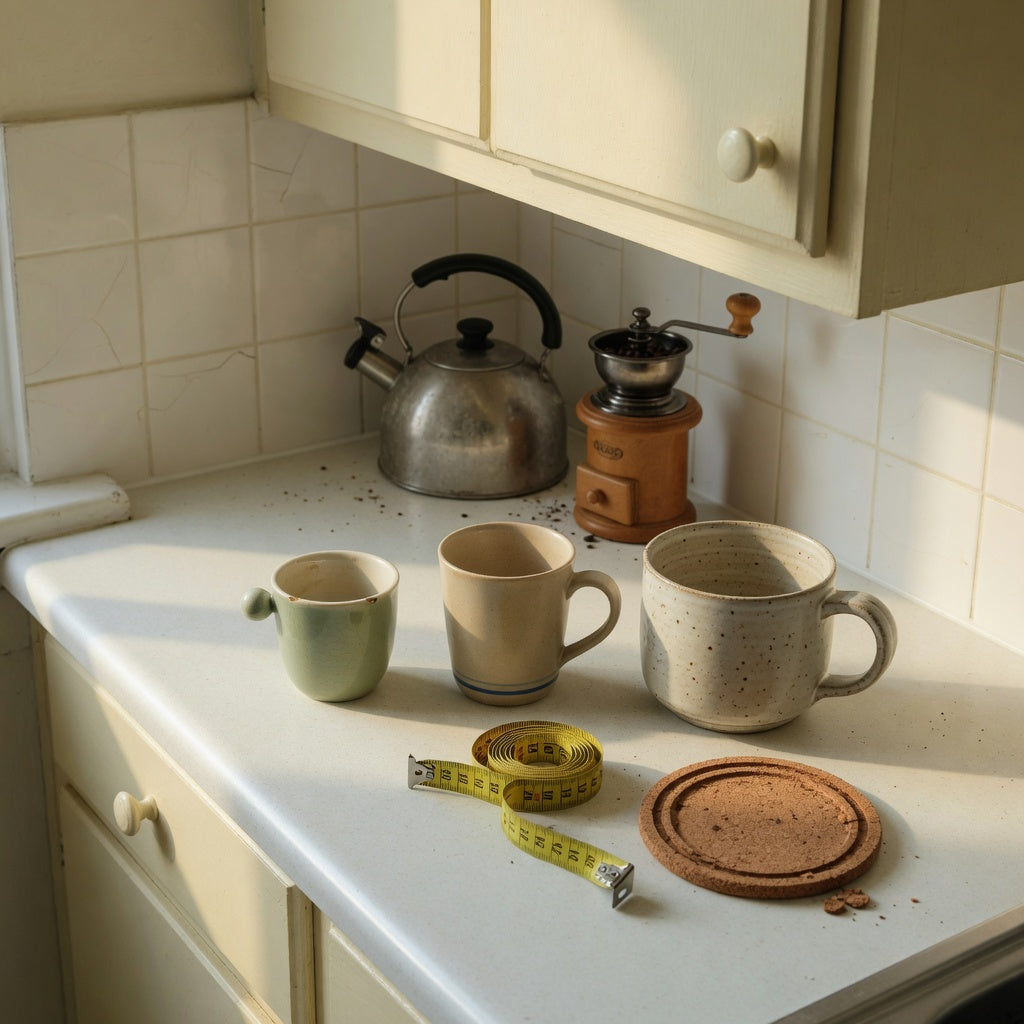
A 40 cm stretch of counter, a kettle, a hand grinder, and one upper cabinet whose door sweeps through the only clear space. That is the setup most compact-kitchen shoppers describe to us, and it is why a mug that photographs well can fail on the first morning. The base overhangs the coaster. The handle clips the cabinet door. The body sits too tall under the drip spout.
So this wide based coffee mugs compact kitchen product shortlist guide stays deliberately narrow: three mugs from our store, three listed capacities — 250 ml, 400 ml and 480 ml — and one plain reason to choose or skip each of them before you hand over counter space you do not have. We would rather sell you the right one of the three, or none of them, than ship a shape that fights your kitchen every morning.
Does a wider base actually keep a mug upright?
Yes and no. A wider base of support and a lower center of gravity make an object harder to tip — that is ordinary physics, not a product promise. What physics does not hand you is a guarantee, because tipping also depends on height, how full the mug is, where the handle sits, and whether the foot is flat enough to sit without rocking.
Three things trip shoppers up before they even start comparing products:
- "Wide base" has no agreed minimum diameter. The phrase tells you nothing comparable across listings, so measure the actual foot rather than trusting the words.
- Base width and mouth width are separate measurements. A mug can have a broad foot with a narrow rim, or a wide opening perched on a small foot. Aroma and cooling follow the opening; coaster and shelf fit follow the foot.
- A wide foot is not a non-slip foot. More ceramic on the counter does nothing to stop a mug sliding when you shove it. We do not describe our mugs as non-slip, and any listing that does should explain the method — a silicone ring, a weighted insert, a rubberized pad — before you believe it.
There is also no public benchmark for "tip-proof." We could not find a government or university test that measures the tip angle of commercial coffee mugs against base diameter, height and fill level, so treat the phrase as marketing copy and buy on measurements instead.
The wide based coffee mugs compact kitchen product shortlist guide starts at the tape measure
Four numbers eliminate most bad fits before you spend anything:
- Base against your coaster. Measure the widest point of the mug's base, then the usable face of your coaster. A base that overhangs a cork coaster rocks on the soft surface — a small annoyance that repeats every single morning.
- Shelf height plus door swing. Measure clear shelf height, then the horizontal gap from where the mug sits to the cabinet wall and the hinge side. A mug can clear the shelf and still foul the door on a handle.
- Brewer clearance. Drip tray to spout, or tray to filter basket. With an AeroPress or a pour-over dripper, check that the dripper base rests on the rim instead of dropping into a wide opening.
- Cup holder, measured at the narrowest point. Vehicle wells taper inward, so the rim number is useless. Drop the tape to the bottom of the well.
Write those four numbers on a sticky note and shop against them. If you want to compare handle shapes and finishes first, browse our unique coffee mugs collection to narrow it to two or three silhouettes, then come back to the tape. Handle style decides a lot of purchases. It decides nothing about shelf fit.
Ball Handle 250 ml: the pick when shelf depth decides for you
Our Ball Handle coffee and tea mug is listed at 250 ml — the smallest capacity on this shortlist by a clear margin, which makes it the least demanding mug to store and the easiest one to justify when the counter is contested.
Choose it when:
- Your cabinet shelf is shallow and mugs end up stacked or pushed two deep.
- You drink small pours — a short morning coffee, a tea refill, a half cup before bed.
- Counter space is shared with a kettle and a grinder, and something has to give.
Skip it when:
- You want one mug to carry a full morning coffee. 250 ml empties fast.
- You are shopping for a commute. This is a counter and shelf mug, and lid performance is a question for the current listing, not something we will infer from a product photo.
- Four fingers around a handle matters more to you than capacity. Check the handle opening on the product page against your own grip before you commit.
Two things we will not claim on your behalf: that the handle shape is easier to hold, and that the base grips a counter. Look at the base photo on the current listing and judge the flat contact patch yourself — a foot that rocks on granite will rock in your cabinet too, and a mug that sits flat is the closest thing to stability you can actually see from a screen.
The Flow 400 ml: the desk-and-drip middle, if the footprint clears
The Flow coffee and tea mug is listed at 400 ml, the range most people finish in one sitting. That is why we point first-time buyers toward it when they want a single mug that serves both the counter and the desk.
Choose it when:
- You brew a drip carafe in the morning and want one refill before lunch.
- The mug lives on a shared desk beside a keyboard and mouse pad, where a settled footprint earns its space.
- You have already run the base against your coaster and it sits inside the rim without overhang.
Skip it when:
- Your shelf is genuinely tight. 400 ml of interior volume has to live somewhere, and that usually means a taller or broader body to shelve.
- You want it in the car. Cup holders are not one standard size, and a handled ceramic mug is a coin flip in a tapered well.
- You fill to the rim and walk. A full mug raises the center of gravity, and no base width cancels that out.
If your pour is closer to a 12 oz measuring cup than to the 400 ml line, size the mug to the volume first and the silhouette second. Capacity is the number you cannot change later.
The Rock 480 ml: capacity you pay for in counter space
The Rock coffee and tea mug is listed at 480 ml — the largest capacity here, and the mug to reach for when volume is the entire point.
Choose it when:
- The job is capacity: a long black coffee, a big tea, or a household that refuses to refill mid-morning.
- You have already checked shelf height, brewer clearance and coaster size, and the numbers leave room.
- The mug lives on a desk or counter rather than travelling between them.
Skip it when:
- Small hands or a weak grip are part of the picture. Empty weight and full weight both climb with capacity, and the full weight is the one you carry across a kitchen.
- Brewer clearance is tight. Put the tape from the drip tray to the spout rather than eyeballing it.
- You need a cup-holder mug or a boat-console mug. These are counter and desk mugs, and any lid's splash versus leak behaviour is listing-specific — we will not assume either.
Which care and glaze checks should knock a mug off your shortlist?
Shape gets a mug onto the list. What happens at the sink decides whether it stays there.
- Dishwasher and microwave. Treat both as listing-specific. Glaze chemistry, metallic trim and any lid can change the answer, so read the care copy on that mug's own product page instead of assuming the whole range behaves the same way.
- A recessed or concave foot. Common on wide-footed mugs, and a small daily nuisance: water pools in the ring after a cycle. Dry it upside down on a rack with clearance underneath rather than face-down on a towel.
- A rough or unglazed foot ring. Run a fingernail around the base of a new mug. A gritty ring can mark a wooden countertop or a laminate desk over months of small drags.
- Glaze safety on decorative ceramics. FDA guidance notes that some ceramic foodware can leach lead from the food-contact surface, and the action level for cups and mugs is 0.5 micrograms of lead per millilitre of leaching solution in any one of six units, using methods that include ASTM C738. The same guidance flags handmade, antique, damaged, or brightly orange-, red- and yellow-decorated pieces as higher concern, describes ordinary commercial factory tableware as much less likely to have the problem, and states that washing or boiling does not remove lead from pottery. Anything labelled "not for food use" should not be holding your coffee.
For the longer version of the shape question — foot versus rim, and why a stable base is not the same thing as a wide mouth — our ceramic wide bottom shape and fit guide works through it without repeating this shortlist.
Which mug for a tiny counter, a desk, a gift, or a commute?
| Reader situation | First look | Why it fits | Skip it if |
|---|---|---|---|
| Shallow shelf, contested counter | Ball Handle 250 ml | Smallest listed capacity here, so the least volume to store and the least counter claimed | You need a full morning coffee or a lid for travel |
| Desk plus drip coffee | The Flow 400 ml | Middle capacity that suits one refill before lunch and a settled desk footprint | Your cup holder tapers narrow or your shelf is genuinely tight |
| One big pour, no refills | The Rock 480 ml | Largest listed capacity on the shortlist | Small hands, low brewer clearance, or a shallow shelf |
| Gift for someone with a small kitchen | Unique coffee mugs collection | Handle shape and finish often decide a gift more than capacity does | The recipient wants a leak-resistant travel lid |
| Commute, boat console, dashboard | Not this shortlist by default | These are counter, desk and shelf mugs first | You need a dedicated travel mug with a verified lid |
Before checkout, open the product page and confirm three things: the listed capacity, the base and height dimensions, and the care instructions. If a number you need is missing, ask us. In our experience a two-line measurement question is faster than a return, and it is the difference between a mug that lives on your counter for years and one that ends up in the back of the cabinet.
Frequently asked questions
Are wide bottom coffee mugs actually harder to tip over?
A wider base of support can make a mug harder to tip, especially when the center of gravity stays low. It is not a guarantee. Height, fill level, weight distribution, handle position and whether the foot sits flat all change the outcome, so treat "tip-proof" as marketing language unless a listing shows test data.
What should I measure before buying wide based coffee mugs for a compact kitchen?
Four numbers: base diameter against your coaster, clear shelf height plus the gap to the cabinet hinge side, brewer clearance from drip tray to spout, and cup holder width at its narrowest point. Then confirm capacity and care on the individual product page, because those details vary by mug.
Does a wide base mean the mug holds more coffee?
No. Base width and interior capacity are separate measurements, and a broad foot can still sit under a modest interior. This shortlist runs on the listed capacities: 250 ml for the Ball Handle, 400 ml for The Flow and 480 ml for The Rock.
Will a 480 ml wide based mug fit under my coffee maker?
Not necessarily. Measure from the drip tray to the spout or filter basket, then compare that with the mug height on its product page. A wide base can also crowd a small drip tray or sit off-centre under a narrow spout, which matters more with espresso machines than with a open carafe-style brewer.
Can I put a wide based mug in the dishwasher or microwave?
Only if that specific listing says so. Suitability changes with glaze, trim and any lid, and a recessed foot can hold water after a cycle even when the mug itself is dishwasher-safe. Dry it upside down on a rack with airflow underneath.
Start with the mug you will actually reach for at 7 a.m., not the one with the best photos. Run the four measurements, then compare the full unique coffee mug collection against your sticky note — and if your shelf, coaster or spout leaves you a number you cannot resolve, send it to us before you order.
More from our blog
Ready to pick your mug? Two ways to save on today's order:
Ordering 1–3 mugs? Get an extra 10% off your 1st order with code 10_OFF Apply 10% Off & Shop Wooden-Handle Mugs →
Gifting 4+ mugs? Buy 3, Get the 4th Free applies automatically at checkout (no code needed; offers do not stack) · Free standard shipping (Nov pre-Christmas delivery: 15–20 calendar days US) · Free replacement if chipped in transit.
Popular mug buying guides: Ceramic Tea Cups & Infuser Mugs · Ceramic Mugs with Lids Compared · Wooden-Handle Tea Infuser Mugs Compared · Christmas & Secret Santa Mugs 2026 · Espresso & Cortado Cups Guide · Cup & Saucer Gift Sets · All 25 Mugs Spec Table · Mug Size Guide · Shipping & Promo FAQ
FIRST ORDER 10% OFF (CODE: 10_OFF) · OR BUY 3, GET THE 4TH FREE


Read more
15 Oz Ceramic Coffee Mugs Compact Kitchen Product Shortlist Guide
A tape-measure-first shortlist: what 15 oz really pours once you leave headspace, the three measurements that rule a mug out of a small kitchen, and which of our three sizes to pick or skip.
Read more
Coffee Mugs With Big Handles: Shared Household Purchase Checklist
A shared kitchen rarely needs four identical mugs. This checklist maps each drinker to a 250, 400, or 480 ml mug, then shows what to verify about handle clearance, filled weight, appliance fit, and...
Read more
Leave a comment
This site is protected by hCaptcha and the hCaptcha Privacy Policy and Terms of Service apply.