



14 Oz Ceramic Coffee Mugs Shared Household Product Shortlist Guide
Reading time: about 9 minutes
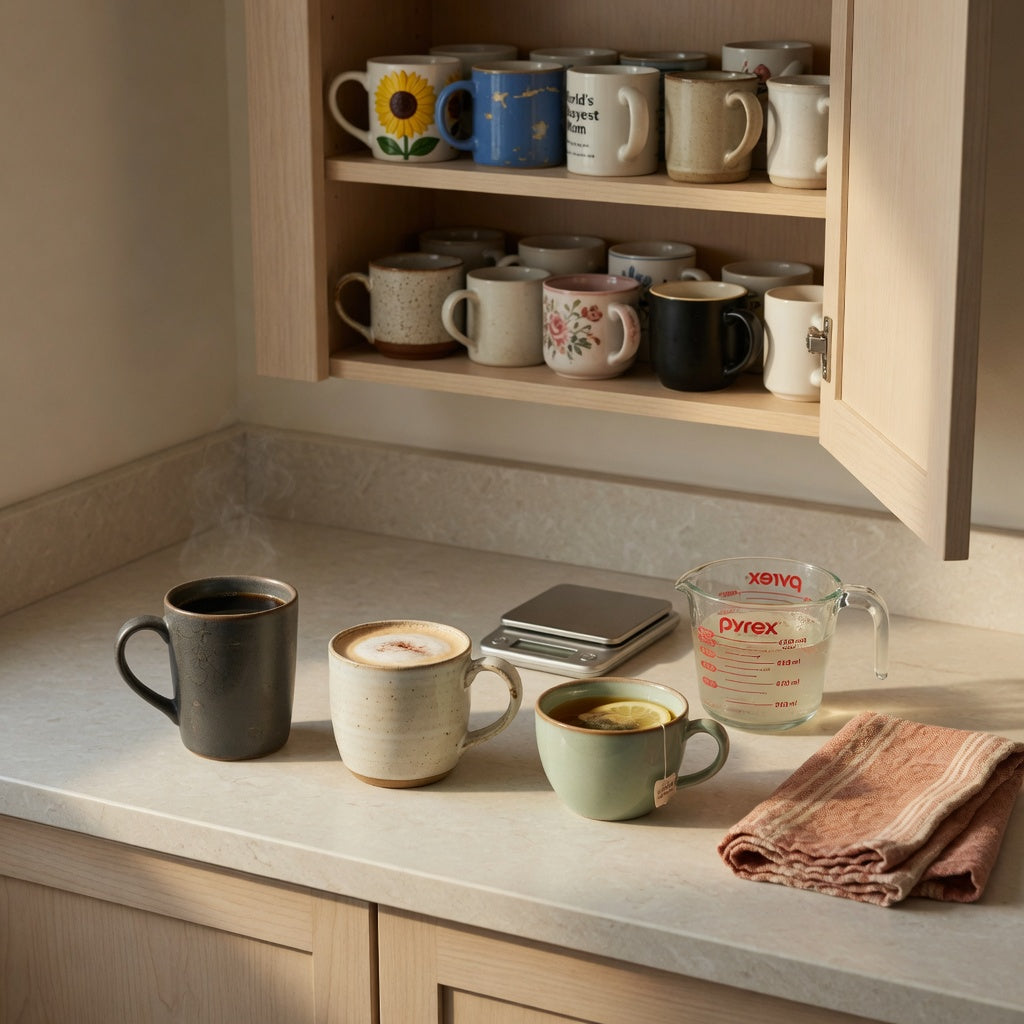
Four people share one cabinet: a 6 oz tea drinker, a latte drinker who needs foam room, a desk grazer, and the person who keeps a spare mug for guests. We build this 14 oz ceramic coffee mugs shared household product shortlist guide around those people, not around a bestseller list, because the number printed on the box rarely tells you who will reach for which mug at 7 a.m.
In our experience, the useful shortlist starts with the pour and the lift, then moves to care and glaze. Capacity is the headline. Fit is what prevents returns.
What does 14 oz actually mean once the mug is in a shared kitchen?
A U.S. fluid ounce is 29.57353 mL, so 14 fl oz is about 414 mL. FDA describes a typical cup or mug as roughly 240 mL (8 fl oz), which makes a 14 oz mug a genuinely large everyday cup rather than a café small.
Three numbers hide inside one listing:
- Brim capacity. Liquid to the lip, no headroom. Most product pages quote this.
- Working capacity. What you can carry across the kitchen without sloshing.
- Comfortable capacity. What one person can lift one-handed while the mug is full and hot. Handle opening and body weight decide this, and listings often omit both.
Stop arguing about ounces and start arguing about working capacity. A 414 mL mug filled to the brim is a different object from the same mug poured two fingers below the rim.
Which drinker profiles should you sort before you shortlist mugs?
Sort people first, mugs second. In our experience, four profiles cover most shared households:
- The 6–8 oz purist. Drinks drip coffee or tea quickly. A full 14 oz body is the wrong tool: wide surface, shallow depth, and the last third goes lukewarm. A smaller mug serves them better.
- The milk-heavy latte drinker. Espresso plus 8–10 oz of steamed milk often lands in the 12–14 oz window. They need foam headroom and a handle wide enough for a hot, full lift.
- The desk or sofa grazer. Sips for 45 minutes. Thermal mass and a narrower mouth matter more than raw capacity.
- The guest-and-spare keeper. Wants a mug that stacks, survives the dishwasher, and looks presentable when someone new arrives.
Write the names on a note. Every choice below should map to a name, not to a finish.
How we build the 14 oz ceramic coffee mugs shared household product shortlist guide
We list three everyday capacities. We publish them in millilitres first because that number stays honest across rim shapes. Treat each capacity as a ceiling and plan your working pour one notch below it. Confirm current weight, handle opening, and care marks on the product page; those details can vary by finish, and we would rather you check than assume.
The Flow 400 ml (~13.5 fl oz): for the drinker who wants a full cup, not a brimful one
The Flow 400 ml is the closest match to a standard 14 oz pour in practice. It suits the latte drinker who wants foam to reach the rim without a spill risk, and the tea drinker who fills once and finishes within the hour.
- Choose it if the drinker's working pour is about 11–12 oz and the mug should feel full, not half-empty.
- Skip it if someone routinely brews 16 oz in one go, or wants one mug to double as a large iced drink.
See The Flow coffee and tea mug and compare its exterior height with your brewer clearance before ordering.
Morning and Night 440 ml (~14.9 fl oz): the closest to a true 14 oz pour with headroom
At 440 ml, this mug reads as '14 oz' on paper but leaves room to carry it. It is our default suggestion for the milk-heavy drinker and for anyone who fills a mug and walks upstairs with it.
- Choose it if the drinker wants a true 14 oz serving with margin, or switches between coffee and a long tea steep in the same mug.
- Skip it if the drinker is the 6–8 oz purist above; the extra volume simply cools unused coffee.
See the Morning and Night coffee and tea mug for the current care line and finish options.
The Rock 480 ml (~16.2 fl oz): for the 16 oz drinker who keeps refilling a 14 oz mug
480 ml is 16 oz territory. That is a real household segment: the person who fills once at 6 a.m. and expects the mug to still be half full at 9. It also works for iced coffee, since ice displaces volume you would otherwise lose to headroom.
- Choose it if someone genuinely drinks 16 oz, or your cabinet shelf has vertical room to spare.
- Skip it if counter space is tight, the drinker has limited grip strength, or the mug must fit under a low brewer spout. A full 480 ml mug is a two-handed lift for plenty of people.
See The Rock coffee and tea mug, then compare it with the rest of the unique coffee mugs collection if you want to mix shapes across the shelf rather than repeat one.
Which care details belong to the mug, not the collection?
In a shared house, the dishwasher decides which mugs survive. Treat every care claim as belonging to that mug, not to the collection. A metallic handle, a gold or platinum rim band, or an overglaze decal applied on top of the glaze can remove microwave safety from one version of a shape while the plain version stays fine. Check the base stamp and the current listing for the exact finish you are buying.
Heat also matters for questionable glaze. The California Department of Public Health advises against microwaving or cooking in dishes that contain or might contain lead, because heat speeds leaching. The same guidance notes that repeated dishwashing can damage a glaze and make later leaching more likely. That applies to suspect ware, not to every ceramic mug, but it is a good reason to buy from a seller who can tell you what the glaze is.
What do 'lead free,' 'lead safe,' and 'food safe' actually promise?
This is where a shortlist earns its keep. FDA sets an action level of 0.5 micrograms of lead per millilitre of leaching solution for cups and mugs, judged on any one of six units tested, using recognised extraction methods such as ASTM C738. Cadmium has its own action level of 0.5 micrograms per millilitre for small hollowware. A 14 oz mug is far below FDA's 1.1 litre threshold for large hollowware, so it is judged under the stricter small-hollowware figures.
- 'Lead free' is not the same as 'tested.' FDA has documented imported traditional pottery labelled Lead Free that still released extractable lead above its action levels.
- Lead-free and lead-safe are different claims. California public health guidance describes lead-free ware as containing no lead, and lead-safe ware as possibly containing some lead while staying under Proposition 65 leaching limits.
- You cannot see it. Plain white glazes are rarely the concern; damaged or chalky glaze, decoration sitting on top of the glaze, and bright colour inside the cup are the patterns worth questioning. Coffee is acidic, which is exactly the kind of drink that encourages leaching from a weak glaze.
- Decorative ware is legally separate. Under 21 CFR 109.16, ceramicware that looks food-safe is treated as food-use unless it carries a 'Not for Food Use' warning or has a hole bored through the food-contact surface.
Ask the seller for a test statement or the standard their glaze is checked against. A shortlist that skips this question is only half a shortlist.
Which fit measurements cause most shared-household returns?
Nearly every 'I wish I had not bought it' email we get traces back to a measurement nobody published. Run these before checkout:
| Check | Why it changes the decision | How to test it |
|---|---|---|
| Exterior height | Determines brewer spout clearance and whether the mug clears the shelf above | Measure the gap under your brewer and the shelf spacing; compare with the listed height in mm |
| Handle opening | A narrow gap means knuckles against a hot wall when the mug is full | Compare the listed inner handle width with your grip; a wide handle on a heavy mug is not a luxury |
| Foot diameter | Stability on a saucer and whether it drops into a car cup holder | Check base diameter against your holder; handled mugs often fail this outright |
| Empty weight | Fine for one person, tiring for another | Compare the listed weight with who will lift it most often |
| Full weight | 414 mL of coffee adds roughly 414 g of liquid load | Add the liquid weight to the empty weight before you judge the handle |
| Stack height | Decides how many mugs fit on one shelf | Nested height per mug multiplied by the number of drinkers; tapered bodies stack, straight cylinders do not |
Weight is the variable people underestimate. If anyone in the house has wrist or grip issues, choose the smaller capacity or a wider handle rather than the largest body on the shelf.
Frequently asked questions
Is 14 oz the amount of coffee I actually get to drink?
Usually not the full amount. Most listings quote brim capacity, so a 14 fl oz mug (about 414 mL) typically pours less once you leave headroom for carrying and for a spoon. Treat the stated number as a ceiling, not a serving.
Do I need a 14 oz mug for every person in the house?
No. Size each mug to the drinker. A practical starting point is one mug per daily coffee drinker plus one spare for guests, but the 14 oz ceramic coffee mugs shared household product shortlist guide logic above only works if the 6 oz tea drinker gets a smaller mug instead of a big one nobody finishes.
Can a 14 oz ceramic mug go in the microwave and dishwasher?
Only if that specific mug is rated for it. A metal handle, metallic rim band, or overglaze decal can make one mug microwave-unsafe while the plain version of the same shape is fine. Check the base stamp and the care line for the exact product you are buying, not for the category.
What should I compare first in a 14 oz ceramic coffee mugs shared household product shortlist guide?
Start with the drinker's working pour, then the lift. A mug that is comfortable when empty can be awkward when full and hot. After that, check care marks and any lead or cadmium test statement for the exact finish.
Will a handled mug fit a car cup holder or under a brewer?
Cup holders are the more likely failure. Handles push the body off-centre, and many holders are sized for a tapered travel tumbler rather than straight-sided ceramic. Brewer clearance depends on exterior height, so measure the gap under the spout first and compare it with the listed height.
Before you add to cart, write down four things: who drinks from it, their working pour, the lift test with about 414 g of liquid added, and the care or glaze statement for that exact finish. Then start with the full CoffeifyMug collection, shortlist one mug per drinker by capacity, and let the finish be the last decision rather than the first.
More from our blog
Ready to pick your mug? Two ways to save on today's order:
Ordering 1–3 mugs? Get an extra 10% off your 1st order with code 10_OFF Apply 10% Off & Shop Wooden-Handle Mugs →
Gifting 4+ mugs? Buy 3, Get the 4th Free applies automatically at checkout (no code needed; offers do not stack) · Free standard shipping (Nov pre-Christmas delivery: 15–20 calendar days US) · Free replacement if chipped in transit.
Popular mug buying guides: Ceramic Tea Cups & Infuser Mugs · Ceramic Mugs with Lids Compared · Wooden-Handle Tea Infuser Mugs Compared · Christmas & Secret Santa Mugs 2026 · Espresso & Cortado Cups Guide · Cup & Saucer Gift Sets · All 25 Mugs Spec Table · Mug Size Guide · Shipping & Promo FAQ
FIRST ORDER 10% OFF (CODE: 10_OFF) · OR BUY 3, GET THE 4TH FREE


Read more
Unique Espresso Cups Weekend Coffee Practical Purchase Checklist
A weekend-focused checklist for choosing unique espresso cups by capacity, machine clearance, crema visibility, glaze safety, and care, with honest fit notes on our 170-250 ml ceramic cups.
Read more
Ceramic Mug Shapes Shared Household Product Shortlist Guide (3 Picks)
A scenario-based shortlist for houses sharing one mug cabinet: which ceramic shapes earn their shelf space for tea, everyday coffee and big pours — and the specific reasons to skip the ones that do...
Read more
Leave a comment
This site is protected by hCaptcha and the hCaptcha Privacy Policy and Terms of Service apply.