



14 oz Ceramic Coffee Mugs Morning Routine Product Shortlist Guide
Reading time: about 11 minutes
At 6:40 on a weekday, the mug you reach for has to do three things at once: hold enough coffee to get you to the door, stay steady in one hand, and not make you think about glaze chemistry before caffeine. In our store, the first question is rarely which mug is prettiest. It is whether the stated ounces are drinkable ounces or brim-full ounces—which is why this 14 oz ceramic coffee mugs morning routine product shortlist guide starts with volume and fit.
A U.S. fluid ounce is 29.57353 mL, so 14 U.S. fl oz is about 414 mL. The FDA describes a typical cup or mug in its ceramicware guidance as about 240 mL, or 8 fl oz. That does not make every 14 oz mug oversized. It means the label sits well above the small cafe cup most people picture, and the extra room changes how the mug feels when full.
Before the first pour: what this 14 oz ceramic coffee mugs morning routine product shortlist guide compares
Capacity has two meanings in listings. Brim capacity is the volume to the very top. Usable capacity is what you can pour without coffee touching the lip or sloshing onto your hand. If a mug is listed at 14 oz, ask whether that is brim-full or a comfortable fill. A 400 mL mug and a 440 mL mug can both get called 14 oz-ish in conversation, but they behave differently at 7 a.m.
In our store, we sort morning mugs by the pour first, then by the fit. Color comes last because a mug that does not fit your hand, shelf, or brewer becomes a cabinet ornament. That order keeps the shortlist practical.
What morning volume are you actually pouring?
Start with what lands in the cup, not with the mug. Most morning routines fall into one of four pours:
- 8 to 10 oz drip or Americano: A 14 oz mug can make a small pour look lonely and cool faster because there is more air above the coffee. A 12 oz mug often suits this better.
- 12 oz brew plus milk or foam: This is the sweet spot for a 14 oz-class mug, but only if the listed capacity leaves headroom. If 14 oz is brim-full, a 12 oz drink plus foam will crowd the rim.
- 14 to 16 oz latte, cold brew, or iced coffee: A true 14 oz mug is the minimum, not the target. Go up to a 16 oz-class body or accept a refill.
- Tea or smaller evening drinks: A wide 14 oz mug can be more bowl than cup. If you drink tea in 6 to 8 oz servings, a smaller mug will keep it hotter.
The size question is really a refill question. If you finish one 12 oz coffee and rarely go back, a 14 oz mug may be more capacity than you need. If you routinely pour 12 oz and add a splash, or you want one mug to cover coffee and a later tea, the larger size starts to earn its shelf space.
Which of our three capacities matches your morning?
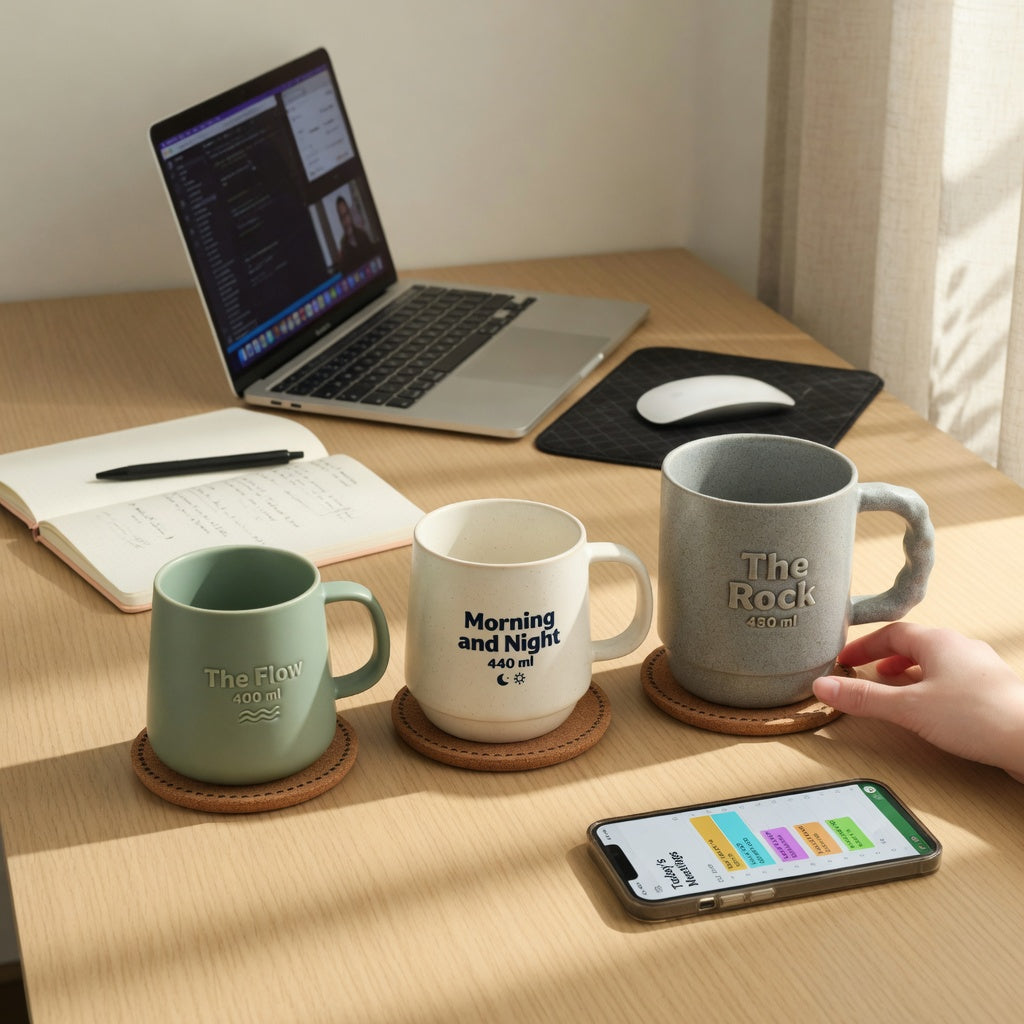
We stock three sizes that bracket the 14 oz question. Here is how we would sort them for a morning routine. The capacities below are the exact listed milliliters; the fluid-ounce figures are conversions.
| Mug | Stated capacity | Best morning job | Choose it if | Skip it if |
|---|---|---|---|---|
| The Flow | 400 ml (about 13.5 fl oz) | A compact one-cup pour | You drink 10 to 12 oz with a little room, or you want a smaller mug for tea. | You routinely pour a full 14 fl oz (about 414 ml) coffee; 400 ml leaves less headroom. |
| Morning and Night | 440 ml (about 14.9 fl oz) | The practical 14 oz-plus choice | Your usual pour is 12 to 14 oz and you want headroom for a splash or foam. | You want to stay under 14 fl oz exactly; 440 ml is slightly above. |
| The Rock | 480 ml (about 16.2 fl oz) | A larger mug for iced coffee, cold brew, or long tea | You routinely finish 16 oz or want one mug for desk refills. | You want a close match to 14 fl oz; 480 ml is a 16 oz-class body. |
The Flow at 400 ml is numerically closest to 414 mL, but it sits about 14 mL under a true 14 fl oz pour. Morning and Night at 440 ml gives roughly 26 mL above the 14 fl oz mark, which is the more practical choice if you want coffee plus foam headroom and can accept a little extra capacity. The Rock at 480 ml is not a 14 oz mug in disguise; it is a 16 oz-class mug for mornings when 14 oz would leave you pouring a second cup.
If you want to see the shapes and finishes side by side, browse our unique coffee mugs collection before you commit to a capacity. A mug that fits your hand and shelf is more useful than a spec sheet winner.
If you are still deciding between 12 and 14 oz, our 12 oz ceramic coffee mugs morning routine guide is the right comparison. The 14 oz size is for a bigger pour, not a default upgrade.
Where does a 14 oz mug stop feeling convenient?
Capacity gets the attention; handle clearance and weight decide whether you actually use the mug. A full 14 oz mug is heavier than the empty weight suggests, and the torque on a handle goes up when you pick it up one-handed. In our experience, buyers notice three fit problems after the first week:
- Handle opening: If your knuckles touch the hot wall when the mug is full, the handle is too tight regardless of capacity. Look for a handle opening that leaves room for a larger hand or a dish towel grip.
- Base diameter and cabinet height: A wide 14 oz mug may not fit under a single-serve brewer or on a crowded shelf. Measure the exterior height and width, not just the ounces.
- Car cup holders: Handled ceramic mugs are not designed around cup holders. If the mug is commuting with you, check the base diameter or plan to transfer the coffee.
Also check what the word ceramic is doing in the listing. A solid ceramic or stoneware body and a steel mug with a ceramic lining can both be called ceramic, but the weight, microwave rules, and care differ. If the material line does not say which one you are buying, ask before you add it to the cart.
For a deeper handle-fit check, our ceramic coffee mugs with large handles shortlist walks through knuckle clearance and grip. That matters more on a 14 oz mug than on a 10 oz cup because the full weight is higher.
What should you verify about glaze and food-contact safety?
You cannot judge lead risk by looking at a glaze. The California Department of Public Health says lead is rarely found in plain white dishes, while higher concern includes damaged or chalky glaze, decoration applied on top of the glaze, and bright color on the food-contact surface. Coffee is acidic, which increases the chance of leaching if a glaze is poorly formulated. That does not mean every ceramic mug leaches. It means the glaze and the test statement deserve a look.
For cups and mugs, the FDA uses an action level of 0.5 micrograms of lead per milliliter of leaching solution, judged on any one of six units, with testing methods such as ASTM C738. Cadmium has a separate action level of 0.5 micrograms per milliliter for small hollowware. Those are regulatory limits, not a brand certification. A listing that says food safe without a test statement is giving you less information than one that names the leach test and the limits it meets.
Also separate lead-free from lead-safe. CDPH describes lead-free tableware as containing no lead, while lead-safe tableware may contain some lead but does not leach above California Proposition 65 standards; above those levels, a warning may be required. The FDA has found imported traditional pottery labeled lead free that still released extractable lead above its action levels. That is why we treat a lead free phrase as a starting point, not proof.
Decorative ceramicware has its own rule. Under 21 CFR 109.16, ornamental ware that looks suitable for food is treated as food-use ware unless it carries a Not for Food Use warning or is physically disabled for food contact. A mug-shaped object with a decorative interior may not be a drinking mug. If the listing does not clearly call it drinkware, ask before you pour coffee into it. Look at the lip separately, too: decoration at the rim is not the same as a plain interior glaze.
Which care claims change with metal trim, decals, and crazing?
Microwave and dishwasher claims are often written for a collection, not for every finish. A gold handle, metallic rim, or overglaze decal can make one version of a 14 oz mug unsuitable for the microwave even when the plain body is rated safe. Check the care line for the exact color and trim you are buying.
- Microwave: Metal trim is the obvious exclusion. Overglaze decoration can also be a problem. If the listing does not say microwave safe for that finish, assume it is not.
- Dishwasher: Repeated cycles can dull overglaze decals and wear the lip. If the decoration sits where your mouth touches, hand washing is the safer habit.
- Crazing and chips: Fine cracks in the glaze, a chalky surface, or a chipped rim are reasons to retire the mug, especially if you do not know its lead status. CDPH warns that damaged glaze and repeated dishwashing can make later leaching more likely in ware that contains lead.
- Heat and acid: CDPH advises against microwaving or heating food or drink in dishes that contain or might contain lead because heat speeds leaching. Coffee is already acidic; adding microwave heat to a suspect mug is a bad combination.
If you are comparing porcelain and stoneware for weight and heat retention, our ceramic vs porcelain coffee mugs guide goes deeper. For a 14 oz morning mug, the practical difference is usually how heavy it feels when full and how quickly it cools, not a laboratory-grade claim.
How do you build a five-minute shortlist?
Use the mug you already own as a baseline. Then run this checklist before you compare colors:
- Measure your usual pour in milliliters. A 12 oz coffee is about 355 mL; 14 oz is about 414 mL.
- Decide whether you want the listed capacity to be brim-full or comfortable. If you add foam, choose a mug whose stated capacity is above your pour.
- Check the handle opening, empty weight, and full weight if published. If weight is missing, ask.
- Measure cabinet height, brewer clearance, and cup-holder base. A 14 oz mug that does not fit will become a shelf ornament.
- Confirm microwave and dishwasher status for the exact finish. Metal trim and decals are the usual exceptions.
- Ask for a lead and cadmium test statement if the glaze is bright, decorated, or imported. If the seller cannot provide one, choose a plainer interior.
Then pick the smallest capacity that covers your usual pour plus headroom. A 14 oz mug is useful when it matches your drink; it is annoying when it is a bucket for an 8 oz cup. In our experience, fit is the complaint we hear more often than color, so give the handle and shelf measurement the same attention as the ounce count.
Frequently asked questions
Is a 14 oz ceramic mug actually 14 oz of coffee?
Not always. The first check in this 14 oz ceramic coffee mugs morning routine product shortlist guide is whether 14 oz is brim capacity or a comfortable pour. 14 U.S. fl oz is about 414 mL, but many listings quote the volume to the rim. A drinkable fill usually leaves headroom for foam and prevents sloshing, so the usable amount can be lower.
Is 14 oz too big for drip coffee?
It depends on your pour. An 8 to 10 oz drip coffee can cool faster in a 14 oz mug because there is more air above the liquid. A 12 oz brew with a splash of milk is a better fit. If you routinely drink 14 oz or more, the larger mug makes sense.
Are 14 oz ceramic mugs microwave safe?
Only if the exact mug is marked microwave safe. Metal handles, metallic rims, and some overglaze decals can make a mug unsafe in the microwave even when a similar plain body is rated safe. Check the care line for the finish you are buying.
How can I tell whether a ceramic mug is lead-free?
You cannot tell by looking. Look for a leach test statement, not just a lead-free phrase. The FDA uses an action level of 0.5 micrograms per milliliter for cups and mugs, and California distinguishes lead-free from lead-safe tableware. If the seller cannot document the glaze, choose a plain interior or ask before buying.
Will a 14 oz mug fit under a single-serve brewer or in a car cup holder?
That is a measurement question, not a capacity question. Check exterior height and base diameter before buying. Handled ceramic mugs often do not fit car cup holders, and a tall 14 oz mug may not clear a brewer or cabinet shelf.
Before you add a mug to the cart, put your usual pour, handle clearance, and care line next to each other. If you want a 12 to 14 oz coffee with room for a splash, start with Morning and Night at 440 mL. If you want a compact one-cup mug, look at The Flow at 400 mL. If your mornings run to 16 oz iced coffee or a long tea, The Rock at 480 mL is the better fit. Compare all three in our unique coffee mugs collection and choose the capacity that matches the drink you actually finish.
Ready to pick your mug? Two ways to save on today's order:
Ordering 1–3 mugs? Get an extra 10% off your 1st order with code 10_OFF Apply 10% Off & Shop Wooden-Handle Mugs →
Gifting 4+ mugs? Buy 3, Get the 4th Free applies automatically at checkout (no code needed; offers do not stack) · Free standard shipping (Nov pre-Christmas delivery: 15–20 calendar days US) · Free replacement if chipped in transit.
Popular mug buying guides: Ceramic Tea Cups & Infuser Mugs · Ceramic Mugs with Lids Compared · Wooden-Handle Tea Infuser Mugs Compared · Christmas & Secret Santa Mugs 2026 · Espresso & Cortado Cups Guide · Cup & Saucer Gift Sets · All 25 Mugs Spec Table · Mug Size Guide · Shipping & Promo FAQ
FIRST ORDER 10% OFF (CODE: 10_OFF) · OR BUY 3, GET THE 4TH FREE


Read more
Big Latte Mug Home Office Product Shortlist Guide: 3 Desk Picks
A scenario-based shortlist for a big latte mug at a home-office desk: The Flow 400 ml, Morning and Night 440 ml, and The Rock 480 ml, each matched to a routine with a plain reason to choose or skip...
Read more
Ceramic Mug Shapes Home Office Product Shortlist Guide
A scenario-based shortlist for desk, meeting, and break routines: compare a 200 ml pleated cup, a 250 ml ball-handle mug, and a 400 ml mug by capacity, handle geometry, and explicit reasons to skip...
Read more
Leave a comment
This site is protected by hCaptcha and the hCaptcha Privacy Policy and Terms of Service apply.