



14 Oz Ceramic Coffee Mugs: Everyday Mug Rotation Purchase Checklist
Reading time: about 11 minutes
Somewhere in your kitchen there is a mug that never makes it back into rotation. Nothing is visibly wrong with it. It just does not pour the volume you want, or the handle pinches when the mug is full, or it sits a few millimeters too tall for the shelf you keep it on. Rebuilding a cabinet is mostly an exercise in not buying that mug twice — which is why the 14 oz ceramic coffee mugs everyday mug rotation practical purchase checklist below is the one we walk shoppers through in our store when they are replacing a whole shelf rather than adding one souvenir.
Here is the uncomfortable part: "14 oz ceramic coffee mugs" is not a standard. Two boxes with the same number printed on them can pour different amounts, be built from different bodies, and carry different care marks. So read the number the way a seller reads it, not the way the shelf label presents it.
What does 14 fl oz actually pour once you leave headroom?
A U.S. fluid ounce is 29.57353 ml, so 14 fl oz comes to roughly 414 ml. FDA's ceramicware guidance describes cups and mugs as small hollowware normally around 240 ml (8 fl oz), which puts a 14 oz mug close to double that reference size. It is still well under the 1.1 liter point where the agency's large-hollowware rules begin, so a mug this size is judged as a cup or mug, not a serving piece.
Now the part listings leave out. That 414 ml is almost always brim capacity. Fill to the lip and you cannot cross a kitchen without a wave going over the edge. Leave 15–25 ml of headroom for a normal pour and a "14 oz" mug delivers roughly 12 to 13 oz of coffee. That is a perfectly good mug. It is simply not the 14 oz you were mentally comparing against the cafe cup you buy on the way to work.
Two questions worth putting to any listing: is capacity measured to the rim or to a fill line, and if the mug has a lid, was it measured with the lid seated? A lid can quietly take back a meaningful share of the advertised ounces.
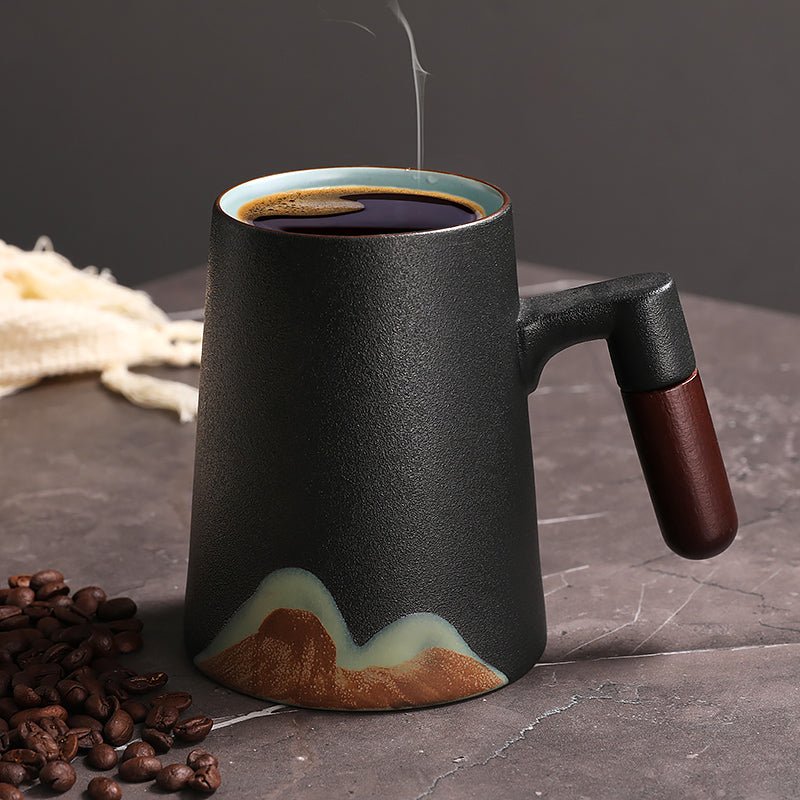
Our three bodies sit on both sides of that line. The Flow is 400 ml (about 13.5 fl oz), Morning and Night is 440 ml (about 14.9 fl oz), and The Rock is 480 ml (about 16.2 fl oz). You can see how the shapes sit next to each other in our unique coffee mugs collection.
Which everyday drink is 14 ounces actually sized for?
Capacity only means something against a specific pour. A mug that is too large for a small coffee is not generous — it is a heat sink with a handle, and your second half-cup goes lukewarm.
- 8–10 oz drip or tea. A 14 oz mug leaves a lot of empty wall and a wide liquid surface for heat to leave from. A smaller body usually drinks better.
- A 12 oz standard drip. This is where 14 oz earns its place: roughly 60 ml of headroom, enough to walk, sit, and sip without spilling.
- Milk-heavy latte or cappuccino. Milk volume pushes you up the range. If your usual build fills a 12 oz glass, a 440 ml mug is comfortable; if you build closer to 16 oz, you want the larger body.
- Iced coffee or cold brew. Ice displaces liquid, so a mug that holds 14 oz of coffee holds noticeably less once cubes go in. Size up rather than match.
If your real pour is closer to 11 oz and you like a dense, small mug in your hand, a smaller body is the honest answer. Forcing a 14 oz mug into a 9 oz job just means more to wash.
Porcelain, stoneware, double-wall ceramic, or ceramic-lined steel — which body is in the box?
These four get lumped together in search results and they behave very differently in a rotation. The body decides weight, how the mug feels when full, and whether it can go near a microwave.
| Type | What it changes in daily use | What to verify on the listing |
|---|---|---|
| Porcelain | Dense, typically thinner-walled and lighter for the same volume; the outside can feel hot sooner | Rim thickness and whether a thin wall suits how you hold it |
| Stoneware | Heavier, thicker-walled body with more mass to balance one-handed when full | Empty weight and handle opening size |
| Double-wall ceramic | Inner and outer wall with a gap; the outside stays cooler and iced drinks do not sweat | Usable interior volume — outer height overstates capacity |
| Ceramic-lined steel | A steel body with a ceramic interior coating, not a solid ceramic mug | Microwave mark, and whether the lining is described as a coating |
The solid-ceramic-versus-lining distinction matters more than most buyers expect. If the product page mentions stainless steel anywhere in the construction, assume the metal-body rule applies to microwaving until the listing says otherwise. Two other lines get skipped constantly: rim and lip decoration is a separate question from the interior glaze, and a matte interior shows coffee staining differently than a glossy one.
The 14 oz ceramic coffee mugs everyday mug rotation practical purchase checklist
Run every candidate through these eight lines before you order. In our experience, a mug that fails two or more is the one that ends up at the back of the cabinet by February.
- Stated capacity in milliliters, not just ounces. Convert before comparing: 400 ml is about 13.5 fl oz, 440 ml is about 14.9 fl oz, 480 ml is about 16.2 fl oz.
- Brim versus comfortable fill. Assume brim unless the listing states a fill line.
- Handle opening. The interior gap has to clear your knuckles when the mug is hot and full.
- Full weight. Empty weight plus roughly 414 g of coffee for a 14 fl oz pour.
- Exterior height and foot diameter. Cabinet shelf spacing, brewer clearance, cup holder, coaster.
- Glaze and food-contact documentation. A method and a limit, not just the words "food safe."
- Care marks per piece. Microwave, dishwasher, oven, freezer — as marked on the item you are actually buying.
- Stackability. Does the handle sit below the rim so two mugs nest and actually save shelf space?
Where does glaze safety sit on that list?
It is the line item most shopping content skips entirely, and the one with real regulatory numbers behind it. Worth knowing before you buy a set of four:
- Lead in cups and mugs. FDA sets an action level of 0.5 micrograms of lead per milliliter of leaching solution for cups and mugs, judged on any one of six units, using methods that include ASTM C738 and AOAC 973.32 / 973.82.
- Cadmium. FDA's action level is 0.5 micrograms per milliliter for small hollowware, and the agency states cadmium is not authorized as a color additive in foodware.
- Decorative ware. Under 21 CFR 109.16, ceramicware that looks suitable for food is treated as food use unless it carries a "Not for Food Use" warning or is physically disabled for food contact. Glazes and decorative decals can leach lead.
- "Lead free" versus "lead safe." California's Department of Public Health draws a clear line: lead-free tableware contains no lead, while lead-safe tableware may contain some but does not leach above Proposition 65 levels. Those are not interchangeable claims.
- A label is not a test. FDA has documented imported pottery labeled "Lead Free" that still released extractable lead above the action levels.
- You cannot see it. CDPH notes lead is rarely found in plain white dishes, while concern rises with damaged or chalky glaze, decoration sitting on top of the glaze, and bright color on the food-contact surface. Coffee is acidic, which increases the chance of leaching.
Two habits follow. First, treat microwaving and dishwashing as separate decisions, since CDPH advises against heating food or drink in dishes that contain or might contain lead and notes that repeated dishwashing can damage a glaze. Second, if a listing says only "food safe," ask which method and which limit the claim rests on. That question is fair to ask us, too.
Will a full mug clear your knuckles, your brewer, and your cabinet shelf?
This is where most returns start, and it is measurable in about five minutes at home:
- Handle clearance. Measure the widest interior gap of the handle. If your fingers touch the wall opposite, you will feel heat through the ceramic on a full mug. That is geometry, not a defect.
- Full weight. Weigh your current mug empty on a kitchen scale. A 414 ml pour weighs close to 414 g, so a 400 g stoneware body lands near 815 g when full — roughly 1.8 lb held in one hand.
- Vertical clearance. Exterior height plus the drip-tray gap on a single-serve brewer, and the shelf spacing in the cabinet where the mug will live.
- Horizontal clearance. Foot diameter against your cup holder, coaster, and the depth of the shelf.
If the handle is your recurring sticking point, measure the one mug you already like and keep that number. It is a better specification than any photo.
Why care marks belong to the piece, not the collection
A plain-glaze mug and a gold-handled mug in the same shape can carry completely different limits. Metal trim, metallic rims, and some overglaze decals remove microwave suitability from an otherwise identical ceramic body, and decorated exteriors are usually the first thing to fade across repeated dishwasher cycles.
Read the marks on the exact piece in your cart: microwave, dishwasher, oven and broiler, freezer. Ceramic and sudden temperature change are a poor pairing, so do not infer oven safety from a "stoneware" description, and do not pour boiling water into a mug pulled straight from a cold cabinet. When a decorated piece is ambiguous, hand wash it. Thirty seconds protects the finish you paid for.
Which of our three capacities fits which slot in the rotation?
Our bodies are spaced deliberately around the 414 ml mark so you can choose by pour instead of by guesswork.
- The Flow — 400 ml (about 13.5 fl oz). Just under a 14 fl oz pour. If your target really is 414 ml, this body cannot reach it even to the rim — and it is honest about the job: a 12–13 oz coffee or a generous tea, with a smaller footprint on the shelf.
- Morning and Night — 440 ml (about 14.9 fl oz). The one that clears a 14 fl oz pour with about 26 ml to spare at the brim, which after headroom lands back at a comfortable 12 to 13 oz drink. This is the middle-of-the-rotation size for most drinkers.
- The Rock — 480 ml (about 16.2 fl oz). Well above 14 oz. Best for milk-heavy lattes, long teas, and iced drinks where ice eats the volume before the first sip.
What these are not: a sealed commuter vessel. If you need a mug that survives a bag on a train, verify lid and gasket details on the listing rather than assuming — a handled ceramic mug generally is not that product. They are also the wrong pick if you want the thin, light feel of a porcelain teacup; these capacities suit people who drink slowly with the mug resting on a desk or table.
Two things still need confirming listing by listing rather than taken on faith: whether each stated capacity is brim or fill-line, and which care marks apply to each specific glaze and decoration.
Frequently asked questions
Is a 14 oz ceramic mug big enough for a latte?
Usually yes, with caveats. 14 fl oz is about 414 ml. If your usual latte build fills a 12 oz glass, a 440 ml mug leaves working headroom for foam. If you build closer to 16 oz of milk and espresso, step up to the 480 ml size instead of pouring to the very lip.
Can a ceramic mug with a gold handle go in the microwave?
Treat metal trim as a no. A gold or metallic handle, rim, or decal can make an otherwise microwave-safe ceramic body unsuitable. Check the mark on that exact piece, not on a sibling mug in the same collection or a plain-glaze version of the same shape.
Is the listed capacity measured to the brim or to a usable fill line?
Most often it is brim capacity, and most listings do not say so. Ask the seller directly, and if the mug has a lid, ask whether the measurement was taken with the lid seated — the lid can take back a meaningful share of the advertised ounces.
How much does a full 14 oz ceramic mug weigh?
Roughly the empty mug weight plus 414 g, since a 14 fl oz pour of coffee weighs close to 414 g. A 400 g stoneware body lands near 815 g full — about 1.8 lb in one hand. Weigh your current mug before committing to a heavier body.
What should I compare first when buying a set of four?
Capacity in milliliters, then handle clearance, then the care marks on the exact piece. Run the 14 oz ceramic coffee mugs everyday mug rotation practical purchase checklist above line by line before ordering, and compare the 400 ml, 440 ml, and 480 ml bodies side by side in the CoffeifyMug collection.
More from our blog
Ready to pick your mug? Two ways to save on today's order:
Ordering 1–3 mugs? Get an extra 10% off your 1st order with code 10_OFF Apply 10% Off & Shop Wooden-Handle Mugs →
Gifting 4+ mugs? Buy 3, Get the 4th Free applies automatically at checkout (no code needed; offers do not stack) · Free standard shipping (Nov pre-Christmas delivery: 15–20 calendar days US) · Free replacement if chipped in transit.
Popular mug buying guides: Ceramic Tea Cups & Infuser Mugs · Ceramic Mugs with Lids Compared · Wooden-Handle Tea Infuser Mugs Compared · Christmas & Secret Santa Mugs 2026 · Espresso & Cortado Cups Guide · Cup & Saucer Gift Sets · All 25 Mugs Spec Table · Mug Size Guide · Shipping & Promo FAQ
FIRST ORDER 10% OFF (CODE: 10_OFF) · OR BUY 3, GET THE 4TH FREE


Read more
Large Round Coffee Mugs First Time Buyer Product Shortlist Guide
A practical first-purchase shortlist for wide, rounded mugs: compare listed capacity, brewer clearance, handle space, filled weight, care claims, and food-contact details before choosing among thre...
Read more
Best Pair of Mugs for Remote Work: A Desk-Space Comparison
A practical, brand-side comparison of the best pair of mugs for remote work: heat loss, handle clearance, base footprint, lid reality, and care. Includes which CoffeifyMug listings to open first an...
Read more
Leave a comment
This site is protected by hCaptcha and the hCaptcha Privacy Policy and Terms of Service apply.