
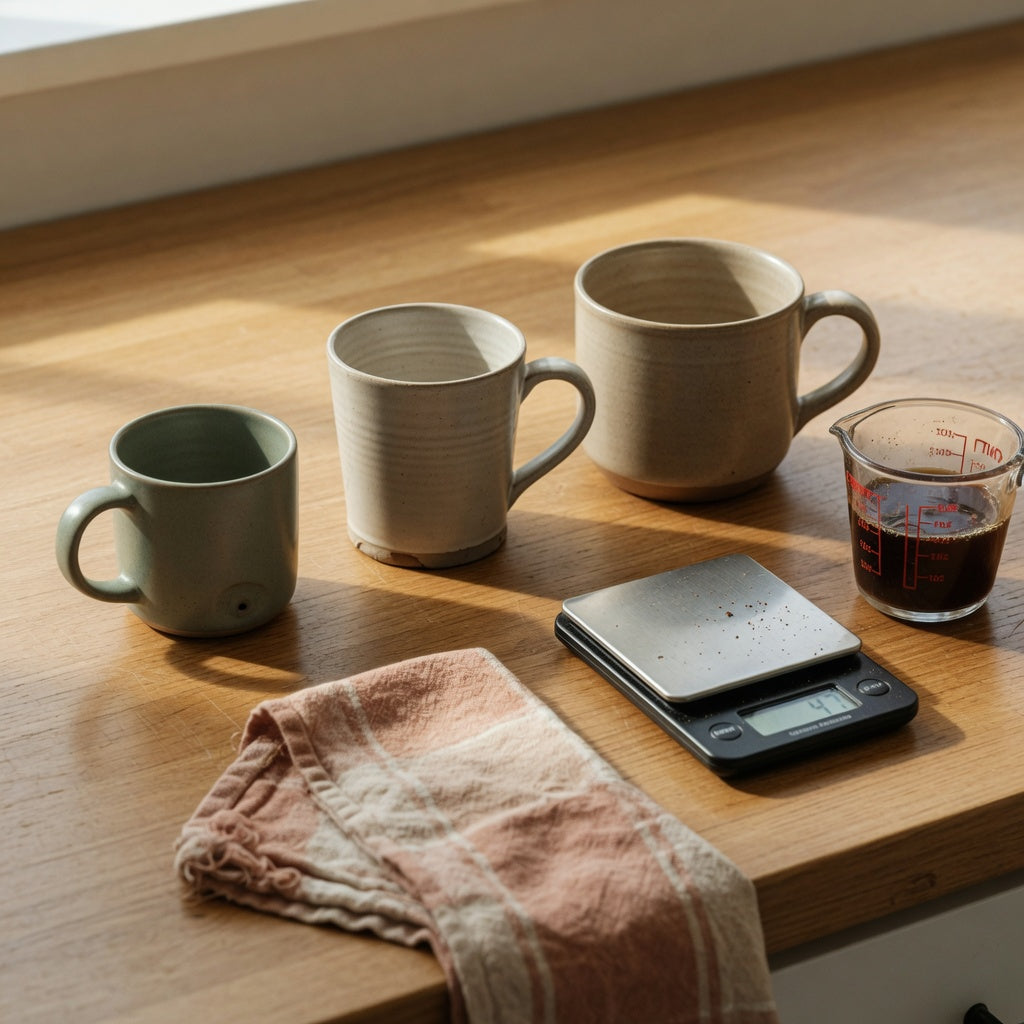
14 Oz Ceramic Coffee Mugs Everyday Mug Rotation Product Shortlist Guide
Reading time: about 10 minutes
Count the mugs you actually reached for this week. Most kitchens hold eight or ten and rotate three. The rest sit at the back of the shelf because they hold less than the label promised, the handle pinches your knuckles once the mug is full, or they foul the shelf above when you stack them.
We sell ceramic mugs and hear those three complaints constantly. That is why this 14 oz ceramic coffee mugs everyday mug rotation product shortlist guide is organized around rotation rather than ratings: which capacity earns a permanent spot, which mug covers which moment of your day, and when the honest answer is to skip a size instead of buying it.
What does a 14 oz ceramic mug actually hold once you pour?
Fourteen U.S. fluid ounces is about 414 mL — the U.S. fluid ounce is defined as 29.57353 mL. That is roughly 1.75 times the size the FDA uses when it describes cups and mugs, which the agency characterizes as small ceramic hollowware for hot drinks, normally but not exclusively around 240 mL (8 fl oz) and usually made with a handle.
Here is the part listings rarely explain. The number is often a brim measurement. Fill to the rim and you cannot carry it to the couch. A practical pour leaves half an inch to three-quarters of an inch of headroom, so a mug advertised at 14 fl oz may hand you 12 to 13 oz of drinkable coffee.
Four things move that number:
- Brim versus working fill. Ask which one the figure describes. If the listing never says, assume brim.
- Lid deductions. On a lidded mug, capacity may be measured with the lid seated, and the lid's underside displaces volume.
- Liquid weight. A full 14 fl oz pour adds roughly 400 grams — near a pound — before you count the mug itself.
- What you actually drink. A 10–12 oz drip coffee looks lost in a 16 oz body and sheds heat from a larger exposed surface. A milk-heavy latte is the opposite problem.
You cannot judge any of this from a product photo. The scale in an image tells you nothing reliable; only the stated number and a note about fill level do.
Which of our three ceramic mugs lands closest to 14 oz?
We do not stamp “14 oz” on any of them. Our three bodies are listed in milliliters, and here is how each converts against a 14 fl oz target.
| Mug | Stated capacity | In fluid ounces | Rotation slot | Skip it if |
|---|---|---|---|---|
| The Flow | 400 ml | ~13.5 fl oz | Morning drip or tea where you leave headroom anyway | You want a full 14 oz working fill — 400 ml sits just under it |
| Morning and Night | 440 ml | ~14.9 fl oz | Lattes and milk drinks that need foam room; closest to a 14 oz pour with margin | You drink a quick 8 oz cup or want the lowest possible cabinet profile |
| The Rock | 480 ml | ~16.2 fl oz | Desk sessions, iced coffee, long tea steeps | You drink small pours, or shelf space is tight |
Two honest notes. The ~13.5 and ~14.9 figures are arithmetic conversions of the stated metric capacity, not separate measurements we took. And whether each capacity describes brim or a comfortable fill is a question for the current product page, not something we will assert here. Material, handle shape, exterior dimensions, and care instructions should also be confirmed on the listing for that specific mug before you commit.
To compare silhouettes side by side beyond these three, the unique coffee mugs collection is the fastest place to start.
Scenario shortlist: 14 oz ceramic coffee mugs everyday mug rotation product shortlist guide
You are not hunting one perfect mug. You are assembling three or four that cover different moments without duplicating each other. Match the mug to the moment, then stop.
- The 6 a.m. drip drinker. You pour 10–12 oz, drink it standing up, and want it gone before it cools. Choose The Flow at 400 ml. Skip anything above 440 ml — a small pour in a wide body has more exposed surface and gives up heat faster.
- The latte household. Milk drinks need room to foam and stir without spilling over the rim. Choose Morning and Night at 440 ml. The roughly 0.9 fl oz above a strict 14 oz pour is headroom, not a bigger drink.
- The desk mug that never travels. Choose The Rock at 480 ml. Trade-off stated plainly: at this capacity a ceramic body is heavy when full and awkward to carry one-handed up stairs. Check the listed exterior dimensions and handle opening before assuming it fits a car cup holder — many handled ceramic mugs this size do not.
- Iced coffee and cold brew. Ice displaces volume, so a 14 oz iced drink needs a body rated well above 14 oz. The 480 ml figure is the one with room for both ice and liquid.
- Guest mugs and gifts. Match the capacity your household already reaches for instead of adding a fourth size to the shelf. Browse the full collection and pick the closest match.
Porcelain, stoneware, double-wall, or ceramic-lined steel — which earns counter space?
The phrase “ceramic coffee mug” covers several different builds, and they behave nothing alike in daily rotation. Our team handles all of them, and here is what actually separates them:
- Porcelain. Dense and usually thinner-walled, so a large capacity stays light in the hand. The trade-off is a body that feels more fragile and can ring sharply when set down hard.
- Stoneware. Thicker walls and more visual heft. Pleasant to hold, slower to warm your hands, but heavier once full — which matters most at 14 oz and above.
- Double-wall ceramic. An air gap between two ceramic layers insulates well, but it makes the mug bulkier than its capacity suggests, so cabinet fit gets tighter than the ounce rating implies.
- Ceramic-lined steel. A travel-mug construction with a ceramic interior coating. Great for commuting, but it is not the same product as a solid ceramic mug and usually cannot go in a microwave.
If heat retention across a whole morning is your priority, a solid ceramic mug is the wrong tool — an insulated vessel wins. For a mug that lives on a desk for 20 minutes, wall material matters far less than how much exposed surface the liquid touches.
Will the handle, height, and foot clear your cabinet, brewer, and hand?
Capacity gets the attention; fit knocks a mug out of rotation. Measure these at home before you shop, and expect to verify the rest on the listing:
- Handle opening. Slide two fingers through. If your knuckles touch the body, a full mug will be unpleasant to carry, and the wall gets hot as capacity rises.
- Exterior height, handle included. Handles often sit higher than the rim, which decides whether the mug slides under a shelf.
- Foot diameter versus shelf depth. Wide bases waste cabinet depth and rarely stack inside one another.
- Empty weight. Seldom published, and it is the number that decides one-handed carrying.
- Brewer clearance. Measure from the drip tray to the dispenser on a single-serve machine; tall bodies can foul it.
- Cup holders. Handled ceramic mugs generally do not fit car cup holders, so plan a separate travel vessel if the mug leaves the house.
Which care claims actually apply to the mug in your hand?
Never assume a ceramic body is microwave-safe just because ceramic is microwave-safe in principle. The trim decides it, and care instructions are written per mug, not per collection.
- Metallic handles, rims, and gold banding. Assume no microwave and no dishwasher unless the listing explicitly says otherwise for that piece.
- Overglaze decals and painted patterns. Repeated dishwasher cycles are the usual cause of fading and dulling; hand-washing protects the print.
- Oven and broiler. Rarely covered in a standard mug's care line. Do not improvise.
- Freezer. Thermal shock is a real failure mode when thick stoneware moves from hot to cold quickly.
- Staining and crazing. Coffee oils darken fine cracks in the glaze over time; a glossy interior glaze is easier to keep clean than a matte one.
California's health department adds useful context: for ware that contains or might contain lead, microwaving speeds leaching and dishwashing can damage the glaze. That warning is conditional on lead being present — it is not a verdict on ceramic generally.
Is “lead free” the same as food safe?
No, and the gap is where shoppers get burned.
- FDA compliance guidance sets an action level of 0.5 micrograms of lead per milliliter of leaching solution for cups and mugs, judged on any one of six units and tested with methods such as ASTM C738.
- For cadmium, the action level is 0.5 micrograms per milliliter for small hollowware.
- Under 21 CFR 109.16, decorative ceramicware that looks suitable for food is treated as foodware unless it carries a “Not for Food Use” warning or is physically disabled for food contact.
- California distinguishes lead-free (no lead present) from lead-safe (some lead may be present but leaching stays under Proposition 65 limits).
- You cannot tell by looking. Plain white glazes are rarely the concern; decoration sitting on top of the glaze, bright color on the food-contact surface, and chalky or damaged glaze are the higher-risk signals — and coffee is acidic, which encourages leaching.
FDA has also documented imported pottery labeled “Lead Free” that still released extractable lead above those action levels, so a two-word claim is not a test result. A small peer-reviewed pilot study of ceramic mugs measured lead in brewed coffee from 0.2 to 8.6 micrograms per liter, with one mug's estimated daily exposure above California's 0.5 microgram-per-day maximum allowable dose level even though estimated leaching stayed inside the FDA cup-and-mug limit. Ask the seller for a leach-test statement, not an adjective.
Frequently asked questions
Is 400 ml or 440 ml closer to 14 oz?
14 U.S. fl oz is about 414 mL, so 400 ml (~13.5 fl oz) sits just under it and 440 ml (~14.9 fl oz) sits just over. If you want headroom for milk or foam, 440 ml is the closer working match; if you want to stay under a strict 14 oz ceiling, 400 ml does that.
Is this 14 oz ceramic coffee mugs everyday mug rotation product shortlist guide useful if I only drink one cup a day?
Partly. With one cup a day, buy for fit and care rather than variety — measure handle clearance and cabinet height first, then pick a single size. A rotation really pays off at two or more drinks per day, when a smaller morning mug and a larger afternoon mug stop competing for the same slot.
Can I microwave or dishwash any ceramic mug?
Not automatically. Metal trim, gold banding, and some overglaze decals rule out the microwave, and dishwasher heat is what typically dulls printed decoration. Read the care line for that exact mug rather than the collection.
Will a 14 oz mug with a lid actually hold 14 oz?
Often not. Capacity on a lidded mug may be measured with the lid seated, and the lid's underside takes up volume. Expect the drinkable amount to land a little under the stated figure once you leave headroom.
Do thicker walls keep coffee hot longer?
Thickness helps a little, but exposed surface area matters more in our experience — which is why a small pour in a wide, tall mug can cool faster than the same pour in a compact one. Match capacity to pour size before shopping on wall thickness.
Before you buy, confirm five things on the listing: stated capacity in both ml and fl oz, whether that figure is brim or working fill, exterior height with the handle, the care line for that specific mug, and any food-contact or leach-test statement. Then pick the size that matches your biggest pour rather than the biggest mug on the shelf — and start with the unique coffee mugs collection if you want to compare shapes side by side.
More from our blog
Read more
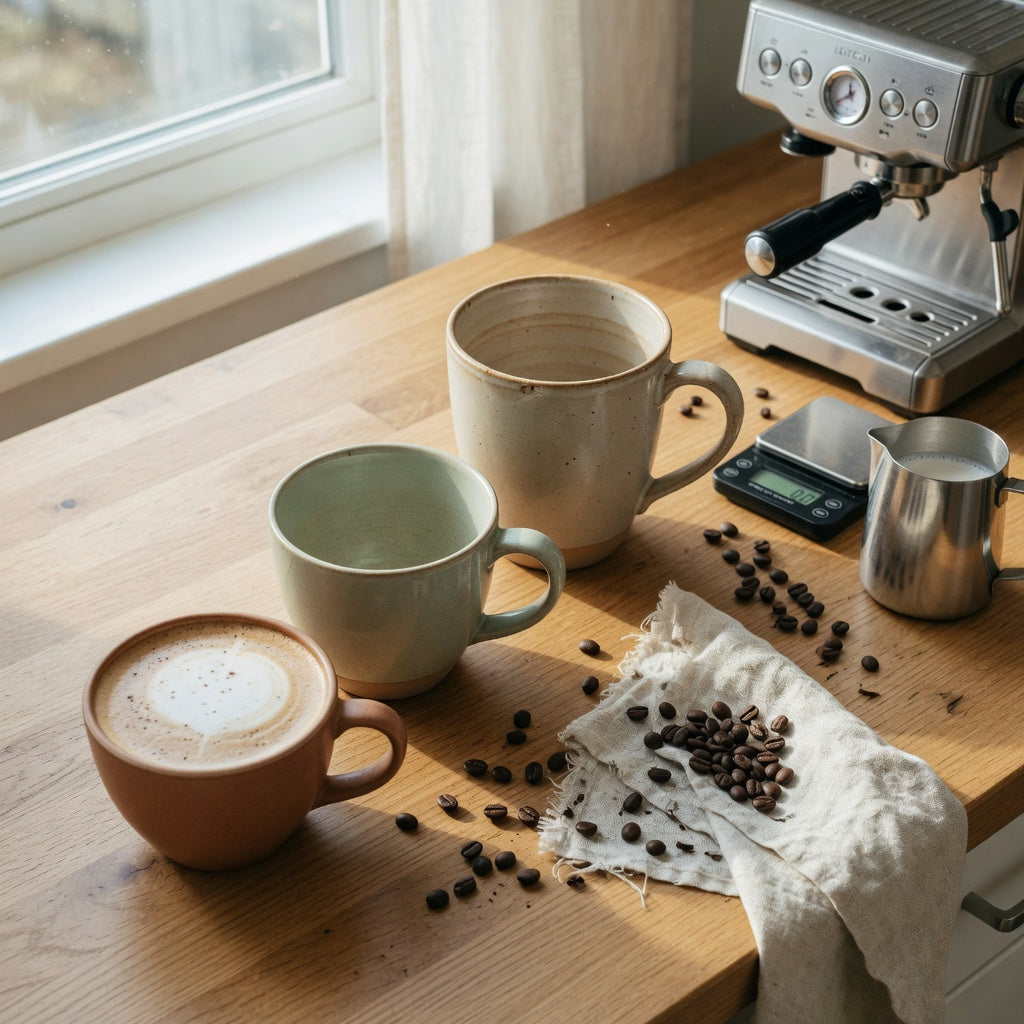
Big Latte Mug Current Product Facts: 400, 440, and 480 ml
A plain comparison of the three big latte mugs in our store — The Flow 400 ml, Morning and Night 440 ml, and The Rock 480 ml — covering what the listings actually confirm, which specs they leave bl...
Read more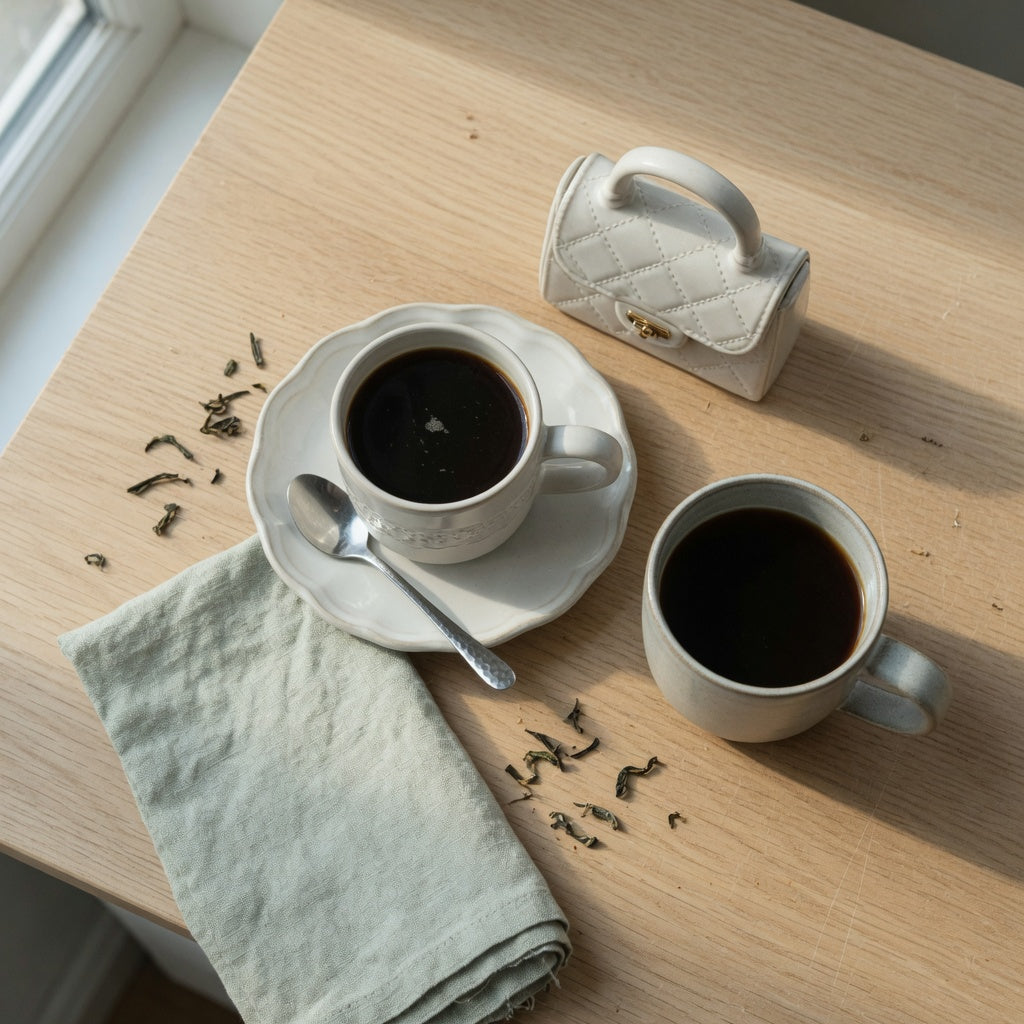
Handbag Tea Cup vs Coffee Mug Size: What Actually Fits
A purse-shaped cup and a kitchen mug can carry the same printed ounce number and still pour very differently. Here is how to compare usable fill, drink style, handle fit, and trim care before you buy.
Read more
Leave a comment
This site is protected by hCaptcha and the hCaptcha Privacy Policy and Terms of Service apply.