



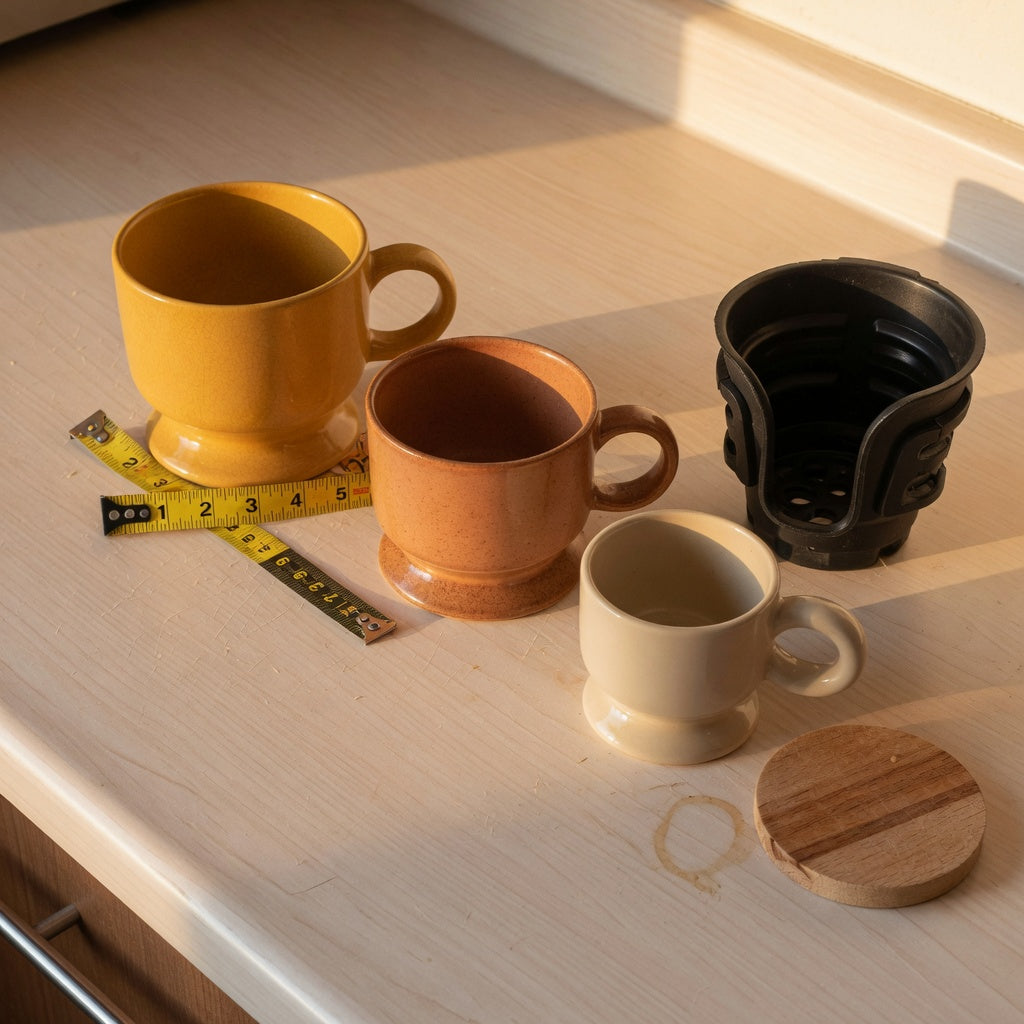
Wide Based Coffee Mugs Shape and Handle Guide: 250, 400, 480 ml
Reading time: about 10 minutes
A sleeve catching the handle is how mugs actually go over — not a slippery foot. In our store, most shoppers who search for a wide based mug can describe the exact moment it happened: a knock on a crowded desk, a hard stop in traffic, a swell on a boat console. They ask for "wide base" as shorthand, but the fix is usually three separate decisions. This wide based coffee mugs shape and handle guide takes them in order: the foot that meets the counter, the opening you drink from, and the handle your fingers have to wrap around.
Why does a broad foot still tip on a desk?
A wider base of support and a lower center of gravity both make a mug harder to push past its tipping edge. That part is settled physics. The complication is that a mug is never one fixed object — it changes as you fill it, and the moving parts (liquid level, handle weight, the hand on the handle) shift where the mass sits.
Two mugs with the same base diameter can behave very differently at breakfast. A tall mug filled to the rim carries most of its weight well above the counter, so a light bump near the top does more than the same bump against a squat cup. A handle that hangs low adds weight to one side; a handle set high can make the mug feel top-heavy before you pour anything into it.
"Tip-proof" appears on product pages and roundups, but we could not find a public benchmark that ranks commercial mugs by tip angle against base diameter, height, and fill level. So we don't print that word about ours. What you can compare from a live listing is narrower and far more useful: base diameter, overall height, listed capacity, and whether the foot is flush, recessed, or tapered.
Wide based coffee mugs shape and handle guide: which part of the mug decides fit?
Search results blur three shapes together, and each one solves a different problem.
- Wide foot, normal rim. The stability shape. A broad contact patch with a drinkable opening, often with less interior volume than the footprint suggests.
- Wide mouth, modest foot. The aroma and pouring shape. Good for pour-over, latte art, and faster cooling; not automatically more stable on the counter.
- Tall with large capacity. The volume play. More coffee per fill, a higher center of gravity when full, and typically the hardest of the three to slide under a brew head.
Before you look at glaze, measure four things:
- Coaster or desk spot: the widest point of the base, not the rim.
- Cup holder: the narrowest point of the holder, since most are tapered or have a handle slot that changes the usable width.
- Brewer clearance: drip tray to spout, or the space under a pour-over dripper or an AeroPress.
- Cabinet shelf: total height including the handle, not just the body.
Look at the base in the product photos. Flush feet sit flat on a coaster, recessed feet leave a ring that can hold water after washing, and tapered feet concentrate the contact patch into a smaller circle than the rim implies. If a listing has no straight-on shot of the base, ask for one — it is the single photo we get requested most. For the wider comparison on foot geometry, our ceramic wide bottom coffee mugs shape and fit guide covers the base profiles in more detail.
To compare silhouettes side by side, open our unique coffee mugs collection, then verify the footprint on the individual product page rather than from the grid image.
What do 250 ml, 400 ml, and 480 ml feel like over a morning?
The verified numbers across our current lineup are capacities, not base widths: Ball Handle at 250 ml, The Flow at 400 ml, and The Rock at 480 ml. A broad foot can sit under a modest interior, and a narrow one can hold more than you expect. Capacity and footprint are separate purchases, so buy them separately.
| Current option | Listed capacity | What to verify on the listing | Start here if |
|---|---|---|---|
| Ball Handle | 250 ml | Handle opening, finger clearance, base diameter | You want the smallest listed capacity for tea, a short coffee, or a gift |
| The Flow | 400 ml | Handle span, grip depth, base diameter, lid wording if included | You want an everyday middle capacity |
| The Rock | 480 ml | Handle opening and whether the base clears your coaster | You want the largest listed capacity |
The honest trade-off: 250 ml is roughly a flat white or a short tea. If your habit is a full 12 oz travel mug in one sitting, it is a refill mug, not a one-and-done mug. At the other end, 480 ml is the heaviest of the three when full, and you feel that most in the handle, not the base. Neither is a flaw — they just suit different mornings.
Which handle will your fingers actually fit through?
Handles are where wide base shopping fails most often. The foot gets all the attention and the handle gets none, yet grip is the thing you notice every single time you lift the mug. Hand size, finger length, whether you hook two fingers or four, and whether you hold the handle or cradle the body all change the answer.
The Ball Handle is the only option in the current lineup with a handle form named in the product title. That name tells you the shape, not the span. Check the clearance between handle and body on the listing and compare it with a mug already in your cupboard. The Flow and The Rock need to be read from their photos and listed dimensions rather than guessed from the name.
- Measure the handle opening at its narrowest point, not the outer curve.
- Decide how many fingers you want inside it while the mug is full.
- Note whether the handle sits high, centered, or low on the body — that changes the lift.
- Add clearance if you wear a hand brace, a thick glove, or have limited grip strength.
Here is the limitation we would say out loud in the store: a broad, low mug with a small handle can be stable on the desk and awkward in the hand. If grip is your priority, handle span outranks base diameter every time.
What a wide ceramic base can't tell you about heat, lids, and the dishwasher
Base width is not a heat-retention specification. Heat loss depends on the material, wall thickness, whether there is a lid, the starting temperature of the drink, and how much surface area is exposed. Retail roundups sometimes credit a wide ceramic base for keeping coffee warm; we found no standards-body test that isolates base width from those other variables. A lid generally matters more than a foot, and a pre-warmed mug matters more than either.
Lid wording deserves a close read. Splash-resistant is not leakproof. If the mug is going into a bag, a stroller caddy, or a car seat, look for the maker's own word on the lid and whether it seals or locks. If a listing only says "lid included," ask before you order.
Care is product-specific too. Ceramic bodies, glazes, metallic rims, and lids can carry different microwave and dishwasher guidance, so read the care section on the exact product page instead of assuming. A recessed foot is a cleaning detail, not a stability flaw: water can pool in the ring after a cycle, so dry it upside down where air reaches the base, or hand wash if the finish is delicate. A rough foot can also mark a wooden desk, and a glossy one can skate across a wet counter — neither problem is solved by choosing a bigger base.
Does the glaze matter for food safety?
More than shape does, when the piece is unverified. FDA guidance notes that some ceramic foodware can leach lead from the food-contact surface, and continued use of lead-leaching ware can cause adverse health effects, including chronic lead poisoning. For cups and mugs, the FDA action level is 0.5 micrograms of lead per milliliter of leaching solution in any one of six units, using methods that include ASTM C738.
That same guidance points to improperly fired traditional pottery glazes as a leaching risk and notes that washing, boiling, and other household steps do not remove lead from pottery. glazed, antique, damaged, and brightly orange-, red-, or yellow-decorated pieces are the higher-concern group, while ordinary commercial factory tableware is described as much less likely to have the problem. Anything labeled for decorative use only should stay out of the kitchen.
We don't treat a pretty glaze as proof of anything. If you are buying from a small studio, ask for the maker's food-contact statement. If you are buying from us, use the product page as the source and message us when a care or food-contact detail is missing — that is a better use of a minute than squinting at a photo caption.
Desk, dashboard, boat, or gift: which setting picks the mug?
- Desk: a flat foot, a handle that clears your hand, and a capacity you finish before it cools. The 250 ml Ball Handle suits short coffees and tea; the 400 ml Flow is the middle for a full working morning.
- Commute: holder measurement first, lid wording second. A wide mug can feel rock-solid on a desk and still not drop into a tapered holder.
- Boat or uneven surface: a wider base helps; a non-slip mat or a secured holder helps more. We don't call our mugs non-slip unless a listing says so.
- Gift: 400 ml or 480 ml reads as a daily-use size, but check the recipient's usual mug and hand size before choosing a handle style.
If you want the biggest pour in the current lineup, start with The Rock 480 ml. If you would rather compare all three shapes at once, browse the unique coffee mugs collection, then confirm base diameter, handle span, lid type, and care instructions on the page before checkout.
Frequently asked questions
Will a wide based coffee mug fit my car cup holder?
Not necessarily. Vehicle cup holders are not one standard size, and a broad base can be too wide even when the mug looks compact. Measure the holder at its narrowest point, compare that number with the base diameter on the product page, and ask us if the listing doesn't state one.
How do I compare wide based coffee mugs shape and handle before I order?
Start with three numbers: base diameter, handle opening at its narrowest point, and listed capacity. Then measure the coaster, the cup holder, and the space under your brewer. Those four measurements decide fit faster than any photo of the glaze.
Does a wider base mean the mug holds more coffee?
No. Base width and interior volume are separate measurements. In this lineup the verified comparison is capacity: Ball Handle 250 ml, The Flow 400 ml, and The Rock 480 ml. A broad foot can still hold a modest amount.
Can a wide based ceramic mug go in the dishwasher and microwave?
Check the care section on the exact product page, because ceramic bodies, glazes, metallic trims, and lids can carry different guidance. A recessed foot may trap water after a dishwasher cycle, so dry it upside down with airflow or hand wash if the finish is delicate.
Is the lid on a wide base mug leakproof?
Only if the maker says so. Many lids are splash-resistant rather than leakproof, especially when the mug tips or rides in a car. Verify the lid wording on the listing, and use a dedicated sealed travel mug if the mug will be loose in a bag.
More from our blog
Ready to pick your mug? Two ways to save on today's order:
Ordering 1–3 mugs? Get an extra 10% off your 1st order with code 10_OFF Apply 10% Off & Shop Wooden-Handle Mugs →
Gifting 4+ mugs? Buy 3, Get the 4th Free applies automatically at checkout (no code needed; offers do not stack) · Free standard shipping (Nov pre-Christmas delivery: 15–20 calendar days US) · Free replacement if chipped in transit.
Popular mug buying guides: Ceramic Tea Cups & Infuser Mugs · Ceramic Mugs with Lids Compared · Wooden-Handle Tea Infuser Mugs Compared · Christmas & Secret Santa Mugs 2026 · Espresso & Cortado Cups Guide · Cup & Saucer Gift Sets · All 25 Mugs Spec Table · Mug Size Guide · Shipping & Promo FAQ
FIRST ORDER 10% OFF (CODE: 10_OFF) · OR BUY 3, GET THE 4TH FREE


Read more
Coffee Mug Gifts Ideas Daily Use Guide: Capacity Picks That Work
A gift mug only earns counter space when its capacity matches the recipient's pour, its handle feels balanced, and its care instructions are realistic. This guide compares 200 ml, 400 ml, and 440 m...
Read more
Large Round Coffee Mugs Daily Use Guide: What Fits Your Day
A practical large round coffee mugs daily use guide from a shop that packs and ships these shapes: how brim-full capacity differs from the line you actually pour, what a wide body does to brewer cl...
Read more
Leave a comment
This site is protected by hCaptcha and the hCaptcha Privacy Policy and Terms of Service apply.