




Large Round Coffee Mugs Daily Use Guide: What Fits Your Day
Reading time: about 10 minutes
A wide, bowl-shaped mug looks generous on a shelf. Then you carry it to the brewer, and the machine's housing bumps the belly before the spout finds the center of the cup. Or you fill it near the rim, walk it to the desk, and the coffee surges over the lip on the first tilt. Round bodies change how a mug sits under a spout, how much it holds below the rim, and how fast the last third of your coffee goes lukewarm — and none of that shows up in a product photo.
We handle these shapes daily in our store, pack them for shipping, and hear back from customers about the ones that became everyday favorites and the ones that got pushed to the top shelf. This large round coffee mugs daily use guide is the honest version: where a round silhouette earns its counter space, where a tall straight-sided mug still wins, and what to check on a listing before you commit.
What "large round" means once it's on your counter
Two mugs can both be listed at 16 ounces and behave nothing alike. A tall diner-style mug gets its volume from height — often five to six inches — with a mouth around three inches across. A round mug gets similar volume from width, so it sits lower and wider. More bowl than cylinder.
That single difference drives most of the decisions in this article. Height decides whether the mug clears a brewer. Width decides whether it fits a cabinet shelf, a car holder, or the space beside a laptop. Mouth diameter decides how quickly heat leaves the cup.
It also helps to keep open ceramic separate from lidded travel mugs. A vacuum-sealed travel mug and an open round ceramic mug are not interchangeable for heat, aroma, or how you hold them. If you want a lid and a sealed body, buy that. If you want to smell the coffee and hold warm ceramic in both palms, a lid defeats the point.
Brim-full capacity versus the line you'll actually pour
Listed capacity is almost always brim-full — liquid level with the lip. Nobody carries a mug across a kitchen like that. Under NIST Handbook 44, one U.S. fluid ounce is 29.57353 milliliters, so a 400 ml mug works out to about 13.5 fluid ounces on paper. Take an inch of headspace and you're pouring closer to 11 or 12.
Run the arithmetic on your own routine before choosing:
- A 10-ounce drip coffee plus 2 ounces of steamed milk needs roughly 12 ounces of usable room, plus a buffer.
- A 12-ounce pour-over in a mug with only an inch of clearance leaves no margin for a hard set-down.
- A second life as a soup or oatmeal mug depends more on a wide, stable base than on extra ounces.
Here are our three round shapes with the numbers we can state plainly:
- The Flow Coffee & Tea Mug is listed at 400 ml, roughly 13.5 fl oz, in a visible rounded silhouette. Best for an 8-ounce brew with a modest splash of milk, or a tea service where you refill rather than top off.
- Morning and Night Coffee & Tea Mug is listed at 440 ml, roughly 14.9 fl oz, also in a rounded silhouette. A comfortable step up for 10-ounce pours and double Americanos.
- The Rock Coffee & Tea Mug is listed at 480 ml, roughly 16.2 fl oz, with the same rounded profile. The one that handles a 12-ounce brew plus milk, or a working lunch of soup.
If you want to see how width and base shape shift within the same ballpark volume, the unique coffee mugs collection lays the silhouettes out side by side.
Will a round body clear your brewer, cabinet, and cup holder?
Measure four things before you order. Not two. Four.
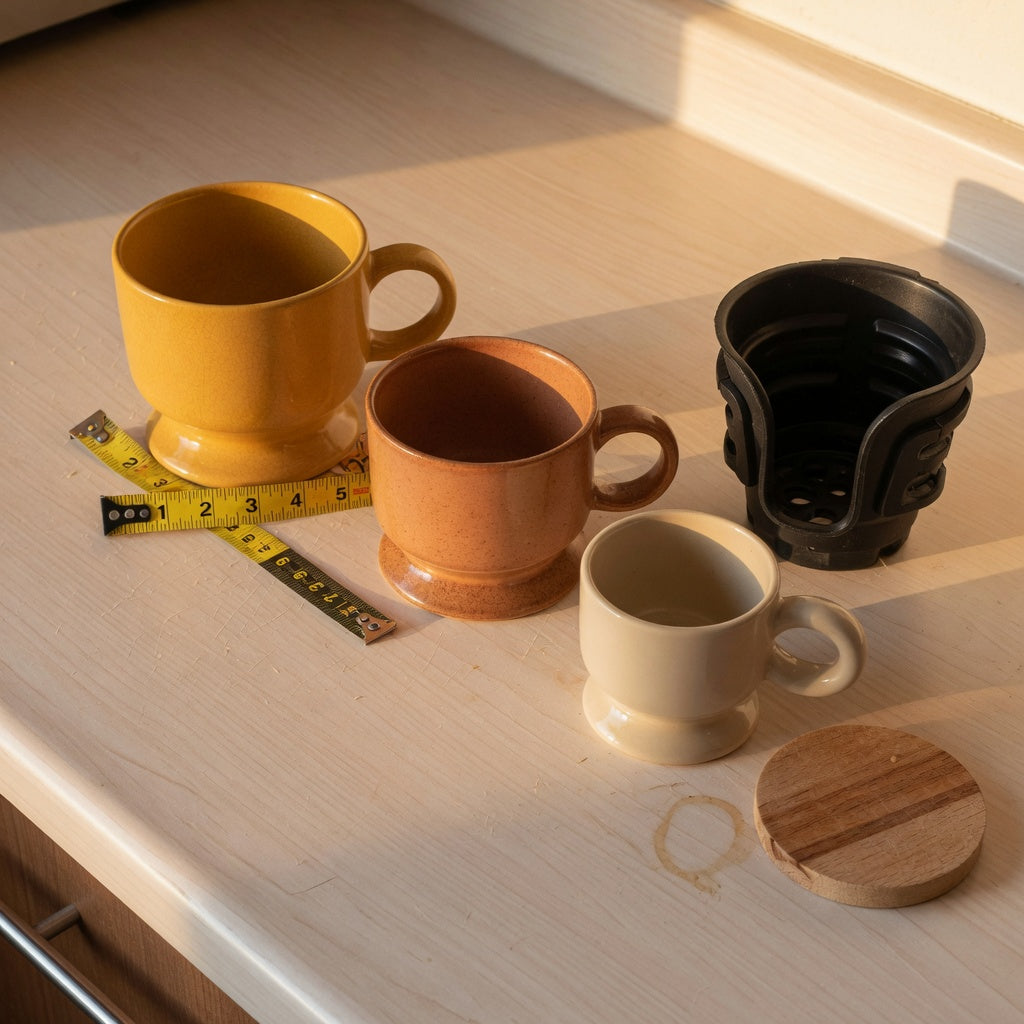
- Spout-to-tray height. Measure from the drip tray to the underside of the dispensing spout. A short, wide mug often clears a low spout that a tall mug cannot — but confirm the machine's side walls don't contact the belly before the center lines up.
- Shelf height and depth. Rounded bodies do not nest. A curved base resting on another curved rim is an unstable contact point, and that is how chips start. Budget shelf width for each mug as if it were a bowl.
- Desk footprint. A wide base is more stable next to a keyboard, but it occupies real estate. Measure the gap before assuming it fits.
- Cup holder diameter. Many car holders are built around a 3-inch base, and a wide round mug may not seat at all. That is a real reason to keep a travel mug in the car and enjoy the round one at home.
Pour-over is its own test. A cone dripper needs a rim wide enough to sit on but not so wide that the base ring drops inside the mouth. Set your dripper on the empty mug at the counter first and check whether it rocks. Better to learn that before you commit a dose of coffee than during the bloom.
Large round coffee mugs daily use guide: handle room and filled weight
This is the part buyers underweight and then regret. A 480 ml mug filled to a sensible line carries roughly 400 grams of liquid — nearly 14 ounces — before you add the weight of the ceramic itself. That mass sits out and away from your hand rather than straight down, because the body is wide.
Fill your current mug with water, hold it at drinking height, and count slowly to thirty. Note where you feel it: forearm, wrist, or nothing at all. That tells you more about whether a 480 ml round mug is a desk mug or a two-handed mug than any spec sheet will.
Handle geometry matters as much as capacity. A loop that only admits two fingers turns your index finger into a fulcrum and makes your wrist do the compensating. Look for an opening that lets three fingers pass with clearance for your knuckles against the body. Handle and opening dimensions aren't something we publish for every shape, so ask us before ordering — we can measure the actual piece on the shelf. If a wide opening is a must for you, shop with that requirement in mind instead of guessing from a photo.
Then there is the tilt. In a straight cylinder, liquid rises toward the lip predictably. In a bellied body it pools low, then crests the internal curve and comes forward all at once. Slow the sip angle, especially above the two-thirds mark, and a round mug stops being a spill risk.
Why a wide mouth cools coffee faster — and when that's the point
Heat leaves an open mug mostly at the surface, and a round mouth exposes more surface than a narrow one. A wide mug of black coffee drops toward drinkable temperature faster than a tall diner mug of the same volume. Thick walls add thermal mass, but they don't cancel the exposed area.
Preheat with hot tap water while the kettle works. That keeps the ceramic from pulling the first 15 degrees or so out of your brew on contact, and it is the cheapest improvement you can make to any mug you already own.
For some drinks, fast surface cooling is exactly what you want:
- Milk drinks. Steamed milk lands hot; a wide mouth brings it to sipping temperature without a long wait.
- Tea. A broad rim lets you watch the leaf unfurl and smell the liquor as it opens.
- Aroma-forward coffee. A wide opening sends more volatiles toward your nose, which is part of why a round mug tastes different from a lidded one.
What a wide round mug is not good for: nursing a single 12-ounce pour for an hour while you work. If that is your habit, a narrower mug, a lid, or a preheated insulated carafe will hold temperature better. Be honest about which drinker you are before you spend.
Glaze, lead, and cadmium: what to check before daily use
You put this rim to your lips every morning, and coffee and tea are hot and acidic — exactly the conditions that pull metals out of an unstable glaze. That is why cups and mugs sit in a stricter regulatory category than plates. Under FDA CPG 545.450, the action level for leachable lead in ceramic cups and mugs is 0.5 µg/mL of leaching solution, applied to any one of six units tested.
Cadmium is the second half of the story. Bright yellow, orange, and red glazes are the usual suspects, and FDA CPG 545.400 sets cadmium action levels of 0.5 µg/mL for small hollowware and 0.25 µg/mL for large hollowware. A jumbo vessel at or above 1.1 liters can move out of the cup-and-mug category into that large-hollowware band. Our round shapes are listed at 400, 440, and 480 ml, comfortably inside the small-hollowware range — but the number to watch on any mug is the stated capacity.
Two things worth internalizing:
- "Lead free" printed on a box is marketing, not a test result. FDA has documented imported pottery carrying that label that still leached lead above the action level.
- Decorative ceramics that look food-safe but aren't must, under 21 CFR 109.16, carry a conspicuous "not for food use" warning — or a hole through the potential food-contact surface. A mug-shaped object with a hole in the bottom is not a mug.
Ask the seller three questions: is there a leach test behind the food-contact claim, are there metallic rims or gold luster, and is the piece rated by the maker for microwave and dishwasher use. Metallic banding never goes in a microwave. And whatever the rating says, don't pour boiling water into a mug that has been sitting in a cold car — thermal shock cracks are usually the owner's doing, not the potter's.
If you use an electric mug warmer, turn the mug over first. A recessed foot ring can hold the base a few millimeters off the plate, which is enough to slow heating to a crawl.
Which of our three round mugs matches your morning?
| Mug | Listed capacity | Good daily fit | Where it's the wrong pick |
|---|---|---|---|
| The Flow | 400 ml (~13.5 fl oz) | 8-oz brew with milk; loose-leaf tea you refill; smaller hands | 12-oz pour-overs with milk — you'll be tight below the rim |
| Morning and Night | 440 ml (~14.9 fl oz) | 10-oz drip; double Americano; oatmeal or cereal | Very tight cabinets — the wider belly wants its own shelf width |
| The Rock | 480 ml (~16.2 fl oz) | 12-oz pour-over plus milk; soup at the desk | One-handed carrying, car holders, or shallow shelves |
Our honest read: if you are buying one mug and drink 10 to 12 ounces with milk, Morning and Night is the safest middle. If you drink smaller cups and refill often, The Flow is better balanced in the hand. If the mug doubles as a lunch bowl, The Rock is the one — and also the one most likely to feel heavy when full. For how these sit alongside bolder designs, our comparison of large unique coffee mugs covers the gifting side.
Frequently asked questions
Is a 13.5-ounce mug actually "large"?
In shopper language, large round mugs usually run from the mid-teens into the mid-20s of fluid ounces, so 13.5 ounces sits at the modest end. That is not a flaw — it is the size that clears most brewers and stays comfortable one-handed. If you want genuinely large, look at the 480 ml shape and plan on two hands when it is full.
Will a wide round mug fit under my single-serve brewer?
Measure from the drip tray to the underside of the spout and compare it to the mug's listed height; short and wide often clears better than tall. Then check side clearance so the belly doesn't hit the housing. Ask us and we'll check the piece before it ships.
Does a round mug spill more easily when you tilt it?
It can, because liquid pools in the belly and then moves forward quickly past a certain angle. Sip more slowly once the mug is over two-thirds full, and the effect largely disappears.
What should I check first before buying large round coffee mugs for daily use?
Brewer clearance, shelf and cabinet width, and handle room, in that order. Then confirm the care instructions on the specific listing rather than assuming ceramic is always microwave or dishwasher safe.
Are these mugs microwave and dishwasher safe?
Check the current product listing for the maker's stated care instructions instead of assuming, since ceramic bodies and glazes vary by piece. Anything with metallic banding or gold luster should stay out of the microwave regardless.
More from our blog
Ready to pick your mug? Two ways to save on today's order:
Ordering 1–3 mugs? Get an extra 10% off your 1st order with code 10_OFF Apply 10% Off & Shop Wooden-Handle Mugs →
Gifting 4+ mugs? Buy 3, Get the 4th Free applies automatically at checkout (no code needed; offers do not stack) · Free standard shipping (Nov pre-Christmas delivery: 15–20 calendar days US) · Free replacement if chipped in transit.
Popular mug buying guides: Ceramic Tea Cups & Infuser Mugs · Ceramic Mugs with Lids Compared · Wooden-Handle Tea Infuser Mugs Compared · Christmas & Secret Santa Mugs 2026 · Espresso & Cortado Cups Guide · Cup & Saucer Gift Sets · All 25 Mugs Spec Table · Mug Size Guide · Shipping & Promo FAQ
FIRST ORDER 10% OFF (CODE: 10_OFF) · OR BUY 3, GET THE 4TH FREE


Read more
Wide Based Coffee Mugs Shape and Handle Guide: 250, 400, 480 ml
A wide base is only one of three fit decisions. Compare the 250 ml Ball Handle, 400 ml Flow, and 480 ml Rock by footprint, handle clearance, lid wording, and ceramic care — including the trade-offs...
Read more
Coffee Mugs With Big Handles Daily Use Guide: Practical Trade-Offs
A seller's-eye look at coffee mugs with big handles in daily use: real finger clearance, filled weight, heat at the loop, and how our 250 ml, 400 ml and 480 ml mugs each suit a different kind of mo...
Read more
Leave a comment
This site is protected by hCaptcha and the hCaptcha Privacy Policy and Terms of Service apply.